

Best overall

Pangram
View Pricing Visit Website →Free plan; paid from $20/month
- Spanish false-positive rate of 0.0026%
- Separates AI-generated, AI-assisted and paraphrased text
- 24 languages, Chrome extension, API and LMS
Best built for Spanish
DetectordeIA
View Pricing Visit Website →Free checks; $3.99 for 24 hours
- Tuned for Spain and Latin American Spanish
- Sentence-level highlights
- PDF, DOCX and TXT uploads, no account needed
Best for multilingual classrooms

Copyleaks
View Pricing Visit Website →From $16.99/month
- Dedicated Spanish detection model
- AI detection in 30+ languages
- Plagiarism checks, Google Docs, LMS and API
Put a bunch of AI detectors side-by-side right now and most of them will give you pretty much the same degree of accuracy when you’re looking specifically for pure AI-generated content. A lot of these tools are even getting better at detecting AI in hybrid text, and many are working to bring down their false positive rates too. But there’s still a problem: they’re still mainly designed for English content.
Other languages are a lot trickier; in fact, one study found three well-known detectors tested on 180 Spanish texts couldn’t reliably identify writing mixing human and AI work, even though they were still happy to apply a high confidence score to their results.
There’s a reason for this problem, since most large language models were built, trained, and fine-tuned mostly on English-language data. Still, that doesn’t help much when your content is in Spanish, and you still need to know whether it was human-written. So I went hunting for the detectors that could actually handle Spanish input.
How I Tested the Best Spanish AI Detectors
I followed the same general process I use whenever I’m trying a new AI detector here, just with Spanish-language content instead of the typical English.
I actually ended up with quite a few documents to run through each tool, including several genuinely human-written Spanish texts (in different styles), a number of AI-generated examples, some samples that translated English to Spanish, and a group of pieces that mixed AI writing with human writing, or involved the use of humanization tools.
I wanted a pretty comprehensive read, so the content covered regional vocabulary (and academic-style writing) from throughout Spain and Latin America. I also tried out a few different tools for the AI samples, including ChatGPT, Gemini and Claude, to see if there were any differences there.
As always, I was looking for overall accuracy in scores (including whether the false positive rates were a problem), as well as looking at how the whole tool worked, whether it gave me reports I could use to make a decent decision, and how much everything cost.
The Best AI Detectors for Spanish: Quick Comparison
The somewhat reassuring news is there are a few options to choose from, although, as usual, they all have their strengths and weaknesses.
| Tool | Built for Spanish? | Published accuracy | False positives | Free tier | Starting price |
|---|---|---|---|---|---|
| Pangram | Multilingual, and trained on Spanish data | 99%+ | 0.0026% | Yes | $20 per month |
| DetectordeIA.ai | Spanish-first | Nothing independently verified | Not established | Yes | $3.99 for 24 hours |
| Copyleaks | Specific Spanish model | 98.02% | 0.15% | Yes | $16.99 per month |
| VeriIA | Spanish and English | Nothing independently verified | Not established | Trial | $9/month |
| Turnitin | Specific Spanish model | Nothing independently verified | Not established | No | Custom quote |
| QuillBot | Multilingual, with Spanish support | Not verified outside of English | Not established | Yes | $8.33 per month |
1. Pangram: Best Overall
Starting price: Free plan or paid plans starting at $20 per month.
Pangram is already my favorite AI detector for checking English-language content, so it wasn’t much of a surprise that it came out on top for Spanish content, too.
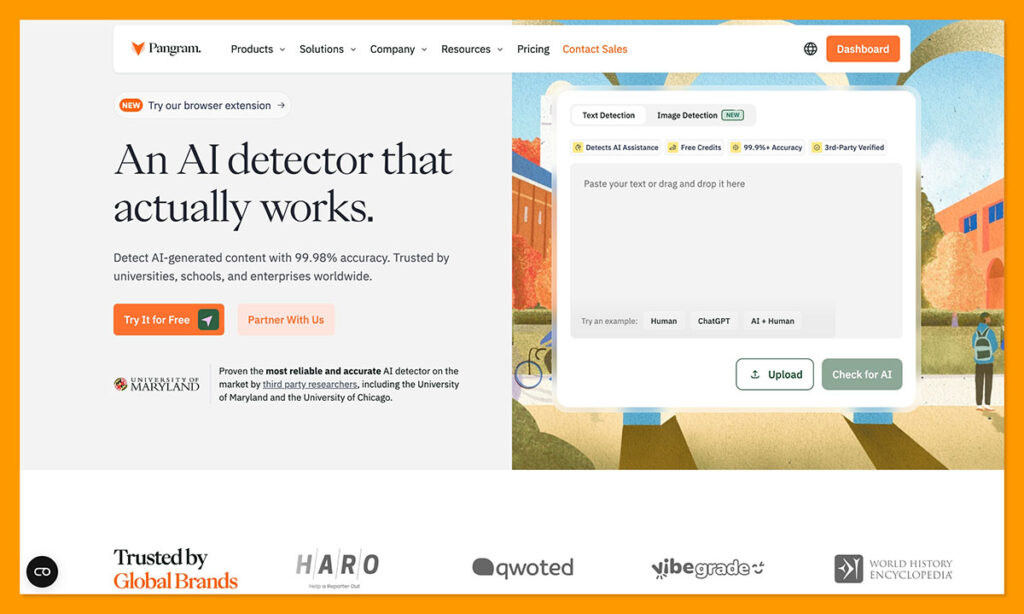
What I like about it is how well it recognizes that people tend to use AI in different ways. That’s why it can flag AI-assisted, AI-generated, and human-written content separately, and even show you when something might have been paraphrased.
The best part for people checking Spanish texts is that not only is Pangram incredibly good at catching all forms of AI, it’s also the best option I’ve found for low false-positive rates. In a recent test, Pangram showed a false-positive rate of only 0.0026% for Spanish-written content.
The reports aren’t quite as in-depth as the ones you might get from other detectors, but they do give you enough to work from. You can see suspicious sections highlighted in different colors based on AI involvement levels, and check individual confidence scores. Plus, Pangram supports 24 languages, document uploads, Google Docs, a Chrome extension, API access, and LMS tool connections.
Pros:
- Very good accuracy and false-positive scores on Spanish text
- Useful reports with color-coded highlights
- Plenty of integration and connection options
- Plagiarism detection is also available
- Surprisingly effective with humanized content
Cons:
- Needs more than 300 words for the best results
- The free tier caps you at 2,000 words per day
2. DetectordeIA.ai: Best Detector Built for Spanish
Starting price: Free option with paid plans starting at $3.99 per day.
DetectordeIA is one of the few AI detectors that claims to be designed specifically for checking Spanish-language documents. It was built using Spanish-language data, so it knows its way around regional vocabulary, syntax, and typical connectors better than most, in theory, although I couldn’t find any independently verified accuracy or false positive scores to back that up.
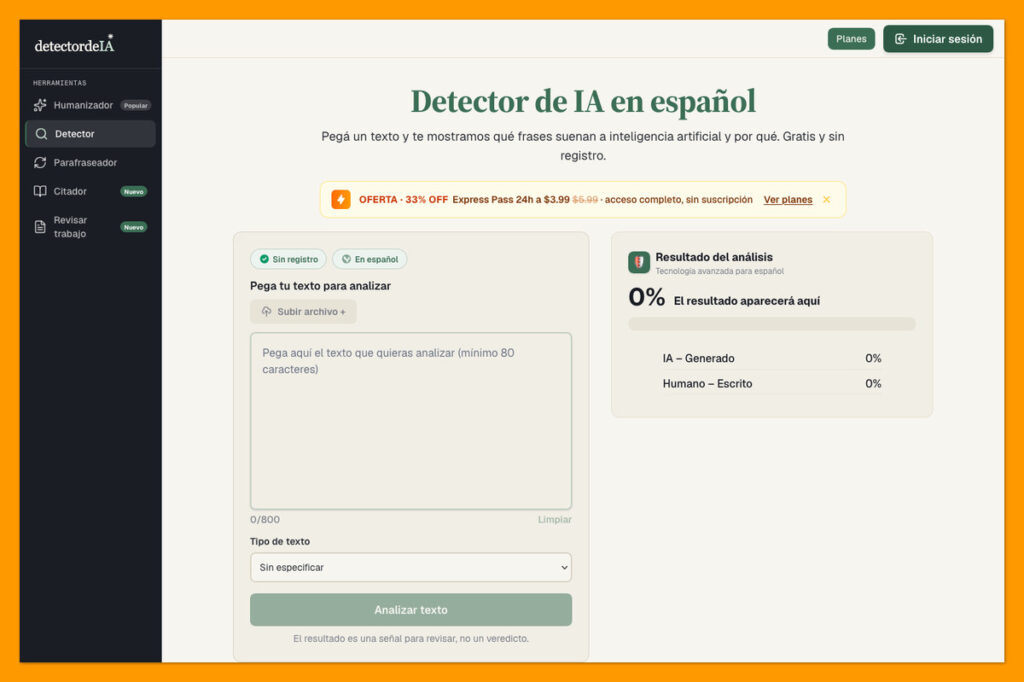
One good thing is how easy it is to use, since the tool runs online, and there’s absolutely nothing to download; you just copy and paste whatever you need to check into your browser page, without even having to create an account. There’s also support for document (PDF, DOCX, TXT) uploads.
Similar to Pangram, DetectordeIA gives users a report with sentence-level highlights, but it doesn’t give you much insight into exactly how AI was involved in the suspicious passages. I’ve also found that it’s not so great at detecting when AI text has been passed through a humanizer tool. I encountered a couple of false positives and false negatives in my tests as well.
Another thing is that while you can get a couple of checks for free, and pay daily for access starting at $3.99, certain things like in-depth reports do cost extra.
Pros:
- Designed specifically for detecting AI in Spanish text
- Useful sentence-level highlights
- Document uploads are supported
- Free checks are available without an account
- No software installation necessary
Cons:
- Variable accuracy and false positive scores
- Paywalls on certain features
- Not brilliant for humanized text
3. Copyleaks: Best for Multilingual Classrooms
Starting price: $16.99 per month.
I regularly recommend Copyleaks to educators and other companies that need help with multilingual detection, because it’s the tool that arguably covers the most languages overall (30+). For Spanish checks, it got a lot better in 2026, because it introduced its own specialist Spanish detection model.
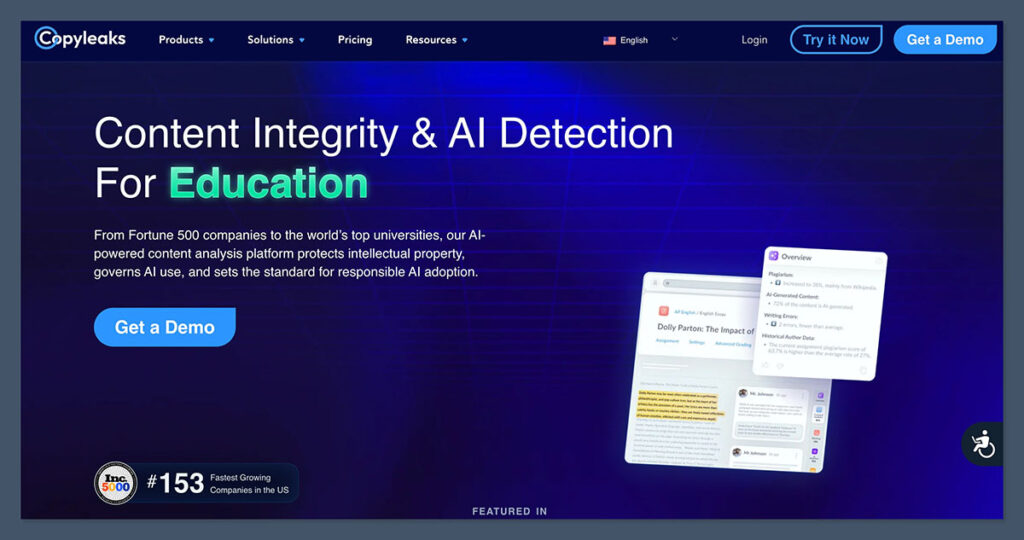
Copyleaks has made some decent claims about its own accuracy scores, saying it can correctly identify 98.02% of AI-written Spanish samples, and 99.85% of human-written samples, but those claims haven’t been backed up by any third parties so far. I covered the rest of its feature set in my Copyleaks review.
Overall, Copyleaks does have a lot of value if you need sentence-level feedback, AI and plagiarism detection in one place, and integrations with Google Docs and LMS tools. There’s even an API for larger projects and institutions. Still, I will say that there’s a pretty high risk of false positives with this tool, especially if you’re checking documents written in a specific style (like academic reports).
It’s also one of the more expensive tools if you start using it regularly, or you need access to the API, so it’s worth keeping that in mind if you need to be careful about your budget.
Pros:
- Excellent multilingual coverage
- Useful extensions and connectors for workflows
- Handy AI insights and plagiarism checks in one place
- Dedicated Spanish model (with good accuracy results)
- Reasonably easy to use
Cons:
- Can get expensive quite quickly
- Slightly higher risk of false positives than other detectors
- Still could benefit from more Spanish datasets for training
4. VeriIA: Best for Professional and Published Spanish Text
Starting price: free trial, then $9 per month
One thing I immediately liked about VeriIA was the developer, who actually explained how he built his detector, and reminded potential users that the results it gives won’t always be right. This is another tool made for people who struggle to get any kind of useful insight from detectors focused only on the English language, but it’s still in its early stages.
It’s mainly intended for editors who need to paste an article, upload a document, or scan a URL and get a basic AI probability score, with highlights for individual sentences that could be triggering that score. Again, you don’t get quite as much insight as you’d get from something like Pangram, and I haven’t been able to find any independent evidence showing specific accuracy or false positive scores.
Also, like most of today’s detectors, this one seems pretty vulnerable to misclassifying content that’s been run through a humanizer. Still, the pricing is reasonable enough, and the system is easy enough to use for a quick “second-opinion” check.
Pros:
- Natively optimized for Spanish-language check
- Useful probability score and sentence-level highlights
- Document uploads, copy/paste and URL scanning supported
- Affordable pricing tiers for quick checks
Cons:
- Not much evidence on accuracy or false-positive rates
- Very few integration options
- Not great for humanized content checks
5. Turnitin: Best Spanish AI Detector for Universities
Starting price: Custom quote.
This is another one that’s easy to recommend to universities and academic institutions, because most of them will probably be using something like Turnitin anyway. It’s more of a suite of tools for helping to manage and grade student work than a simple AI detector.

On the AI detection front, Turnitin has its own dedicated Spanish model, which recently got updated so it can recognize content produced by newer models, like GPT-5.1. The accuracy scores are pretty limited, but Turnitin does say that it has a false positive rate lower than one percent for documents that contain more than 20% AI-written text.
I do appreciate the small safeguards in place, too, since AI scores under 20% appear as an asterisk, rather than a potentially worrying percentage. (I go deeper on this in my Turnitin review and my Pangram vs Turnitin comparison.) Plus, users can easily review the highlighted passages in the Similarity Reports Turnitin provides to make their own assessments.
Unfortunately, Turnitin still doesn’t work very well with Spanish content passed through a humanizer, and it’s really only intended to help you check for pure AI-written content.
Pros:
- Specific Spanish-language model available
- Extra tools to help out schools, like plagiarism checking
- Easy integrations with most academic tools
- Safeguards to help protect against false positives
- Strong performance on pure-AI content
Cons:
- Institutional licenses can be expensive
- Not great for content run through a paraphraser
- Tends to flag idiomatic expressions as AI
6. QuillBot Detector de IA: Best Free Spanish AI Detector for Quick Checks
Starting price: Free plan, prices starting at $8.33 per month
I’ve mentioned before that QuillBot feels like a bit of a contradictory tool to me, because it’ll actually help you “humanize” something written by AI while simultaneously offering to help you figure out if anything seems AI-generated.
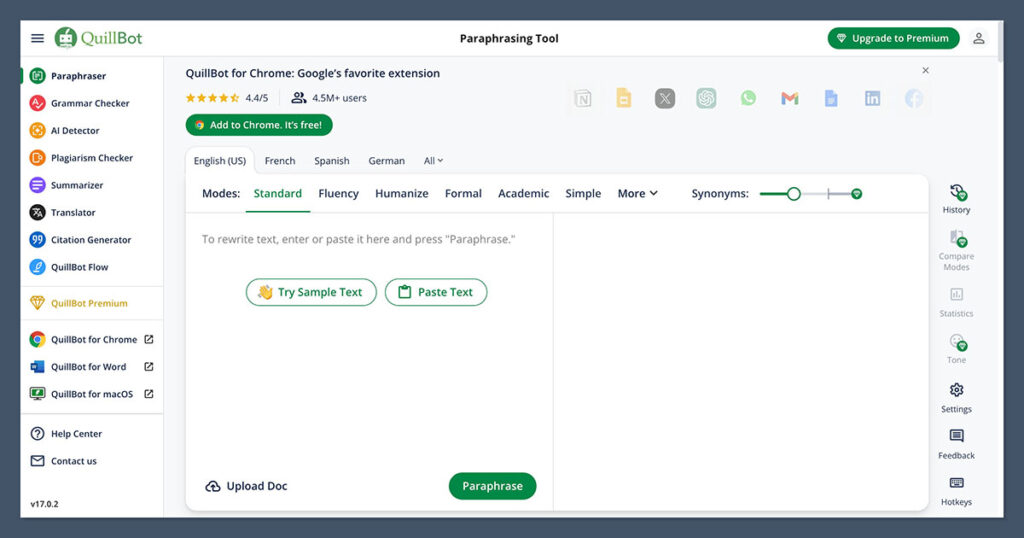
Despite that, it’s still a good option if you want something that’s free to use, and reasonably straightforward. The detector gives you up to six free checks a day (as long as the content you’re checking is no longer than 1,200 words). For each scan, you get a probability score and a very basic explanation of why certain snippets might be AI. On premium plans, those reports are a bit more in-depth, and you can also access a handful of other tools.
QuillBot has its own tools for checking Spanish grammar, and translating documents, not to mention that paraphrasing tool I mentioned before. The problem, as with most free tools, is overall accuracy.
It’s not particularly great at finding AI influence when content’s been humanized, or when there’s a mixture of human and AI writing in a document. It also has a pretty high false positive rate, specifically for certain styles of writing.
Pros:
- Useful free daily scans
- Multilingual support is already built-in, even for the interface
- Fast results if you’re just looking for a percentage
- Extra useful tools for translation and grammar checks
Cons:
- Restrictive caps on word limits for the free plan
- Not the best accuracy or false-positive rate
- Struggles a lot with hybrid writing
Which AI Detector Should You Use for Spanish Content?
I said this earlier, but detecting AI in Spanish content is understandably trickier, because the training data for models tends to skew English, and regional variations can cause a lot of problems. Using a translation tool can mess things up further, because that sometimes hides the patterns that AI detectors would typically look for, or increase the risk of a false positive score.
None of these tools are absolutely perfect, and ultimately, I’d still use most of them for a quick second opinion rather than relying on them to tell you the absolute truth about how a piece of content was created. Still, if you want the best all-round accuracy rate, I’d go with Pangram. If you want a tool made only for Spanish, DetectordeIA is probably a safe bet.
FAQs
Can AI detectors identify ChatGPT-written content in Spanish text?
Sometimes. (For English text, see my ChatGPT checker tests.) There are tools like Pangram, Copyleaks, and Turnitin that support Spanish AI detection, and certain solutions like DetectordeIA are specifically designed for Spanish scans. Still, accuracy varies, and most of these tools perform better when there’s plenty of text to analyze, so avoid relying on short snippets for a complete score.
Does translation fool AI detectors?
Translation tools can make it harder for an AI detector to give an accurate score. Sometimes, those tools can hide certain things that would otherwise allow a detector to recognize AI, and sometimes they add things that make a false positive rate more likely.
Which free AI detector works in Spanish?
Pangram gives you a more detailed analysis, although you can only scan up to 2,000 words a day for free. QuillBot works on Spanish text, and gives you six free scans a day (1,200 words per scan), if you’re looking for a quick check.

Comments 0 Responses