

Claude vs ChatGPT is the hardest comparison in AI right now, and not because the tools are far apart. It’s because they’ve converged. Both charge $20 for the main plan. Both sell $100 and $200 power tiers. Both run rolling five-hour usage windows. Both ship a coding agent and a desktop agent. Both promise a million tokens of context.
When two products mirror each other rung for rung, the sticker price stops being the decision, and most comparisons quietly give up at that point and declare a tie.
That’s a cop-out. The two are genuinely different, just not where the pricing page suggests. One of them cannot generate an image. One of them will show you ads. One of them costs three times more per token at the frontier. And the privacy story that everyone repeats about both companies is, on inspection, mostly wrong.
So here’s a winner for each job that actually decides your subscription: writing, coding, agentic work, creative media, price, and data privacy.
Claude vs ChatGPT at a Glance
Neither of these is one model. ChatGPT’s GPT-5.6 family runs Sol (flagship), Terra (middle), and Luna (budget), each with five reasoning effort levels plus an Ultra mode. Claude runs Fable 5 at the top, then Opus 4.8, Sonnet 5, and Haiku 4.5.
That means the useful question isn’t “Claude or ChatGPT.” It’s “which Claude, versus which ChatGPT.” A comparison of the two flagships tells you almost nothing about the tiers you’ll actually spend your month in.
Key Takeaways
- ChatGPT wins creative media outright. Claude generates no images, no video, and no voice. This is not a close call, it’s an absence.
- Claude wins agentic desktop work and holds a contested lead on coding, depending entirely on whose benchmark you believe.
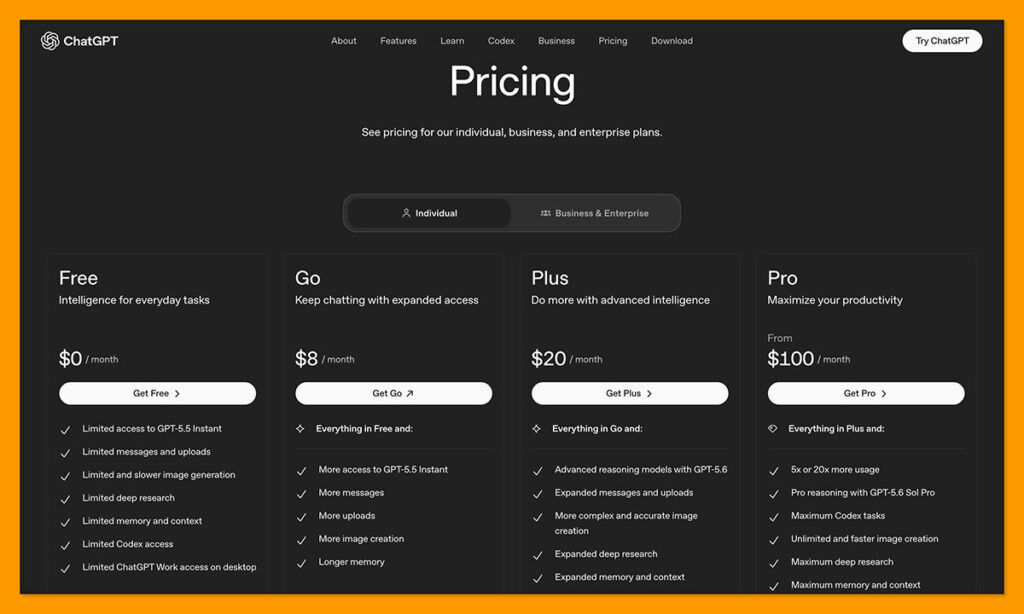
- ChatGPT is cheaper to enter ($8 Go tier, no Claude equivalent) but shows ads below the $20 plan. Claude products carry no ads at any tier.
- Claude Fable 5 costs $10/$50 per million tokens, double Opus 4.8 and double Sol on input. The frontier premium is real.
- Privacy is a wash, not a Claude win. Both train on consumer chats unless you turn it off. Anyone telling you otherwise is repeating a 2024 talking point.
- At $20, either one is defensible. The tiebreaker is what you make, not what you pay.
| Dimension | Claude | ChatGPT |
|---|---|---|
| Maker | Anthropic | OpenAI |
| Flagship | Claude Fable 5 | GPT-5.6 Sol |
| Workhorse tiers | Opus 4.8, Sonnet 5, Haiku 4.5 | Terra, Luna |
| Flagship API price | $10 / $50 per M tokens | $5 / $30 per M tokens |
| Context window | 1M tokens | ~1M tokens |
| Image generation | None | Yes |
| Video generation | None | Yes |
| Voice | Voice mode | Voice mode, plus GPT-Live models |
| Coding agent | Claude Code | Codex |
| Desktop / task agent | Claude Cowork | ChatGPT Work |
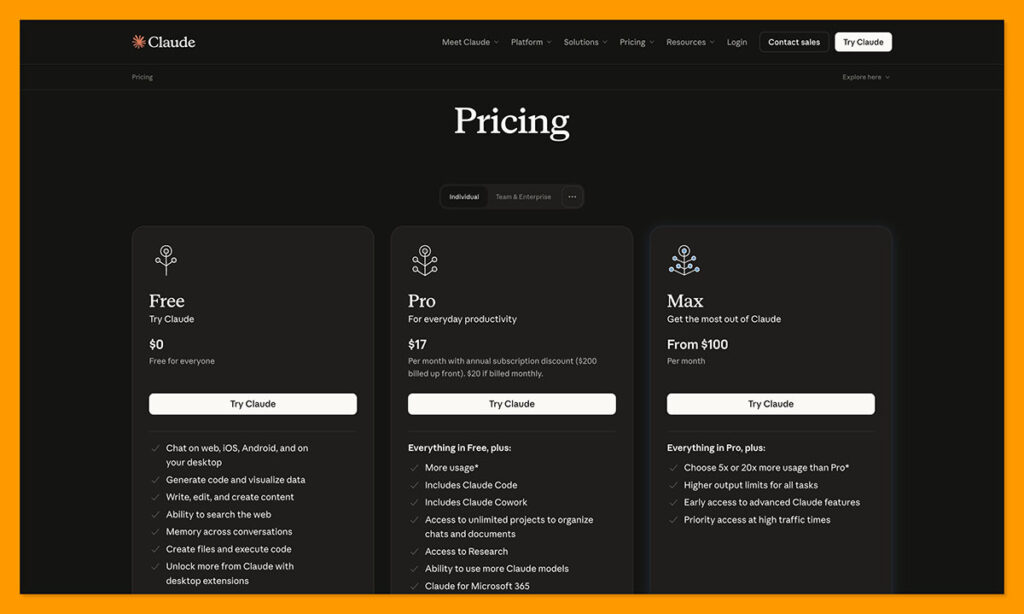
| Cheapest paid plan | $20 (Pro) | $8 (Go, with ads) |
| Ads | None at any tier | On the Go tier |
| In-chat checkout | None | Instant Checkout |
| Trains on consumer chats | Yes, unless you opt out | Yes, unless you opt out |
Note the last row, and note that it’s identical. We’ll come back to that, because it’s the most widely misunderstood fact in this comparison.
1. Writing and Long-Form Content
This is the category where preferences run hottest and the evidence runs thinnest. There is no clean benchmark for “writes well,” and anyone who tells you a leaderboard settled it is selling something.
What can be said with confidence is that the two models fail differently, and knowing how they fail is more useful than knowing which one won a blind vote.
Where Claude tends to land better
- Long documents that hold their shape. Structure across a full report or chapter, without the outline dissolving in the back half.
- Editing and rewriting your text rather than replacing it with its own. It cuts less aggressively toward a generic register.
- Following a stated constraint and not quietly abandoning it four paragraphs later.
Where ChatGPT tends to land better
- Range. Formats, voices, and registers, on demand, with less coaxing.
- Reasoning effort as a dial. Sol at max effort produces noticeably stronger prose than Sol at light effort, which gives you a lever Claude doesn’t expose the same way.
- Everything around the writing. If your post needs an image, ChatGPT finishes the job in one place.
Two practical notes that matter more than the vibes debate. First, Claude’s free tier runs the same default model as Pro (Sonnet 5), so you can evaluate the actual writing quality without paying, which is not true of ChatGPT’s free tier. Second, higher reasoning effort on either platform burns your usage allowance dramatically faster. Great prose at max effort is a real thing, and it will cost you your afternoon’s allowance.
The Winner:
Claude, narrowly, and only for long-form. For structured documents that must hold together over thousands of words, and for editing your own prose without flattening it, Claude is my default. For range, speed, and anything that needs an accompanying image, ChatGPT. This is the one category where I’d tell you to test both yourself, because the honest answer is that it depends on your ear.
2. Coding and Technical Work
Here’s where it gets genuinely contested, and where you should distrust every number you’re about to read, including the ones I’m citing.
OpenAI’s July 9 launch claims Sol sets a new state of the art on the Artificial Analysis Coding Agent Index at 80, roughly 2.8 points above Claude Fable 5, while using less than half the output tokens, running in less than half the time, and costing about a third less. It further claims Terra performs just above Fable 5, and Luna outperforms Opus 4.8. If true, that’s not a narrow win. That’s OpenAI’s budget tier beating Anthropic’s premium one.
Anthropic’s own launch materials for Fable 5 report a SWE-bench Pro score of 80.3%. Sol is reported at 64.6% on the same named benchmark. That gap points the opposite direction, hard.
Both cannot be right, and the reason is boring: they aren’t running the same harness. Vendor benchmarks use different scaffolding, different retry budgets, and different definitions of “solved.” Scores routinely move several points once a neutral party re-runs them under a common agent.
| Measure | Claude | ChatGPT | Who reported it |
|---|---|---|---|
| Coding Agent Index | Fable 5: ~77 | Sol: 80 (Terra 77, Luna 75) | Artificial Analysis, cited by OpenAI |
| SWE-bench Pro | Fable 5: 80.3% Opus 4.8: 69.2% | Sol: 64.6% | Vendor launch materials, different harnesses |
| Cost per task | Higher | Lower (~40% below Fable 5 at max effort) | Artificial Analysis |
| Flagship token price | $10 / $50 | $5 / $30 | Published rate cards |
Strip the marketing and here’s what I’d actually tell a friend. The most independent number on that table is the Coding Agent Index, and it favors Sol. The cost picture also favors Sol, decisively: Fable 5 at $10/$50 is double Sol on input and well above it on output, and a model that costs twice as much has to be twice as right to break even.
What the benchmarks don’t capture is Claude Code, which has earned a reputation among working developers that no leaderboard measures. It’s included in Pro at $20, it runs in the terminal, and the people who like it tend to like it a lot. Codex is the equivalent on the other side, now merged into the ChatGPT desktop app alongside ChatGPT Work.
The cost tip that saves you the most money on either platform: don’t run the flagship. Route everyday coding to Sonnet 5 ($2/$10 introductory through August 31, then $3/$15) or Terra ($2.50/$15), and escalate to Fable 5 or Sol only for the hard steps. Anthropic’s Opus 4.8 sits between them at $5/$25, which is slightly cheaper than Sol on output.
The Winner
Contested, and I won’t pretend otherwise. On the most independent benchmark and on cost, ChatGPT’s Sol has the better case. On developer loyalty and Claude Code’s actual daily ergonomics, Claude does. If you’re paying per token at volume, the math points at OpenAI. If you live in a terminal, try Claude Code before you decide.
3. Agentic Work: Cowork, ChatGPT Work, and What Actually Ships
Both companies spent 2026 racing to build an AI that does the work rather than describing it. Both shipped. Both are still rough.
Claude Cowork is the desktop agent: it reaches your local files and your browser, runs multi-step jobs, and organizes work across documents. As of July 7 it also runs on web and phone, with sessions that keep going in the cloud after you close the laptop, and scheduled tasks that fire without a device switched on.
ChatGPT Work launched July 9 as OpenAI’s answer: an autonomous agent for multi-step tasks across connected apps, sharing an app with Codex.
The catch nobody puts on the pricing page
These agents eat your usage allowance at a rate that will surprise you. Anthropic says plainly that Cowork consumes more allocation than chatting, without publishing a multiplier. Users report a single five-hour Cowork session consuming a meaningful slice of a weekly quota. And the background and scheduled-task features that make Cowork sound magical are rolling out starting with the $100 Max plan, not the $20 Pro one.
ChatGPT has the mirror-image problem: Codex, ChatGPT Work, and ChatGPT for Excel all draw from the same credit pool. Run one hard and you throttle the others.
Where the two genuinely diverge is reach. Claude’s advantage is depth on your machine: Cowork on desktop touches local files and your browser directly. ChatGPT’s advantage is breadth of connectors and a commerce surface Claude has no answer to, including Instant Checkout for in-chat purchases.
The Winner
Claude, on the strength of desktop depth and the fact that Cowork reaches your actual files and browser. But temper the enthusiasm: the good version costs $100/month, and both platforms will burn your allowance faster than you expect. Nobody has made agentic work cheap yet.
4. Creative Media: The Category Claude Simply Loses
Let’s be blunt, because a review that buries this is not a review. Claude does not generate images. It does not generate video. There is no Claude equivalent of Sora, and there is no Claude equivalent of DALL-E.
This isn’t a “Claude is weaker here” situation. It’s an absence. If your work involves visual output at any point, from a blog header to a product mockup to a social clip, ChatGPT is the only one of the two that finishes the job.
What ChatGPT brings that Claude cannot match
- Image generation at competitive quality, in the same chat where you drafted the copy.
- Video generation, a category Claude does not enter.
- GPT-Live voice models, a new generation of conversational voice shipped alongside GPT-5.6.
- ChatGPT Sites, a public beta that builds hosted websites, with an optional “Login with ChatGPT.”
Claude has an answer of sorts in Claude Design, a canvas for producing slides, prototypes, and layouts through chat, and Artifacts for interactive components. Those are design tools, not generative media tools. They will lay out your deck. They will not draw you a picture.
The Winner
ChatGPT, unopposed. If images, video, or voice are anywhere in your workflow, this single category may decide the whole comparison for you, regardless of who writes marginally better prose. Claude is not competing here and does not claim to be.
5. Pricing: The Ladders That Mirror Each Other
Put the two plan structures side by side and the resemblance is almost comic.
| Tier | Claude | ChatGPT |
|---|---|---|
| Free | $0, runs Sonnet 5 (same default model as Pro) | $0, limited, not the flagship |
| Entry paid | None | Go, $8/mo (shows ads) |
| Individual | Pro, $20/mo ($17 annual) | Plus, $20/mo |
| Power | Max, $100 (5x) or $200 (20x) | Pro, $100 (5x) or $200 (20x) |
| Teams | Team, $25/seat ($20 annual) | Business, $25/seat ($20 annual, 2-seat min) |
Two real differences hide inside that symmetry.
First, ChatGPT is cheaper to get into. The $8 Go tier has no Claude equivalent, and if $20 is a real constraint, that’s a genuine advantage. But Go shows ads, and Claude carries no ads on any tier. Whether $12 a month is worth an ad-free experience is your call, and it’s a legitimate call either way.
Second, Claude’s free tier is unusually generous in one specific way: it defaults to Sonnet 5, the same model Pro users get by default. You can judge Claude’s actual quality at $0. ChatGPT’s free tier does not give you the flagship.
The Fable 5 trap. Anthropic’s top model was included on paid plans for a limited window after its July 1 return, capped at half your weekly usage. That window has closed. Fable 5 access now runs on prepaid usage credits, metered at $10 per million input and $50 per million output tokens. If you subscribed to Pro expecting the flagship, check your settings, because the $20 plan does not include unlimited Fable 5.
On the API, the ladders converge again. Flagship for flagship, Opus 4.8 ($5/$25) is slightly cheaper than Sol ($5/$30) on output. Mid-tier, Sonnet 5 ($2/$10 introductory, $3/$15 from September) runs against Terra ($2.50/$15). Budget, Haiku 4.5 ($1/$5) faces Luna ($1/$6). Then Fable 5 sits alone at $10/$50, with nothing on the OpenAI side priced that high.
The Winner
ChatGPT on entry price (the $8 Go tier), Claude on the free tier (same model as Pro) and on ads (none, ever). At $20 they are the same price for a comparable product, and price should not decide it. At the frontier, Fable 5’s $10/$50 is the hardest number in this article to defend.
6. Data Privacy: Where Everyone Repeats the Wrong Thing
Claude built a reputation as the privacy-conscious option. That reputation is out of date, and it’s time people stopped repeating it.
In 2025, Anthropic changed its consumer policy. Claude Free, Pro, and Max conversations are now used for training unless you actively turn that off, and for accounts where it’s left on, data retention extends to five years, up from thirty days. The rollout drew criticism from privacy researchers, who described the consent interface as a dark pattern: a large accept button, and a small toggle already switched on.
Meanwhile, ChatGPT’s consumer tiers do the same thing. Free and Plus chats train the models unless you go into Data Controls and switch it off.
So the honest scoreboard on consumer privacy is a tie, and it’s a tie at a level that should make you uncomfortable. Neither $20 plan is a private plan. Paying does not buy you privacy on either platform. It buys you features.
Where they actually differ
- Retention if training is off: Claude returns to a 30-day window. Both are broadly comparable here.
- API retention: Anthropic’s API defaults to 7 days, notably stricter than the 30-day norm. Point to Claude.
- Litigation exposure: a court order in the New York Times case required OpenAI to retain consumer conversations, including deleted ones, with enterprise and zero-retention customers excluded. Litigation moves, so verify current status, but it’s a real asterisk on the ChatGPT side.
- Business tiers: both exclude training by default on Team, Business, Enterprise, and API. This is the only tier where either company gives you a contract instead of a toggle.
- Fable 5 and Mythos 5 carry 30-day retention and are not available under zero-data-retention agreements, which matters for compliance-heavy work.
The Winner
A tie on consumer, and the tie is the story. If you handle client data, neither $20 plan is appropriate, and no toggle fixes that. Move to a business tier on either platform, where the no-training promise is contractual rather than a setting you hope you remembered. Claude edges ahead on API retention. That’s the whole margin.
The Verdict
| Use case | Winner | Why |
|---|---|---|
| Long-form writing | Claude (narrowly) | Holds structure; edits your prose without flattening it |
| Coding | Contested | Independent index and cost favor Sol; developer loyalty favors Claude Code |
| Agentic desktop work | Claude | Cowork reaches local files and browser, though the good version is $100 |
| Images, video, voice | ChatGPT | Claude does not compete in this category at all |
| Price | Split | ChatGPT enters at $8 with ads; Claude’s free tier runs the Pro model |
| Data privacy | Tie | Both train on consumer chats unless you opt out |
Now the part most comparisons dodge. Pick on output, not on price.
Choose ChatGPT if your work touches images, video, or voice at any point, if $8 versus $20 is a real constraint, if you want the deepest connector ecosystem, or if you’re paying per token at volume and the cost math has to work.
Choose Claude if you write long documents that have to hold together, if you live in a terminal and want Claude Code, if you want an agent that reaches your local files, or if you’d rather not see ads at the entry tier.
And the answer nobody’s subscription page wants to hear: at $20 each, running both for a month costs $40 and settles the question permanently, in a way that no article, including this one, can. The models are close enough that your own work is the only benchmark that matters.
If you can only keep one, the deciding question is simple. Do you make pictures? If yes, it’s ChatGPT, and everything above is a footnote. If no, it’s closer than the internet pretends, and Claude is a legitimate default.
Frequently Asked Questions
Can Claude generate images?
No. Claude has no image generation, no video generation, and no equivalent to Sora or DALL-E. Claude Design produces slides, prototypes, and layouts, and Artifacts produce interactive components, but neither generates original imagery. If visual output matters to your work, ChatGPT is the only one of the two that finishes the job.
Is Claude or ChatGPT better for coding?
Genuinely contested. OpenAI reports Sol at 80 on the Artificial Analysis Coding Agent Index, 2.8 points above Fable 5, at roughly a third less cost per task. Anthropic reports Fable 5 at 80.3% on SWE-bench Pro against Sol’s 64.6%. These come from different harnesses and cannot be directly compared. On cost, Sol has the clearer case. On daily ergonomics, Claude Code has a following that benchmarks don’t measure.
Does Claude train on my conversations?
Yes, on Free, Pro, and Max, unless you opt out. Anthropic changed this policy in 2025; accounts with training left on carry up to five years of data retention, versus thirty days if you switch it off. ChatGPT’s consumer tiers work the same way. Neither $20 plan is a private plan. Business, Team, Enterprise, and API tiers on both platforms exclude training by default.
Is Claude Pro worth $20 when ChatGPT Go is $8?
Depends on two things. Go shows ads, and it doesn’t give you the flagship model. Claude has no $8 tier, but its free plan runs Sonnet 5, the same default model Pro users get, so you can evaluate Claude properly at zero cost before paying. If $8 is your ceiling, ChatGPT is your answer. If you’re comparing $20 to $20, price is not the differentiator.
Do I get Claude Fable 5 with a Pro subscription?
Not on an unlimited basis. Fable 5 was included on paid plans for a limited window after returning on July 1, capped at half your weekly usage. That window has closed, and Fable 5 now runs on prepaid usage credits metered at $10 per million input and $50 per million output tokens. Everyday Claude work still runs on Opus 4.8 and Sonnet 5 within your plan limits.
Why do both keep rate limiting me?
Because agents are expensive and effort settings are a trap. Both platforms run rolling five-hour windows with weekly caps stacked on top, and on both, every surface draws from one shared pool: Claude’s chat, desktop, mobile, and Claude Code; ChatGPT’s Codex, Work, and Excel. Running the flagship at maximum reasoning effort will consume an allowance many times faster than ordinary chat. Default to the mid-tier model and escalate deliberately.

Comments 0 Responses