

Quick Verdict:
Pro at $17 to $20 a month is the right default for almost every individual. Max at $100 or $200 buys usage headroom, not extra features, so only move up once you are hitting limits during real work. Teams should start on Team Standard at $20 per seat and upgrade only the heaviest users to Premium. Developers running scripts or agents need the metered API, not a subscription.
Claude just overtook ChatGPT in the US App Store for the first time, with more than a million people signing up every single day. Almost all of them hit the same wall within a week: which plan do I actually need, and what does it really cost? The Claude pricing page shows you a sticker price, but it will not tell you how the plans actually differ or where you will burn through your limits.
Third-party guides make it worse. They openly contradict each other on what a Team seat costs (one popular guide says $25 to $30, another $20 to $25) and whether long-context requests get surcharged.
I have mapped every pricing surface here: the consumer plans (Free, Pro, and Max), Team and Enterprise seats, API per-token rates, and Claude Code. Every figure is checked against Anthropic’s official pages (claude.com/pricing and the platform docs), including the brand-new India rupee pricing. Where the numbers disagree, I tell you which one the official page backs.
Claude Pricing at a Glance
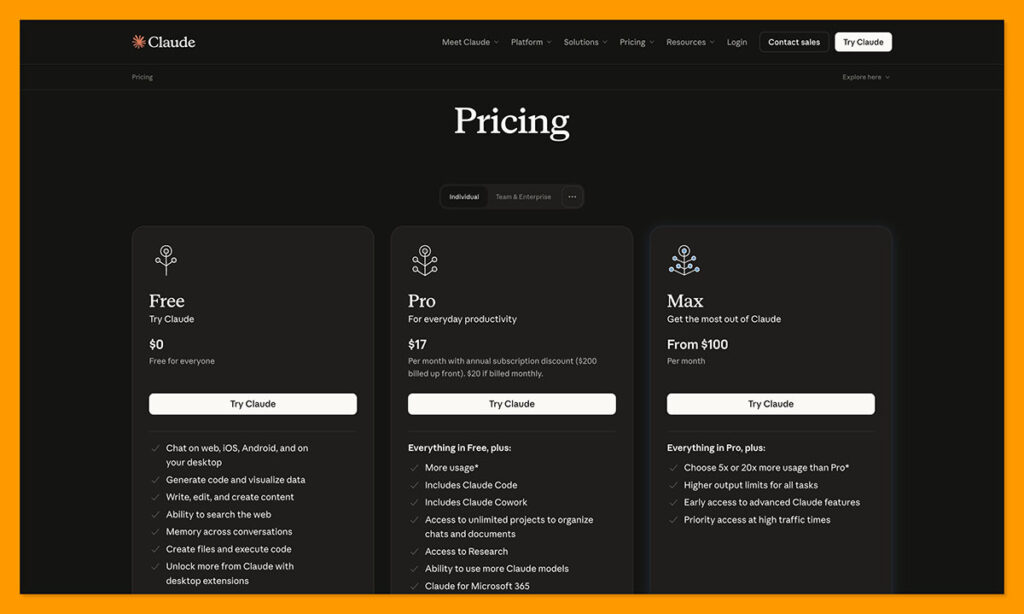
Every price Claude charges, from the free tier to the top API model, fits in one table. Start here, get your answer in five seconds, then jump to the section that matches your situation.
| Plan | Monthly price | Billing | Usage vs Pro / notes | Best for |
|---|---|---|---|---|
| Free | $0 | Free forever | Far below Pro | Casual, occasional use |
| Pro | $17 annual / $20 monthly | Annual or monthly | Baseline | Daily solo users, light coders |
| Max 5x | $100 | Monthly only | 5x Pro | Heavy builders hitting limits daily |
| Max 20x | $200 | Monthly only | 20x Pro | Power users living in Claude Code |
| Team Standard | $20 annual / $25 monthly per seat | Annual or monthly (5 to 150 seats) | Shared team chat | Small teams needing central billing |
| Team Premium | $100 annual / $125 monthly per seat | Annual or monthly | 5x Standard, plus Cowork | Teams running Claude Code at scale |
| Enterprise | Custom | Negotiated | Seat plus API-rate usage | Regulated orgs needing SSO and compliance |
| API | Pay-as-you-go | Per token | No usage cap | Developers, scripts, agents |
Claude’s lineup now spans four pricing tiers with roughly a 10x spread from the cheapest model, Haiku 4.5, to the most expensive, Fable 5, according to independent analyst Artificial Analysis. That range is the whole story. Your cost depends far less on which plan badge you buy than on how much you actually use and which model you point at the work.
Two rules make the table easier to read:
- Subscriptions are flat fees with rate limits and no forced overage. Hit the ceiling and Claude tells you to come back later. Your card is never charged more than the sticker price unless you deliberately switch on usage credits.
- The API is metered per token with no cap. You pay for exactly what you use, and there is no upper bound if a script runs away from you.
Most individuals want Pro. Teams should jump to the Team and Enterprise section, and developers weighing per-token costs should skip to the API pricing section.
Claude Consumer Plans: Free, Pro, and Max
Features are not what separate Claude’s three plans. Chat, web search, and file creation work much the same across all three. What differs is how fast you burn through the usage limit, the number the pricing page will not give you straight.
| Tier | Price | Approx usage | Reset | Key exclusions |
|---|---|---|---|---|
| Free | $0 | Roughly 30 to 50 messages, then locked | Rolling 5-hour window | No Opus, Claude Code, Cowork, or Research |
| Pro | $17/mo annual, $20/mo monthly | Roughly 225 Sonnet or 45 Opus messages per day | Rolling 5-hour window | None of the above |
| Max 5x | $100/mo | 5x Pro | Two weekly caps plus 5-hour | Still rate-limited at heavy volume |
| Max 20x | $200/mo | 20x Pro | Two weekly caps plus 5-hour | Still rate-limited at extreme volume |
Free
Pricing: $0 per month, forever.
Free is genuinely usable, unlike some rivals’ stripped tiers. You get web search, artifacts, connectors, memory, and file creation with code execution, all ad-free, which is more than ChatGPT gives away free in some countries.
The catch is volume. Limits are token-based, so most people get 30 to 50 messages (up to 100 on a light day) before Claude locks them out. Since an April 8, 2026 change, Free resets on a rolling 5-hour window rather than a daily clock, so you will see notices like “available again at 3 PM,” and the ceiling drops lower at peak hours.
Pro
Pricing: $17 per month billed annually ($200 up front), or $20 per month billed monthly.
Pro is where Claude opens up. The Claude Pro price unlocks Claude Code, Cowork, Design, Science, unlimited projects, Research access, Microsoft 365 integration, and multiple models including Opus.
The lever most people miss is the model budget. Opus eats about 5x the allotment Sonnet does, so one Pro plan gives you roughly 45 Opus messages a day or 225 Sonnet messages. Default to Sonnet and Pro stretches far. Lean on Opus for everything and you will hit the wall by lunch.
Max
Pricing: $100 per month (5x usage) or $200 per month (20x usage), billed monthly only. There is no annual discount on Max.
The Claude Max plan cost buys 5x or 20x more usage than Pro, priority access during traffic spikes, and early feature access. One wrinkle: Max carries two separate weekly caps, one across all models and one for Opus, both resetting 7 days after your session starts rather than on a fixed calendar day.
Even that ceiling gets hit. One user cancelled Max twice over rate limits before Anthropic raised them, and after Opus 4.7’s heavier tokenizer landed, a power user’s verdict was blunt: “$100 is barely enough.” A separate incident had Opus 4.8 spawning subagents on its own, forcing Anthropic to reset every Pro and Max cap at once.
Best for
- Free: casual, occasional questions
- Pro: daily solo users and light coders
- Max: heavy builders who live in Claude Code
Skip if
- Free: you use Claude most days
- Pro: you hit limits multiple times a day
- Max: Pro comfortably covers your day
Claude Team and Enterprise Pricing
Two of the most-cited Claude pricing guides cannot agree on what a Team seat costs. One says $25 to $30 per seat plus a $150 premium tier. Another says $20 to $25 plus $100 to $125. Only one of them matches Anthropic’s official pricing page, so here is the settled answer.
| Tier | Annual (per seat/mo) | Monthly (per seat/mo) | Usage vs Standard | Includes |
|---|---|---|---|---|
| Standard | $20 | $25 | Baseline | Shared chat, central billing, SSO, admin controls, Claude Code |
| Premium | $100 | $125 | 5x Standard | Everything in Standard, plus Cowork and far more Claude Code headroom |
Team Standard costs $20 per seat per month billed annually, or $25 billed monthly. Team Premium jumps to $100 per seat annually, or $125 monthly, and that 5x price increase buys 5x the Standard usage. Every Team plan requires between 5 and 150 members.
That is it. No hidden $150 tier, no per-seat mystery. If a guide tells you otherwise, it is working from stale numbers.
One correction worth making, because plenty of guides still get it wrong: Claude Code is now included on every paid plan, Team Standard seats included. Older guides describe Premium as the first Team tier with Claude Code access. That is out of date. What Premium actually buys is roughly 5x the usage headroom plus Cowork, which matters enormously if your developers run Claude Code all day, but the access itself is no longer the dividing line.
Enterprise is where pricing goes custom. There is no published sticker. You negotiate a seat price (Anthropic references roughly $20 as a baseline) and then usage is billed on top at raw API rates. Cost scales with the models and tasks your org runs, which is the catch worth flagging: your monthly Enterprise bill is not fixed and can swing hard month to month. If half your team defaults to Opus for routine work, that variable line climbs fast, so the spend-limit controls below are less a nicety than a requirement.
What the money buys is governance:
- SCIM provisioning and role-based access control
- Audit logs and a Compliance API
- Spend limits to cap runaway usage
- Custom data retention windows
- IP allowlisting for network-level control
- HIPAA-ready configuration for regulated workloads
Choose Standard for shared chat and light coding across a small team. Move to Premium only if the team genuinely needs Claude Code at scale. Reach for Enterprise when you need SSO, compliance controls, and can absorb usage-based billing on top of seats.
Claude API Pricing: Per-Token Rates for Every Model
For the first time, Claude’s most expensive model is not an Opus. Fable 5 landed at $10 per million input tokens and $50 per million output tokens, exactly double the Opus line across every token type, per Artificial Analysis. That makes Fable 5 the top rung of a ladder that now stretches roughly 10x down to Haiku 4.5.
Here is the complete Claude API pricing card:
| Model | Input $/MTok | Output $/MTok | 5-min cache write | 1-hr cache write | Cache read | Context |
|---|---|---|---|---|---|---|
| Fable 5 | $10 | $50 | $12.50 | $20 | $1.00 | 1M |
| Opus 4.8 / 4.7 / 4.6 | $5 | $25 | $6.25 | $10 | $0.50 | 1M |
| Sonnet 5 (intro) | $2 | $10 | $2.50 | $4 | $0.20 | 1M |
| Sonnet 4.6 | $3 | $15 | $3.75 | $6 | $0.30 | 1M |
| Haiku 4.5 | $1 | $5 | $1.25 | $2 | $0.10 | 200K |
Two rows need spelling out.
Sonnet 5’s rates are introductory. The $2/$10 pricing holds through August 31, 2026, then rises to standard $3/$15 on September 1. If you are building a Sonnet 5 workload, lock in what you can before the intro window closes.
Haiku 4.5 is the only current model capped at a 200K context window. Every other model carries the full 1M-token window.
There is no long-context surcharge. This is exactly where the competitor guides diverge. Anthropic’s own documentation says a 900K-token request is billed at the same per-token rate as a 9K-token request, on Fable 5, Opus 4.6 and later, and Sonnet 4.6 and later. The claim you will see elsewhere that requests above 200K tokens cost extra is outdated.
There is a subtler cost trap the sticker prices hide. Opus 4.7 and later, Fable 5, and Sonnet 5 all use a newer tokenizer that produces roughly 30% more tokens for the same text. Your real cost per finished task can rise even when the headline rate falls. Artificial Analysis puts it bluntly: strip away its introductory discount and Sonnet 5 can cost more per completed task than Opus 4.8.
How Claude stacks up against the other frontier providers
| Model | Input $/MTok | Output $/MTok |
|---|---|---|
| Claude Opus 4.8 | $5 | $25 |
| Claude Sonnet 5 (intro) | $2 | $10 |
| GPT-5.6 Sol | $5 | $30 |
| GPT-5.6 Luna | $1 | $6 |
| Gemini 3.1 Pro | $2 | $12 |
Claude sits mid-pack. Opus 4.8 undercuts GPT-5.6 Sol on output ($25 versus $30), while Gemini 3.1 Pro comes in roughly 2.5x cheaper than Opus at the flagship tier.
The verdict: default to Sonnet for the best price-to-performance ratio, reach for Opus or Fable only when the task genuinely justifies the tier, and get your Sonnet 5 workloads running before the September 1 intro-pricing expiry.
Claude Code Pricing and What Developers Actually Spend
Anthropic quietly doubled its own estimate of what Claude Code costs. Within a matter of weeks, the company’s published figure for average spend per developer per active day jumped from roughly $6 to roughly $13. Anthropic framed it as usage evolving alongside model capability rather than a price change, but the effect on your budget is the same: the “it’s just $20 a month” story understates what heavy coding actually burns.
Here is the real shape of Claude Code pricing in practice:
| Metric | Figure |
|---|---|
| Average cost per developer, per active day | Roughly $13 (up from roughly $6) |
| Typical monthly spend per developer | $150 to $250 |
| Share of users under $30 on any active day | 90% |
| One power user’s heaviest month at API rates | $5,000 or more |
Most developers sit in that 90% who stay under $30 on a given day. The tail is what surprises people: cloud-cost vendor Cloud Zero found some power users’ heaviest months would have topped $5,000 at direct API rates. One solo builder pushed roughly 5 billion tokens through Claude Code in 30 days, which would have cost over $4,500 metered.
How you pay depends on how you access it:
- Pro ($20/mo), Max ($100 or $200/mo), and Team seats bundle Claude Code into the subscription. It runs against your plan’s rolling 5-hour and weekly rate limits, the same pool as chat.
- The API meters Claude Code per token with no cap, which is how you would run it in scripts or CI.
On subscriptions, those limits bite fast under heavy load. Earlier this year, developers on the $200 plan watched session limits drain “in under 20 minutes, not hours.” Max softens this with higher ceilings, but it does not remove them. You still have two weekly caps, one across all models and one for Opus.
The thing to internalize about Claude Code pricing is that your spend scales with how agentic your usage gets. The more you hand off multi-step, multi-file work, the faster the meter (or the rate limit) moves. Instrument it early. Check Settings, then Usage, before you are surprised by the bill, not after.
Claude Subscription vs API: Which Billing Model Fits You
One developer plugged a lightweight Telegram bot into Opus 4.6 through the API and watched it burn $50 in 30 minutes. On a subscription, that same runaway usage would have simply stopped at the rate limit. That is the core tradeoff between Claude’s two billing models, and confusing them is how people get hurt.
| Dimension | Subscription (Pro/Max/Team) | API (pay-as-you-go) |
|---|---|---|
| Billing | Flat monthly fee | Metered per token |
| Usage cap | Rolling rate limits | None |
| Overage risk | None by default (come back later) | Unpredictable spend |
| Best for | Interactive daily use | Scripted, programmatic, high-volume |
| Third-party agent frameworks | Banned | Required |
Subscriptions are capped but safe. The API is uncapped but exposed. That agent-frameworks row matters more than it looks: third-party frameworks like Open Claw are explicitly banned on subscription plans, and running one on Pro or Max can get your account banned. If you want that kind of autonomous tooling, you need a direct API key with per-token billing.
The change that almost happened, and did not: Anthropic announced in May that from June 15, 2026, programmatic usage (the Agent SDK, headless claude -p, and Claude Code GitHub Actions) would be carved out of the subscription pool and moved onto a separate monthly dollar credit billed at API rates. It then paused the change on the day it was due to take effect. Its Help Center now confirms that programmatic usage still draws from your normal subscription limits and that there is no credit to claim. Plenty of guides published in May and June still describe the split as live. It is not. Anthropic has said it is reworking the plan and will give notice before any future change, so treat this as a deferred risk rather than a settled one, and do not architect around cheap programmatic access indefinitely.
If you are not sure which side you are on, work the ladder:
- Start on Free or Pro to test fit before spending more.
- Track a week of real usage in Settings, then Usage.
- Move to Max 5x if you hit limits multiple times a day.
- Switch to the API the moment you need scripted or programmatic access at scale.
Stay on a subscription for interactive work. Move to the metered API the moment you script it or run agents in production.
How to Cut Your Claude API Costs
Three levers can knock as much as 90% off a Claude API bill, and they stack. Most developers overpay because they have never touched them.
| Lever | How it works | Savings |
|---|---|---|
| Prompt caching (read) | Reused cached input bills at roughly 0.1x the base input rate | Up to 90% off cached tokens |
| Prompt caching (write) | 1.25x base rate for a 5-min cache, 2x for a 1-hour cache | Pays for itself on reuse |
| Batch API | Flat 50% off input and output on every current model | 50% (Opus 4.8 at $2.50/$12.50 vs $5/$25) |
| Web search tool | $10 per 1,000 searches, failed searches are not billed | Budget line to watch |
| Web fetch tool | No surcharge beyond token costs | Free tool |
| Code execution | Free when paired with search or fetch, otherwise $0.05 per container-hour after 1,550 free hours per month | Often free |
Batch and caching stack, so a non-urgent job on cached prompts compounds both discounts. Two smaller multipliers to know: US-only data residency (inference_geo: us) adds a 1.1x surcharge across all token categories, and Fast mode carries an Opus premium.
The biggest lever is not in that table. It is model selection. Sonnet delivers roughly 80% of Opus’s quality on about 95% of everyday tasks while consuming about one fifth the budget. Default to Sonnet, escalate to Opus only for complex multi-file analysis, deep strategic reasoning, or coordinating agent teams. On the API that cuts your token bill directly. On a subscription it stretches your allotment just as far.
The math is concrete. Take a one-hour Opus 4.8 session on Managed Agents consuming 50,000 input and 15,000 output tokens:
- Input: 50K x $5/MTok = $0.25
- Output: 15K x $25/MTok = $0.375
- Session runtime: $0.08
- Total: $0.705
Now serve 40,000 of those input tokens from cache at $0.50/MTok instead of $5, and the same session drops to $0.525. Scale it up and the gap compounds: processing 10,000 support tickets at roughly 3,700 tokens each on Haiku 4.5 costs roughly $37 total.
Your savings checklist:
- Cache long, shared prompts you reuse across calls.
- Batch anything that is not latency-sensitive for a flat 50% off.
- Route every task to the cheapest model that clears the quality bar.
- Check the usage dashboard weekly, before patterns become bills.
Claude India Pricing in Rupees
Anthropic just did something it had never done before: localized Claude’s price. On July 13, 2026, the company rolled out rupee-denominated pricing for India, its second-largest market by usage at 5.8% of global Claude activity and its biggest after the United States.
| Plan | Monthly (Rs) | Annual / notes |
|---|---|---|
| Pro | Rs 2,033.05 (plus GST) | 17% saving on annual billing |
| Max | From Rs 11,999 (incl GST) | Higher tiers scale up from here |
| Team Standard | Rs 2,999 per seat (incl GST) | Rs 2,399 per seat billed annually |
| Team Premium | Rs 14,999 per seat (incl GST) | Rs 11,999 per seat annually, 5x Standard usage |
These are genuinely local prices, not a currency conversion at checkout. Pro lands at Rs 2,033.05 per month plus GST, with the usual 17% discount for paying annually. Max starts at Rs 11,999 per month inclusive of GST. Team Standard is Rs 2,399 per seat per month on annual billing (Rs 2,999 monthly), and Team Premium runs Rs 11,999 per seat annually (Rs 14,999 monthly) for 5x the Standard usage.
One gap remains. Unlike OpenAI’s India rollout, Anthropic still requires a card or app-store payment method. There is no UPI support yet, which is the payment rail most Indian consumers actually use.
This pricing is brand new, and India is only the first market to get it. Expect more localized currencies to follow, and expect these figures to shift as Anthropic tunes them. If you are buying from India, check claude.com/pricing for the live number before you commit.
Which Claude Plan Should You Pick?
The plan most people default to is not the one they actually need. Buyers overpay for Max when Pro would clear their workload, or limp along on Free when a single upgrade would 50x their return. The right pick is a function of how you use Claude, not how impressive the tier sounds.
Match your profile:
- Casual or occasional user: Free. If you use Claude a few times a week, do not pay.
- Daily solo user or light coder: Pro ($17 to $20/mo). The default for most individuals.
- Heavy builder hitting Pro limits daily: Max 5x ($100), stepping up to 20x ($200) only if 5x still is not enough.
- Small business needing shared access: Team Standard, or Premium if the team runs Claude Code at scale.
- Scripted, programmatic, or agent workloads: the metered API.
- Regulated organization: Enterprise, for SSO and compliance controls.
Justify the spend with one formula: hours saved per week x your hourly rate = monthly value. Save 5 hours a week at $50 an hour and that is $1,000 of value against a $20 Pro plan, a 50x return. At that math, the risk is not overpaying. It is under-buying and capping your own output.
One caveat worth holding in mind. A creator on the $200 Max plan calculated pulling roughly $4,500 of equivalent API-rate compute through it in a single month. Today’s subscription prices are VC-subsidized, the same Uber playbook of subsidizing now and figuring out pricing later. Anthropic’s paused Agent SDK credit change was a direct attempt to close exactly that gap, and it has said it will revisit the plan. Prices will likely rise, so treat cheap access as a window to exploit, not a permanent rate.
Start on Pro, track a week in Settings, then Usage, and upgrade only against the evidence.
Claude Pricing FAQ
Is Claude Max worth $200 a month?
Only if you consistently hit Pro’s limits during real work. Heavy builders can extract thousands of dollars of equivalent API-rate compute for the flat $200 fee, but Anthropic offers no standing discounts, and reviewers repeatedly caution that most people do not need Max. Track a week of Pro usage in Settings, then Usage, before you upgrade.
What is the difference between a Claude subscription and the API?
A subscription (Free, Pro, Max, Team) is a flat monthly fee with rolling rate limits and no forced overage billing. The API is metered per token with no usage cap but unpredictable cost. Third-party agent frameworks require the API, not a subscription, and are banned on subscription plans.
Does Claude charge more for long-context requests above 200K tokens?
No. Anthropic’s documentation states plainly that a 900K-token request is billed at the same per-token rate as a 9K-token request. The full 1M-token context window on Fable 5, Opus 4.6 and later, and Sonnet 4.6 and later carries zero long-context premium. Older guides claiming a surcharge above 200K tokens are out of date.
Did Anthropic move Agent SDK usage off subscriptions?
No. Anthropic announced that change for June 15, 2026, then paused it on the day it was due to take effect. Its Help Center confirms that Agent SDK usage, headless claude -p, and Claude Code GitHub Actions still draw from your normal subscription limits, and that there is no separate credit to claim. Guides published in May or early June often describe the split as live. It never activated. Anthropic has signalled it will revisit the policy with advance notice.
How much does Claude Code actually cost per developer?
Anthropic’s own published estimate is roughly $13 per developer per active day, up from about $6 earlier in the year. Typical monthly spend lands at $150 to $250 per developer, and 90% of users stay under $30 on any given active day. Heavy power users can run into the thousands.
Is Claude Code included on Team Standard seats?
Yes. Anthropic’s pricing page states that Claude Code is included on all paid plans and shares the same usage pool as the rest of your plan. What Team Premium adds is roughly 5x the usage headroom plus Cowork, which is what matters if your developers run Claude Code all day. Guides that describe Premium as the first Team tier with Claude Code access are working from older information.
Can I get a discount on the Max plan?
No. Official Claude support content confirms there are no standing discounts or coupons on any paid plan, including Max 5x and 20x. Support teams cannot manually issue discounts either. The only exceptions are occasional limited-time promotions announced through official channels, so do not count on a coupon.
Does Anthropic offer pricing in Indian rupees?
Yes, since mid-July 2026. Pro is roughly Rs 2,033 per month, Max starts from Rs 11,999, and Team plans start at Rs 2,399 per seat billed annually, all plus or including GST. Payment requires a card or app-store method. There is no UPI support yet, unlike some competitors’ India offerings.
Should I default to Sonnet or Opus to control costs?
Default to Sonnet. It delivers roughly 80% of Opus’s quality on about 95% of everyday tasks while using only about one fifth of the usage budget. Reserve Opus for complex multi-file analysis, deep strategic reasoning, or coordinating agent teams. On a subscription, that single habit stretches your allotment further than any plan upgrade.

Comments 0 Responses