

I’ll be the first to admit that AI can be helpful. I still hate a lot about today’s AI-centric culture though. It’s starting to make people lazy, particularly when it comes to creating content, which is obviously something I take quite seriously.
Of course, there’s some AI-generated content that’s more dangerous than others. You might roll your eyes at a blog post with ChatGPT’s influence splashed all over it, but publishing it probably won’t affect much beyond your reputation, and maybe your ranking potential.
Hiring a person based on an AI-generated resume is a totally different matter, and one that’s becoming more serious, now that about 90% of teams say they’ve received an increasing amount of low-effort and spammy applications thanks to AI.
You could recruit a team member based on a totally fabricated story (and an incomplete list of skills) if you miss evidence of AI in an application. You could also cost someone their career if you assume a resume is machine-written and get it wrong. It’s a thin line.
So, I went looking for AI resume scanners hiring teams can actually trust. The kind that don’t just detect GPT influence, but know how to spot real humans too.
The Best AI Resume Scanners
This is a short list because it had to be. I wasn’t looking for basic ATS systems that can look through resumes for specific keywords, I also wasn’t looking for generic tools that can track AI in a blog post but get completely thrown off whenever they see something with a different format.
I had to narrow my choices down, by which ones could actually parse resumes, detect AI content, spot humanized or hybrid machine-human content, and avoid accusing everyone of being GPT-dependent at the same time.
I gave the most credit to the tools that were easy to use, accurate, and showed reasonable levels of restraint. This is what I ended up with:
| Tool | Best for | Starting price | Standout strength | Main drawback |
|---|---|---|---|---|
| Pangram | Recruiters who need careful, accurate AI detection | Free plan; paid from $20/month | 99.98%+ accuracy claim, third-party validation, AI assistance detection, strong false-positive performance, specifically built for recruiters | Short snippets still need caution |
| GPTZero | High-volume resume and cover-letter checks | Free start; paid plans available | Recruiter page, batch application screening, PDF/DOCX/TXT support | Less convincing on rewritten AI |
| Originality.ai | Compliance-style review and broader content verification | From $12.95/month annually or $14.95/month monthly | AI detection, plagiarism, fact-checking, reports, Chrome extension | More general-purpose than recruiter-native |
| It’s AI | Recruiters who want a specialist challenger | Free start; paid details vary | Batch CV scanning, deep scan, plagiarism checks, benchmark claims | Less brand recognition |
1. Pangram: Best AI Resume Scanner Overall
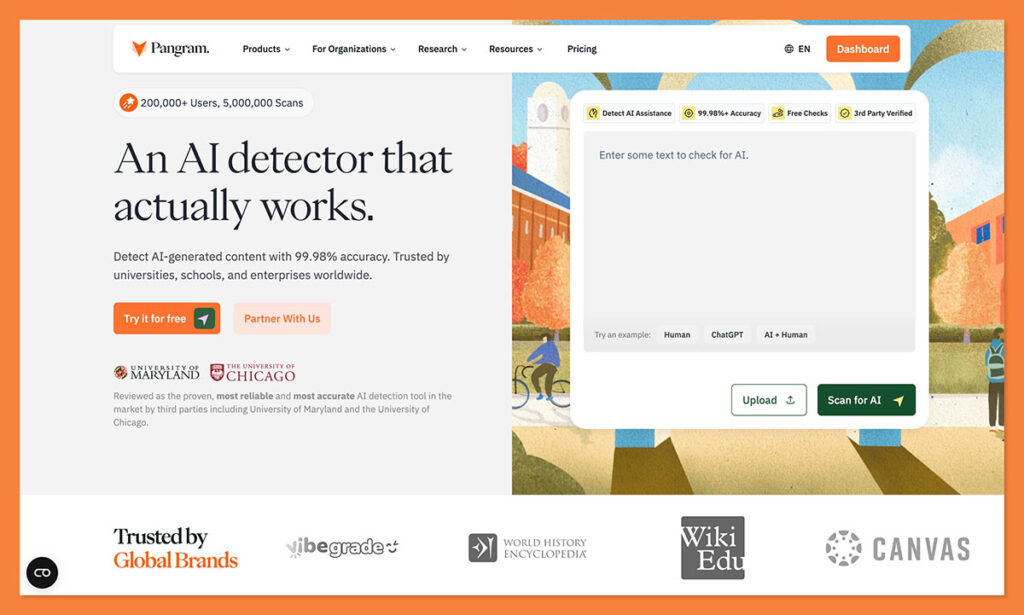
Starting price: Free plan with 4 credits per day; Individual plan at $20/month for 600 credits; Professional plan at $65/month for 3,000 credits.
Pangram is the AI detection tool that just keeps surprising me. First, I was impressed by just how great it was at tracking AI in blog posts, then on social media and Google docs with it’s Chrome extension, now I’m being blown away by its resume scanning abilities.
The best thing about Pangram is that it’s accurate without being overly suspicious. It detects AI incredibly well, with a 99.98% accuracy score (verified by third parties). It can even tell you when someone’s been assisted by AI, or when someone’s tried to clean up AI slop.
But, at the same time, it also works hard to avoid false positives. That’s really important when a lot of resumes include formal writing, and formatting tweaks that confuse other detectors.
Pangram is built for recruiting teams. It can distinguish resume formatting from AI-generated copy with color-coded mixed-content highlighting, so you see when someone maybe got a bit of Grammarly support, compared to when someone just churned something out with ChatGPT.
There’s batch ZIP upload support for bulk screening, and the Chrome extension scans LinkedIn and ATS inboxes too. Plus, tehre’s a Python SDK and API for ATS integration.
All that, and this tool (built by AI researchers from Google, Tesla, and Stanford, by the way), is privacy first. It’s SOC 2 Type 2 and GDPR compliant, and never trains on candidate data.
Pros:
- Exceptional, third-party validated accuracy scores
- Distinguishes resume formatting from AI-generated content
- Spots humanized, hybrid, and fully AI writing
- Bulk upload support, chrome extension, and API
- SOC 2 Type 2 and GDPR compliant
- Suitable for non-native English speakers
- Lowest false-positive story around
Cons:
- Regular use requires a paid plan
- Can occasionally struggle with short snippets of text
2. GPTZero: Best for High-Volume Resume Screening
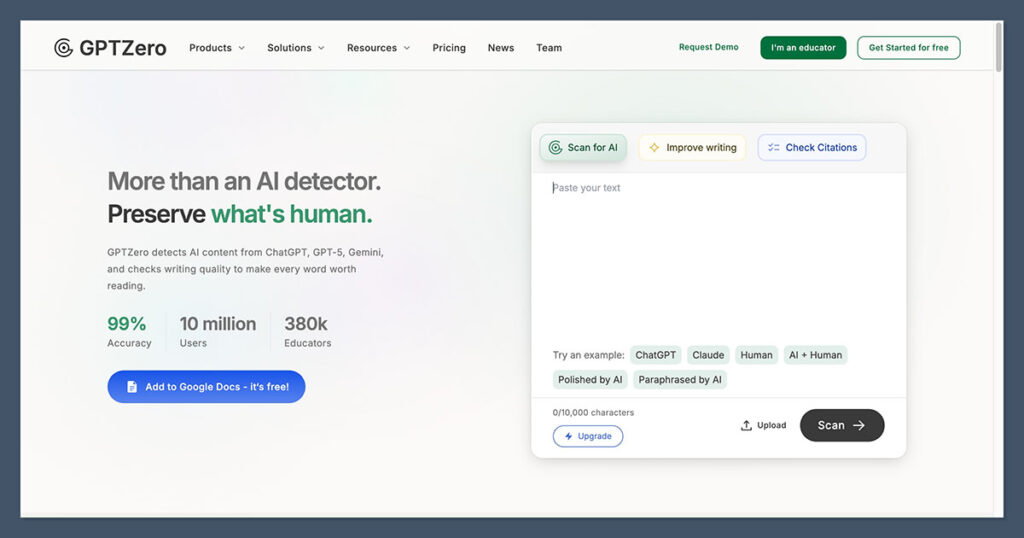
Starting price: Free quick scans; paid plans available
Like most tools in this list, GPTZero doesn’t focus entirely on finding AI content in resumes, it can scan just about any kind of text, and honestly, it does a pretty good job.
It’s average “accuracy” score isn’t as high as Pangram’s, but on average, you can expect something around 96.5%. What makes it more appealing, if you ask me, is how easy it is to use, particularly if you’re checking a lot of applications at once.
The batch processing feature lets you upload a bunch of applications at once, scanning through common files like PDFs, DOCX, and TXT files. You can also use the API if you want to build scanning into your wider setup, or check out the Chrome extension for online docs.
Like Pangram, GPTZero can detect “partly-human” and “partly GPT” content, although I don’t think it’s quite as accurate on that front. University of Chicago’s Becker Friedman Institute actually found GPTZero ended up with false-negative rates of around 50% when text was passed through a “humanizer” tool.
You also get a very generous free plan with GPTZero (10,000 words per month), even though that’s still probably not enough for teams checking applications at scale.
Overall, it’s a good tool, but more of a first-pass filter than anything else. It’s fine at confirming right away whether you’re probably seeing a bunch of AI slop in cover letters and resumes. It’s less good at discerning the difference between standard formal writing and resume formatting, and GPT copy.
Pros:
- Supports batch processing for quick high-volume checks
- Fast API and a good Google chrome extension
- Good enough at spotting obvious AI content
- Easy to use with a generous free plan
- Decent sentence-level reviews
Cons:
- Struggles with humanized or hybrid text
- Can produce a lot of false positives
- Not specially designed for recruiters
3. Originality.ai: Best for Compliance-Style Review
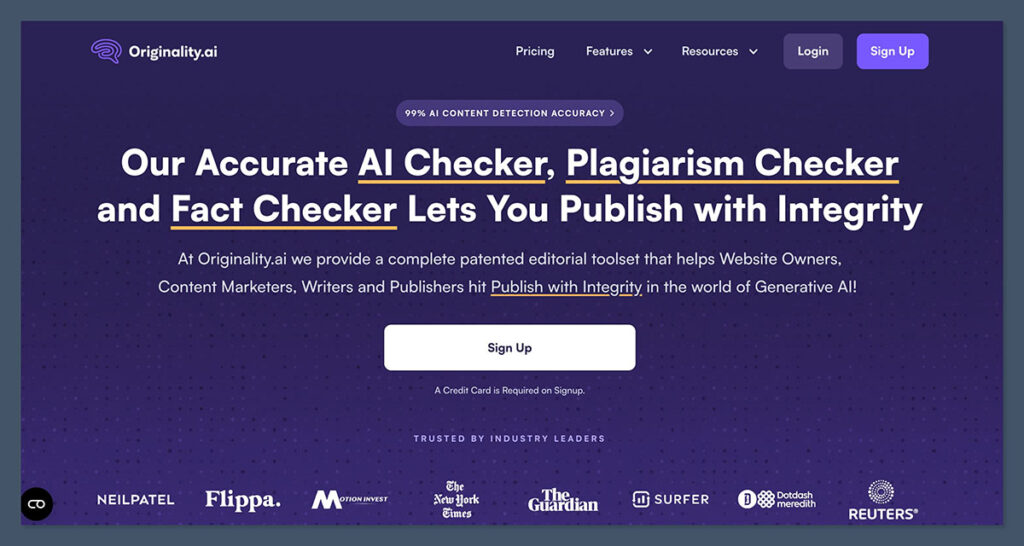
Starting price: Pay-as-you-go at $30; Pro from $12.95 per month.
Originality.ai is the name in AI detection that everyone seems to know at this point. It’s convenient, it’s accuracy scores are impressive, and it even has extra features that can really help certain teams.
The Chrome extension, for instance, comes with writer replay, which can be very helpful for hiring teams reviewing candidates for content-heavy roles.
Like GPTZero, this isn’t really a dedicated tool for scanning resumes for signs of machine influencer, but it does the job well to a certain extent. Plenty of people think so, HBR, SHRM, and Fortune 500 research all seem to recommend Originality.ai as a top option.
The fact that you can check for facts, plagiarism, and AI at once is also helpful if you’re searching for a fabricated work history. Plus, you can use Originality.ai to check out a client’s website, portfolio copy, take-home assignments, and other work too.
Originality.ai makes a lot of sense for legal, defence, and finance recruiters, were strong audit trails really matter. It still doesn’t feel like it’s built around recruiters entirely, though. It also still, like most of the tools I’ve tried, struggles a lot with false positives, particularly when reviewing heavily formatted content (like resumes).
Pros:
- AI detection, fact-checking, and plagiarism checks in one
- Patented detection tech with a good level of accuracy
- Shareable reports for internal reviews
- Excellent chrome extension and Google docs support
- Useful writer replay tools
- Flexible file uploads and API access
Cons:
- Still surfaces false positives
- Might be a bit much for basic resume checks
- Not as strong as some alternatives in accuracy levels
4. It’s AI: Best Recruiter-Specialist Challenger
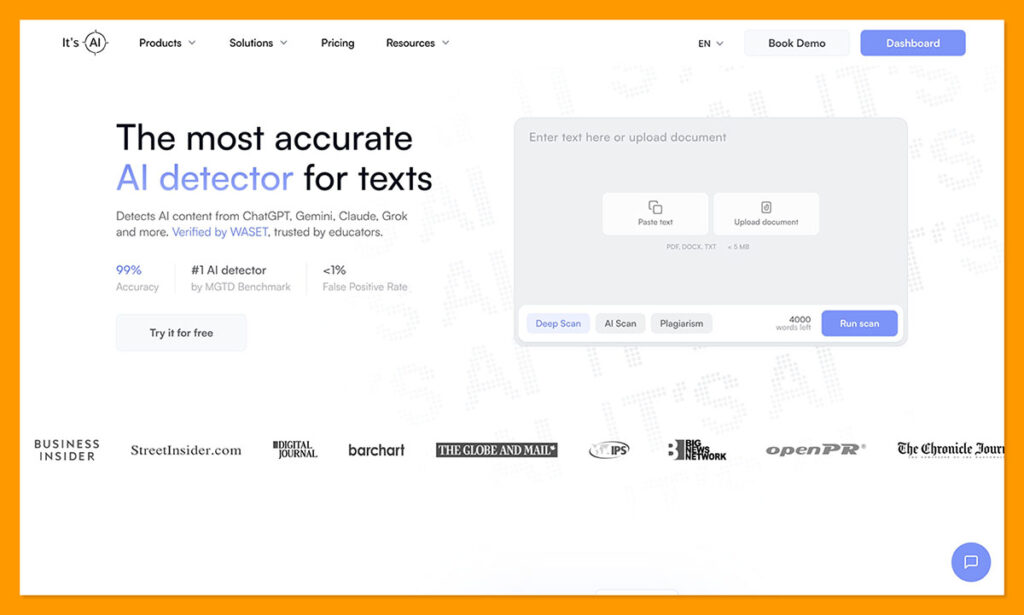
Starting price: Free start; paid details vary
It’s AI is one of the few tools available right now that really does concentrate on recruitment teams. It’s not as well-known as the other options here, but it’s gaining credibility quickly.
With It’s AI, recruiters can upload resumes, cover letters, and other content, and scan them quickly for AI content, human insight, or a mix, with simple probability scores. Batch uploads are supported too, so you can go through dozens of resumes in a fraction of the time. Plus, with ATS-ready API endpoints, you can connect the system to the recruitment tools you already use.
Like Pangram and Originality.AI, scans include checks for plagiarism with this tool, too, which can be very helpful if you’re searching for copied content, or checking citations.
The benchmark claims for It’s AI are strong too. It’s currently ranked first on the MGTD benchmark with a score of 92.0. I’d still take that with a pinch of salt, because benchmarks aren’t always as reliable as they seem, but it’s a good indicator of accuracy.
The biggest problem, really, aside from the fact that this tool isn’t well-known enough, or proven enough yet for some recruiters, is that it still has the growing pains of a lot of AI detectors. High false positive rates, problems with detecting humanized text, and issues with content in certain formats.
It’s a good challenger product, worth watching, but not the best at this stage.
Pros:
- Clearly built for recruiting and hiring teams
- Convenient batch scanning options
- Plagiarism and AI detection in one
- Deep scans for mixed human and AI content
- Strong benchmark claims
- API, chrome extension, and SDK options
Cons:
- Less name recognition
- Fewer independent trust signals than some alternatives
- Still struggles with false positives and negatives at times
The Best AI Resume Scanner for Recruiters
At this point, I think most of us agree that catching AI isn’t hard when someone dumps raw content from ChatGPT or Gemini into a cover letter. It’s much harder when you’re checking hundreds of applications at once, trying to spot humanized AI text, or looking for signals without automatically accusing everyone of being machine-supported.
I think all four of these tools are helpful for recruiters. GPTZero is great for first-pass screening at scale. Originality.ai is fantastic if you’re assessing lots of different pieces of content, and It’s AI is the compelling upcoming challenger in the recruitment space.
Still, Pangram is the only one I’d confidently recommend to everyone at this stage. It won’t stop you from needing to use real judgement, obviously, but it will give you an easy way to detect different levels of AI influence at scale. It’ll also help you gather the insights you need with the confidence that comes with knowing you’re less likely to be making decisions based on false positives.

Comments 0 Responses