

I’m all for the concept of predictive analytics in theory. What could be better than getting ahead of issues like churn, or wasted spend before they have a way to derail your business? What I struggle with is how difficult it can be to build a system you can both trust and use.
That’s what I was thinking about throughout this whole Databricks vs Pecan AI comparison. Both platforms are arguably excellent; they just solve different problems for businesses in very different ways. Databricks, for instance, is a huge, and genuinely impressive platform.
It’s clearly made for data engineers and data scientists. It gives you all the tools you need to build, train, and deploy custom machine learning models. But it’s not a lightweight system.
Pecan AI is very different. It’s made for businesses that are sick of waiting around to get answers to questions like “Which customers are most likely to churn next week?” You give it your data, and the question you want to answer, and you get a model ready to plug in your tools and share answers.
Pecan AI vs Databricks: Quick Verdict
Choose Pecan AI if you want faster predictive analytics for business users.
Choose Databricks if you need a full data engineering, ML, and AI infrastructure platform.
Use both together if Databricks is your data foundation and Pecan is your business-facing predictive layer.
| Category | Pecan AI | Databricks |
|---|---|---|
| Main job | Answers business questions with predictive insights | Enables teams to build and run AI and ML workflows at scale. |
| Best users | BI, RevOps, ecommerce, marketing, CS, planning | Data engineers, data scientists, ML engineers |
| Starting point | “What do we need to predict?” | “What do we need to build?” |
| Skills needed | Business team with Analyst support | SQL, Python/Scala, ML, platform skills |
| Predictive workflow | Guided by Predictive AI Agent | Built through AutoML, notebooks, MLflow, serving |
| Model control | More guided | Much deeper control |
| Best use cases | Churn, LTV, ROAS, lead scoring, demand, fraud | Custom ML, AI apps, governance, data engineering |
| Delivery | Predictions into workflows | APIs, batch inference, real-time serving |
| Governance | Strong business-grade controls | Unity Catalog, lineage, AI governance |
| Pricing feel | Clearer entry pricing | Usage-based, more moving parts |
Pecan AI vs Databricks: The Overview
First, let’s define these two tools, because it would be far too easy to call them both “AI software”.
Pecan AI is the kind of predictive analytics tool I’d show to people who want the answers without the heavy lifting. You tell the Predictive Agent what you want to know, and it builds a model using your data, without several months of programming work.
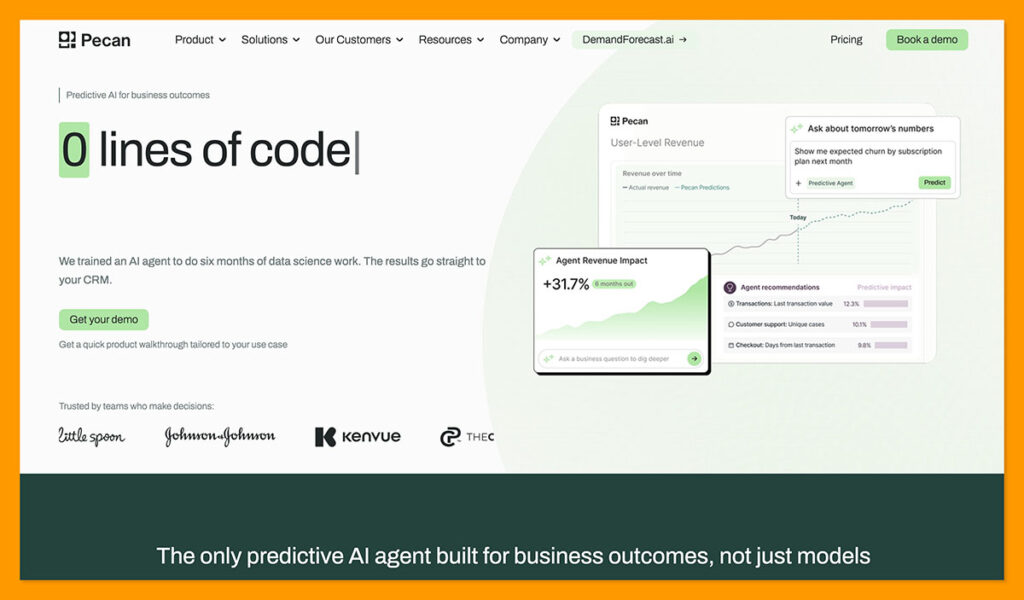
Once your model is ready, you can connect it to your tools, like CRM or a warehouse, and ask questions in the flow of work. Pecan’s software prepares the data, creates the training sets for the models, develops the predictive features, and tests everything for you.
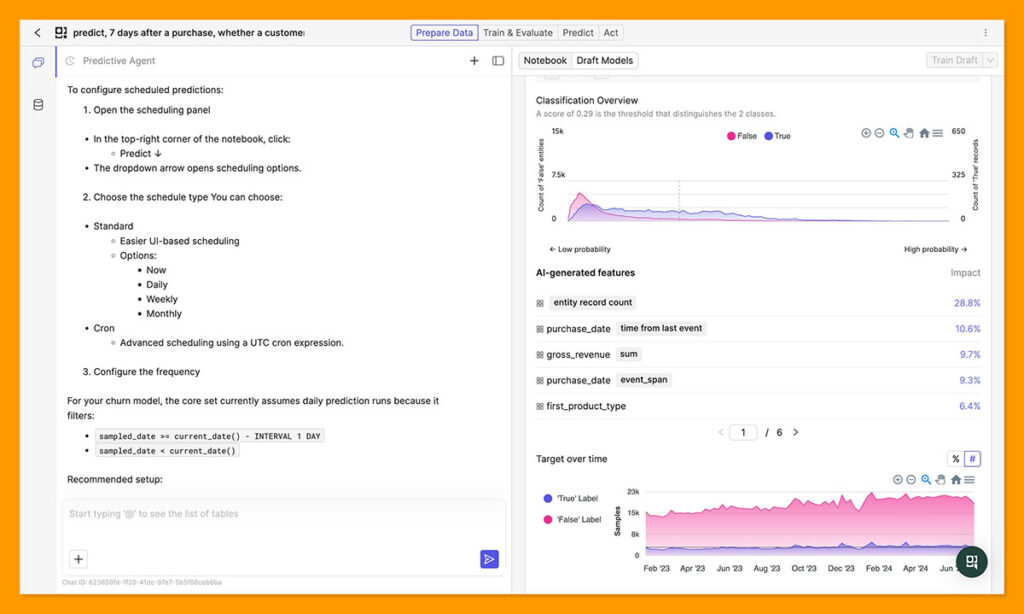
It’s a far more user-friendly experience. Pecan uses LLMs as part of a structured predictive workflow, not in place of one, so you get a validated model tuned to your data rather than a chatbot’s best generic guess. There’s a whole proprietary technology stack behind it, and the model you get is customized to you (not some generic bot)
That’s what’s really important: Pecan isn’t another all-purpose AI workbench or one-size-fits-all prediction tool, it’s a system that gets you from question to answer quickly (and accurately).
It’s also worth noting that Pecan is actually an official Databricks Technology Partner that integrates directly with the Databricks Data Intelligence Platform.
Databricks is a comprehensive data and AI platform. It gives you a full end-to-end data lakehouse, support for massive data processing jobs, data warehousing, and custom model building across all kinds of domains.
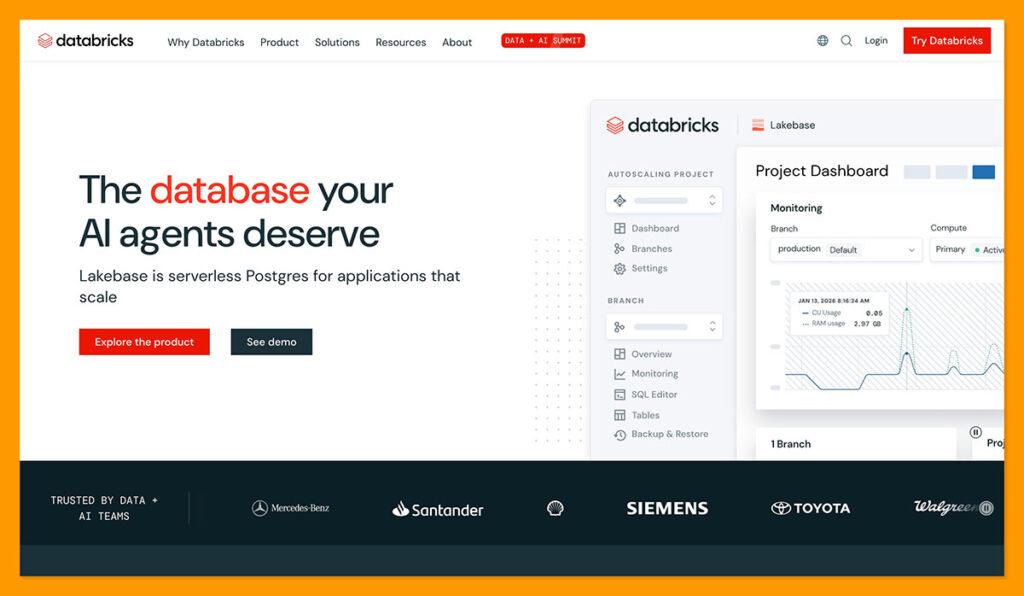
It’s meant for teams that want to own every aspect of their data strategy, without limits. For predictive analytics, Databricks has a lot of strength. You get a central place (Feature Store) to manage features used in your model with governance, cross-workplace sharing, model serving, feature serving, and batch inference. You also get the full Unity Catalog to help you keep everything controlled.
It’s honestly excellent if you’re building a company-wide foundation for data and AI. It’s a bit “too much” if you just need quick answers to questions.
So, honestly, you don’t have to choose one or the other.
Pecan AI vs Databricks: Ease of Use and Setup
This is the main thing that separates Databricks and Pecan AI for me. One is clearly designed to deliver value fast, without giving you a coding headache. The other isn’t.
Pecan starts where your business team is: struggling with a question. You’re not waking up, deciding you need to find out where your marketing or inventory strategy is losing money, and then committing to six months of building to get a model that works it out for you.
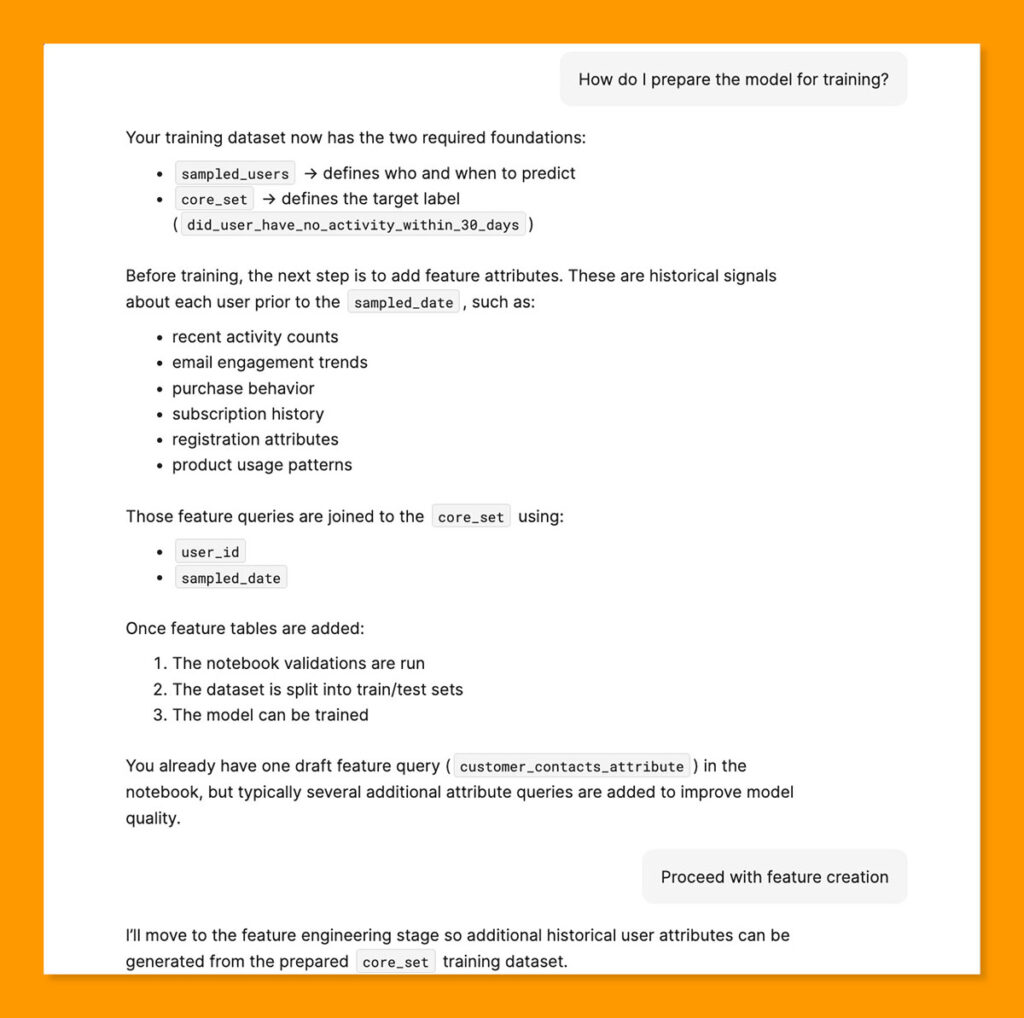
You’re asking an intelligent agent a simple question. That agent handles all the exhausting stuff, like turning raw data into training sets with auto-generated SQL, dealing with data prep, feature work, model checks, and feature delivery. The answers you need arrive where you actually want to see them, straight in your CRM, BigQuery, or even Databricks if you like.
It’s all brilliantly straightforward.
Databricks is much more complicated, and it’s supposed to be. AutoML supports classification, regression, and forecasting, and it generates trial notebooks for each model. There’s a lot of work involved in getting everything up and running. But for some teams, that’s a good thing.
You’ve got more control if you want to inspect the code, adjust logic, and actually maintain ownership over the model. You just need to be willing to put the work in.
Predictive Analytics Use Cases: Where Each Platform Fits Best
As I said, neither of these platforms is better than the other universally; they just serve different use cases. Pecan AI is focused on answering the questions that actually decide if a business grows.
It’s ideal for customer churn prediction, lead scoring, sales prioritization insights, customer lifetime value calculations, and campaign ROAS prediction. It’s also brilliant if you need a bit of support with demand forecasting, inventory planning, and logistics management.
If your main goals are to protect revenue (with churn and fraud prevention), grow that revenue (with LTV modelling, customer win-back strategies, and upsell/cross-sell opportunities), improve efficiency with demand forecasting, or transform the workforce, Pecan is the easy win.
Databricks can handle all of those use cases too; of course, it just takes a lot longer to get from figuring out what you need to getting it. It’s the better pick if your predictive model needs to sit in an enterprise platform with governed features. It’s just not the easy route.
Time to Value: Pecan’s Biggest Advantage
That brings me straight to Pecan’s biggest advantage over Databricks, really. Predictive analytics does have a shelf life. If a churn model is finally finished after you’ve already lost half of your customers, you just end up with a very expensive post-mortem tool. Same issue with campaign ROAS, lead scoring, demand forecasting, and so on.
Pecan helps you create a system that actually lets you respond to your data while your action still counts. You’re ready to start making real, data-driven decisions in weeks, not months.
Databricks can get predictive models into production, and once they’re live, they can be extremely useful. But the timeline depends on a lot of things. You need the right team already. Your data needs to be ready. Plus, you need to get your head around the whole build.
Governance, Security, and Control: The Databricks Advantage
Pecan brings enterprise-grade security: ISO 27001 certification, SOC 2 Type II assessment, AWS hosting, encryption, 2FA-enabled VPN access, firewall protection, and periodic penetration testing.
The data you share is used only to generate your predictions, never to train underlying models.
Databricks arguably has the more serious “control” pitch.
It lets you govern the entire data and AI estate. The Unity catalog handles access controls, workspace bindings, data discovery, audit logs, data classification, row and column filters, sharing, quality monitoring, and governance rules.
Pecan covers what most teams need for production predictions. If governing an entire data-and-AI estate is the priority, Databricks goes deeper.
Integrations and Workflow Delivery
I think a lot of companies underestimate how easy it is to ignore a prediction that doesn’t land right in front of you at the exact moment you need it.
Pecan helps with that delivery. It connects to platforms like Snowflake, BigQuery, HubSpot, RedShift, Shopify, Klaviyo, Oracle, and several others. It also connects to Databricks (so yes, you can use both of them together).
The benefit there is that the predictions appear where your team can actually use them. They’re not under pressure to keep checking in with a separate model every time they need to make a decision.
Databricks obviously integrates with plenty of platforms too, but you do have to take on more work to make sure the predictions land where and when you want them. Pecan AI just makes that whole process and journey a lot easier.
Pecan AI vs Databricks: Pricing and Total Cost
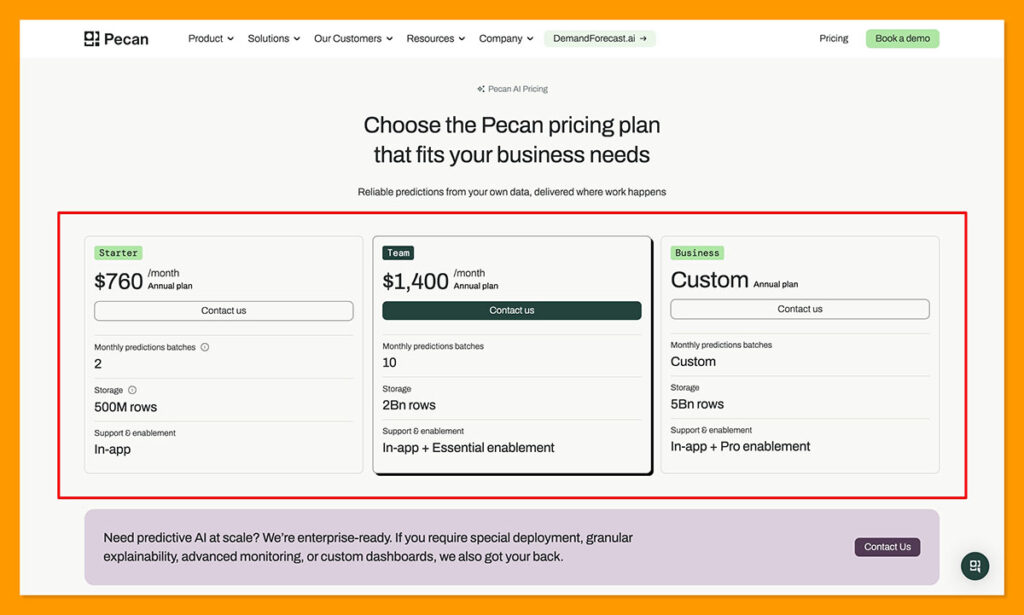
Both platforms are premium in terms of cost, but Pecan is easier to get your head around if you’re trying to get a budget approval from your finance team. There are multiple plans, based on your needs.
The Starter plan is $760 per month (annually), with 2 monthly prediction batches and up to 500m rows of storage. The Team plan is a bit bigger, for $1,400 per month, with 10 monthly batches, and 2B rows of storage. The Business plan is a custom (Enterprise) option that allows you more flexibility per your business needs.
Databricks uses a pay-as-you-go model, which might sound more attractive at first. You only pay for the products you use on a per-second granularity. That pricing can very quickly add up though.
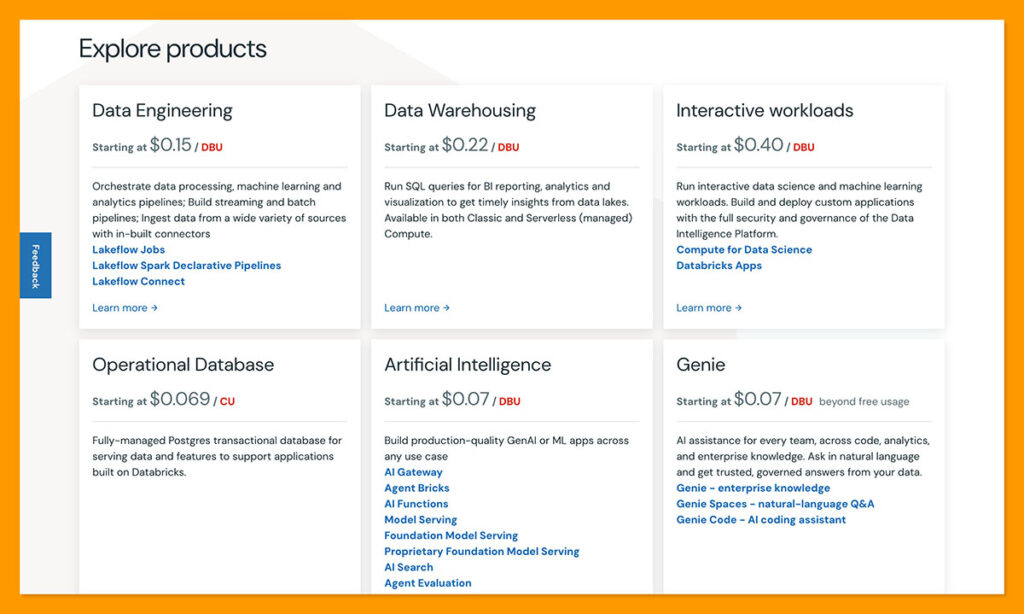
Overall, I’d say Pecan is easier to budget around. Databricks can be cost-effective, but only when you know how much you’re going to be relying on it.
Pecan AI vs Databricks: Which is Best
Databricks is popular for a good reason. It’s an obvious choice if you want to own the complete data and AI machine from start to finish. You get full control, endless customization options, and plenty of features that help you create AI models that really can transform how you run your business.
However, that doesn’t make it the ideal option for every use case. If you want to act on predictions and fast, Pecan is by far the better fit.
It’s not trying to replace Databricks as your data estate. You can still use both of the tools together. It’s just trying to give you an easier way to get answers to the questions that matter. You ask a business question, the system prepares everything for you, and you get the answers you need in the tools your teams are already using.
You still need sufficient historical data and an analyst with basic knowledge to get the most out of Pecan AI. But you don’t need a comprehensive data scientist team, several months, and a huge budget.
That’s my honest verdict. Still choose Databricks if you need the full system. Choose Pecan AI when you want the predictions you can act on fast. Or, combine the two, they both work together, too.
If you want to try Pecan for yourself, you can request a demo for free here.

Comments 0 Responses