

I don’t think many business leaders need someone to convince them that analytics tools are worthwhile. We all know how useful the right insights can be. Most of us also know how difficult it can really be to get those insights while they’re still worth using.
Plenty of ecommerce companies, for instance, have tons of dashboards to show them when revenue dipped, or when ad spend starts eating too much margin. But those tools still just illustrate the problems after they’ve already happened.
Pecan AI is different because it focuses on helping businesses get ahead of the issue, without forcing leaders to hire a data science team to build a proprietary model.
With the “Predictive Agent”, all you need to do is describe what you want to predict, and the system generates a custom model from your data, then sends predictions straight into the places where people can actually use them.
Quick Verdict
Pecan AI is one of the most valuable AI-powered tools I’ve tested in quite some time. It’s absolutely worth your attention if you’ve got customer, sales, campaign, or inventory data, and you’re tired of using last month’s results to power the next month’s plan.
Business teams build the model themselves, get predictions where they already work, and skip the months of setup. That agility drives real results for businesses.
In fact, Pecan says the average customer reports 12% lower churn, 15% better marketing ROAS and 25% lower inventory costs.
What I like about Pecan AI 👍
- It’s built for business teams, not data scientists
- You get results in weeks, not months
- It’s more guided (and straightforward) to use than platforms like Vertex AI
- Predictions appear where teams are, not in a separate dashboard
- Integrations with platforms like Salesforce, HubSpot, BigQuery, Databricks and more
- Handy pre-built templates
What I don’t like 👎
- You still need sufficient structured data
- Customization options are a little limited
- Plan limitations can be consumed quickly
What Is Pecan AI?
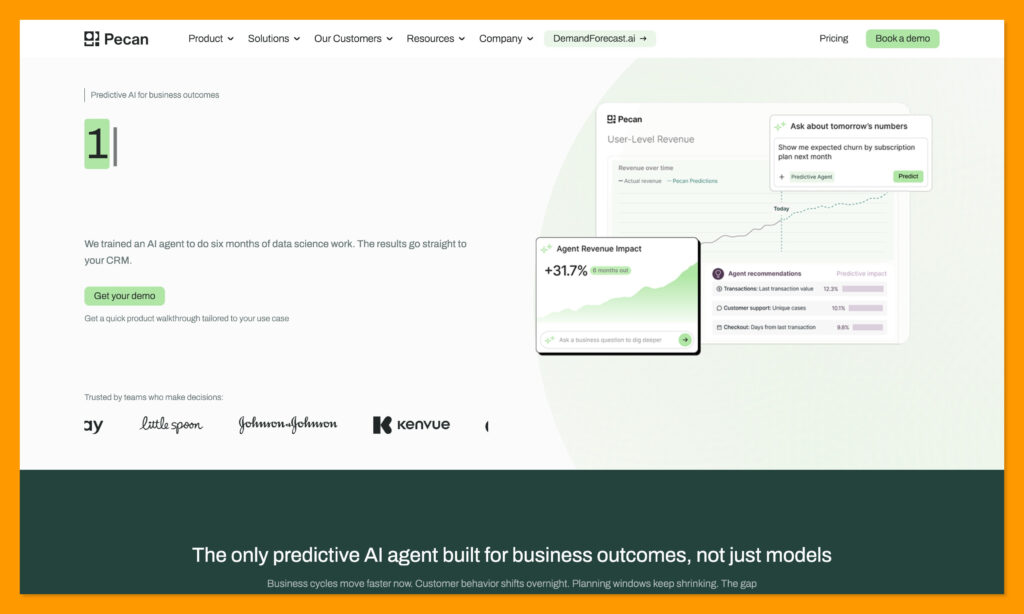
Pecan AI is a predictive analytics platform created for teams that already have plenty of data, and want to use it to answer valuable questions faster. If you’re sick of asking “what happened to our revenue last quarter?”
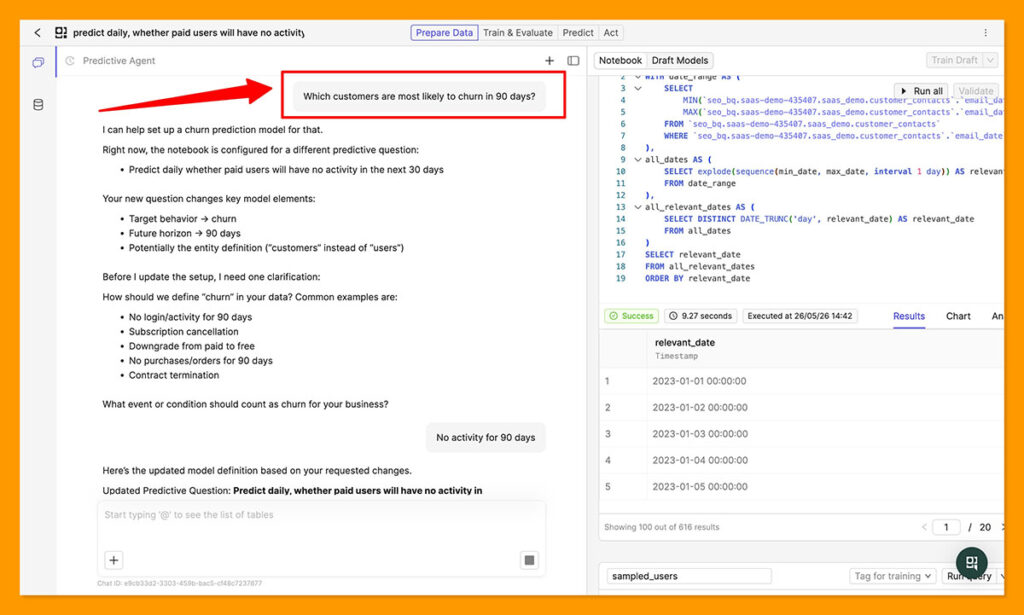
Pecan AI gives you the tools you need to get ahead, with questions like “Which customers are most likely to churn in 90 days?” or “Which SKUs might cause problems?”
BI tools describe what happened. Generic AI agents generate answers but aren’t designed for predictive modeling on tabular data. AutoML platforms build models but require data science expertise. Pecan automates all three while staying accessible to business teams
The central “product” they’re selling is the Predictive AI agent. You tell the agent the thing you want to predict, and Pecan builds a predictive model using your data. Models that used to require months of data science work can now be built in a couple of weeks by analysts and ops teams, without manually writing SQL or wrangling pipelines.
If you’re wondering how it all works, the process moves through five parts: connect, define, build, predict, and act. You connect your data sources (like your CRM or warehouse), then you define the use case with the agent.
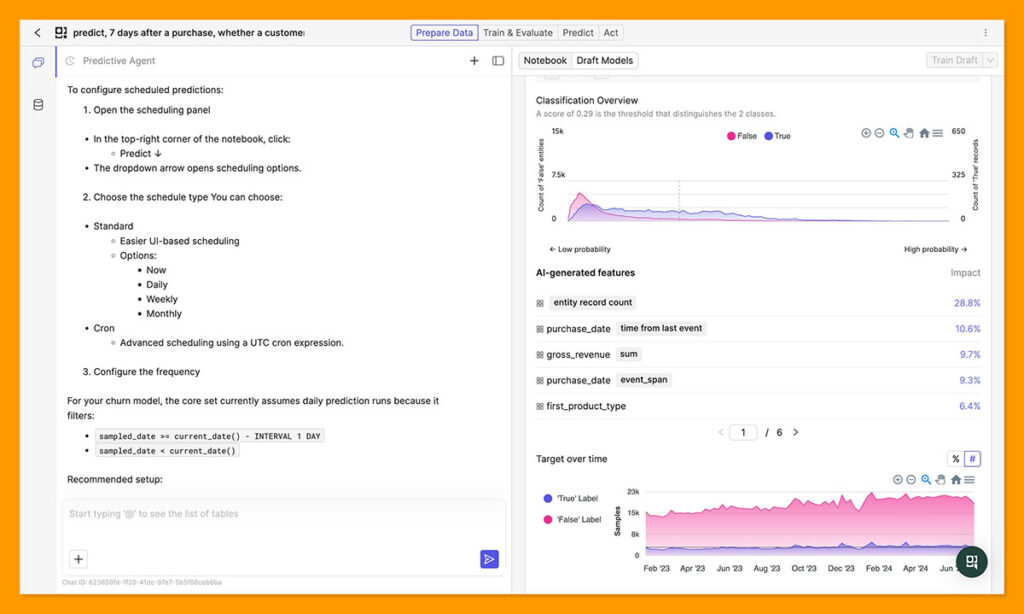
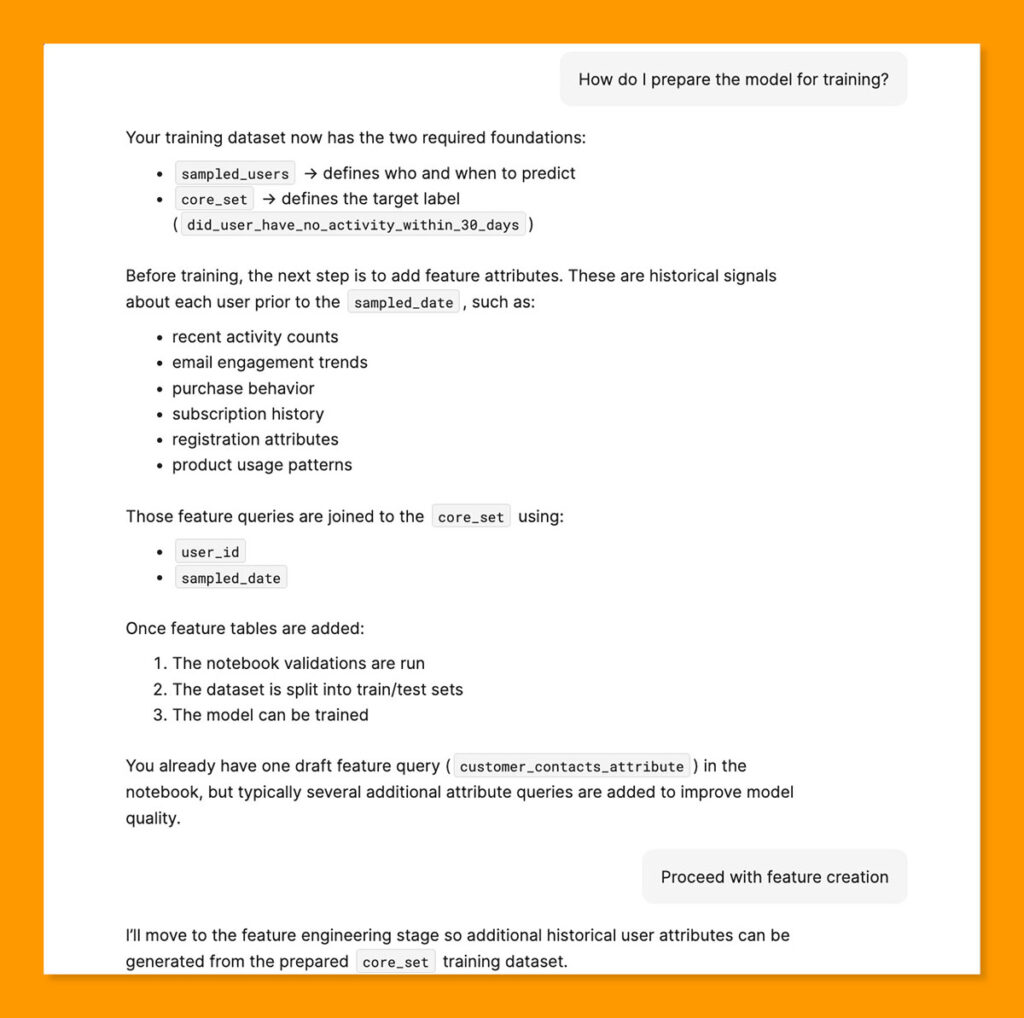
Pecan’s software prepares the data, creates the model training sets, develops predictive features, and tests model performance for you. Then, the system sends predictions back into the tools you’re using.
The fact that predictions are embedded in actual workflows is probably one of the most valuable parts. A churn score in a dashboard is great if someone remembers to check and act on it. A score sent straight to your CRM is much easier to use before the insights go stale.
Pecan AI Review: The Main Features
Pecan isn’t trying to give companies a version of ChatGPT with a sales dashboard attached. It’s a unique system with its own patented technology.
Those patents cover automated feature engineering for systems that automatically detect patterns, define predictive labels, and structure time-series granularities for forecasting.
They also cover built-in algorithmic safeguards for data leakage prevention, and SDCI (System for Dynamic Contextual Integration), the system invented to build explainable, deterministic AI architectures analysts can easily interpret.
Part of what makes it so compelling is how focused its use cases actually are. You’re looking at tools that help with things like churn prediction, lead scoring, demand forecasting, and chargeback prevention. In other words, the cases that sit closer to painful money and growth questions.
The main features include:
- Predictive AI Agent: The central agent that can understand real business questions (written in normal language), and use your actual data to answer them. You ask a business question; the agent shapes it into a predictive use case.
- Auto-Generated SQL and data prep: This is one of the more useful features if you’ve tried to build out a predictive project before and got stuck in the preparation swamp. Pecan’s agent turns raw data into ready-to-use model training sets with auto-generated SQL, so there’s less work for your team.
- Model Building and Validation: Pecan’s platform evaluates model performance automatically, and it explains accuracy in clear business terms. That’s useful, because your team needs to know (without endless homework), whether the churn score is safe enough to trigger outreach, whether a lead score is better than the current hand-rolled system, or whether an inventory forecast is worth trusting before purchase orders go out.
- Prediction Delivery and Monitoring: Pecan lets teams schedule prediction runs and send results back to a CRM, data warehouse, database, or dashboard. It also gives you prediction monitoring, with real-time alerts for model training and prediction progress.
The integrations are worth mentioning too. Pecan can easily connect with all the tools teams already rely on, from CRMs like Salesforce, to Shopify, Klaviyo, Databricks, BigQuery, and more.
Pecan AI Use Cases: Where the Platform Has the Strongest Proof
I love it when a platform I’m reviewing doesn’t just “suggest” use cases, it actually gives you real insights into where it’s helped other businesses grow. Pecan does that really well. It’s case studies make it a lot easier to create a business case built around real numbers.
The top use cases for Pecan AI are:
Customer Churn Prediction
Every company asks this question at some point: “who’s likely to leave soon, and what can we do about it?” Pecan helps companies answer that fast.
Clearwave Fiber, for instance, built a churn model in four weeks, started using live predictions in 2 months, and ended up seeing 20x lower churn in its highest-risk segment. For the top 1% of at-risk customers, treated churn landed at 1.2% to 1.5%, while untreated churn sat around 40%.
Credit Pros gives you another handy success story, too. The company significantly reduced prediction windows, and increased revenue, with longer client retention rates.
Lead Scoring and Sales Prioritization
Plenty of companies already have lead scores in their CRM, but fewer have scores that reps actually trust, and that consistently predict revenue.
Pecan gives companies the tools they need to rank leads more effectively, model lifetime value, and explore opportunities for upselling, cross-selling, and revenue growth.
Customer LTV and Acquisition
In most industries, paid acquisition has become far too expensive for anyone to rely on lazy measurement anymore. If you only know if someone has bought something once, you don’t know much. You need to know if that customer has any chance of coming back, upgrading, or re-ordering after they’ve claimed their initial welcome discount.
Pecan helps with that. Little Spoon, for instance, used the predictive LTV, weekly order insights, and upsell models offered by the system to improve acquisition, retention and revenue.
Campaign ROAS Prediction
This use case will probably appeal most to ecommerce teams and app sellers. Early campaign metrics very rarely give you an honest view. Cheap clicks can bring cheap customers, and strong first orders can still deliver poor payback if retention drops.
Pecan’s campaign ROAS insights forecast return before your spend is already locked in. That means you get to figure out if campaigns are going to pay off, before you waste your budget.
Even better, compared with building something similar in Databricks, Snowflake, or Vertex AI, Pecan gives you the results much faster, and with much less spending on talent and extra support.
Demand Forecasting and Inventory Planning
Demand forecasting sometimes feels less exciting than lead scoring, but that doesn’t make it less valuable. Bad forecasts can create some serious issues, like stockouts, overstocks, warehouse clutter, and markdowns.
Pecan can stop you from falling into those traps. Kenvue, as an example, achieved a significant reduction in MAPE in the first year it used Pecan for demand forecasting.
Shipping, Repeat Purchase, and Logistics
Sick of bad logistics planning holding your team back? Pecan could be the answer. ShopTJC, for instance, used the platform with a focus on one question: “After a customer buys, will they buy again in the next couple of days?”
If the predictive model pointed to “yes”, ShopTJC could group orders and avoid duplicate shipments without making everyone wait. Pecan says the model reached production grade in one week, was built without prior ML experience, saved 2,000–3,000 shipments per month, and cut shipping costs by 6%.
How Easy Is Pecan AI to Use?
I honestly think one of the biggest selling points of Pecan AI isn’t that it’s just proven how valuable it’s predictive agent can actually be, it’s that it’s committed to making predictive analytics so much easier to embed into how your business works.
You’re not hiring data experts, or spending weeks building custom models. You’re just speaking to a system that handles the tough stuff for you.
The Predictive Agent can automate data prep, handle complex modelling, and answer questions without forcing you to translate paragraphs of jargon. Even better, it gives you those answers in the places you can actually use them, whether that’s your CRM, or your data warehouse.
I also like the fact that Pecan doesn’t make you compromise on safety just to make analytics strategies easier. It’s not necessarily designed for highly regulated industries, but it keeps things trustworthy.
The platform is ISO 27001 certified, and undergoes SOC 2 Type II assessments. Data, as you’d probably expect, is secured in transit and at rest.
Plus, you get granular access controls, SIEM controls, monitoring logs, penetration testing, and several extras that can give your C-suite a bit more peace of mind.
Pecan AI Review: How Much Does it Cost?
Serious AI solutions like Pecan AI tend to come with a serious price tag, that’s definitely true with Pecan AI. It’s not the most expensive platform I’ve seen in its category, but it’s not cheap.
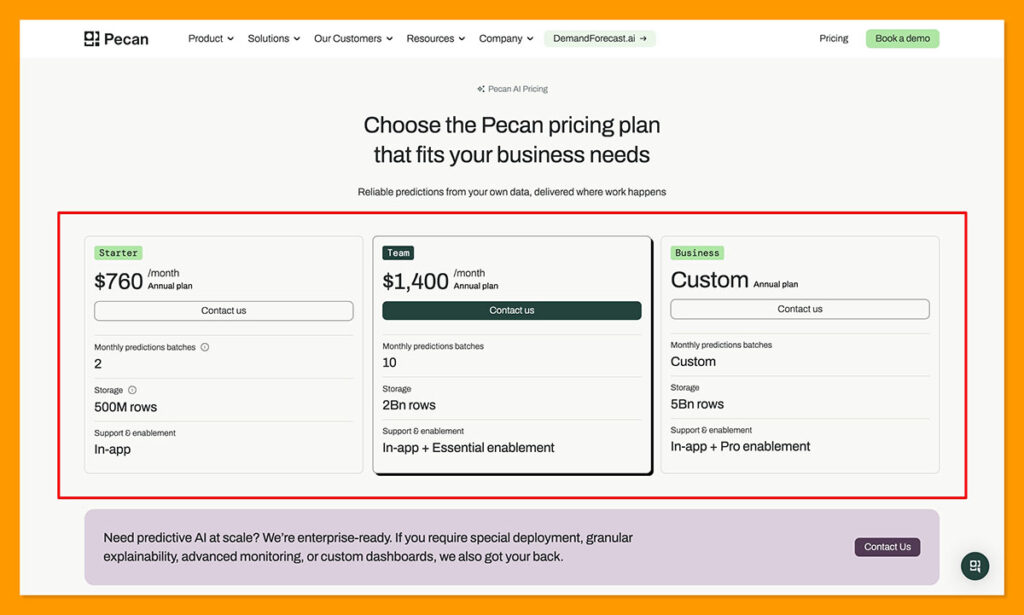
The Starter plan, which I think most companies will test out first, costs $760 per month, and gives you 2 monthly prediction batches and 500m rows of data storage. The Team plan, for $1,400 per month upgrades your monthly prediction batches to 10, and gives you 2 billion rows of storage.
The more expensive “enterprise-style” plan is the “Business” subscription, which is custom priced based on what you actually need.
I get that prices like that can drive smaller teams away from a platform initially, but honestly, it’s worth thinking about the actual value for money you’re getting here.
Building an internal predictive analytics strategy can cost you over $600,000 in annual personnel, even if you’re just hiring a handful of specialists. Then you’ve got to account for the amount of time you’re spending getting everything set up, maintaining your models, and updating the system.
Pecan might seem expensive upfront, but it could actually end up saving you money in the long-term.
Who Pecan AI Is For, and Who It Isn’t For
I’m not going to argue that Pecan AI is the perfect predictive analytics software for every company. I’d say it’s generally best for companies with enough data to make predictive analytics worthwhile. If you’re running a company earning about $10 to $500 million in revenue, Pecan is ideal for you.
In fact, I’d say Pecan is a good fit for:
- Ecommerce and retail teams working on churn, repeat purchase, LTV, inventory, shipping, fraud, and ROAS.
- Subscription brands trying to spot cancellation risk before customers disappear.
- Sales and RevOps teams that need better lead scoring than “they downloaded a PDF, call them.”
- Marketing teams that want to know which campaigns are likely to produce valuable customers, not just cheap clicks.
- Supply chain teams dealing with stockouts, overstocks, and forecast misses.
- Analytics leaders who want predictive models in weeks, without waiting for a full data science backlog to clear.
On the other hand, it might not be the kind of system you want if you’re running a tiny store (with very little historical data), you’re still fixing basic data hygiene, or you’re managing a business that needs very deep control over every model, feature, pipeline, and deployment choice.
Pecan AI Reviews: What Real Users Say
I don’t expect anyone to trust just my opinion directly. Pecan AI has plenty of positive reviews from other users too. Just a few examples:
“The biggest strength for me is how accessible the platform makes predictive modeling – you don’t need a dedicated data science team to get real value out of it. Building and training models is genuinely straightforward, and the prediction quality has held up well in production. The onboarding experience stood out too. We had our first model live and being used by our sales reps in under a month, which is faster than I expected. The support team deserves a specific callout: they run regular check-ins, respond quickly to questions, and walked us through setup step by step. It feels more like having a partner than a vendor.” – J G – 04/20/2026
“Onboarding predictive models for our sales team was a remarkably smooth experience with Pecan. From the very first kickoff call, the Pecan team was hands-on and genuinely invested in making sure we got value quickly. The platform’s UI is clean and intuitive – even team members without a technical background were able to follow along and understand the model outputs without much hand-holding. What really stood out was the level of support we received throughout the process; the team is always responsive, knowledgeable, and a pleasure to work with. It’s clear they care about their customers’ success, not just deploying a tool.” – Verified user in hospital and healthcare – 04/13/2026
“Above all else, Pecan has been deeply committed to our success with the product. They have been consistently available to assist and consult with us on how to improve our use of the product across both current and future projects. The customer service has been excellent. Additionally, the model-building process speeds up our ability to produce predictive models for key business initiatives. In situations where our Team doesn’t have the bandwidth to spend weeks building a predictive model, the Pecan product allows us to create models much more quickly when time is limited.” – Verified User in sports – 02/26/2026
Pecan AI Alternatives
I’ve mentioned a handful of other “similar” tools to Pecan AI throughout this review, because I know it’s not the only option out there for predictive insights.
Still, I’d generally place Pecan in a separate shopping aisle from things like Amazon SageMaker, Databricks, Google Vertex, and Snowflake.
Vertex AI and SageMaker, for instance, are great when you already have ML engineers and data scientists on your team, and they know what they’re building. Snowflake and Databricks are excellent if teams have a lot of data infrastructure, with pipelines, storage, and support for large-scale processing.
All of those alternatives are wonderful for predictive work in their own way, but none of them feel particularly “accessible” if you’re trying to dive into an analysis without getting lost in the weeds of data science. Pecan is the smoother option, with the lowest barrier to entry.
More importantly, it focuses on the business question first. With Pecan, you’re getting a direct insight into what’s really driving churn, lead conversions, demand, ROAS and lifetime value, fast, without the extra admin work. The agent helps define the goal, prepare the data, create the training set, and customize the model, so you get the results without the extra background work.
That doesn’t mean Pecan is automatically better for every company and use case. A lot of mature teams focusing on machine learning might want the control another platform gives them. But if you’re leading an analytics, revenue, operations, or ecommerce team, and you want usable, trustworthy predictions, without building a machine yourself, Pecan is the better choice.
Pecan AI Review: My Final Verdict
Pecan AI is an incredibly useful platform for the right companies. If you’ve got plenty of historical data, a clear prediction question, and someone in your team who understands both the data, and the commercial problem, Pecan will help you a lot.
Alternatively, Pecan probably won’t be the right tool for tiny stores, messy data teams, or data scientists who want every lever exposed. Those buyers will either outgrow the guardrails or crash into them. But for ecommerce, subscription, revenue, and planning teams that want predictions in workflows instead of another dashboard autopsy, Pecan has a strong case.
My overall take: Pecan’s real advantage isn’t prediction for its own sake. It’s helping teams act while there’s still time to change the outcome.

Comments 0 Responses