

If you’re looking for tools that can help you get more out of all that handy data you’ve been collecting for the last few years, you’ve probably seen both Alteryx and Pecan AI already. They seem like they’re one and the same, both connected to data analytics. They’re actually quite different.
Pecan AI is a predictive modelling platform. It was made to help businesses answer useful questions fast. It’s the kind of tool you use if you want to know why people are churning, or what you can change to cut costs and increase growth.
Alteryx is handy if you want something smart to help you get your data sorted. If you need data cleaned, and ready to convert into valuable insights, that’s Alteryx.
One tool isn’t really automatically better than the other, each is better at different things.
Pecan AI vs Alteryx: Quick Verdict
Pecan AI is the platform I’d go for to answer specific questions quickly. If you’re looking for actionable insights into what’s going on with churn, LTV, lead quality, demand, inventory, or even fraud risk, and you want them delivered straight into the tools your teams are already using to address those problems, Pecan is a strong choice.
Alteryx is more the platform you choose when the data work itself is what’s holding you back. If your analysts are cleaning exports manually, connecting awkward files, rebuilding reports and trying to bring everything together into something they can actually use, Alteryx helps to give you a clearer path to success.
Pecan AI vs Alteryx: What Are They Both?
Pecan AI is the more focused tool, built for business teams asking prediction questions. It’s the tool you use for time-series forecasting, and predictive analytics you can actually act on. You connect your data, define the question you want to ask, and Pecan’s Predictive AI Agent builds a model, checks its performance, deploys predictions, and delivers insights straight into your workflow tools.
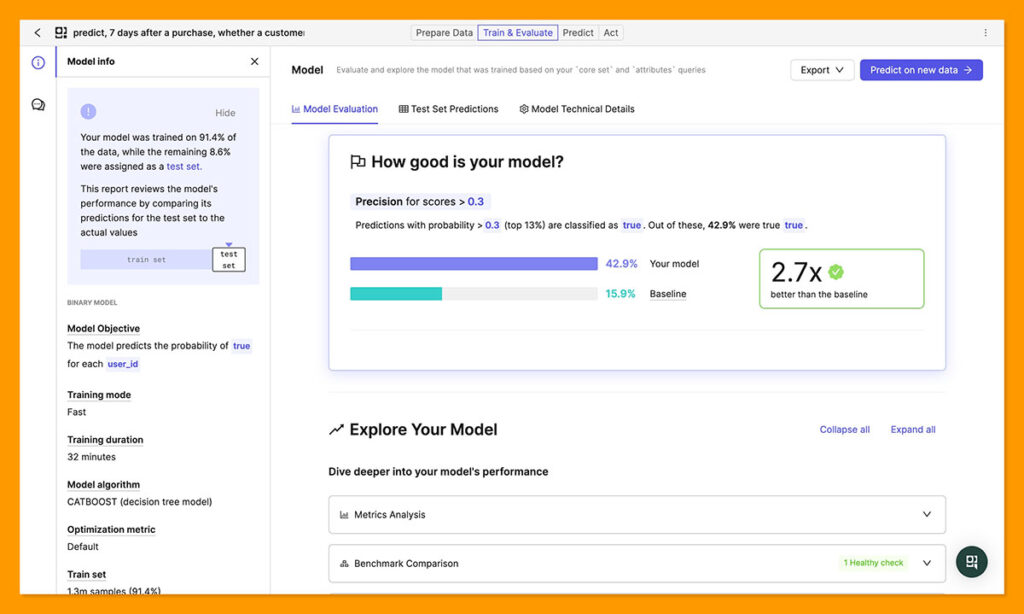
The main value is that a task that used to take months of data science work can be done in days to a couple of weeks. No need to manually build everything from scratch yourself when all you want is accurate, useful answers to questions like:
- Which leads should sales call first?
- Which campaigns are bringing in the most valuable customers?
- Which accounts are most likely to churn in the next 30 days?
Alteryx is a slightly broader analytics machine. It handles data ingestion, blending, and transformation, cleans files, joins sources, and builds repeatable workflows. There are more than 300 drag-and-drop analytics tools, and you can connect with more than 80 data sources. You can also use Alteryx to deliver output to about 70 tools.
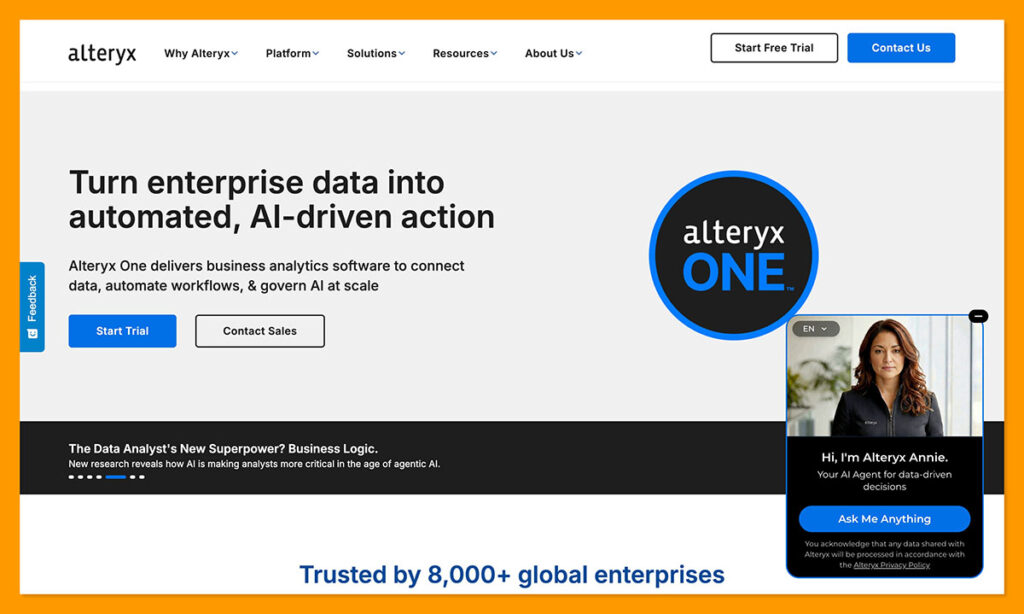
Both platforms are low-code and no-code friendly, but Alteryx is more broad, it even has an Agent Studio and MCP server to make datasets and workflows actionable through AI assistants. That gives it more room for wider data strategies, but it also means the setup takes longer.
Pecan AI vs Alteryx: Main Use Cases
I honestly think it’s easier to compare Pecan AI and Alteryx based on use cases, rather than features. Pecan AI focuses on four specific use case categories. It can help companies:
- Protect revenue, by predicting customer churn or flagging high-risk or fraudulent transactions
- Grow revenue with customer win back strategies, LTV modelling, lead scoring, and upsell/ cross-sell strategies
- Improve efficiency and planning with demand forecasting and campaign ROAS insights
- Optimize your workforce with employee attrition predictions, retention insights, workforce demand forecasting and new hire success prediction
As an example, ShopTJC used Pecan AI to predict the likelihood of customers making extra purchases, and ended up decreasing its shipping costs by 6%. Whistle Express used the system to build a predictive churn model, and reduced its churn rate in competitive markets by 30%.
Alteryx can help with predictions too, but its bigger focus is data preparation. It works well when you need to unify data from various sources like Salesforce and Snowflake, and arrange everything into clean, repeatable datasets. It’s all about bridging business intelligence and machine learning without having to spend too much time on typical coding tasks.
You can also use GenAI tools, and the Alteryx Copilot to build workflows based on those datasets. That’s where Alteryx excels, at getting you ready to use data. For instance, Kingfisher used the system to save 170 FTE hours a month on data consolidation.
Realistically, they’re not even two “competing” tools. Companies can use Alteryx to clean and enrich the data they need for structured predictive models, then they feed that data to Pecan AI to automate predictions and build forecasting models.
Pecan AI vs Alteryx: Ease of Use and Setup
Both tools are intuitive, but Pecan AI feels easier to use if you already have a real business question you need to answer with predictive analysis.
The whole setup is built around the idea that you’ll approach the Predictive AI Agent with a question like “Which leads are most likely to convert this quarter?”
Pecan’s system does the harder work of connecting the data you provide, shaping the model, evaluating how it works, and sending the predictions to your relevant tools.
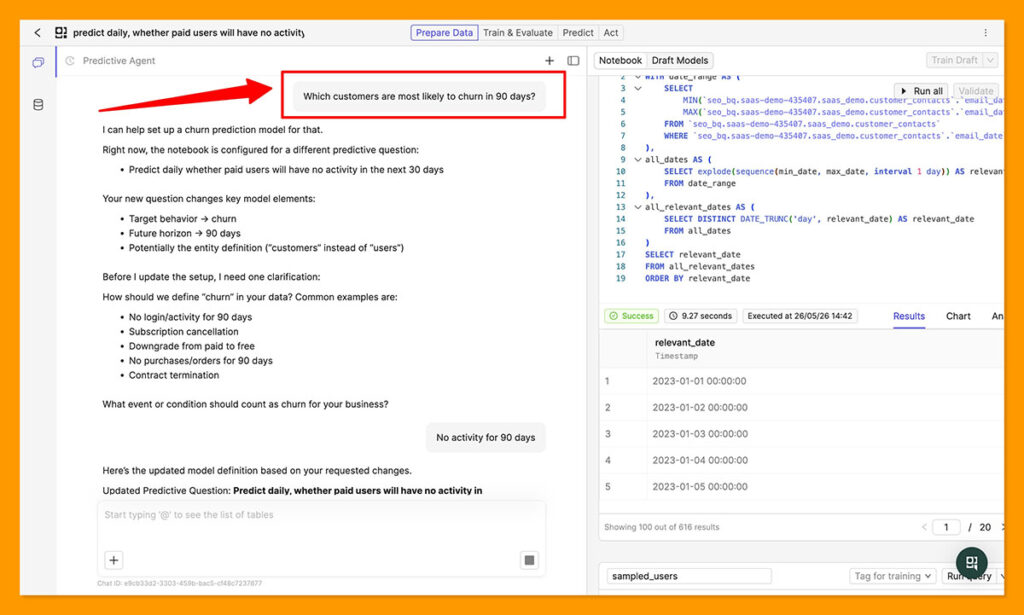
It’s not the kind of tool intended for data scientists. It’s for business teams who want to turn insights into guidance they can use straight away.
Alteryx is easy in a different way. It’s visual, so you don’t have to write every workflow from scratch, and you’ve got hundreds of drag-and-drop tools to help you.
However, Alteryx does depend on users to manually configure their data cleansing steps, and table joining requirements. Pecan automates data preprocessing and even handles outliers and missing data in the pipeline.
Pecan AI vs Alteryx: Pricing and Time to Value
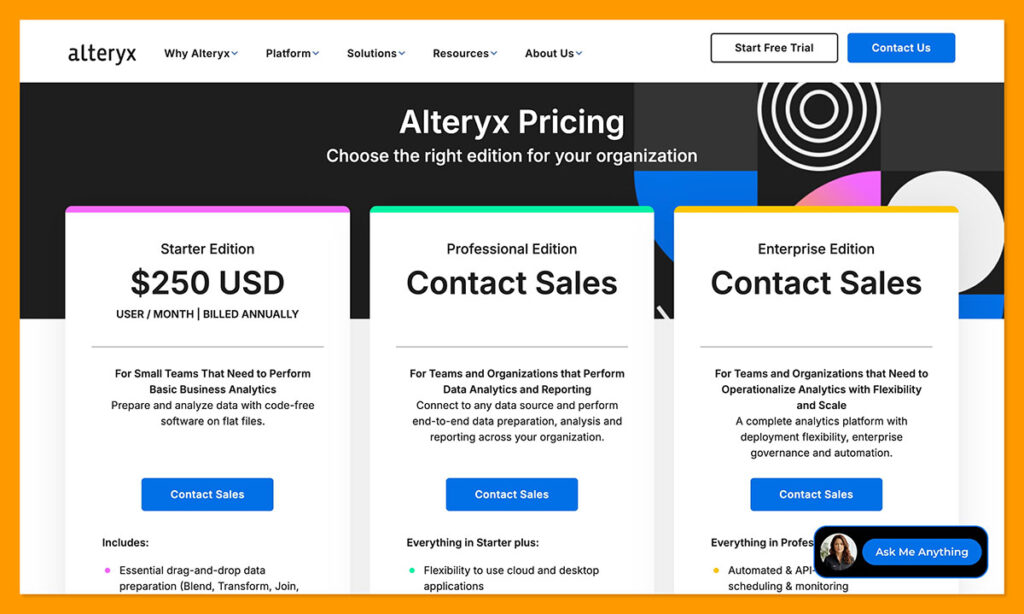
Alteryx is the cheaper option upfront, with plans starting at $250 per month.
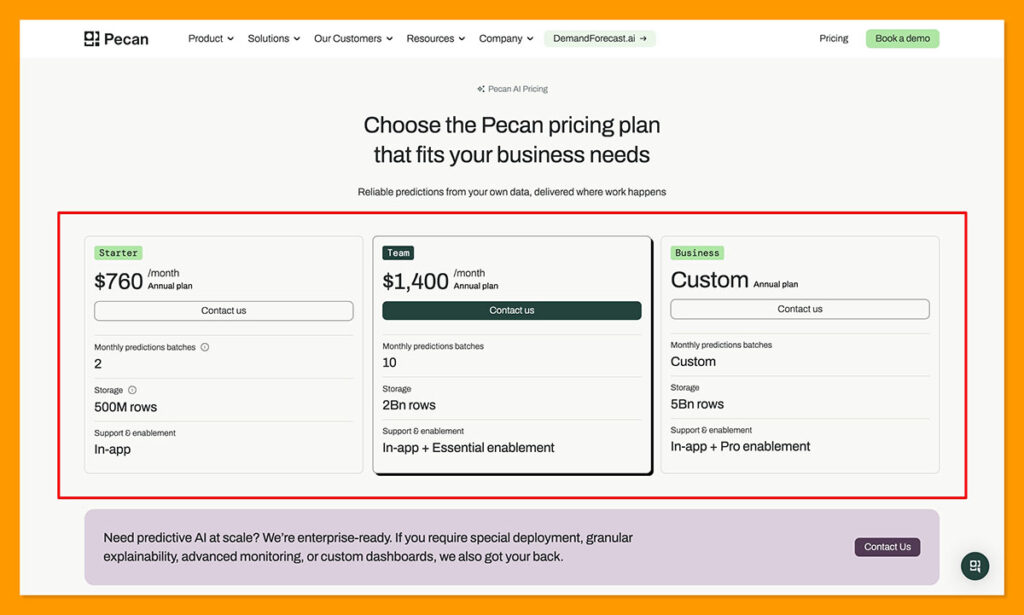
Pecan’s Starter plan, on the other hand, costs $760 per month (Billed annually), and gives you 2 monthly prediction batches, alongside 500 million rows of storage. There are two additional plans too, Team for $1,400 per month with 10 batches and 2 billion storage rows, and the Business plan, with custom pricing.
Still, the basic plan for Alteryx doesn’t give you nearly as much scope as you get from Pecan. You’re really paying for basic drag-and-drop data preparation tools. More expensive plans, like the Professional Edition, are where you start to add-in AI-powered assistance, more data source connectors. The Enterprise plan is the first one to introduce automated workflows run on Alteryx’s servers.
Plus, there are extra costs with Alteryx too. The Intelligence Suite, which adds machine learning and AI tools, is priced separately as an add-on and pushes the total cost up, and if you’re using regular server and automation runs, you might need to buy additional usage packages.
There are serious differences in time to value too. Pecan AI significantly cuts down the distance between a business deciding they need to know something, and getting the predictions they need to actually move forward. Within weeks, you can be acting on real, accurate insights, without having to build models and prep everything yourself.
Alteryx takes longer to deliver value, because you’ll be spending a lot of time cleaning and managing your data before you can actually use it to automate a workflow, or make a measurable change to your business strategy.
Pecan AI vs Alteryx: Governance, Security, and Reliability
For governance, Pecan AI handles the essentials perfectly. It is ISO 27001 certified and SOC 2 Type II audited, follows GDPR and CCPA as a data processor, and doesn’t need PII. The system only uses the data you provide to train your custom model, nothing else. You also maintain complete control over what kind of data Pecan can access.
Alteryx has a slightly broader governance story, because it’s so focused on prepping and managing large amounts of data. Like Pecan, it’s ISO 27001 and SOC 2 Type II certified, and there are a lot of controls you can tweak. You can add role-based access controls to manage who gets to use AI features. There are data labels for marking certified datasets and workflows.
Also, the MCP server is designed to expose governed workflows and datasets without exposing any raw data to potential threats. Both keep your data safe, and ensure you can stay in control, the governance rules really just differ because of the use cases each system is tuned to.
Pecan AI vs Alteryx: Strengths and Weaknesses
If we’re breaking it down into clear strengths and drawbacks, Pecan AI’s biggest benefit is focus. It’s specifically built for business teams with a prediction problem that might be holding back their growth. That specificity is useful.
I like Pecan because it:
- Focuses on genuine business questions
- Reduces your need for a full data science team
- Handles model prep, feature work, and validation
- Delivers predictions into the tools you’re using
- Shows its value quickly
The weakness is pretty much the same thing: focus. If what you need is a general-purpose engine for cleaning, joining, and governing data across the whole company, that’s not what Pecan is built for.
Alteryx’s big strength is breadth, when the work you need to do starts before the prediction, with cleaning files, joining sources, and bridging business intelligence to machine learning, Alteryx is great. It’s easy enough to use, and can really help you turn data into action. I like it for:
- Comprehensive data prep and blending
- Replacing spreadsheet processes
- Enabling company-wide analytics governance
- Taking advantage of convenient AI features
The downside is the weight. Alteryx can be a lot more “platform” than someone just trying to answer a few business questions they really need.
Verdict: Pecan AI or Alteryx?
I’d pick Pecan AI when your company has data and you want to know what’s coming next. Churn, LTV, lead quality, demand. You ask the question, Pecan builds and validates the model, and predictions land in the tools your team already works in.
The messy part, the joins, the outliers, the missing values, the feature work, Pecan handles all of it automatically while it builds the model. No months of data science. No clean-up project before you can start. You’re acting on real answers in weeks.
Alteryx earns its place when a clean, repeatable data layer is the goal in itself. If teams and tools across the company all depend on the same well-governed datasets, and your analysts spend their days blending and transforming sources for reporting and dozens of downstream uses, Alteryx is built for that breadth. It’s the broader data-prep and automation platform, and that’s the point.
It comes down to what you’re trying to produce. If that’s a prediction you can act on, Pecan takes the raw data and delivers the prediction. If it’s a governed data foundation the whole company draws on, Alteryx is the tool for it.

Comments 0 Responses