

I can say, with total transparency, that this is one of the most complicated comparisons I’ve ever done, because the two platforms I was looking at don’t even try to fit into the same category.
Claude is a tool I’ve already used quite a lot for research, summarization help, and general insights into files. I like keeping it open and ready when I’m reviewing campaign results or trying to figure out why certain product sales might have gone awry.
Pecan AI is a totally different system. It’s a predictive AI platform built for business teams, asking real business questions, like “Which customers in this cohort are more likely to churn in 90 days.”
Claude reasons over what you upload; Pecan builds and validates a model on your full dataset and deploys it.
Pecan AI vs Claude: Quick Verdict
Pecan AI is what I’d use if I want a true predictive analytics platform without the unnecessary headaches. Pecan lets you streamline the path from question to answer. If you want quick, accurate insights into the reasons behind churn, customer lifetime value, potential efficiency improvements, and so on, Pecan AI is the better option.
Claude, however, genuinely can help you make more sense of your data. I’d happily use it when I need to think things through from different perspectives. It can help out with reading a spreadsheet, writing SQL, building a chart, explaining a pattern, or converting ideas into a report. It can also build machine learning models, if you know how to go through the process.
But building a machine learning model with Claude isn’t the same as using a predictive solution like Pecan. Claude can build a model on static data, provided you have structured, clean data that’s easy to process (most companies don’t).
Still, that model doesn’t update, connect to your system, or automatically run again tomorrow. Claude can generate the feature engineering code, but it doesn’t automatically guard against leakage, so future information can slip into the training set without anyone noticing. It looks accurate in testing, then fails in production.
That’s the big difference, Claude can generate code, Pecan gives you a system that ensures you can trust the insights the model is giving you.
| Category | Pecan AI | Claude |
|---|---|---|
| Main job | Predictive analytics for business questions | Analysis, coding, reports, files |
| Best users | BI, RevOps, ecommerce, CS, marketing analytics | Analysts, marketers, operators, developers |
| Starting point | Prediction question | Prompt or uploaded file |
| Skills needed | Business team with Analyst support | Anyone can start |
| Data prep | Auto-generated SQL, training sets | Can help write SQL/Python |
| Model work | Built for scoring, validation, monitoring | Can prototype models |
| Output | Scores pushed into CRMs, warehouses, dashboards | Charts, files, scripts, summaries |
| Pricing | From $760/month annually | Pro is $20/month, API by tokens |
Are Pecan AI and Claude Actually Competitors?
Not exactly. Claude is a general-purpose AI assistant for reasoning, writing, coding, file analysis, and workflow support. Pecan AI is a predictive analytics platform designed to build, validate, monitor, and deliver business predictions from company data. Claude can support analytics work, but Pecan is built to operationalize predictions.
Pecan AI vs Claude: The Overview
First, let’s get specific. Pecan AI is a predictive analytics platform built for business questions. It’s not even trying to be “something like Claude, with more of your data plugged in”. It’s also not trying to be a business intelligence platform.
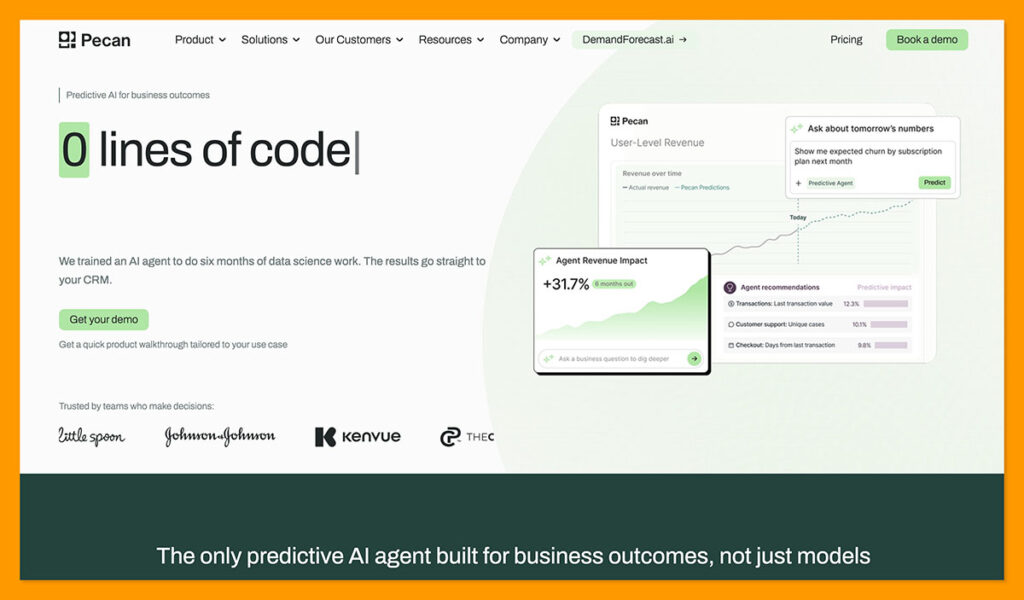
The whole product is built around the Predictive AI Agent. You tell it what kind of questions you want to answer, like “Which campaigns should produce the best high-value buyers?” and feed in your data. Pecan helps to clean that data, define the use case, build the model, test it, and plug predictions back into the tools you’re using, like a CRM, data warehouse, or ecommerce system.
The feature list is very business-team focused. You get auto-generated SQL, data prep, training set creation, predictive features, model evaluation, scheduled predictive runs and integrations.
Claude is an AI assistant. It can read through common business files to help you review exports, check tables, figure out what’s changed, and create reports. It can also build PDFs, excel spreadsheets, PowerPoint decks, visualizations, and Python scripts. All of that means it can technically help with predictive analytics work, but that’s not its core purpose.
Pecan AI vs Claude: Ease of Use and Setup
Claude is, technically, easier to use at the very beginning of an analytics project. If you’ve used it before for general AI assistant stuff, or you’re familiar with things like ChatGPT, you shouldn’t have any problem using it for analysis. You upload a file, ask a question, and get a response.
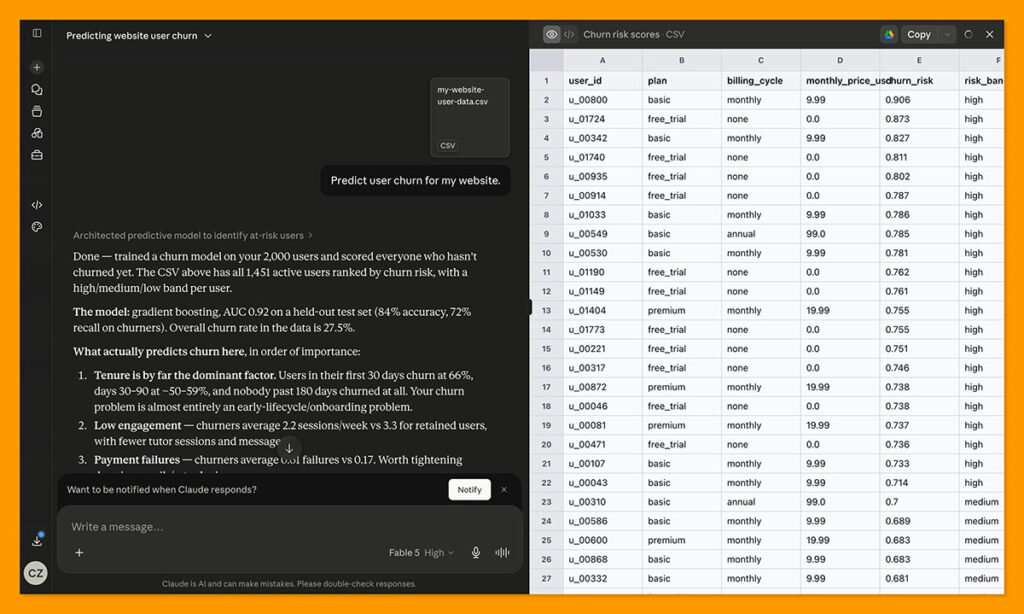
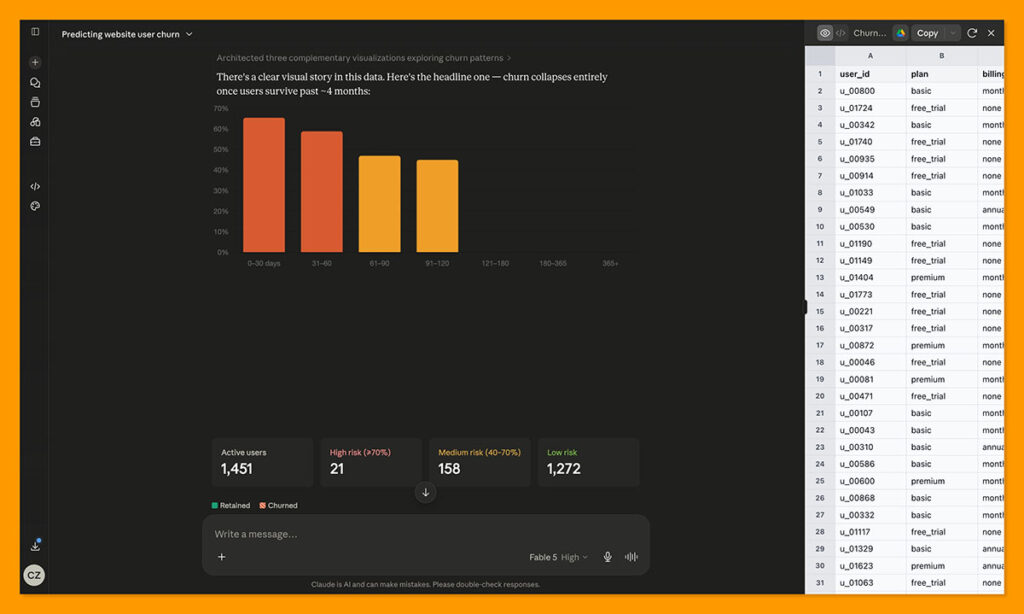
The catch is ownership. Claude can help you build the pieces, but you still need to figure out why each piece matters. An LLM, even a great one like Claude, has limits. If you build a model for churn prediction, for instance, Claude won’t frame your question or warn you that “predict churn” is too vague to act on. You’ll find that out later when it’s too late.
Claude won’t automatically validate your model or flag data leakage, overfitting, or unbalanced labels. That’s on you to catch, which means the model can look good in testing but underperform in production.
Plus, Claude won’t deploy where you work. An LLM hands you a script, but it doesn’t push the predictions into HubSpot or Salesforce, or refresh on new data. That work of making it live and keeping it live comes back to you.
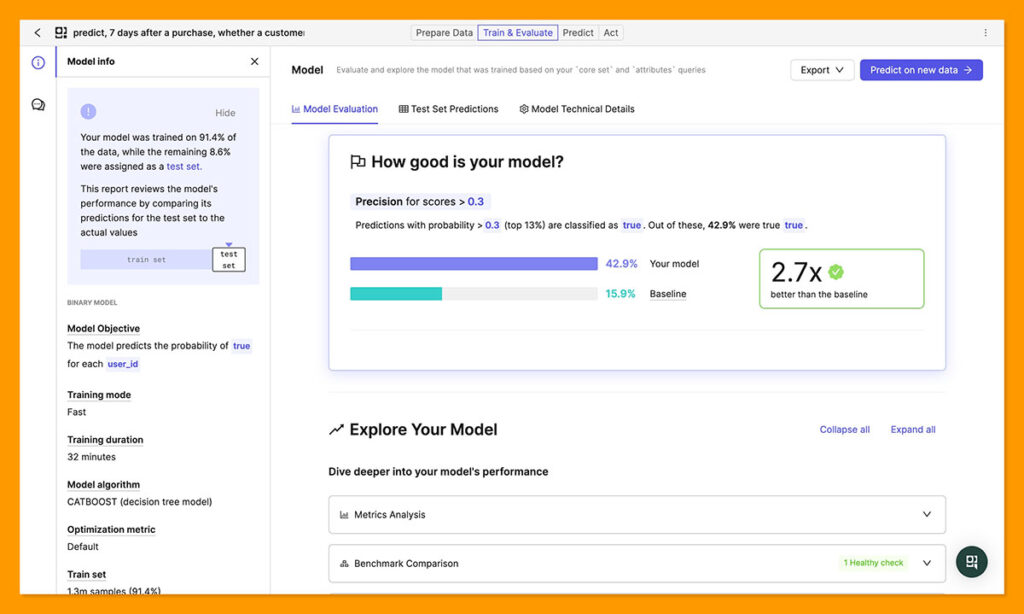
Pecan AI fixes these problems. The agent sharpens vague intent into a precise question, and shows you what your data can support before anything gets built. It validates every model and runs leakage prevention automatically. Plus, it sends predictions into environments where your team already works.
So, Claude might seem easier on the surface, but Pecan really gives you the more straightforward way to turn predictive intelligence into an advantage.
Use Cases: Where Each Platform Fits Best
Pecan’s best use cases fall into four clear categories. The first is protecting your revenue. You can create models that predict churn, and prevent fraud, protecting your customers, and potentially lost opportunities.
The second is growing your income. Pecan can help with customer win back campaigns, lead scoring, LTV modelling, upselling, and cross-selling. The third and fourth use cases are improving efficiency and planning, and optimizing the workforce.
You can use Pecan to help with demand forecasting and campaign ROAS prediction. You can also use it to predict employee attrition, improve employee retention, forecast workforce demand, and even figure out how successful a new hire is likely to be.
You can technically use Claude for similar things, you can ask it about churn based on your data, use it to spot patterns in order history, and assist with campaign analysis and reporting. You can even ask Claude to give you ideas on how you can improve workplace retention or efficiency.
Still, you’re not getting a true predictive model with Claude. You’re getting practical suggestions based on your data, not a custom model that’s actively driving you towards results.
Pecan AI vs Claude: Time to Value
Both solutions are technically fast at delivering results, but the results you get are different.
Pecan AI gives you a more robust system faster. You can build your model with the tool in a matter of weeks, and start acting on insights immediately, without constantly questioning if you’re getting accurate insights. That’s the thing, Claude can analyze things quickly. Pecan AI gets you to the point of making a decision faster.
Claude gives you speedy answers. You can upload a CSV, ask for charts, get some code, or create a report without waiting very long. If you want a true predictive model, however, you’ll need to consider creating your own (which takes coding knowledge and time).
That’s particularly true since Pecan delivers the insights you need within the tools you’re already using, like Databricks, Salesforce, HubSpot, BigQuery, Shopify, RedShift, or Oracle. Claude isn’t designed to do that as standard, unless you’re using APIs and MCP connectors. You can definitely do that, but it does take time and effort, and someone who can actually understand the code.
Governance, Security, and Reliability
Neither platform is particularly unsafe, depending on how you use it. Claude gives teams a lot of freedom. That’s the appeal, and also the headache. People can upload files, ask for code, connect workplace tools, and work fast.
Pecan AI feels a bit more controlled. It’s built around model creation, scheduled predictions, monitoring, and delivery back into business systems. You’re getting ISO 27001 and SOC 2 Type II certifications as standard, and data is automatically encrypted in transit and at rest. Pecan also never stores sensitive data for internal model training.
Claude’s Team plan includes admin tools, SSO, domain capture, JIT provisioning, role-based permissions, spend controls, workplace connectors, and more usage than Pro. Enterprise adds stronger controls, including audit logs, custom data retention controls, Compliance API access, and Enterprise-only security/data controls.
Pecan AI vs Claude: Total Cost
Pecan AI starts at a higher price because it’s not priced like a personal AI assistant. The Starter package, with 2 monthly prediction batches and 500M rows of storage starts at $760 per month (in annual plan).
The Team plan with 10 prediction batches per month and 2 billion rows of storage starts at $1,400/month in annual plan.
The Business plan, with 60 prediction batches per month and 5 billion rows of storage, starts at $2,000/month in annual plan, and there are enterprise options if you need something specific or tailored to your needs.
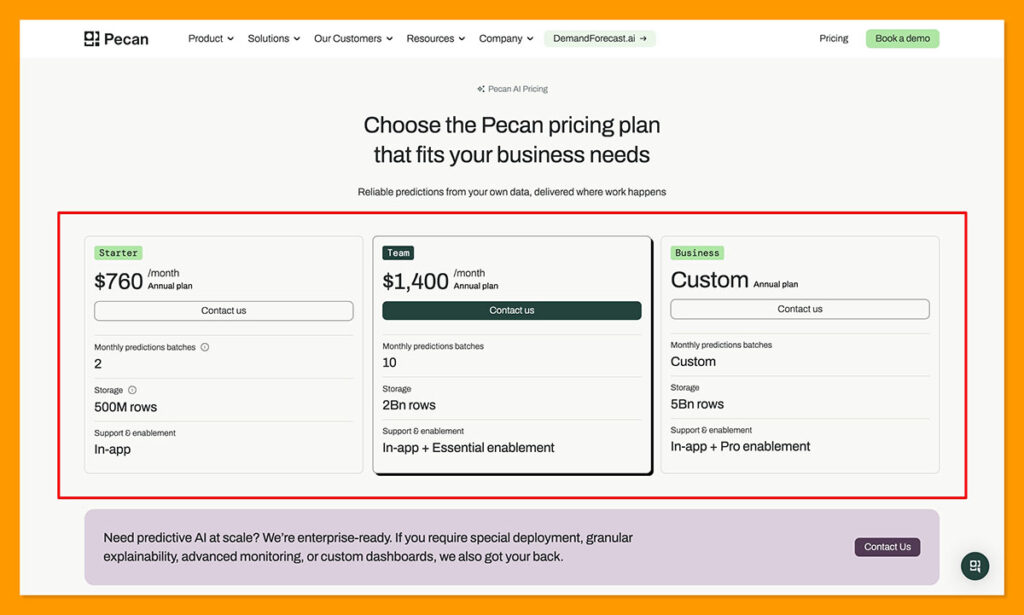
Claude is obviously the cheaper buy. Prices start at $20 per month, and if you need extra usage, you’re spending around $5 per million input tokens and $25 per million output tokens for models like Opus 4.8. Obviously, though, if you’re going to be analyzing a lot of data, or building your own model with Claude, you can end up spending quite a lot.
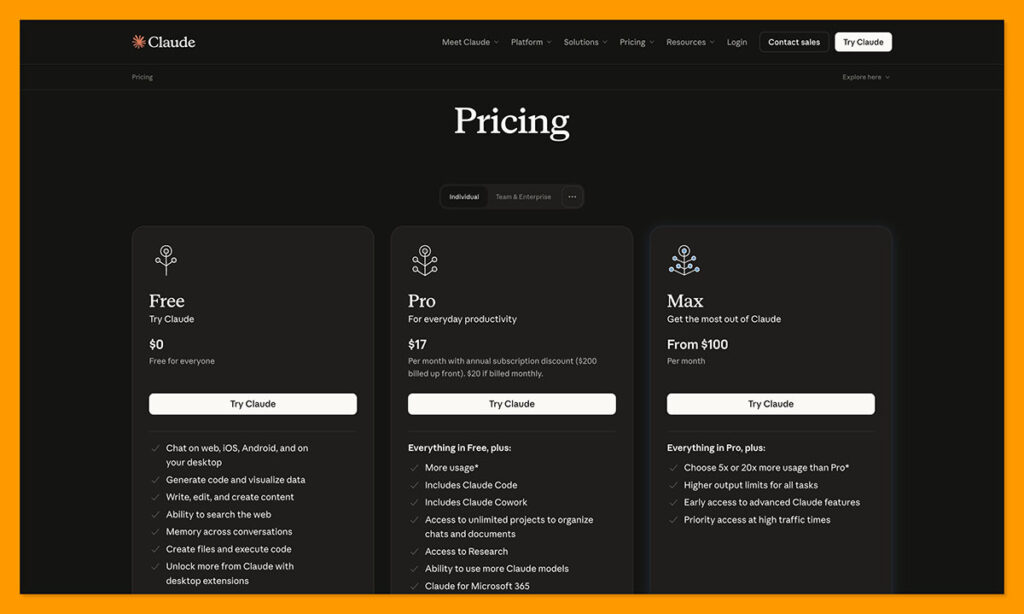
Still, Pecan can give you better value for money in the long-term. If the predictions you get actually reduce churn and waste, focus your sales efforts, improve acquisition spend and minimize mistakes, Pecan pays for itself very quickly.
Pecan AI vs Claude: The Verdict
I said at the beginning of this comparison that looking at both of these platforms side by side was difficult, and I stick by that. Using them both hasn’t led me to one simple conclusion about one being better than the other. They’re very different tools, for very different things.
Claude is still something I’d choose for basic admin work, research, and simple analysis. If you’re investing in predictive analytics, it can technically help you with spreadsheet reviews, campaign reporting, trend and pattern spotting, and summaries. It’s a very useful thinking partner. It also has the cheaper entry point overall.
But Claude is great when the question is still forming, or still getting refined. Pecan is better when the question is already clear, and you need an answer you can act on quickly.
It’s not giving you a basic AI assistant, it’s giving you a custom-built predictive AI model that can answer the questions that matter most to your team, and deliver those answers in the places where people can make the most use of them. Plus, it does all that without requiring you to spend thousands of dollars and several months building the whole workflow from scratch.
You can still use Claude for everyday basic assistant tasks. Pecan AI is what you choose when you want to turn predictive analytics into a real strategy, fast.
You can see the difference for yourself, by requesting a free demo of Pecan.ai here.

Comments 0 Responses