

The short answer: GPTZero is the safer, more defensible ai detector for high-stakes use, and ZeroGPT is the cheaper, faster option for casual quick-checks. The winner flips depending on what you feed it. ZeroGPT catches raw, unedited AI blog text better.
GPTZero is far safer at not falsely accusing a real human writer, posting a 3.3% false-positive rate against ZeroGPT’s 50% on formal human text. Which one you should use comes down to your content type and how much a wrong answer costs you.
First, clear up the confusion that sends most people here: GPTZero and ZeroGPT are not the same product, and not the same company. They are two unrelated tools with near-identical names.
GPTZero was built by Princeton undergrad Edward Tian and co-founder Alex Cui; ZeroGPT, run by CEO Rawad Baroud, launched roughly 15 days later and rode the wave of GPTZero’s viral press.
To get past the marketing, I tested both tools and reconciled every independent study I could find: the AmpiFire 40-sample head-to-head, an independent 160-text study, the RAID benchmark of 672,000 texts, and the Ryne AI study of 100,000-plus real student submissions. I’m not selling either one.
Most comparisons of these two are published by companies that also sell humanizers or writing suites, so I use their data but draw my own verdict. What follows is a content-type-aware answer, a reconciled accuracy table, current pricing, and honest guidance on when not to trust any score at all.
GPTZero vs ZeroGPT at a Glance: The Lead Comparison Table
If you only have 30 seconds, this is the whole decision. Six findings drove every verdict below, and they come from independent tests rather than either vendor’s marketing page: the AmpiFire 40-sample head-to-head, an independent 160-text study, the RAID benchmark of 672,000 texts, and the Ryne AI study of 100,000-plus real student submissions. Here is the bottom line, then the table.
Key Takeaways
- GPTZero is the safer pick for high-stakes use. It posted a 3.3% false-positive rate versus ZeroGPT’s 50% on formal, literary, and political human text in the AmpiFire 40-sample test.
- ZeroGPT is better at catching raw, unedited AI blog text. It averaged 95% AI probability on casual ChatGPT blogs versus GPTZero’s 84%, and it is free with no account.
- The accuracy winner flips by content type. You are choosing between sensitivity (ZeroGPT) and safety from false accusations (GPTZero).
- GPTZero wins on trust and compliance. It has Princeton origins, SOC 2 Type II, FERPA, published benchmarks, and LMS integrations, while ZeroGPT publishes no methodology.
- ZeroGPT wins on price and speed. Its Pro tier is $9.99/mo versus GPTZero’s $14.99, and it scans in 2-3 seconds versus 5-10.
- Neither is reliable enough to accuse anyone on its own. Both score humanized AI at roughly 0%, both over-flag non-native English writers, and even Turnitin warns its own scores should never be the sole basis for action against a student.
| Feature | GPTZero | ZeroGPT |
|---|---|---|
| Best for | High-stakes, education, enterprise | Free casual quick-checks |
| Origin | Princeton (Edward Tian + Alex Cui), Jan 2023 | Rawad Baroud, Iceland/Lebanon (reported), Jan 2023 |
| False-positive rate (formal/human) | 3.3% | 50% |
| False-negative rate (misses AI) | 35% | 10% |
| Free tier | 10,000 words/mo, account needed | 15,000 chars/scan, no account |
| Entry paid tier | Essential $14.99/mo | Pro $9.99/mo |
| Speed | 5-10 sec | 2-3 sec |
| Compliance | SOC 2 Type II, FERPA | None published |
| LMS integration | Canvas, Blackboard, Moodle, Google Classroom | None |
| Scan classification | Mixed/AI/Human + sentence highlighting | Single AI % score |
The rest of this article unpacks each of these rows, ends every criterion with a clear winner, and closes with per-use-case picks. If your decision is consequential, keep reading. The nuance matters more than the headline, and the worst mistakes come from acting on the headline alone.
1. Origin and Trust: Princeton Research vs an Anonymous Copycat
Here is the surprising part of the names collision: ZeroGPT reportedly launched about 15 days after GPTZero, just as GPTZero’s coverage went viral. The timing and the near-identical name fueled enormous confusion. I won’t claim ZeroGPT’s intent as proven fact, but the Tracxn-sourced timeline makes the pattern hard to ignore.
GPTZero’s story is well-documented. Princeton undergrad Edward Tian and his co-founder Alex Cui shipped it on January 3, 2023, and it pulled 30,000 users in the first week, crashing the servers.
By July 2024 it had 4 million users. It has raised $13.5M, reached $24M ARR in 2025 (253% year-over-year), scanned 600M documents, and partnered with the American Federation of Teachers covering 1.7M educators.
“We have millions of examples of text that is human versus AI,” Cui said of their data advantage. On the compliance side, GPTZero is SOC 2 Type II certified, FERPA-compliant, publishes its methodology, and works with Penn State’s AI/ML lab.
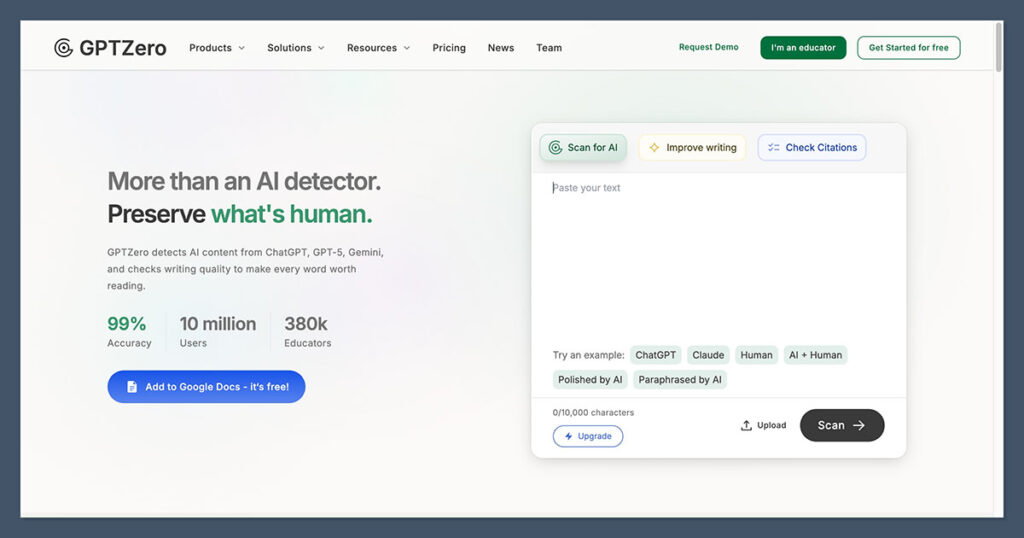
ZeroGPT is the opposite on transparency. Its CEO is Rawad Baroud, it launched in 2023, and it is reportedly based in Iceland per Tracxn but registered in Lebanon per some sources. I’ll report both HQs without picking one, because they genuinely conflict across sources. It is unfunded, with no published methodology, no academic validation, no SOC 2, and no FERPA documentation.
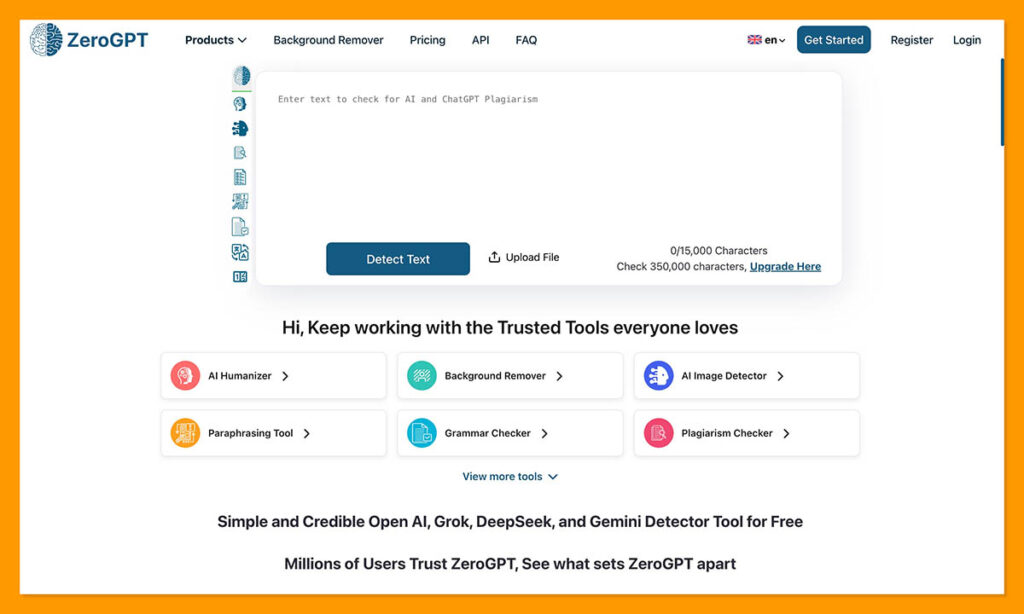
That gap matters because credibility, for any decision you have to defend, means published and auditable methodology. Only GPTZero offers that.
| Origin and credibility | GPTZero | ZeroGPT |
|---|---|---|
| Founded | Jan 3, 2023 | Jan 18, 2023 (reported) |
| Founders | Edward Tian, Alex Cui (Princeton) | Rawad Baroud |
| Funding | $13.5M raised, $24M ARR | Unfunded |
| Compliance | SOC 2 Type II, FERPA | None published |
| Published methodology | Yes | No |
Winner: GPTZero, decisively, for anyone whose decision must hold up to scrutiny. One honest caveat in plain terms: pedigree is not the same as accuracy. I tackle that next.
2. Accuracy and False Positives: The Decisive Test (With the Numbers)
Feed the same human text into both tools and you get wildly different verdicts. ZeroGPT rated Hans Christian Andersen’s “The Little Match Girl” at 60% AI, Conan Doyle-era fiction around 76%, and George W. Bush’s 2008 State of the Union at 93% AI.
In a separate Wikipedia test, GPTZero scored a Wikipedia article at 7% AI while ZeroGPT scored the same text at 83%. These are unambiguously human texts, written by humans, some of them long before AI chatbots existed.
This is where the competitors leave things messy, so let me reconcile it. The winner flips by content type because there are two different errors at play. A false positive is wrongly flagging a human, which carries the false-accusation risk. A false negative is missing real AI, which means a cheater slips through.
GPTZero runs a sensitivity of 0.65 and a specificity of 0.90 per JustDone’s testing, which in plain English means it catches only about 65% of AI but correctly clears 90% of humans. It is conservative. ZeroGPT is the inverse: more sensitive, and far more indiscriminate.
Here is the centerpiece, built from the AmpiFire 40-sample test (10 casual AI blogs from ChatGPT-4o, 10 literary stories from the 1840s-1920s, 10 stories from the 1990s, and 10 political speeches from 1980-2013) plus the independent 160-text study.
| Metric (independent tests) | GPTZero | ZeroGPT |
|---|---|---|
| False-positive rate (formal/literary/political human) | 3.3% | 50% |
| False-negative rate (misses AI) | 35% | 10% |
| Casual AI blog detection (avg AI prob) | 84% | 95% |
| Avg AI prob on human literary/political text | 4.3% | 30% |
| Overall accuracy (independent 160-text study) | RAID: 95.7% TPR @ 1% FPR | 73.8% |
| Worst false positive on record | Carter 1987 speech (>20%) | Bush 2008 SotU (93% AI) |
The independent 160-text study puts a number on ZeroGPT’s looseness too: 20.51% false positives on human-written content, against a Turnitin baseline of 1.3% in the same JustDone benchmark. So ZeroGPT wrongly flags roughly one human text in five, and that is on general writing, not just the classics.
Now the honesty guardrail. GPTZero markets a self-reported 99.39% accuracy and a 0.00% false-positive rate, and that number does not survive contact with the real world.
The Ryne AI study of 100,000+ texts across 32 university courses found an 18% real false-positive rate on actual student work, with a 32% false-negative rate. That same study split the figure by background: 3.2% false positives for native English speakers, 61.3% for non-native speakers.
ZDNet rated GPTZero 100 and ZeroGPT 80 in its own test, but warned scores “aren’t reliable and will vary from test to test.” Treat any vendor’s marketing benchmark as a best-case lab number, not what you will see at scale.
Winner: GPTZero for high-stakes accuracy. The costliest error is falsely accusing a real person, and a 3.3% versus 50% false-positive gap is decisive. The honest nuance: if your only job is catching raw, unedited AI blog spam, ZeroGPT’s higher sensitivity (95% versus 84%, 10% versus 35% false negatives) genuinely catches more. It just cannot tell human from AI safely on anything formal. So GPTZero for not accusing innocents, ZeroGPT only for low-stakes raw-AI sensitivity.
3. Features, Reporting and Transparency: Depth vs a Single Score
A bare AI percentage tells you nothing about which sentences triggered it or what to do next. That reporting gap is the difference between a flag and actual evidence, and it is where these two tools diverge most outside of accuracy.
GPTZero returns a 3-way classification (Mixed, AI, or Human) with sentence-level yellow highlighting, so you can see exactly which lines it doubts. Its standout is Writing Replay / Origin, a Chrome extension that records keystrokes, typing speed, and paste history in Google Docs and produces a timestamped replay of how a document was written.
That is behavioral authorship evidence, independent of any probabilistic score, and ZeroGPT has no equivalent. GPTZero also offers API access (Professional tier), LMS integration across Canvas, Blackboard, Moodle, Google Classroom, D2L, and Schoology, a Chrome extension, 9 validated languages (October 2025), and 15 model updates shipped in 2025 alongside published benchmarks.
ZeroGPT gives you a single AI percentage plus sentence highlighting, but wraps it in a broader companion toolset: paraphraser, summarizer, grammar checker, translator, ZeroCHAT, and a plagiarism checker. It claims 20+ languages, though with no accuracy validation across them, so treat that number with caution. It also offers WhatsApp and Telegram delivery on the Max plan and a basic pay-as-you-go API described as roughly three times cheaper than GPTZero’s.
| Feature | GPTZero | ZeroGPT |
|---|---|---|
| Classification | 3-way Mixed/AI/Human | Single AI % |
| Sentence highlighting | Yes | Yes |
| Authorship evidence | Writing Replay / Origin | None |
| API | Pro tier | Pay-as-you-go |
| LMS integrations | 6+ | None |
| Companion writing tools | Writing feedback, plagiarism | Paraphraser, summarizer, translator, chatbot |
| Languages | 9 validated | 20+ claimed (unvalidated) |
| Published methodology + benchmarks | Yes | No |
The honest tradeoff: ZeroGPT is the broader writing toolkit, while GPTZero is the deeper, more defensible detection and authorship platform. The depth shows up under pressure too. GPTZero catches QuillBot-humanized text at roughly a 97% detection rate per AidetectPlus, where ZeroGPT’s accuracy can fall to 22% on the same kind of paraphrase. GPTZero was also named G2’s number-one AI software for 2025 on customer satisfaction, a third-party signal ZeroGPT has nothing to match.
Winner: GPTZero on reporting depth, authorship evidence, and transparency; ZeroGPT on breadth of companion tools. For this article’s high-stakes audience, GPTZero takes the criterion.
4. Pricing and Value: Cheaper Tiers vs More Scans Per Dollar
ZeroGPT looks cheaper on the sticker, undercutting GPTZero at every paid tier. The catch is that the limits aren’t measured the same way, so “cheaper” needs an asterisk. Here is the reconciled, current pricing side by side.
| Tier | GPTZero | ZeroGPT |
|---|---|---|
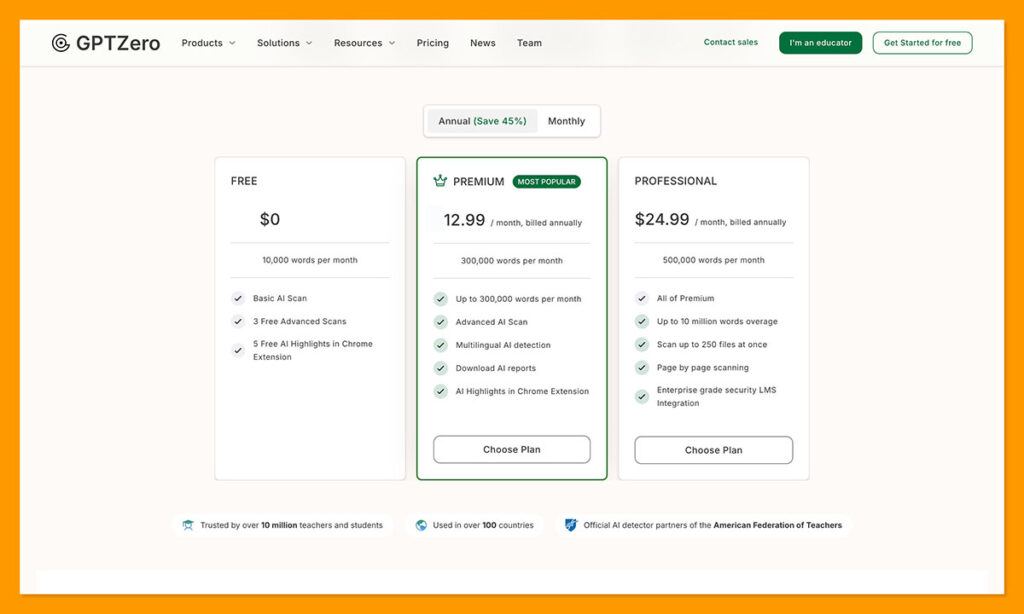
| Free | $0, 10,000 words/mo, account needed | $0, 15,000 chars/scan, no account, ad-supported |
| Entry | Essential $14.99/mo, 150k words, Chrome ext, plagiarism | Pro $9.99/mo, 100k chars/mo, 50 batch, ZeroCHAT (plagiarism 750 words one-time*) |
| Mid | Premium $23.99/mo, 300k words, writing feedback | Plus $19.99/mo, +25k words plagiarism, 60 batch |
| Top | Professional $45.99/mo, 500k words, API, LMS, team | Max $26.99/mo, 150k chars, WhatsApp/Telegram |
| Billing note | Annual saves ~45% | Annual saves ~20-30% (Pro $95.88/yr, Max $227.88/yr) |
*The 750-word plagiarism check on ZeroGPT’s Pro plan is one-time only, not monthly. Real recurring plagiarism checking only unlocks on the Plus plan. compareaitools flagged this as a “plagiarism trap” for buyers comparing on price alone, and it is worth knowing before you subscribe.
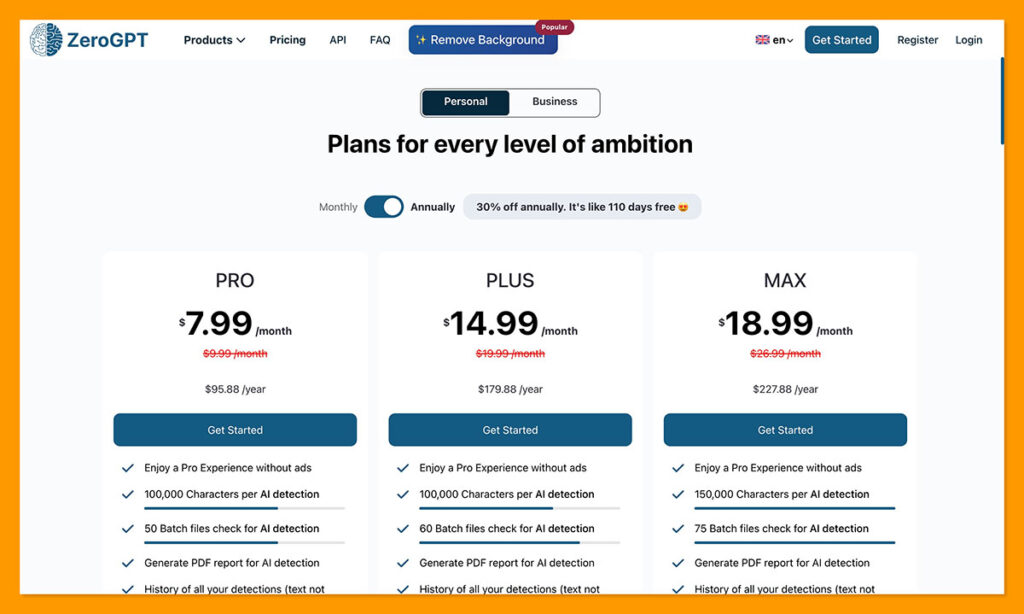
The bigger trap is the unit of measurement. ZeroGPT counts characters, GPTZero counts words, and compareaitools calculates that GPTZero delivers roughly 7-9x more scannable content per dollar once you normalize for that difference. So the sticker-cheaper option is not automatically cheaper per page scanned.
Annual billing narrows the gap further. GPTZero’s Essential drops to about $8.33 a month billed yearly for 150,000 words a month, Premium to about $13.99 for 300,000 words, and Professional to about $27 for 500,000 words plus API access. ZeroGPT’s Pro runs $95.88 a year (about $7.99 a month) for 100,000 characters a month, and Max runs $227.88 a year (about $18.99 a month). GPTZero’s 45% annual discount is steeper than ZeroGPT’s 20-30%, so on like-for-like volume the headline price advantage keeps shrinking.
Two more catches favor caution. ZeroGPT’s monthly credits expire without rollover, so anything you don’t use is gone. And multiple reviewers report its customer support is slow or absent, which matters more once you are paying.
Winner: ZeroGPT on raw price. Its free tier is unbeatable and its paid tiers undercut GPTZero across the board. That is its strongest and most honest advantage. But on value per scan, and on what each dollar actually unlocks (compliance, LMS, API, consistent results), GPTZero closes most of the gap. Put plainly: cheapest is ZeroGPT, best value for serious use is GPTZero.
5. Ease of Use, Speed and Score Consistency: Fast vs Steady
Submit the same document twice and get two different verdicts. That is the reliability problem hiding behind the word “speed,” and it is the day-to-day experience that the marketing pages skip.
On raw speed and friction, ZeroGPT wins easily. It returns results in 2-3 seconds, needs no account, and works paste-and-go, the lowest barrier to entry of any major detector. GPTZero takes 5-10 seconds and requires a login. ZeroGPT also reportedly runs higher uptime, while GPTZero has had occasional slowdowns (TwainGPT noted Sunday-night sluggishness, so attribute that one).
Then consistency flips the picture. Across one week, compareaitools submitted identical documents to ZeroGPT and got 73%, 81%, and 68%, a 13-point swing. GPTZero returned 94%, 96%, and 93% on the same documents, a swing of only 2-3 points. The peer-reviewed JALT study found score inconsistencies across every tool it tested, but ZeroGPT’s swings were the widest of the group.
| Same document, three scans | GPTZero | ZeroGPT |
|---|---|---|
| Scan 1 | 94% | 73% |
| Scan 2 | 96% | 81% |
| Scan 3 | 93% | 68% |
There is a friction counterpoint on ZeroGPT, too. Its free interface is ad-heavy, and one reviewer reported scans taking “5 minutes just to paste text” because of ad overload. So you get a fast engine wrapped in a cluttered UI. The same review listed unresponsive support, non-renewable credits, and inconsistent results among its top five complaints, and concluded it should not be used for academic or professional decisions.
Winner: Tie, depends on your goal. ZeroGPT wins on raw speed and zero-friction access; GPTZero wins on score consistency and a cleaner, ad-free interface. For a casual one-off check, ZeroGPT feels better. For a result you will act on, GPTZero’s consistency wins. Call it a split decision leaning GPTZero for anything that matters.
6. The Reliability Reality Check: Why You Should Never Trust One Score
The most reliable result from both tools is the one neither can give. Feed either detector humanized or paraphrased AI and both score it at roughly 0% AI. Pangram Labs showed on X that GPTZero, ZeroGPT, Grammarly, UndetectableAI, and Originality all simultaneously called a humanized text human-written. ZeroGPT drops to around 22% detection after a basic Quillbot paraphrase. The thing both tools are sold to catch is the thing they miss most.
The vendor-neutral evidence stacks up fast. On non-native English, a Stanford study found over 61% of TOEFL essays from real ESL students flagged as AI, while detectors stayed near-perfect on US-born eighth graders. A separate 5,000+ sample study found non-native texts flagged up to 35% higher than native ones. GPTZero acknowledges this bias and cites Penn State ESL work; ZeroGPT does not.
The real-world harm is documented. In a 2024 UC Davis case, 15 of 17 flagged students turned out to be false positives, disproportionately non-native speakers and writing-tutor users. One Reddit student was flagged at 38% on their own work, a Trustpilot user saw a pre-AI novel chapter flagged, and ZeroGPT flagged a 20+-year-old research article at 85% AI. GPTZero’s Trustpilot score sits around 2.4 out of 5. Meanwhile, 50+ universities (Vanderbilt, Johns Hopkins, Queensland, Waterloo, Curtin, UT Austin among them) have disabled AI detection citing harm, transparency, and equity. Even Turnitin says its results “should not be used as the sole basis for adverse actions against a student,” and OpenAI killed its own classifier at 26% accuracy.
So here is what to do instead of trusting a single number:
- Treat any score as a flag for investigation, not proof. It is a starting point, never a verdict.
- Cross-check with a second tool before any consequential decision, since scores diverge between detectors.
- Use process evidence: drafts, version history, GPTZero’s Writing Replay / Origin, or an in-class writing comparison.
- Have a conversation, not a confrontation. Ask the writer to walk you through their process and arguments.
- Apply extra skepticism to non-native English writers and short texts under 500 words, where false positives spike.
- Never let a single percentage be the sole basis for an accusation. This rule has no exceptions.
Winner: Neither. This is a tie at “do not trust alone.” The differentiator is that GPTZero hands you tools to investigate responsibly (Writing Replay, sentence highlights, an acknowledged ESL bias), while ZeroGPT hands you only a number. If you must pick a detector, GPTZero at least supports the responsible workflow.
The Bottom Line: Which AI Detector Should You Choose?
These are two different companies, and the winner depends on content type and stakes. GPTZero is the safer, more defensible, more transparent detector. ZeroGPT is the cheaper, faster casual quick-check. Neither is trustworthy enough to accuse anyone on its own, and that caveat applies to every recommendation below.
- Teacher grading for academic integrity: GPTZero. The 3.3% versus 50% false-positive gap, FERPA, LMS integration, sentence highlights, and Writing Replay make it the only defensible option, but use it as one signal, never sole proof.
- Publisher or agency vetting freelancers: GPTZero. ZeroGPT’s 50% false-positive rate would reject real human work. Pair it with editorial judgment and a second tool.
- Student self-checking before submitting: GPTZero for a safer read; ZeroGPT free for a rough gut-check. Expect both to be noisy.
- Casual blogger or low-stakes quick check: ZeroGPT free tier. It is fast, free, and good enough when nothing is at stake.
- Non-native English writer being evaluated: Neither alone. Demand process evidence, because both over-flag ESL writing.
If the stakes are real, start with GPTZero’s free tier (10,000 words a month), run the same text through a second detector such as Originality.ai or Copyleaks, and lean on Writing Replay and drafts for anything you will act on. If the stakes are low, ZeroGPT’s free tier costs nothing and returns a result in seconds. I’m not selling either one. I’m telling you what the data shows.
Frequently Asked Questions
Are GPTZero and ZeroGPT the same company?
No, there is no relationship between them. GPTZero was built by Edward Tian and Alex Cui at Princeton and launched January 3, 2023. ZeroGPT, run by Rawad Baroud, launched roughly 15 days later with a near-identical name. The timing and naming fueled the confusion, though I won’t claim ZeroGPT’s intent as proven fact.
Which one is more accurate?
Accuracy depends entirely on content type. ZeroGPT catches casual AI blog text better, averaging 95% AI probability versus GPTZero’s 84%. GPTZero is far safer on human formal and literary text, with a 3.3% false-positive rate versus ZeroGPT’s 50% in the AmpiFire test. For anything high-stakes, GPTZero is the clear pick.
Is ZeroGPT really free, and is GPTZero’s free tier worth it?
Both offer free tiers, but ZeroGPT’s is more generous at 15,000 characters per scan with no account required. GPTZero’s free tier caps at 10,000 words a month and needs a login. ZeroGPT wins on sheer free volume, but remember its false-positive rate is much higher, so a clean score from it means less.
Can AI text get past both detectors?
Easily. Humanized or paraphrased AI scores roughly 0% on both tools. Pangram Labs showed five major detectors, including GPTZero and ZeroGPT, all calling a humanized text human at the same time. ZeroGPT’s detection drops to around 22% after a basic Quillbot paraphrase. Neither is bypass-proof.
Is GPTZero FERPA-compliant and safe for student data?
It is. GPTZero is SOC 2 Type II certified and FERPA-compliant, storing only minimal data like name, email, and institution. ZeroGPT has no published certifications and documentation gaps around whether it retains submitted text. For schools handling student data, GPTZero is the compliant choice.
Do these tools discriminate against non-native English speakers?
Severely, yes. A Stanford study found over 61% of TOEFL essays from real ESL students flagged as AI, while native-speaker writing stayed near-perfect. Neither tool is reliable for evaluating non-native English writers in high-stakes contexts. GPTZero at least acknowledges the bias and cites Penn State ESL work; ZeroGPT does not.
Can a detection score alone prove someone used AI?
It cannot, and even the vendors say so. Turnitin states its results should not be the sole basis for action against a student. Treat any score as a flag for investigation, then add process evidence: drafts, version history, writing replays, or a conversation. A single percentage is never proof.
Which is better for the newest models like GPT-5?
Neither is reliable on frontier models, since current-generation AI writes more human-like text. aicheckr.io reports ZeroGPT at roughly 60-75% accuracy with no visible detection updates since 2024. GPTZero claims 15 model updates in 2025 and is more likely to stay current. Expect noise from both, and corroborate any result.

Comments 0 Responses