

Choosing the most valuable demand forecasting software is frankly a lot more complicated than most companies realize. Historical data matters, obviously, but demand often changes too quickly for traditional “historical reports” to tell you what’s likely to happen next.
What’s confusing is that choosing the right tool isn’t as simple as looking for the system with the highest accuracy scores.
You need forecasts you can trust, obviously, but you also need something your team can actually use without months of training, with results delivered into the right systems so you can act quickly.
So, with that in mind, I looked beyond accuracy alone, considering things like ease of use, implementation effort, where forecasts are delivered, and how quickly teams can actually start using them.
The Best Demand Forecasting Software: My Ten Picks
There’s no single “best” demand forecasting tool for every company. Some of the platforms on this list are full supply chain planning suites, while others focus more specifically on forecasting, inventory, or analytics. So I’ve ranked them primarily on time to value: how quickly teams can get reliable forecasts up and running and start using them to make decisions.
That’s why Pecan comes first. It offers ML-powered forecasting with options for teams that want to build and manage forecasts themselves, as well as a fully managed solution for enterprise demand forecasting. But if you need forecasting as part of a much broader supply chain planning system, tools like Blue Yonder, Kinaxis, or o9 may be a better fit.
| Demand Forecasting Software | Who It’s Best For | Main Benefit |
|---|---|---|
| Pecan AI | Business, analytics, and demand planning teams that want ML-powered forecasting | Fast time to value for accurate ML forecasting, with self-serve and enterprise options. |
| Blue Yonder | Large retailers with complex global supply chains | Demand sensing connected to broader supply chain planning. |
| o9 Solutions | Large enterprises with conflicting or complicated signals | Advanced demand sensing using internal and external signals |
| Kinaxis | Enterprises connecting demand and supply planning | Forecast updates can immediately influence supply chain decisions |
| SAP IBP | Global organizations already using SAP tools | Broad range of ML forecasting methods and statistical tools |
| Anaplan | Teams using demand for financial planning. | ML forecasting with connected scenario planning |
| Netstock | Mid-sized inventory teams | Forecasting immediately influences replenishment and ordering |
| Streamline | Distributors and manufacturers | Forecasting with links to inventory, purchasing, and MRP |
| Inventory Planner | Ecommerce or multichannel retail teams | Useful retail buying decisions at SKU and location level |
| Prophet | Teams with engineers who prefer open-source software | Free, open-source foundation |
1. Pecan AI: Best Overall for Fast ML Demand Forecasting
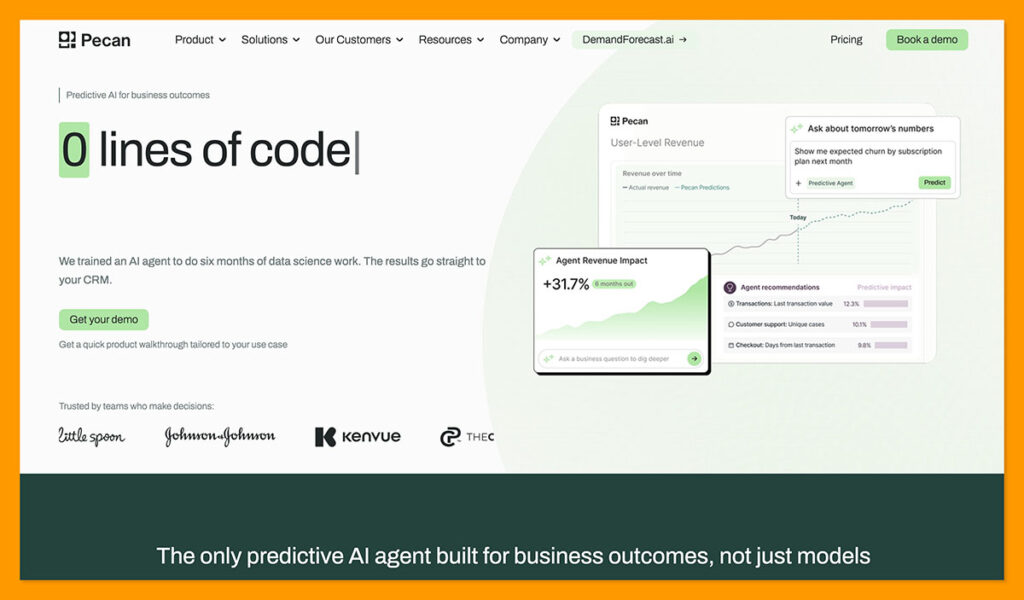
Most of the tools I’m going to talk about here either focus specifically on forecasting and inventory, or include forecasting as part of a much larger supply chain planning suite.
Pecan takes a slightly different approach. It focuses on ML-powered forecasting that can work alongside the systems and planning processes you already have.
You can run forecasts across SKU, store, region, product line, or total-demand levels, while accounting for things like promotions or seasonality. Pecan can also support new product forecasting and more complex demand patterns.
There are two ways to use Pecan for demand forecasting. Teams that want to own the process can use the Pecan AI platform to build and manage forecasts themselves, with support from Pecan. For enterprise teams that want a more hands-off approach, Demand Forecast is a fully managed solution, with Pecan taking on more of the forecasting work.
For teams using the Pecan AI platform, the Predictive AI Agent handles much of the workflow, from data preparation and feature engineering to model building and validation. Guardrails run by default to catch issues like data leakage, overfitting, outliers, and data drift. Pecan reports that planners using it spend around 60% less time building, reviewing, and adjusting forecasts..
The explainability features help too, so teams can understand what’s actually driving a forecast rather than just hoping they can trust the results. Pecan is built around the forecast itself and feeds the planning systems you already run. If your goal is a better forecast with less manual work, the rest of a planning suite is weight you don’t need to carry.
Pros 👍
- Very simple setup with no-code predictive modeling
- Fast time to value with less manual forecasting work
- Self-managed and fully managed forecasting options
- Forecasts across products, locations, and planning horizons
- Integrations with data warehouses, databases, CRMs, and cloud storage
- Explainability insights and automated model guardrails
Cons 👎
- Requires enough historical data to support the forecast
- Not a full end-to-end supply chain planning platform
- Quote-based pricing
2. Blue Yonder: Best for Large Retailers and End-to-End Supply Chain Planning
If problems with forecasting are causing new hurdles to crop up throughout your entire supply chain, Blue Yonder is a strong option. The Demand and Supply Planning suite connects statistical forecasting and machine learning with scenario planning, causal demand signals, inventory management, as well as downstream decisions. There’s also a useful Inventory Ops agent that can track down problems like sourcing issues or broken bills of materials for you.
Blue Yonder has been an established enterprise planning platform for years, and in 2026 it added several new features, like root-cause analysis for supply and demand problems, audit trails showing forecast changes and overrides, and a “planner’s brief” tool.
The tradeoffs are the same ones you’ll encounter with most other demand forecasting tools built for larger companies. Blue Yonder can be expensive, especially when you add in implementation costs and continued optimization. Rollouts can take several months, depending on how prepared you are, and sometimes large datasets can slow the whole work process down.
Pros 👍
- Advanced combination of AI, ML, and statistical models
- Comprehensive scenario planning and what-if analysis
- Forecasts can immediately trigger supply chain decisions
- Helpful Inventory Ops agent and planner’s brief tool
- Strong auditability
Cons 👎
- Expensive quote-only pricing
- Deployment can take several months
- Can occasionally struggle with lag
3. o9 Solutions: Best for Advanced Demand Sensing and Enterprise Digital Planning
I struggle a little bit with giving o9 Solutions the simple definition of “demand forecasting software”, because it’s really more of a planning platform. The forecasting tools are bundled with the Digital Brain and Enterprise Knowledge Graph, so you get a model that can connect products, locations, and relationships for you, then pass the details along to a planning team.
The demand sensing features are definitely impressive here, with store-item-channel forecasts at daily or intraday resolution. You can even account for signals like weather changes, social data, local events, or search behavior. Plus, there are some great tools for running those “what-if” scenario checks if you want to experiment with different scenarios.
I also like the collaborative workspaces, and the forecasting tools that can give you insights into potential new product performance. NPI models can find comparable items using attributes like price or category to build a demand baseline. The setup is tricky though, since the platform requires a lot of architecture planning, and the learning curve can be pretty steep.
Pros 👍
- Complete integrated business planning toolkit
- Proprietary Digital Brain for complex demand signals
- Full scenario simulation tools
- Helpful collaborative workspaces
- Useful for new product performance predictions
Cons 👎
- Expensive and time-consuming setup and configuration
- Quote-based pricing only (focused on large enterprises)
- Somewhat opaque algorithmic modeling
4. Kinaxis: Best for Concurrent Demand and Supply Planning
Kinaxis bundles its demand forecasting into Maestro, the platform formerly known as RapidResponse. The idea is to give businesses a system for concurrent planning, so teams can see what a change in demand does at various points throughout the business.
The Demand.ai tool can mix your own company data with external signals, as well as open orders, shipments, promotion flags, POS data, weather, and competitor activity. There’s also near-term demand sensing which can share updates at a daily or intra-day frequency level.
Kinaxis is also one of the better tools for scenario experiments, with insights into what might happen on a baseline, optimistic, and slightly more pessimistic level. The biggest problem I’ve seen companies have with this comes from the complicated initial setup. Onboarding takes a while, and some users say that they’ve needed specialized training to get the most out of the tool. That obviously adds to the cost of an already relatively expensive piece of software.
Pros 👍
- Strong scenario planning and what-if simulations
- Concurrent planning with demand and supply planning connections
- Plenty of AI and ML models, with automatic selection suggestions
- Cross-functional collaboration tools for sales, marketing, and other teams
- Enterprise scalability
Cons 👎
- Complicated onboarding, extra training might be necessary
- Not intended for smaller companies
- Can be expensive, especially if you need configuration help
5. SAP IBP: Best for SAP-Centric Global Supply Chains
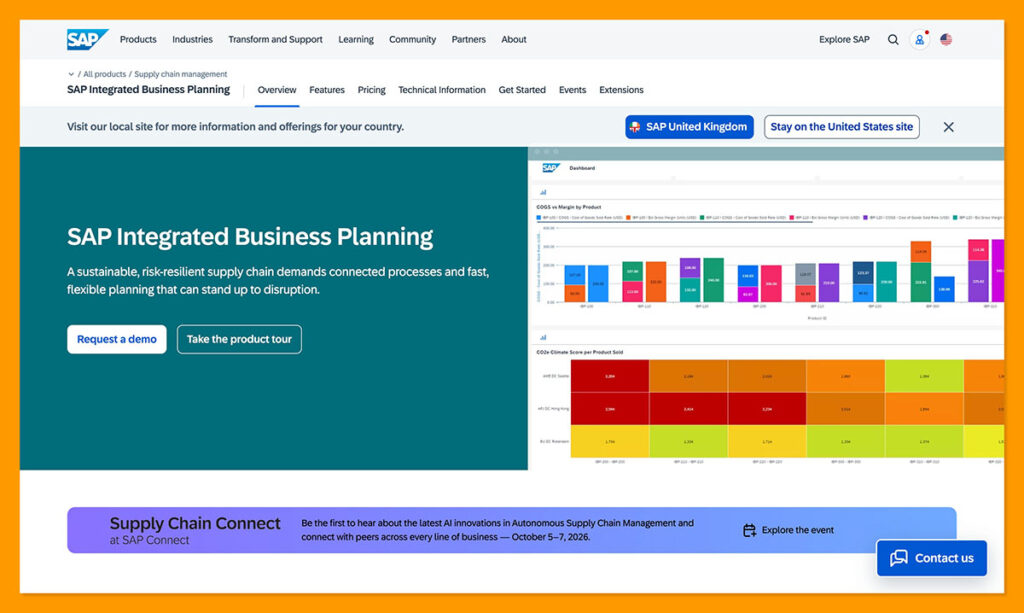
If you’re using SAP S/ 4HANA or similar tools, then SAP Integrated Business Planning (IBP) is probably going to be an easy sell. It’s a flexible cloud-native platform that gives you a basic forecasting toolbox, with support for Auto-ARIMA/SARIMA, ARIMAX/SARIMAX, Croston and Croston TSB for intermittent demand, plus gradient boosting, XGBoost and several exponential-smoothing methods.
You can build models that use several algorithms and select the best result using specific error measures. There are also demand sensing tools that can improve your short-term forecasts with information about orders, deliveries, promotions, or outside signals.
Right now, the product is a little easier to interrogate too, since SAP added an AI-assisted forecast analysis system that can explain algorithm choices and how variables contribute to outputs. Still, if you’re not familiar with SAP already, there’s an initial learning curve to overcome. SAP also expects a significant initial investment for licenses, cloud infrastructure, plus possible external consultants.
Pros 👍
- Good choice for companies that already use SAP tools
- Advanced machine learning algorithms and forecasting models
- Excellent demand sensing and new product support
- Cross-functional collaboration features
- AI assisted forecast analytics
Cons 👎
- Can be expensive, especially if you need consultant help
- Implementations can take between 6 and 12 months (sometimes longer)
- May be more than a smaller team needs
6. Anaplan: Best for Connected Demand, Financial, and Commercial Planning
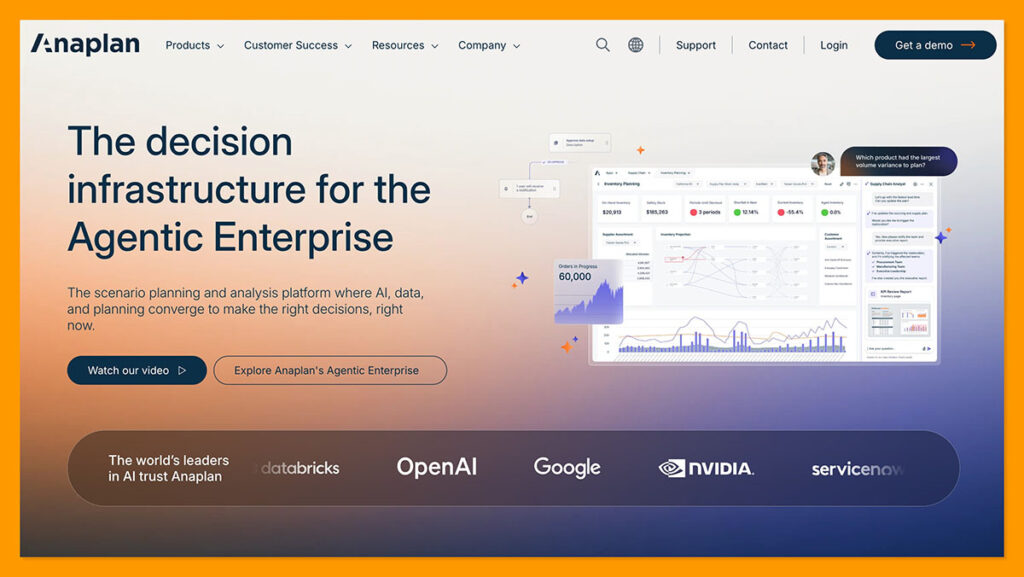
Anaplan is a planning platform with forecasting built-in. It’s meant to support companies that need to align sales, marketing, finance, and supply chain data (plus teams) in one space. The Demand Planning application links forecasts to your larger business plans, while PlanIQ adds machine learning. You also get to segment forecasts by product, customer, or region, work with promotions and irregular demand spikes, and run “what-if” tests.
I’d still say Anaplan can have a steeper learning curve than tools like Pecan, but the suite of tools does include some extra things that can help with setup, like ready-made planning logic and workflow templates. There’s also the Supply Chain Analyst feature, which can answer natural language questions, flag disruptions, and run impact scenarios.
I also appreciate how customizable the whole thing is, letting you add in data from everything from POS sales, to short-term insights based on SKUs, or current promotions. Anaplan isn’t quite so great if you’re looking for native visualization capabilities, though, and the pricing will probably still keep it out of the hands of much smaller teams.
Pros 👍
- Useful single-source-of-truth setup for forecasting data
- Combines machine learning algorithms with statistical models
- Full dynamic “what-if” scenario planning features
- Helpful auditability and tracking features
- Supply Chain Analyst and other tools make it a little easier to set up
Cons 👎
- Can be too expensive for smaller teams
- Not ideal for native visualization features
- Sometimes struggles with performance limits
7. Netstock: Best for Mid-Market Inventory Forecasting and Replenishment
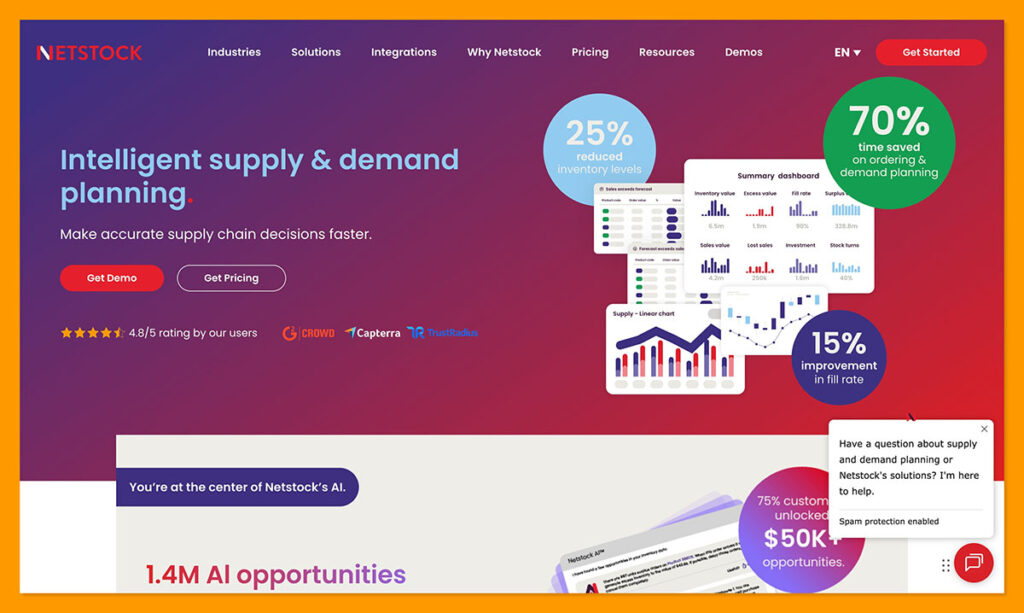
Netstock might be one of the best demand forecasting software options for companies that want a quick way to turn forecasts into inventory decisions. It’s a cloud-based inventory forecasting and optimization tool that works alongside systems like SAP and NetSuite, and it gives you automated replenishment recommendations, too.
With Netstock, you can review forecasts at the SKU level, or create predictions that pull in data from numerous products or channels. There’s also the Pivot Forecasting feature, which supports middle-out, top-down, and bottom-up forecasts across various customizable dimensions. Teams can also adjust units and currencies, or future costs and prices, then see what that does to the plan.
Really, the best thing about Netstock is how quickly it can turn forecasts into replenishment recommendations, overviews of supplier performance, or changes to order management. Still, it’s not meant for highly complex supply chains, and advanced customization can be tricky.
Pros 👍
- Reasonably straightforward dashboards and insights
- Automated replenishment and purchasing recommendations
- Convenient integrations with accounting and ERP platforms
- In-depth SKU categorization capabilities
- Flexible scenario planning
Cons 👎
- More limited if you need advanced customization
- Customer support and documentation can be inconsistent
- Configuration issues can create extra costs
8. Streamline: Best for Manufacturers and Distributors
Streamline is a complete inventory planning and supply chain optimization toolkit, designed to automate demand forecasting, optimize stock levels, and generate regular replenishment orders. It’s popular among distributors and manufacturers who have outgrown spreadsheets.
The forecasting tools cover seasonality, holidays, promotions, price elasticity, and lost sales. For newer SKUs or products, you can also use the demand pattern of a similar product, or build a brand-new profile. Plus, planners can override forecasts if they know their historical data won’t provide the models with everything it needs.
For manufacturers, Streamline can also turn finished forecasts into material requirements using bills of materials. There’s also multi-echelon planning for networks where warehouses tend to supply one another. It does have a few limitations, though, like the Shopify connector that only sends data one way, the customization limits if you need non-standard reporting, and a slightly tricky initial setup process.
Pros 👍
- Generally high accuracy results for forecasts
- Automates data aggregation, order planning, and replenishment
- Can handle multi-echelon inventory and supplier issues
- Designed to support flexible integrations (though some have limitations)
- Built for collaborative manufacturing work
Cons 👎
- Some initial learning is required
- Limits on certain connectors, like the Shopify integration
- Limited on some types of customization
9. Inventory Planner by Sage: Best for Ecommerce and Multichannel Retail
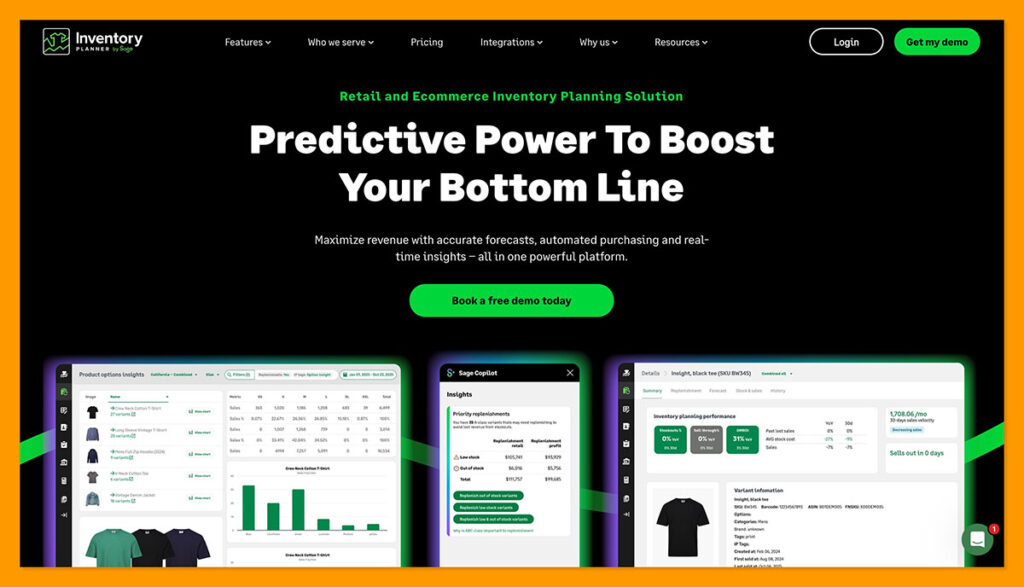
Inventory Planner is particularly well suited to ecommerce companies using platforms like Shopify. It’s a specialized cloud tool in the Sage toolkit that can automate demand forecasting, sync your stock data across channels, generate purchasing recommendations, and potentially help prevent stockouts.
For omnichannel or multichannel sellers, recent updates include the Option Insights report from late 2025, which can break down demand insights by size, color, material, or other variants. There’s also Sage Copilot, added in 2026, which includes a Retail Intelligence agent that can highlight priority replenishment requirements and data problems, though it’s still in beta and limited to the Premium tier.
Inventory Planner is also one of the best demand forecasting software options if you want custom reporting and dashboards, or quick ways to save time. It’s still a more expensive tool for smaller stores, especially with volume-based pricing and tier minimums. Also, while this platform can be faster to set up than others, onboarding alone can take about 30 days, assuming your data is already prepared.
Pros 👍
- Great for ecommerce and multi-channel syncing
- Accurate forecasts based on real-time and historical data
- Useful automation features and helpful AI assistants
- Custom reporting and dashboards available
- Can help to prevent stockouts and lost sales
Cons 👎
- Can be expensive for smaller businesses
- There’s still a learning curve, and your data needs to be pre-prepared
10. Prophet: Best Free Demand Forecasting Option for Technical Teams
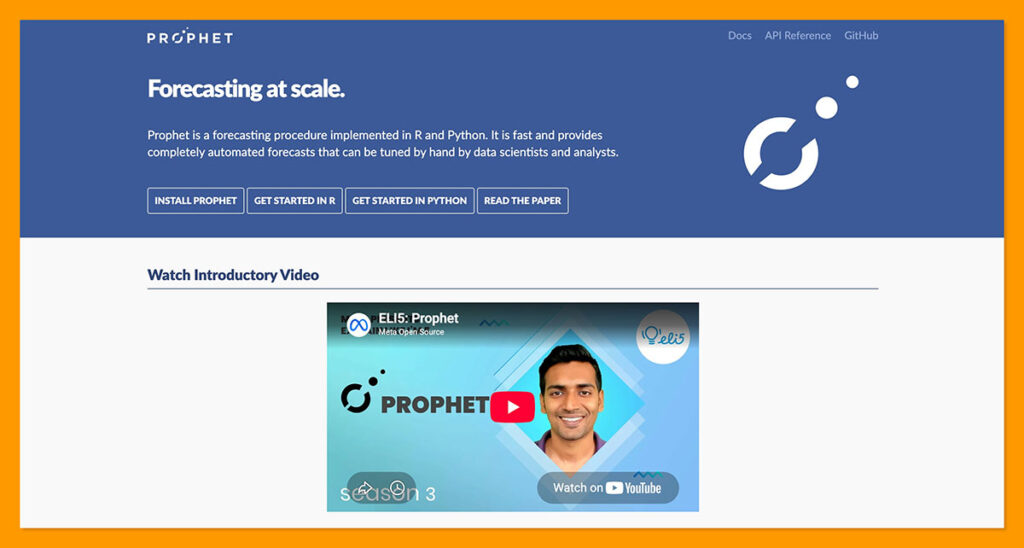
I’ve put Prophet at number ten because it’s probably going to be too much work for a company without technical resources. However, it could be the best demand forecasting software here if you want a more flexible, open-source solution.
It’s not really traditional demand planning software so much as a forecasting library. There’s no planner dashboard, SKU hierarchy management, or replenishment engine included, but the forecasting itself is still helpful. Prophet can model nonlinear trends with daily, weekly, and yearly seasonality insights, and you can add custom patterns or regressors.
Prophet is also surprisingly good at handling messy data (with missing values or outliers), and it can break your forecasts down with intuitive additive segments. Technical teams may also appreciate that it supports both Python and R environments. The big downsides are how much work it takes to get everything set up in the first place, and the fact that major feature development for the platform has really slowed down lately.
Pros 👍
- Free and open-source platform with fast baselines
- Built-in seasonality insights and holiday controls
- Good at handling messier data
- Useful cross-validation tools and tools for tuning
- Supports both Python and R
Cons 👎
- Does need a team of engineers to implement
- External regressors can be complicated to setup
- Not many new features introduced recently
How to Choose a Demand Forecasting Tool
I said at the top that picking the right tool isn’t just about chasing the highest accuracy score, so here’s how I’d actually work through the decision. Most of it comes down to five questions.
How ready is your data?
Demand forecasting needs enough historical data to learn from, but that doesn’t mean everything has to be perfectly clean and structured before you start. Look at what data you have, whether there’s enough history to support the forecast you want to make, and how much of the preparation your team will need to handle. Some tools require more work upfront, while others, like Pecan, can automate much of the data preparation for you.
How fast do you need value?
This is the criterion I leaned on most for the ranking. Pecan can have you acting on forecasts in roughly three to five weeks, while the bigger enterprise suites like Kinaxis, o9, and SAP IBP often run six to twelve months before they’re fully live. If you need answers this quarter, a long rollout isn’t a detail you can wave away, it’s the whole timeline. Be honest about whether you’re buying a forecast or signing up for a deployment project.
What are you connecting the forecast to?
A forecast is only worth anything if it feeds a decision, so work backwards from the decision you’re trying to improve. If you want demand changes to ripple through your supply chain, look at Blue Yonder or Kinaxis. If the goal is turning forecasts into replenishment and purchasing decisions, Netstock, Streamline, and Inventory Planner are built for exactly that. If you’re tying demand to financial and commercial plans, Anaplan and o9 make more sense. And if you already live in SAP, IBP is an obvious option to consider. If you primarily want better forecasts that can feed the planning and business systems you already use, Pecan takes a more forecasting-focused approach without requiring you to replace the rest of your stack.
Who’s actually going to use it?
Match the tool to the team, not the other way around. If you want business, analytics, or planning teams to work with ML-powered forecasts without relying on a traditional data science workflow, Pecan is designed for that, with both self-managed and fully managed options. Technical teams that want to own the entire forecasting stack might be happy building on Prophet. Larger organizations that need broad supply chain planning capabilities may be better suited to the enterprise suites, but should factor implementation and training into the decision.
What’s your budget, really?
Don’t compare subscription prices alone. Factor in implementation, configuration, training, external support, infrastructure, and the internal time required to keep forecasts running. Pecan, for instance, charges no setup fee and includes the Predictive AI Agent in every plan. Compare that with an in-house build, where 3 to 4 specialists run $600K or more a year before you’ve produced a forecast.
Run those five questions in order and the shortlist usually narrows itself. Start with the data and resources you actually have, then weigh time to value against the planning depth, integrations, and level of ownership you need.
Which Demand Forecasting Software Is Best for You?
There’s no single best demand forecasting platform for every team. If you need forecasting as part of a broader supply chain planning system, platforms like Blue Yonder, Kinaxis, o9, or SAP IBP give you more functionality around the forecast. If your priority is inventory and replenishment, tools like Netstock, Streamline, and Inventory Planner are more specialized around those decisions.
Overall, though, Pecan is the one I’d start with if your priority is getting to accurate, usable forecasts quickly without replacing your existing planning stack. You can take a self-managed approach with Pecan AI or use its fully managed Demand Forecast solution, depending on how much of the forecasting workflow you want your team to own.
That combination of ML-powered forecasting, less manual work, and flexibility in how you use it is ultimately why Pecan comes out on top in this ranking.
FAQs
What is demand forecasting software?
Demand forecasting software helps businesses estimate future demand using historical data and other relevant signals. Depending on the platform, forecasts can account for factors like promotions, product attributes, seasonality, or weather. Some tools also connect forecasts directly to purchasing, inventory, or planning systems so teams can act on them.
What is the difference between demand forecasting and demand planning?
Demand forecasting usually focuses on figuring out what customers are most likely to buy during a specific period in the future. Demand planning software takes the “prediction” or forecast and tries to determine how the business should respond. That could mean changing purchase quantities, inventory targets, or supplier strategies.
How accurate is ML-based demand forecasting?
That depends on a lot of different factors. Some benchmark reports suggest an average accuracy of around 70-90%, but the results you get will vary depending on product maturity, the quality and volume of the data you’re using, the external signals you’re accounting for, and the time-horizon for your forecast.
How long does demand forecasting software take to implement?
It depends on the tool. Some solutions like Pecan can get you acting on forecasts within three to five weeks. Other systems, like Kinaxis, or o9 Solutions can take six to twelve months, sometimes even longer. The more data, systems, and extra steps involved in the implementation, the longer you can expect it to take.
What data do you need for demand forecasting?
In general, you’ll need historical demand data tied to a product or SKU, potentially along with location and sales channel data, plus extra information that might explain why demand changes. That could include data about stockouts, prices, promotions, product attributes, weather conditions, POS data, or lead times.

Comments 0 Responses