

Fin is an AI customer service agent that resolves chat, email, WhatsApp, SMS, Slack, and phone tickets end to end at $0.99 per outcome, not per seat. Researching this fin ai review surfaced a problem: Fin holds 4.5/5 across 2,900+ G2 reviews, yet nearly every review ranking for the term was written by a rival vendor, and none mentions Salesforce is buying it.
I’ll cover what Fin costs, what setup involves, how good its answers are, and where the per-outcome model bites. It’s the strongest AI support agent I looked at, sold on a billing unit that charges for conversations nobody confirmed were resolved.
Key Takeaways 🔍
- Fin costs $0.99 per outcome (a Resolution, a Procedure handoff, or a Disqualification), plus $9.99 per Qualification and a $49.50/month standalone minimum
- Salesforce agreed to buy Fin for roughly $3.6B on June 15, 2026, closing in Q4 of its fiscal 2027; CEO Eoghan McCabe promises “little will practically change”
- 76% is the marketing resolution rate, not a forecast: production deployments run 25% to 80%+, driven by knowledge base quality
- “Assumed resolutions” are the biggest complaint: a conversation bills as resolved if the customer doesn’t come back within roughly 24 hours
- Fin is not “built on GPT-4”: it runs a proprietary seven-model CX Model Suite topped by Fin Apex 1.0
Fin AI Pros and Cons
Short on time? Here’s what impressed me about Fin and what I’d want fixed before signing an annual contract.
What I Like
- Outcome-based pricing with no platform fee: $0.99 per resolution, no setup or integration fees standalone, and unlimited teammates in that mode
- Genuine omnichannel from one agent: chat, email, WhatsApp, SMS, Slack, and phone through Fin Voice, not just a website widget
- It acts, it doesn’t only answer: Procedures run multi-step workflows against live systems, including refunds, order lookups, and eligibility checks
- Simulations before go-live: multi-turn test conversations, AI-generated edge cases, and a stored regression library so changes don’t quietly break things
- The strongest third-party standing in the category: G2 4.5/5 across 2,900+ reviews, #1 AI Agent by review volume, a 90% satisfaction score, and Capterra 4.5/5 from roughly 1,133 reviews
What I Dislike
- “Assumed resolution” billing: you’re charged when a customer goes quiet, which is not the same thing as a customer being satisfied
- Bills scale unpredictably as Fin gets better: users report jumps from $4,000 to $9,000 a month, and $119 to $854 a month after a pricing migration
- Your resolution rate is your documentation’s problem: the marketed figures assume a maintained knowledge base that most teams don’t actually have
- A real ongoing maintenance load: weekly optimization reviews, release-synced doc updates, and six-monthly content refreshes
- Lock-in plus ownership uncertainty: Procedures and Guidance don’t travel off the platform, and the pending Salesforce close puts long-term direction under a new parent
What Is Fin AI? Intercom’s Rename and the Salesforce Acquisition
The company behind Fin isn’t called Intercom anymore, and in June 2026 it agreed to be bought by Salesforce for roughly $3.6 billion.
Fin itself is an AI agent grounded in your own content: help center articles, internal docs, PDFs, and webpages. There are two ways to buy it, and they cost very different amounts:
- Bundled with the Intercom helpdesk: a helpdesk seat from $29/seat/month plus $0.99 per outcome, with no per-seat charge for the AI agent itself
- Standalone as “Fin for Platforms”: Fin runs on top of Zendesk, Salesforce, HubSpot and others at a $49.50/month minimum, with no platform fees and unlimited teammates
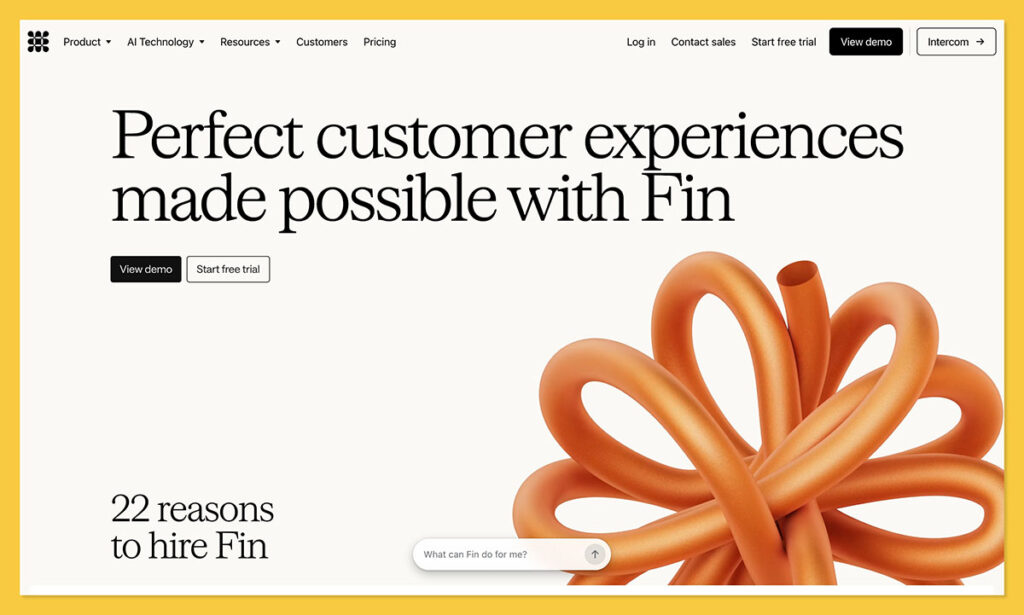
The published customer counts don’t agree, so treat all of them loosely. Salesforce’s June 2026 announcement cites 30,000+ companies, Fin’s homepage says 12,000+ customers and 2 million weekly resolutions, and April 2026 API launch coverage put it near 8,000. Different dates, and different definitions of “customer.”
The acquisition details a buyer needs: signed June 15, 2026 at approximately $3.6 billion subject to purchase price adjustments, expected to close in Q4 of Salesforce’s fiscal 2027, with Fin’s technology and team folding into Agentforce. Eoghan McCabe stays CEO and Des Traynor keeps leading R&D.
What the Salesforce deal means for your contract.
No pricing changes have been announced, and the deal hasn’t closed. If you’re signing now, prefer a shorter term or written price protection through the close, confirm your per-outcome rate is contractually fixed rather than list-referenced, and diary a terms review for after close.
It’s also worth checking for any pricing, packaging, or Agentforce migration announcements published since this article went live.
Which mode applies to you? Already on Intercom, or moving there: the bundled route is simpler and the AI carries no seat cost. Committed to Zendesk, Salesforce, or HubSpot: standalone tests Fin for $49.50 a month without touching your helpdesk.
How Much Does Fin AI Cost?
Published reviews of Fin quote seat prices from $29 to $169 a month, and Copilot at both $29 and $35. I checked the official pricing page, where the seat price turns out to be the least important number.
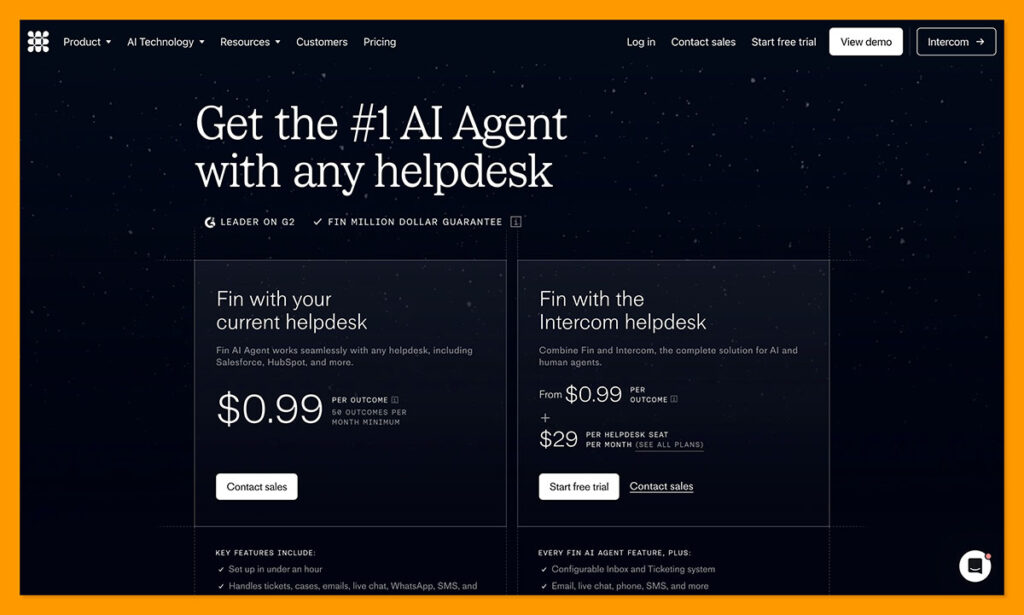
- $0.99 per outcome: a Resolution, a Procedure handoff, or a Disqualification
- $9.99 per Qualification: ten times the standard rate, billed separately
- $49.50/month standalone minimum (Fin for Platforms): equal to 50 resolutions, no setup or platform fees, unlimited teammates
- From $29/seat/month bundled with Intercom: plus $0.99 per outcome; a 35% new-customer discount took Essential to $19 in June 2026
- Copilot: $35 per user/month, which settles the $29 versus $35 conflict quoted elsewhere
- Pro: $99/month, deeper analytics across roughly 1,000 analyzed conversations
- Fin Voice: custom pricing only, “available to select customers working directly with our sales team,” and the largest cost unknown here
- Free trial: 14 days, unlimited outcomes, no card. Qualifying startups get 93% off Intercom plus a year of Fin free
| Line item | Price | What it covers | Watch out for |
|---|---|---|---|
| Fin outcome | $0.99 | Resolution, Procedure handoff, or Disqualification | Includes assumed resolutions |
| Qualification outcome | $9.99 | Lead qualification | 10x the standard rate, bills separately |
| Standalone minimum | $49.50/month | Fin on Zendesk, Salesforce, HubSpot etc. | Equals 50 resolutions, whether you use them or not |
| Intercom Essential seat | $29/seat/month | Human helpdesk seat | $19 during the 35% new-customer promo |
| Copilot | $35/user/month | AI assist for human agents | Priced per human agent, not per outcome |
| Pro add-on | $99/month | AI Topics, CX Scoring, Monitors, Scorecards | Capped near 1,000 analyzed conversations |
| Fin Voice | Custom | Phone channel | No public rate card, sales-led only |
| Free trial | $0 | 14 days, unlimited outcomes | No card required |
Fin publishes a real rate card, unlike nearly every enterprise rival here. Source: Ecommerce-Platforms.com
Here’s the monthly invoice: my own arithmetic at list price with three Intercom seats, excluding Qualifications, Voice, add-ons, and discounts.
| Monthly resolutions | Fin outcome cost | Intercom seats (3 × $29) | Estimated monthly total |
|---|---|---|---|
| 500 | $495 | $87 | $582 |
| 2,000 | $1,980 | $87 | $2,067 |
| 10,000 | $9,900 | $87 | $9,987 |
What counts as a resolution? ⬇️
An “assumed resolution” fires when a customer doesn’t return within roughly 24 hours of Fin’s last answer. If they come back later needing a human, even in a different billing period, Fin deducts the charge. Silence still bills as success.
On Intercom’s own community forum, a user posting as bosbeest listed the fallout when agents step in before a customer clicks “Speak to Human”: “Lower customer satisfaction. Longer resolve times. Incorrect Fin statistics. More expensive invoices.” Intercom support engineer Paul Byrne agreed that stepping in “should be seen as good judgment, not something to be penalized,” then committed only to passing the thread along internally.
Is Fin Good Value for Money?
- Per unit, Fin is the cheapest serious option: $0.99 flat against Ada’s $1 to $3.50 resolution equivalent and Decagon’s $50,000/year platform fee
- The savings are real when it works: Ibbaka estimates each automated resolution saves 80% to 90% of a human-handled query’s cost
- But the bill grows as Fin improves: users report jumps from $4,000 to $9,000/month, and $119 to $854 after a pricing migration
- You’re billed on an outcome you don’t fully control: assumed resolutions mean good agent judgment can raise your invoice
- The trial de-risks it: 14 days of unlimited outcomes, no card, enough to measure your own rate
Author’s Testing Notes 📝
Run the trial before committing and measure your own resolution rate instead of trusting 76%. On Zendesk, Salesforce, or HubSpot, start standalone at the $49.50 minimum rather than migrating helpdesks to find out whether Fin works.
Skip Copilot until agent volume justifies it, and skip the $99 Pro add-on until CX Scoring has enough conversations to mean anything. Negotiate volume discounts before signing annual, and fix your per-outcome rate in writing before the Salesforce close.
My Experience With Fin: Setup, Guidance, and Going Live
Most Fin deployments that miss their marketing number don’t miss because of the model. They miss because of the first hour of setup.
Connecting Knowledge Sources
Setup starts in the Knowledge Hub. You connect help center articles, internal docs, PDFs, and webpages; entering a primary web domain auto-traverses it and imports nested subpages. Fin adds up to 100 external sources through Knowledge > Content > Add content, choosing a source such as Confluence.
Fin only resolves what your documentation already answers, so a stale help center buys you a confident, stale agent. The fastest part of setup, and the part that decides your resolution rate. Source: Ecommerce-Platforms.com
Writing Guidance
Guidance is where you tell Fin how to behave in plain language, refined with a one-click “Improve AI” button:
- Tone: “Use clear, straightforward language and avoid jargon or buzzwords. For example, say ‘easy’ instead of ‘frictionless.'”
- Clarification gating: “If a customer reports a bug, first clarify whether they are using the iOS or Android app before proceeding.”
- Hard escalation: “If a customer asks about having their data deleted, escalate the conversation to a human agent straight away.”
Guidance reads like onboarding notes for a new hire. Source: Ecommerce-Platforms.com
Author’s Testing Notes 📝
Guidance is the highest-leverage 20 minutes of setup, and escalation rules matter more than tone rules. Escalation stops Fin answering what it should hand to a person.
It’s also where the “no-code” pitch holds up. TrustRadius reviewers say edge-case customization took more technical effort than expected, and that friction lives in Procedures.
Building a Procedure and Testing It With Simulations
Procedures are where Fin stops answering and starts doing. The documented refund example retrieves order details through a get_order_details step, then applies the if/else logic Intercom recommends: under 30 days, refund automatically; older, explain the 30-day policy and decline.
Then you test it. Simulations run multi-turn conversations against your Procedure, including image uploads such as receipts, with AI-generated cases for partial refunds or missing attachments, all stored in a library that catches regressions. Fin calls the cycle the Fin Flywheel: train, test, deploy, analyze. Simulations let me run edge cases before a customer touched the Procedure. Source: Ecommerce-Platforms.com
Author’s Testing Notes 📝
Simulations are the most underrated part of Fin. Build one Procedure for your highest-volume workflow, run it through simulated edge cases, then enable it live. Five on day one is how you debug in production.
Going Live
Going live with Fin AI is light: it connects to existing knowledge sources and workflows, with no content migration if your documentation exists.
“Connect it and go” holds if your documentation is maintained, which is why mature support orgs hit the marketing numbers. If your help center hasn’t been audited in a year, that flow is a content project.
Fin’s AI Engine: How Good Are Its Answers, Really?
One of the most-read Fin AI reviews still describes it as “built on GPT-4.” It isn’t, and it hasn’t been since 2024.
🧠 The Fin CX Model Suite and Fin Apex 1.0
Fin’s architecture changed twice in two years, and both changes matter to what you’re buying.
- October 2024: Intercom switched Fin’s underlying LLM from OpenAI to Anthropic’s Claude with Fin 2. VP of AI Fergal Reid put it plainly: “We switched to Anthropic because its Claude models are the best at providing high-quality answers to our customers at scale.”
- By 2026: Fin runs a proprietary multi-model pipeline called the Fin CX Model Suite. Seven purpose-built models each handle one stage: language detection, issue summarization, knowledge retrieval, reranking, answer generation, feedback parsing, and escalation routing.
- The flagship is Fin Apex 1.0. Fin’s published benchmarks claim it beats GPT-5.4 and Claude Sonnet 4.6 on customer-service resolution, with a 2.8% higher resolution rate, 0.6s faster time to first token, 65% fewer hallucinations than Sonnet 4.6, and 3.7-second responses. These are vendor self-reported benchmarks with no independent replication available, and I’d read them that way.
- Apex is only accessible through Fin. It can’t be licensed separately, which matters if model portability is part of your evaluation.
📊 What Resolution Rate Should You Actually Expect?
Four different resolution figures circulate for Fin, and they measure four different things.
| Figure | Where it comes from | Date | What it actually measures |
|---|---|---|---|
| 51% | Fin 2 launch, out of the box before customization | Oct 2024 | Baseline with no tuning; per-customer spread ran from the low 20s to 86% |
| 67% | Last-30-day average across 7,000+ customers | Dec 2025 | Trailing aggregate, tied to the $1M Guarantee at a 65% resolution SLA |
| 76% | fin.ai homepage and Salesforce’s acquisition statements | 2026 | Current aggregate across 12,000+ customers, reported to rise roughly 1%/month, “many seeing over 85%” |
| 25% to 80%+ | Reported production deployments | Ongoing | The real spread, driven almost entirely by knowledge base quality |
The most useful caveat on that 76% comes from Fin’s own co-founder. Des Traynor has warned that vendors “can selectively sample certain customers or certain verticals and give you a far higher number,” which is a remarkable thing to say while publishing an aggregate. Paul Adams made the companion point in the Fin 2 keynote: “resolution rate isn’t everything,” and what matters more is that “Fin doesn’t guess.”
Author’s Testing Notes 📝
For month-one expectations, the vendor-published customer results give a directional range worth naming as vendor-published rather than independent. Anthropic hit 50.8% within one month of deployment with 1,700+ support hours saved. Sharesies reached 70% in 12 weeks. Tado° hit up to 70% across six languages while holding near-90% CSAT through a 400% demand spike.
Budget for the low end in month one. Treat 76% as a ceiling you earn through documentation work, not a number you’re buying.
Take the headline figure as a ceiling and measure your own during the 14-day trial. That single number is worth more than every published average combined.
Procedures, Actions, and Omnichannel: What Fin Can Actually Do
The difference between a chatbot and an agent is whether it can do something. ParkBee’s Marco Seeleman put the inflection point well: once you connect external systems, support “stops being about answering questions. It becomes part of your operations.”
🔁 Procedures and Tasks
Procedures encode multi-step workflows as if/else logic that support and ops staff own without engineering involvement. That was the explicit design motivation: teams “didn’t want to route through engineering teams to create or amend logic.”
- Raylo runs a payment-information Procedure at roughly 94% CSAT
- MONY Group built a cashback-claim Procedure that checks account information through a live API mid-conversation, makes eligibility decisions, and guides the customer dynamically instead of following a fixed script
- Documented workflow types include refunds, subscription changes, identity verification, order lookups, and cashback or eligibility claims
If/else logic against a live order lookup is what separates Fin from a well-trained FAQ bot. Source: Ecommerce-Platforms.com
📞 Fin Voice 2
Voice runs on a separate low-latency model called Apex Flash, which Fin reports delivers a 24.5% higher resolution rate and 0.43s faster time-to-first-audio than Fin Voice 1, alongside 20+ new features.
- 30+ languages with dynamic language switching mid-call
- Telephony integrations with Twilio, Genesys, RingCentral, Five9, 8×8, Aircall, and Mitel
- Multi-step voice tasks: identity verification, refunds, appointment booking, subscription changes
Credit Repair Cloud’s Rizwan Sherif says “customers often tell us they’re amazed it’s not a real person.” The commercial reality is less flattering: Fin Voice has no public pricing and is sales-led only, so you cannot model its cost before you talk to a rep.
💬 Where Fin Runs
Chat, email, WhatsApp, SMS, Slack, and phone, all from one agent, either inside Intercom or standalone on Zendesk, Salesforce, and HubSpot.
🔌 The Fin API Platform
Launched April 3, 2026, this exposes Fin Apex, Fin RAG, Fin Retrieval, and Fin Reranker as standalone APIs so developers can build custom front ends outside the Intercom Messenger. Access requires at least $250,000/year of Intercom spend, which puts it out of reach for the large majority of readers of this review.
Top Tip 💡
Don’t launch five Procedures at once. Build one for your highest-volume repetitive workflow, validate it against simulated edge cases including missing uploads and partial refunds, then expand. That also keeps your Procedure-handoff outcomes, which bill at $0.99 each, predictable while you learn the model.
Against a flat-rate chatbot builder, this is the whole argument. Those tools answer questions and stop there. Fin AI completes the transaction, which is also why its bill moves with your volume instead of sitting still.
Fin’s Analytics and the Maintenance Work Nobody Mentions
Nobody sells you the weekly maintenance loop, and it’s the single biggest variable in whether Fin resolves 35% of your tickets or 70%.
📈 The Optimize and Performance Tabs
- Review Analyze > Optimize weekly. A pass typically surfaces 10 to 15 content-gap suggestions, most fixable in under an hour. Prioritize content gaps over data or action gaps; they resolve faster.
- Work Analyze > Performance by involvement. Sort articles by how often Fin uses them, focus on the top 20%, and flag anything under a 50% resolution rate for a rewrite.
- Audit negative CX and CSAT conversations. These catch answers that were confident and wrong because the source content was stale.
🔁 Building the Feedback Loop
- Set up an agent feedback loop as a back-office ticket type so humans can flag bad Fin responses directly. Teams doing this surface 15 to 20 content suggestions per week, each taking 15 to 45 minutes. That’s roughly half a day a week of somebody’s time.
- Sync documentation to releases. Expect three to six article updates per product release, plus a refresh of untouched high-traffic articles at least every six months.
- Connect external sources such as Jira, Slack, and Linear so changes that will break Fin’s answers get caught before a customer finds them.
💼 Copilot and the Pro Add-On
Copilot at $35/user/month is the agent-assist side: Lightspeed Commerce reports agents using it close 31% more conversations per day. The $99/month Pro add-on unlocks AI Topics, CX Scoring, Monitors, and Custom AI Scorecards across roughly 1,000 conversations, so deeper Fin AI reporting is a paid tier, not a default.
Top Tip 💡
Before you sign, name the person who owns the weekly Optimize review. Deployments almost never fail on the model. They fail because nobody owns the content queue.
Budget half a day a week of a real person’s time, or plan for the low end of the resolution range.
Is Fin AI Secure? Compliance, Data Residency, and Model Training
The question none of the other Fin reviews answer, and the first one your legal team will ask: where does your customer data actually go?
- Certifications: SOC 2 Type II, ISO 27001, ISO 27701, ISO 27018, ISO 42001, HIPAA, and GDPR/CCPA compliance
- Data residency: customer data can be hosted in the US, EU, or Australia depending on your requirements
- Third-party model providers: contractually restricted from training on your data, with zero data retention once an output is generated
- Reliability: a 99.8% uptime SLA with redundant systems across regions
Does Fin train on your data? 🔒
By default, Fin can use anonymized customer data for model fine-tuning. You can opt out at any time and data is deleted within 30 days, but the default is opt-in by inaction, which is the part worth flagging to procurement.
If you handle regulated or sensitive data, raise the opt-out and your residency region at contract signing rather than after go-live. It’s also worth asking whether the Salesforce acquisition changes sub-processors, residency commitments, or the fine-tuning default once the deal closes.
Three things to get in writing before you sign: your residency region, your fine-tuning opt-out, and the current sub-processor list. With that settled, the comparison question becomes the interesting one.
How Does Fin Compare to Competitors?
Every list of Fin AI agent alternatives compares it against small chatbot builders. Its actual competition is priced up to 50 times higher and publishes no rates at all.
- Decagon: enterprise contracts only with no public pricing. Vendr-reported median annual contract is around $386,000, with a range from $95,000 to $590,000+, plus a mandatory $50,000/year platform fee before a single conversation. Modeled annual TCO lands near $1.26M to $1.29M at 100,000 monthly conversations and 76% resolution.
- Sierra: no published pricing, enterprise sales-led, and the highest modeled TCO of the group at roughly $2.4M to $3.7M annually at the same volume.
- Ada: conversation-based commitments give more predictable contracts than per-resolution billing, which is a genuine advantage. Entry deals start near $30,000/year with a Vendr median around $70,000, and the per-resolution equivalent runs $1 to $3.50, above Fin’s flat $0.99.
- Zendesk AI agents: the obvious pick if you’re staying on Zendesk and want one vendor and one invoice. Zendesk publishes the mechanic but not the rate: AI agents bill per automated resolution on top of your Suite seats, and third-party analyses converge on roughly $1.50 per resolution on committed volume and $2.00 pay as you go, both well above Fin’s $0.99. Copilot is a separate line at around $50 per agent per month.
- SiteGPT, Chatbase, and Tidio Lyro: flat monthly pricing means a predictable bill, which is the one thing Fin genuinely cannot offer, with entry tiers starting around $39 to $40 a month. The trade is depth: no multi-step Procedures against live systems, no voice channel, far weaker omnichannel coverage. Right choice for a low-volume site with a simple FAQ, wrong choice if you need Fin’s actions.
Worth disclosing: several of the most visible “Fin reviews” in search results are published by vendors selling competing agents, so their alternatives sections funnel to their own products. I haven’t reused any of their figures here, and I’d treat their pricing claims about Fin with the same caution.
| Tool | Pricing model | Entry cost | Public pricing? | Best for |
|---|---|---|---|---|
| Fin | Per outcome | $49.50/month standalone minimum | Yes | Teams wanting multi-channel actions with a published rate |
| Decagon | Platform fee plus usage | $50,000/year platform fee; roughly $386K median contract | No | Large enterprises with dedicated deployment support |
| Sierra | Sales-led enterprise | Not published; roughly $2.4M to $3.7M modeled TCO | No | Enterprises buying a high-touch build |
| Ada | Conversation commitments | Roughly $30,000/year entry; around $70K median | No | Buyers who need a forecastable annual number |
| Zendesk AI agents | Helpdesk-native, per automated resolution | Suite seats plus roughly $1.50 to $2.00 per resolution | Partial | Teams consolidating on Zendesk |
| SiteGPT / Chatbase / Tidio Lyro | Flat monthly | From roughly $39/month | Yes | Low-volume sites with simple FAQ deflection |
The comparative TCO modeling above draws on a calculator Fin itself publishes plus third-party contract data, so read the enterprise columns with that bias in mind.
Pick Fin if you want the only public rate card in its class plus multi-channel actions. Pick Ada if predictable committed spend matters more to you than unit price. Pick a flat-rate builder if your volume is low and your questions are simple.
How We Test AI Customer Service Agents
Here’s exactly how I reached this verdict, so you can weigh it properly.
Our in-house research team puts every AI customer service agent through structured, source-by-source evaluation. For this Fin AI review, I:
- Verified pricing against the official pricing page rather than copying other write-ups
- Traced the model architecture and resolution-rate claims back to primary announcements and the vendor’s own executives
- Sampled user sentiment from Intercom’s own community forum and review-platform aggregates, not from competing vendors’ articles
- Took the compliance claims from Fin’s trust page
I’ve also personally used Fin and worked through its setup so I can share genuine observations. Where a detail couldn’t be independently confirmed, I left it out rather than guessing. That leads to the verdict.
Fin AI Review: Should You Automate Your Support With Fin?
Fin is the most capable general-purpose AI support agent you can buy with a public rate card, and the only one in its class that publishes what it charges. Whether it’s worth it comes down to one thing you control and one you don’t: the quality of your documentation, and how comfortable you are with a billing unit that fires when a customer goes quiet.
Best for:
- Teams already on Intercom, or willing to run Fin standalone on Zendesk, Salesforce, or HubSpot
- Support orgs with a maintained knowledge base and someone who can own the weekly Optimize review covered above
- Companies that need omnichannel coverage including voice, plus multi-step actions rather than FAQ deflection
- Buyers who want a published price instead of a six-figure sales-led contract
Skip if:
- Your documentation is thin or stale, because you’ll pay for a resolution rate you never reach
- You need a fixed, forecastable monthly bill; a flat-rate tool or Ada’s committed model fits better
- Nobody will own ongoing optimization
- Ownership uncertainty through the Salesforce close is a procurement blocker
Your next step is the 14-day trial: unlimited outcomes, no card. Connect your real help center, build one Procedure, run it through Simulations, and measure your own resolution rate. That single number tells you more than any review, including this one. If you then sign annual, negotiate volume discounts and get your per-outcome rate fixed in writing before the Salesforce deal closes.
Fin AI Review: Frequently Asked Questions
Is Fin AI worth it?
Fin is worth it for teams on or moving to Intercom that maintain their documentation, where outcome-based pricing and omnichannel coverage pay off. It’s weaker if you need a predictable monthly bill. G2 and Capterra both sit at 4.5/5, but real-world resolution varies widely by deployment quality.
What exactly counts as a billable resolution?
A Resolution, a Procedure handoff, or a Disqualification, each billed at $0.99. That includes assumed resolutions, where the customer doesn’t return within roughly 24 hours of Fin’s last reply. If they come back later needing a human, Fin deducts the earlier charge.
How much does Fin AI cost?
Fin AI pricing is $0.99 per outcome and $9.99 per qualification. Standalone deployment on another helpdesk carries a $49.50/month minimum. Bundled with Intercom, you pay a seat from $29/month plus outcomes. Copilot is $35/user/month, Pro is $99/month, and Fin Voice is custom-priced.
What happens to Fin now that Salesforce is acquiring it?
Salesforce signed a roughly $3.6 billion agreement on June 15, 2026, expected to close in Q4 of Salesforce’s fiscal 2027. Fin’s technology and team fold into Agentforce, Eoghan McCabe stays CEO, and no pricing changes have been announced. McCabe’s guidance to customers: “little will practically change” near term.
What LLM powers Fin, is it GPT-4 or Claude?
Neither, strictly. Fin moved from OpenAI to Anthropic’s Claude in October 2024 with Fin 2, and by 2026 it runs a proprietary seven-model pipeline called the Fin CX Model Suite, topped by Fin Apex 1.0. Apex is only available inside Fin and can’t be licensed separately.
Does Fin train AI models on our customer data?
By default, Fin can use anonymized customer data for model fine-tuning. You can opt out at any time, with data deleted within 30 days. Third-party model providers are contractually barred from training on your data and keep zero data retention once an output is generated.
What are the best Fin AI agent alternatives?
Decagon, Sierra, and Ada are the enterprise-class peers, all with far higher entry costs and no public rate cards. Ada starts near $30,000/year and Decagon adds a $50,000/year platform fee. For low-volume FAQ deflection, flat-rate builders like Tidio Lyro or Chatbase are cheaper and more predictable.
See the verdict above for how those trade-offs shake out by team profile.

Comments 0 Responses