

The days of every AI tool fitting neatly into one category with a clear “winner” are over. If you want to choose the right platform today, you first need to be clear about what you’re actually trying to achieve.
For instance, if you’re comparing Pecan AI and Google Vertex AI (now rebranded as Google’s Gemini Enterprise Agent Platform), you’re probably deciding between getting quick answers to commercial questions or building and running AI systems from the ground up.
Pecan AI is a no-code platform for business teams, ready to answer questions about outcomes like churn and efficiency without hiring a data science team. Vertex is about building, deploying, governing, and improving enterprise-grade AI agents and model-based solutions.
Pecan AI vs Google Vertex AI: Quick Verdict
If you want a predictive AI platform for your marketing, customer success, sales, or RevOps teams – I’d go for Pecan AI first. It’s made for those commercial use cases that usually get held up by data science backlogs. If you want to know who’s going to churn and why, or what’s going to waste your marketing budget, Pecan can tell you, without spending months building and deploying models.
Google Vertex might be better when you want to build an AI system fully. It’s a larger, more technical platform. Especially now that it’s part of the whole “Gemini Enterprise Agent Platform” hub. If you’ve got ML engineers, developers, cloud architects, and a reason to build models, agents, apps, pipelines, or governed AI workflows, Vertex should probably be your choice.
What Are Pecan AI and Google Vertex AI?
| Category | Pecan AI | Google Vertex AI |
| Best for | Organizations using predictive AI to improve business decisions | Technical teams building AI, ML, GenAI, and agent systems |
| Core strength | Turning business data into usable predictions | Giving teams deep control over AI models, agents, and deployment |
| Main workflow | Connect, define, build, predict, act | Build, train, tune, deploy, monitor, govern |
| Ease of use | Better for data analysts and commercial teams | Better for teams already comfortable with Google Cloud |
| Model control | Guided, with less technical work exposed | Much deeper control over models, pipelines, endpoints, and agents |
| Pricing style | Subscription plans, starting from $760/month billed annually | Usage-based cloud pricing |
Let’s start with what we’re actually comparing here, because it’s not just “two AI platforms.”
Pecan AI is a predictive AI platform built for business teams asking commercial questions. If you don’t want every question like “Which campaigns are bringing in the best buyers?” to become a full data science project, Pecan helps you get to an answer much faster.
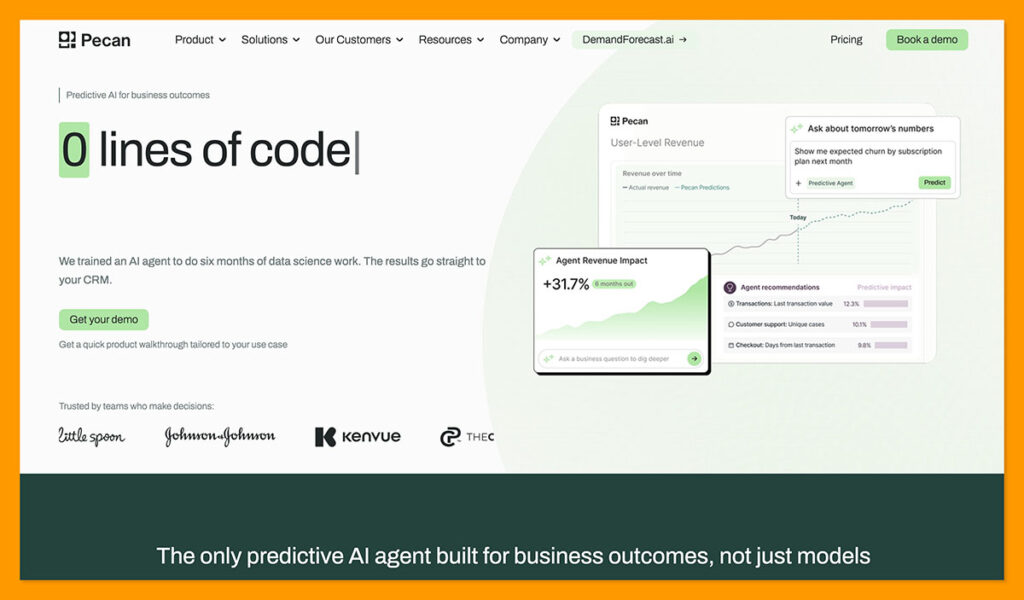
It takes care of much of the technical work behind the scenes. You give the Predictive AI Agent a question, it refines it, tells you what data you need, prepares that data, turns it into training material, produces the model, validates it, and delivers predictions in the tools your teams already use.
You’re not getting the blank AI playground here; you’re getting a guided path to answering specific business questions.
Google Vertex is the Managed ML platform inside of the Google Gemini Enterprise ecosystem. It’s there for teams building full AI solutions (not just asking revenue questions). There’s a lot bundled in here, like the Model Garden, Gemini models, AutoML, custom training, model monitoring, registries, pipelines, and even new tools like Agent Studio.
It’s a serious stack, made for companies that already have ML people, cloud architects, and engineers, and want to build and manage their own AI infrastructure.
Use Cases: What Is Each Platform For?
Pecan is more specific with its use cases than most AI tools try to be these days. It’s there to answer the questions that companies ask when money starts leaking out of the business.
If you want to protect or grow revenue, Pecan helps you predict churn, flag risks, develop win-back strategies, score leads and customer lifetime value, and optimize upselling and cross-selling strategies. If you’re trying to reduce inefficiencies, it helps with campaign ROAS calculation, forecasting, customer churn, retention data, and growth opportunities.
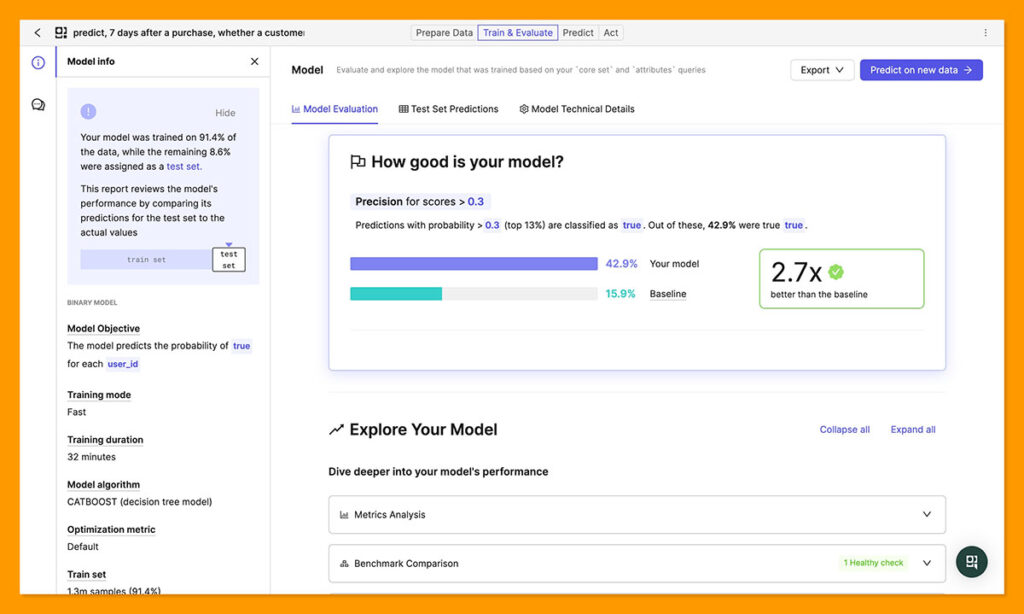
The idea is simple: you start with a question, and Pecan helps you get to a prediction you can actually trust. The Predictive AI agent helps with everything from preparing the data to building the model and delivering predictions where teams can use them. It also helps catch common ML issues, like data leakage and overfitting.
According to Pecan, customers see an average of 12% less customer churn, 15% higher ROAS, 10% higher customer LTV from its platform alone.
Vertex is for a very different kind of user. It’s the tool you use when you want to build AI into products and internal systems. Maybe you’re designing support agents grounded in company data, or document processing tools. Maybe you want forecasting models, or custom models that need specific levels of monitoring and governance. The use case library is huge, particularly with the Model Garden already giving you 200+ existing models to choose from.
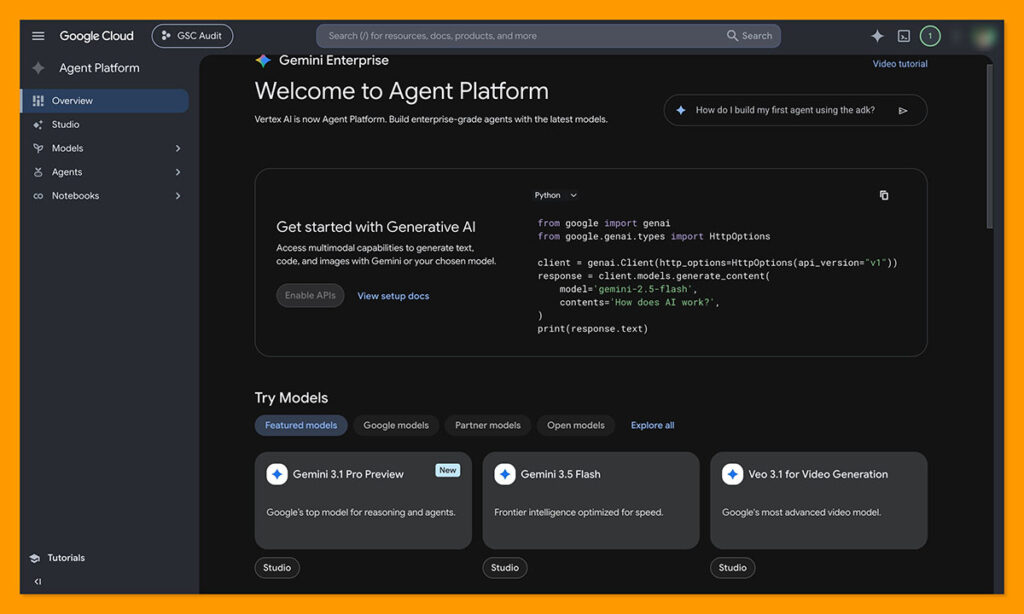
Plus, you get all the extra tools for agent building, gateway controls, observability, and anything else you can think of. The downside is that you need the data, skilled employees, and strategy to make all of that work. It’s a bigger job overall.
Features and Workflow: Guided Business Answers vs Full AI Build **
When you look at the average workflow, the difference between Pecan AI and Vertex feels a lot clearer. Pecan’s workflow is deliberately focused. You start with a question, refine it, connect the relevant data (with guidance from the Predictive AI agent), then let the Agent handle the stretch that tends to slow things down. It’s there for data prep, auto-generating SQL, creating training sets, adding features, and running model checks, not just prediction delivery.
One of the biggest advantages is the handoff from prediction to action. Once your custom model’s built it’s not just sitting there waiting for someone to tag it into the conversation. It can deliver predictions straight to your CRM, warehouse, or planning workflows, so teams can act on it right away. That reduces the time to value significantly.
Just look at Whistle Express, they had first churn predictions within two weeks and a production model live in under two months, cutting churn 30% in competitive markets. Clearwave got its own churn model up and running in 2 months, and cut churn by twenty times in the highest risk segment.
Vertex is intended for more diverse jobs, so the workflows are more complex. The Gemini Enterprise Agent Platform wraps up Vertex-style model selection and building, along with agent building and agent orchestration, DevOps and security. You’ve got the Model Garden with over 200 foundation models, custom training, AutoML, Agent Studio, Agent Runtime, model monitoring, and governance tools like Model Armor, and Agent Gateway.
There’s a lot packed into Vertex, but it comes with a different expectation. It’s not that Vertex is difficult to use (and get value from), it simply expects you to take on more of the work from day one in exchange for greater flexibility.
Google gives you the build environment; Pecan gives you business answers faster.
Pecan AI vs Google Vertex Pricing and Total Cost
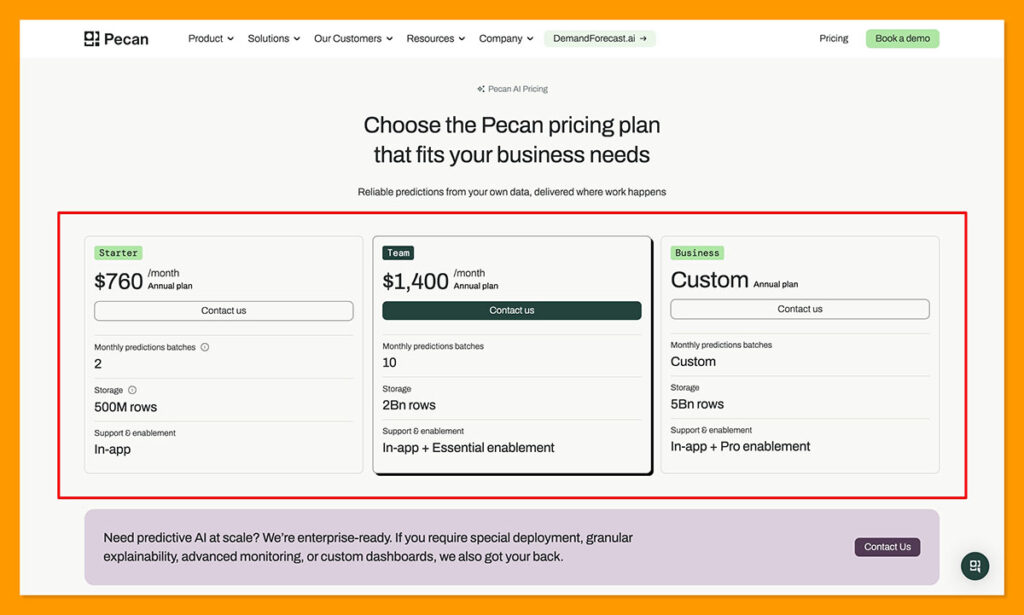
If you want the system that’s “easier” to budget for, that’s probably Pecan AI. It bundles pricing into tiers, starting at $760 per month (2 monthly prediction batches and 500m rows of storage) for the Starter plan. Team upgrades you to 10 monthly batches and 2 billion rows for $1,400 per month, then there’s Business, which gives you custom pricing for custom access.
That isn’t cheap, but the cost for Pecan is easier to attach to a business case. If you’re using it to build a model for churn, ROAS, or lead scoring, you can at least point to the number you’re trying to move when you’re calculating ROI. You can also compare the cost to how much you’d probably spend on several new specialists, training, and maintenance.
Google Vertex comes with usage-based pricing, so the bill varies depending on how much energy you’re putting into training, prediction, endpoints, notebooks, pipelines, storage, APIs, model usage, and the Google Cloud services wrapped around the project.
I’ve seen people list average costs for the platform as being anywhere from $100 to $100,000 depending on what they’re trying to achieve. Costs split across the agent runtime (billed per vCPU-hour), foundation model usage (billed per token, varying by model), retrieval and search queries, storage, and the surrounding Google Cloud services.
A light test workload and a heavy production deployment can differ by orders of magnitude, which is the trade-off for that flexibility. That doesn’t mean Vertex or the wider Gemini Enterprise platform is bad value for money, it’s just harder to predict what you’re going to spend.
Pecan AI vs Google Vertex: Governance, Security, and Reliability
A lot of people seem to think that if a platform is “simpler”, it isn’t as safe. That’s not the case with Pecan AI. It still gives you exactly what you need to trust a commerce prediction model. The system is SOC 2 Type II compliant, ISO 27001 certified, and aligned with GDPR and CCPA rules.
You have full control over the data you feed your model, and you don’t have to share PII to start creating models. Plus, the data you use with Pecan AI is encrypted in transit and at rest, and it’s never used to train models for any other customer.
Google Vertex does have more control options for enterprise users, mainly because the ways you use it can be a lot broader. You’ve got Google Cloud security models, Agent Identity, Agent Gateway, Agent Registry, and Model Armor. That’s probably what you want if you’re working with a ton of different models, apps, and agents with their own guardrails.
Still, you don’t really need that level of governance or complexity if all you’re really doing is forecasting churn. Sometimes simpler isn’t worse.
Pecan AI vs Google Vertex: My Verdict
If I had to sum it up to pinpoint the biggest strengths and weaknesses of both systems, this is what I’d say. Google Vertex’s biggest strength is its range. Within the Gemini Enterprise platform, it gives you a complete environment for building and managing agents and model-based systems. There’s no limit to what you can do or build (aside from the limits imposed by your own team).
The downside is the weight. Vertex adds for technical ownership and people who really understand the build from day one. It’s fine if you’ve got the background, talent, and data to develop your own AI infrastructure, it’s too much if you just have pressing questions, you need answering.
Pecan is more focused, but that’s also one of its biggest strengths. It’s not what you choose when you’re building diverse Gen AI apps and enterprise agents. You’re not using it to manage a large AI program across departments. It’s there to help you make better commercial decisions from the data you already have.
Pecan’s Predictive AI agent transforms the complicated data you’ve gathered into reliable predictions you can use without coding, model tuning or ML expertise. That makes it a lot more appealing for business leaders who want to see a return on their investment fast.
If all you need is business predictions you can action, without waiting for a data science queue to clear, start with Pecan AI. The best platform doesn’t have to be the biggest one. Sometimes it’s the one that gets you to the right decision faster. Request your demo of Pecan AI here.

Comments 0 Responses