

Bottom line: HubSpot AEO is the better choice for marketers who want fast, clear insights into how AI engines like ChatGPT, Gemini, and Perplexity talk about their brand, especially at $50/month. Semrush One is the stronger pick for SEO teams that need AI visibility data alongside traditional search analytics.
The days when marketing success depended on how much search engines like Google respected your brand are done. SEO is still important, of course. Plenty of companies still depend on the basics to get traffic to their website, but now it’s not enough to just be number one on the SERPs. You also need to convince AI tools like ChatGPT, Gemini, and Perplexity that your brand is worth mentioning too.
That’s why a lot of the classic SEO platforms are starting to introduce plans and features focused on AI visibility. Both Hubspot AEO and Semrush One are designed to give businesses a better understanding of how LLMs view their brands, position them in answers, and rank them against the competition. The question is which one of those platforms can help you strengthen your brand’s presence best.
My take so far? HubSpot AEO feels like the friendlier tool for marketers who want clear next steps, and suggestions based on their data. Semrush One seems like the better option if you’re taking a comprehensive approach to SEO and AEO at once.
HubSpot AEO vs Semrush One: Quick Verdict
Hubspot AEO is the simpler, more affordable option for companies tired of guessing how platforms like ChatGPT, Gemini, and Perplexity talk about their brand. It’s the easy entry point, costing $50 per month, and it’s great if you want to infuse AEO with CRM insights and existing Hubspot marketing and content tools.
Semrush is the better option if you want AI visibility insights sitting next to actual SEO data. You get a full overview of how everything from backlinks and keywords to AI sentiment is influencing your position on the web, and your ability to earn traffic. It’s more expensive, but it’s also a little more comprehensive if you need a full “visibility toolkit”.
| Category | HubSpot AEO | Semrush One |
|---|---|---|
| Best for | HubSpot users, marketers, smaller teams | SEO teams, agencies, advanced marketers |
| Main job | AI visibility tracking with clear next steps | SEO plus AI visibility in one place |
| AI engines covered | ChatGPT, Gemini, Perplexity | ChatGPT, Gemini, Google AI Overviews, Google AI Mode, and other AI search surfaces |
| Starting price | $50/month after a 28-day trial | $199/month for Semrush One |
| Traditional SEO tools | Light compared with Semrush | Very strong |
| Reporting | Better for internal marketing teams | Better for SEO teams and agencies |
| Ease of use | Cleaner and friendlier | More powerful, but busier |
| Biggest win | It tells marketers what to fix next | It explains the search reasons behind AI visibility gaps |
| Biggest catch | The 25-prompt limit can feel tight fast | The price and learning curve are real |
What Are HubSpot AEO and Semrush One?
HubSpot AEO is HubSpot’s Answer Engine Optimization tool. You give it your brand, competitors, and the prompts you’re trying to target, and it checks how Perplexity, Gemini, and ChatGPT reference you. You get an overview of how often you’re mentioned, the sentiment behind how these tools talk about your brand, and what kind of sources LLMs cite.
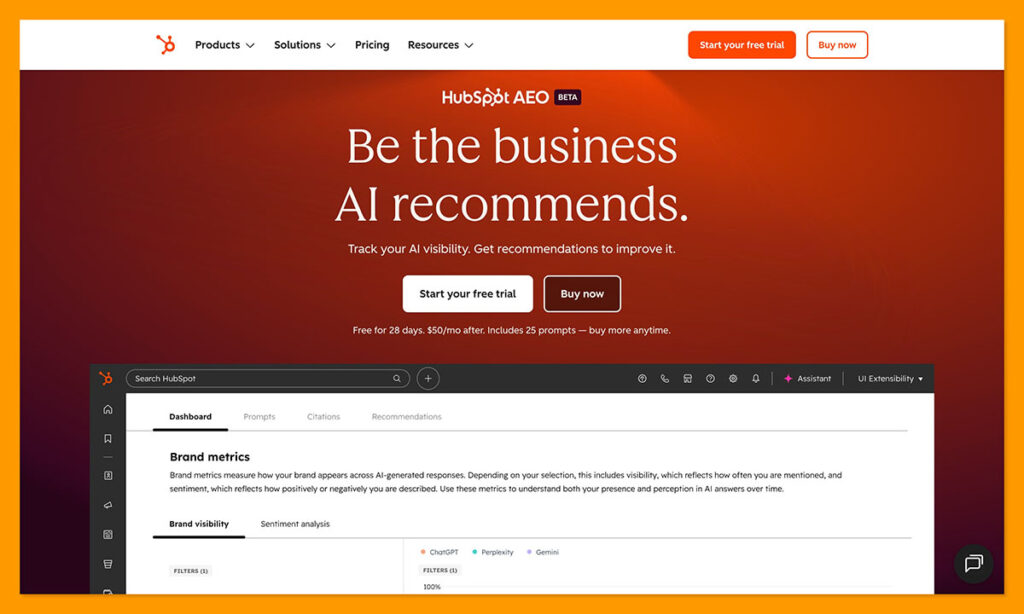
What’s great about this tool, aside from its low-cost entry plan ($50 per month), is that it makes it easy to go from finding out where you’re falling behind, to fixing the problem. The AI system generates suggestions about what you can fix first, showing where you can fix competitor gaps, or update pages and content for a better impact.
Semrush One is the flagship “visibility toolkit” from Semrush, combining all of the traditional SEO tools you’d expect from the platform (keyword research, tracking, site audits, competitor analysis, and so on) with AI insights.
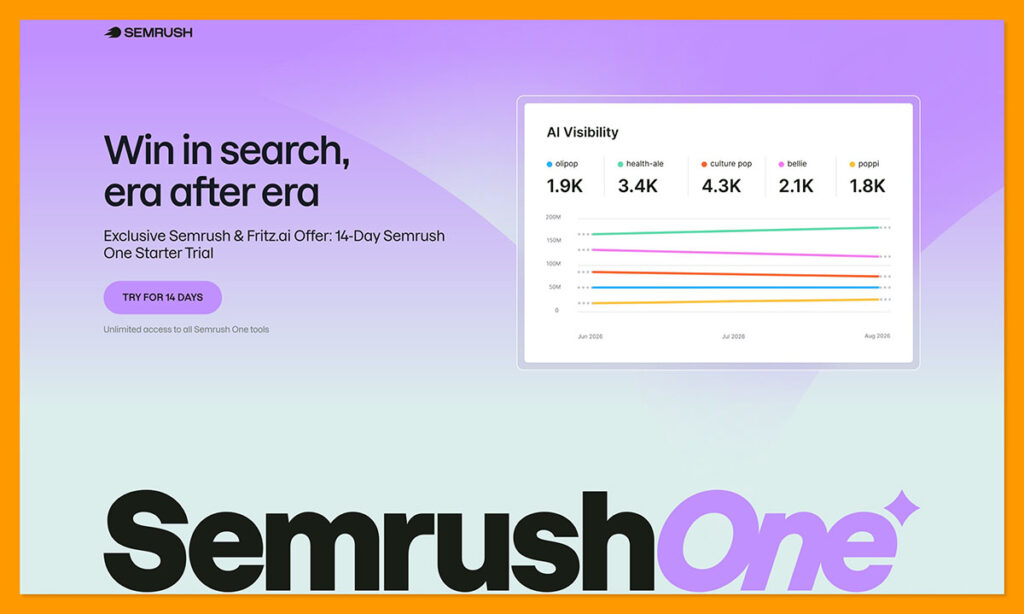
The AI tools cover brand performance scores, prompt research, AI citations, competitor AI visibility, and sentiment, among other things. The big selling point with Semrush is really the scale.It’s one of the best SEO systems positioned side by side with a truly cohesive system for AI visibility. You pay extra for that, but you can get extra value from it too.
HubSpot AEO vs Semrush One: Key AI Visibility Features
I wanted to really focus with this comparison, as it’d be easy to say that HubSpot’s the better tool if you want a CRM integration or you already use HubSpot’s marketing tools. It’d also be easy to say Semrush One is better if you’re already investing a lot into SEO. Here, we’re concentrating on which tool really pays off from an AI visibility perspective, and why.
AI Visibility Tracking
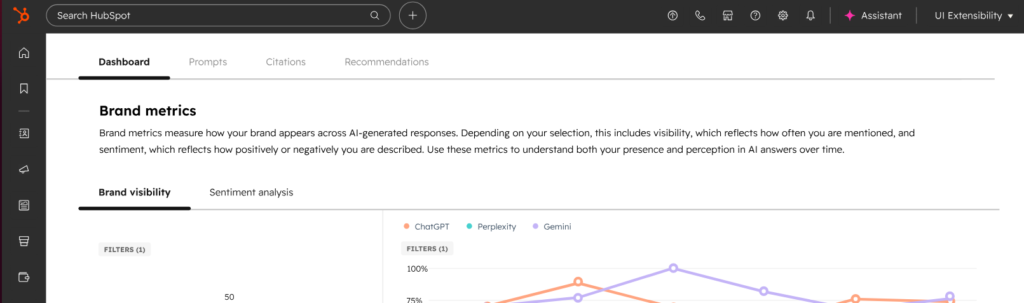
This is the central feature behind both toolkits. HubSpot AEO gives you the simpler first read of how your brand appears across Perplexity, Gemini, and ChatGPT. Then you can check the visibility score, prompt performance, share of voice, citations, and sentiment. You’re not creating giant reports, you’re getting more of an instant health check.
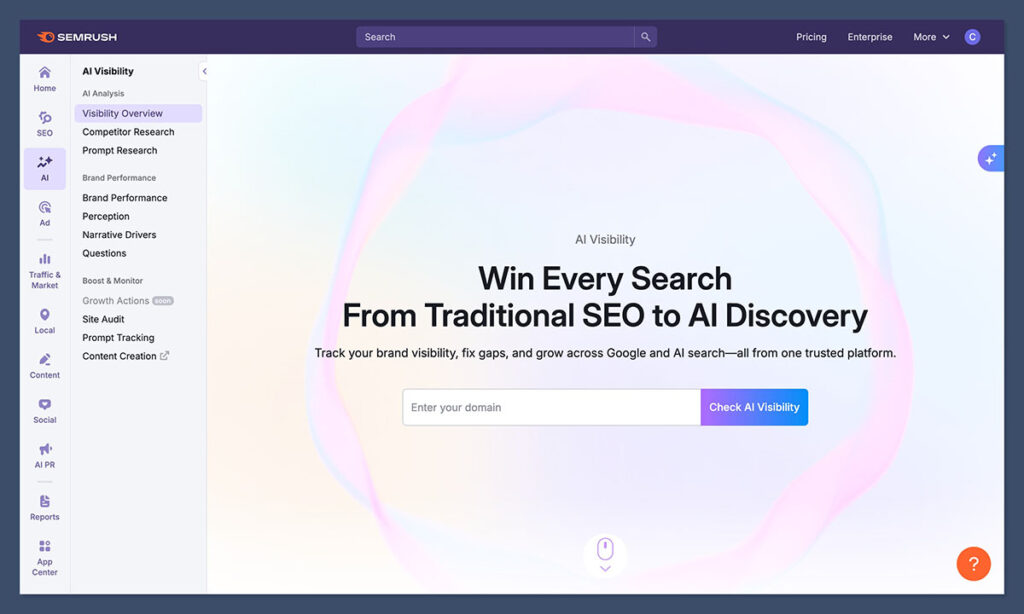
Semrush gives you a bigger view. It also monitors brand mentions across those three platforms above, as well as Google AI overviews, and Google AI mode. Plus, you see your SEO results side-by-side with AI insights, so you know how both sides of the equation are contributing to your traffic.
Prompt Research And Tracking
HubSpot AEO might actually be the better option for companies still figuring out what buyers might be asking AI tools. It can suggest prompts based on your company, industry, and competitors, plus CRM context (if you have the right plan). The tracking options are slightly more limited, giving you access to only 25 prompts for $50 per month, compared to the 200 prompts on Semrush’s Pro+ plan, but that’s still enough for beginners.
Semrush One obviously gives you more scale, but the discovery process is a little more manual. You’ll be primarily building your own tracking list, but that doesn’t mean you can’t get help. You can enter topics into the system, and Semrush can give you a list of the kind of prompts most people use related to that topic. Very helpful if you’re not sure where to begin.
The database is huge on Semrush too, with over 261 million prompts taken from more than 32 countries. Great for large agencies and international brands.
Citation Analysis
I’m a big fan of citation analysis as a feature for AEO tools, because it really gives you a good idea of which resources AI platforms are actually drawing from when they mention you. HubSpot’s citation view is fantastic because it immediately shows you which domains and content types are getting the most AI attention. Plus, it breaks the insights down based on owned content, social platforms, competitor domains, third-party pages and other sources.
HubSpot even used this feature to its own advantage, reporting a 1,850% increase in qualified leads from AI and 433% increase in citations after it implemented a few data-based tweaks.
Semrush does most of the same things, but it gives you citation data with more SEO context around it. If a competitor regularly gets cited over you, you can check their backlinks, rankings, topic coverage, site health, and content structure. All of that information together forms the clues for what you need to rewrite, refresh, restructure, or support with better authority signals.
Sentiment And Brand Positioning
Both tools track sentiment, and your overall position as a brand vying for AI attention. They just work a bit differently. HubSpot makes overall sentiment really easy to understand. You get a reference to whether mentions are negative, positive, or neutral, and what sort of terms are usually associated with your brand. It’s all very straightforward.
Semrush gives sentiment a little more competitive context through Brand Performance. You still get a sentiment score, but you also get a deeper insight into how AI platforms describe your brand compared to rivals, and where your share of voice is changing. Plus, you can see which prompts are more likely to trigger positive or negative mentions.
Competitor Visibility
HubSpot is good for finding quick competitor gaps. You can see who appears beside you, who appears instead of you, and which prompts push AI engines toward another brand. For a lean marketing team, that’s enough to decide whether to build a comparison page, or chase new third-party mentions.
Semrush, as one of the more established SEO leaders, goes a little further. The AI competitor tools compare brand visibility, citations, prompt coverage, and share of voice against rivals. For me, that means HubSpot is stronger for marketing action, while Semrush fits SEO teams and agencies that need deeper competitive research around AI visibility.
AI-Readiness And Technical Checks
This is Semrush’s easiest win. HubSpot can recommend fixes, and it does so very well, but it isn’t built like a technical SEO system.
Semrush’s Site Audit includes AI-readiness checks that show whether your site blocks AI crawlers, including ChatGPT-User, OAI-SearchBot, PerplexityBot, Claude-User, Claude-SearchBot, Googlebot, and Google-Extended. That can be extremely useful if your technical teams are going to be helping with your visibility plan, alongside your marketing team.
Reporting and Workflow
Hubspot does very well if your overall goal is to turn AI visibility insights into marketing work quickly, particularly if you’re already using HubSpot marketing hub. The recommendations you get point directly to pages to update and content to create. You can also see sources to improve, and fill gaps with AI-powered content creation tools.
Semrush is better when you’re looking for deeper reports, and a comprehensive marketing toolkit that scores and optimizes everything you produce in real-time. The AI visibility data sits next to rankings, backlinks, audits, keywords, competitor research, and Google Analytics reporting. Plus, there are plenty of tools to help you build workflows, such as assistants that can design SEO-ready content and topic briefs.
I’d say HubSpot AEO is great for giving marketers a short list of jobs to finish, whereas Semrush is better at explaining why those jobs exist, and turning them into a full action plan.
Semrush One vs HubSpot AEO Pricing
Pricing is the easy win area for HubSpot, at least at first glance. You can get a 28-day free trial of the AEO toolkit, then pay $50 per month or $45 per month (annually) to access 25 prompts across ChatGPT, Perplexity, and Gemini. Extra prompts are available to purchase if you need them, too.
You don’t need the HubSpot CMS solution to use the plan, and if you already have Marketing Hub Professional or Enterprise, the AEO tool comes included.
Semrush One is more expensive. You’re paying $249.95 per month for the Pro+ plan, with 15 websites you can monitor, 1,500 keywords, and various other features. The Advanced plan costs $549 per month, and gives you monitoring for 40 websites, and 5,000 keywords. You also get 200 prompts you can track each day.
Alternatively, you can choose to buy Semrush classic for $139.95 per month, and add the AI visibility toolkit for $99 per month. Honestly, though, I think the Pro+ plan is better value for money, particularly since you get 100 prompts to track, rather than just 25.
Hubspot AEO vs Semrush One: Which Platform Wins
Both tools are fantastic if you genuinely care about AI visibility, and these days, you probably should. For me, Semrush wins if you’re looking for a proper diagnostic that helps you understand exactly where your visibility is struggling, across AI, and search engine platforms.
It’s the more comprehensive (and expensive) toolkit, with more tools for content optimization, and more coverage for a wider range of LLMs. It’s also the more complicated option, which can make it less appealing for smaller companies just looking for insights into what they need to fix fast.
HubSpot is the far easier, more accessible option. It’s ideal if you just want to see how three of the top AI platforms are describing your brand, and get a short list of things you might need to fix. You don’t need to go through an entire SEO audit to start making improvements, and you don’t need to spend a fortune, either.
That’s the final verdict really. If you need a comprehensive digital marketing solution that combines AEO and SEO in one place, Semrush is the better pick. If your primary goal is figuring out where you should start if you want to give your AI visibility a boost, HubSpot wins.
Ready to see how AI engines talk about your brand? Start your free 28-day trial of HubSpot AEO today, no credit card required. Try HubSpot AEO Free.
Frequently Asked Questions
What is HubSpot AEO best for?
HubSpot AEO is best for marketing teams that want a fast, affordable way to track how AI engines like ChatGPT, Gemini, and Perplexity describe their brand, without needing a full SEO audit.
How does HubSpot AEO compare to Semrush One for AI visibility?
HubSpot AEO is simpler and more affordable at $50/month. Semrush One combines SEO and AI visibility in one platform for $249.95/month, making it better suited for larger SEO teams.
Is HubSpot AEO included in Marketing Hub?
Yes. HubSpot AEO is included at no extra cost in Marketing Hub Professional and Enterprise plans.

Comments 0 Responses