

Semrush One is Semrush’s flagship visibility platform, combining its established SEO toolkit with a dedicated AI visibility suite so you can track your brand across both traditional Google rankings and AI-powered answers in tools like ChatGPT, Gemini, and Perplexity.
Our team has spent considerable time testing Semrush One alongside classic Semrush plans and competing platforms, so I can confidently break down what it does well, where it falls short, and whether the price tag is justified.
In this review, I’ll walk you through Semrush One’s features, pricing, and real-world performance, so you can decide whether it’s the right fit for your workflow.
Why you can trust this review
We’ve conducted extensive hands-on testing across multiple SEO and AI visibility platforms. Our recommendations are independent and backed by real usage, not affiliate incentives. We test features, compare pricing, and evaluate performance so you can make an informed decision.
Semrush One Pros and Cons
Pros 👍
- Unified SEO and AI visibility tracking in one dashboard
- Full access to Semrush’s mature keyword research, site audit, and backlink tools
- AI prompt tracking and share of voice across ChatGPT, Gemini, and Perplexity
- Brand sentiment analysis inside AI-generated answers
- Daily data refreshes across most reports
Cons 👎
- Entry price of ~$199/month is steep for smaller teams
- AI coverage varies by platform and geography
- Lower tiers limit user seats, tracked keywords, and AI prompts
- Dense interface with a significant learning curve
- Add-ons can raise the total cost significantly
Need a quick summary of Semrush One? Here’s what stood out during testing:
What I Like
✔️ The ability to see how your brand performs in Google SERPs and AI answers side by side is genuinely useful. I could spot gaps where a page ranked well organically but barely appeared in AI Overviews or Gemini responses for the same topic.
✔️ Prompt discovery is one of the standout features. I could find the exact natural-language questions triggering AI citations for my brand and for competitors, which gave me a clear content roadmap I wouldn’t have had otherwise.
✔️ You still get the full Semrush SEO stack: keyword research with intent data, competitive domain analysis, technical site audits, rank tracking, and backlink analytics. Nothing from the classic toolkit has been stripped out.
✔️ AI sentiment analysis lets you see whether AI tools are framing your brand positively, neutrally, or negatively, and compare that to how competitors are portrayed in the same answers.
What I Dislike
❌ The pricing jump from classic Semrush Pro (~$139.95/month) to the Semrush One Starter tier (~$199/month) is hard to justify if AI visibility isn’t a priority for your team right now.
❌ AI platform coverage is still evolving. Not every AI surface or locale is tracked equally well, and I found myself running manual spot-checks for some markets.
❌ The unified dashboard is powerful but overwhelming. Combining SEO data and AI visibility metrics into one interface took time to learn, and smaller teams without clear workflows could easily get lost.
❌ Lower-tier plans restrict the number of tracked keywords, AI prompts, and user seats, which can be a real constraint for agencies managing multiple clients.
My Experience With Semrush One
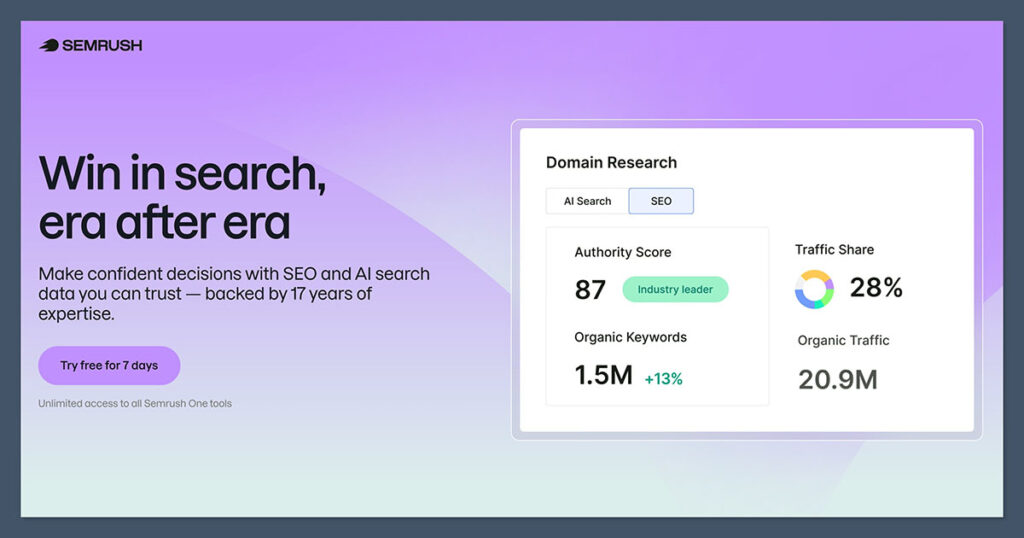
Setting up Semrush One was straightforward if you’re already familiar with Semrush. After logging in, I was prompted to connect my domain, set up a project, and configure keyword tracking.
The AI visibility features are integrated into the main navigation rather than being tucked away in a separate product, which makes it easy to jump between traditional SEO reports and AI-specific data.
What immediately stood out was the unified workspace. Instead of toggling between rank tracking in one tool and checking AI mentions in another, I could see both in a single view.
For a term where my test site ranked in Google’s top five, Semrush One showed me that the same brand was barely referenced in AI Overviews and appeared inconsistently in ChatGPT responses. That kind of visibility gap is invisible in any traditional rank tracker.
Author’s Testing Notes
The biggest shift in using Semrush One versus classic Semrush isn’t the feature set itself, it’s the mindset. You’re no longer just tracking keyword positions. You’re evaluating your brand’s presence across an entire ecosystem of search and AI experiences.
It requires strategic thinking, not just feature toggling, and teams that aren’t ready for that shift may not extract full value from the AI side.
Key Features of Semrush One
AI Visibility Tracking
This is the headline feature that separates Semrush One from classic Semrush. You can monitor how often your brand, specific products, or individual URLs appear in AI-generated answers across Google AI Overviews, ChatGPT, Gemini, Perplexity, and other supported LLMs.
The AI share of voice metric is particularly useful for competitive benchmarking. I could see exactly how my test brand compared to three direct competitors inside AI-generated responses, broken down by query type and platform. This is data you simply cannot get from a standard rank tracker.
Prompt Discovery and Tracking
Prompt discovery lets you find the natural-language questions and prompts that surface your brand in AI tools, as well as the ones where competitors get cited instead. I could track these daily and spot shifts in visibility as AI models updated their responses.
This feature works best when you approach it as a content strategy input. The prompts that surface competitors but not you are effectively a gap analysis for AI-era content planning.
AI Sentiment and Brand Analysis
Semrush One assesses sentiment in AI answers mentioning your brand, categorizing mentions as positive, neutral, or negative. You can compare this directly against how competitors are framed in the same answers.
In practice, I found this useful for identifying reputation risks. If an AI tool consistently frames your product as “expensive” or “complex” while positioning a competitor as “affordable” or “easy to use,” that’s a content and messaging problem you can actually address.
AI-Enhanced Site Audits
Site audits in Semrush One go beyond the standard technical checks (crawl errors, Core Web Vitals, on-page issues). They now incorporate AI-driven recommendations that evaluate how well your content structure, relevance signals, and metadata align with what generative AI systems tend to surface.
Author’s Testing Notes
The AI-enhanced audit recommendations are interesting but still feel like early-stage guidance. Some suggestions were actionable (improving content structure for AI citation likelihood), while others were vague enough to be hard to prioritize. I’d treat these as directional signals rather than a definitive playbook, at least in the current version.
Integrated Content Workflows
Semrush One ties AI visibility data into its existing content workflow tools. Topic selection, brief creation, and optimization guidance all pull from combined SEO and AI performance data, so you can plan content that targets both organic rankings and AI citations in the same workflow.
This is a meaningful efficiency gain if you’re producing content at volume. Instead of building separate keyword and prompt research workflows, everything feeds into one pipeline.
Full SEO Toolkit
The complete Semrush SEO stack is included in every Semrush One plan:
- Keyword research with search volume, keyword difficulty, SERP features, and intent classification
- Competitor domain analysis and traffic analytics
- Position tracking by keyword, location, and device (now with AI Overview monitoring built in)
- Technical site audits covering crawl health, Core Web Vitals, and on-page issues
- Backlink analytics and CRM-style link building and outreach tools
- Content tools for topic research, content templates, and SEO writing assistance
These are established, well-tested features that haven’t been diluted in the transition to Semrush One. If you’re already using classic Semrush for SEO, the toolkit you rely on is still there.
How Much Does Semrush One Cost?
Semrush now offers two tracks: the newer Semrush One tiers (the flagship bundle) and the older classic Semrush plans (Pro, Guru, Business), which are now positioned as “SEO Classic” options focused purely on traditional SEO.
Semrush One Pricing
| Plan | Monthly Price | What’s Included |
|---|---|---|
| Starter | ~$199/month | Full SEO toolkit + AI visibility monitoring, entry-level keyword and prompt limits |
| Pro+ | ~$249.95/month | Higher caps on tracked keywords, prompts, projects, and user seats |
| Advanced | ~$499.95/month | Expanded limits for agencies and large teams, advanced reporting |
| Custom | Contact sales | Enterprise-grade limits, negotiable pricing |
All Semrush One plans include AI visibility tracking as a core feature. Higher tiers increase the caps on tracked keywords, AI prompts, projects, user seats, and reporting limits.
A 14-day free trial is commonly available through partner and affiliate offers, which gives you enough time to test the AI features before committing.
If you only want the AI visibility features without the full SEO suite, Semrush also offers a standalone AI visibility product at roughly $99/month per domain.
Classic Semrush Pricing (SEO Only)
| Plan | Monthly | Annual (per month) | Projects | Tracked Keywords |
|---|---|---|---|---|
| Pro | ~$139.95 | ~$117.33 | 5 | 500 |
| Guru | ~$249.95 | ~$208.33 | 15 | 1,500 |
| Business | ~$499.95 | ~$416.66 | 40 | 5,000 |
Annual billing saves roughly 17% compared to paying month-to-month. Classic plans do not include AI visibility features.
Keep in mind 💡 Semrush sells several add-ons (Local, .Trends, Social, Agency Growth Kit, ImpactHero) that can significantly increase your total spend. Factor these in when budgeting, especially if you’re comparing Semrush One against alternatives that bundle more features at a lower base price.
Is Semrush One Good Value for Money?
That depends almost entirely on whether AI visibility tracking matters to your team right now. The price jump from classic Pro ($139.95/month) to Semrush One Starter ($199/month) is about $60/month, and what you get for that delta is the entire AI visibility suite: prompt tracking, AI share of voice, sentiment analysis, and AI-enhanced audits.
For teams actively investing in AI search strategy, AEO, or generative engine optimization, that’s a reasonable premium for data you can’t get anywhere else in one integrated platform. For teams that only care about Google rankings today, classic Semrush Pro or Guru covers the essentials at a lower price.
Author’s Testing Notes
If AI visibility isn’t on your roadmap yet, start with classic Semrush Pro at $139.95/month. You’ll get a powerful SEO toolkit that covers keyword research, rank tracking, site audits, and backlink analysis.
You can always upgrade to Semrush One later when AI search becomes a priority for your business. The AI visibility data is valuable, but only if you’re ready to act on it.
Semrush One vs Classic Semrush
This is the core question many existing Semrush users will have: do I actually need to upgrade to Semrush One, or is classic Semrush still enough?
| Aspect | Semrush One | Classic Semrush (Pro/Guru/Business) |
|---|---|---|
| Core focus | Unified SEO + AI visibility across SERPs and AI assistants | Traditional SEO data and tools only |
| AI visibility | Full monitoring across AI Overviews, ChatGPT, Gemini, Perplexity | Not included |
| Prompt tracking | Discover and track prompts that surface your brand or competitors in AI answers | Not available |
| AI sentiment | Sentiment analysis for brand mentions inside AI-generated responses | Not offered |
| Site audits | Traditional technical audits + AI-enhanced recommendations | Standard technical and on-page audits |
| Content workflows | Combined SEO + AI data feeding into topic selection and optimization | SEO-only content tools |
| Starting price | ~$199/month (Starter) | ~$139.95/month (Pro) |
| Best for | Teams tracking visibility in both SERPs and AI ecosystems | Users focused on Google rankings and classic SEO metrics |
The short answer: if your brand competes for visibility in AI answers, and your team has the strategic capacity to use AI visibility data, Semrush One is a meaningful upgrade.
If you’re focused purely on organic search rankings and traffic, classic Semrush still delivers excellent value without the AI premium.
Who Should Use Semrush One?
Semrush One is ideal for:
AEO and AI search-focused teams. If you’re optimizing for AI Overviews, ChatGPT citations, Gemini responses, or Perplexity mentions, Semrush One is one of the most comprehensive platforms for tracking that performance in one place.
Mid-to-large agencies. Agencies managing multiple client projects benefit from unified SEO and AI reporting. Being able to show clients their AI share of voice alongside traditional rankings adds a new layer of strategic value to client deliverables.
In-house teams at content-heavy companies. Ecommerce brands, SaaS companies, and publishers that produce a high volume of content can use the integrated workflow to plan content targeting both organic and AI-driven discovery channels.
You might be better with classic Semrush if:
You’re a solo blogger or small site on a tight budget. Classic Semrush Pro or even a cheaper alternative already covers the SEO basics. Paying for AI visibility data you won’t act on is wasted spend.
Your stakeholders only care about Google rankings right now. If AI search isn’t on the radar yet and nobody is asking about ChatGPT or Gemini visibility, the AI features will sit unused.
How We Evaluate AI Visibility Platforms
To bring you fair and accurate reviews, we evaluate AI visibility and SEO platforms through hands-on testing across multiple areas. Here’s how we weight our assessment:
| Area | Weight | What We Assess |
|---|---|---|
| AI Visibility Features | 25% | Coverage of AI platforms, prompt tracking depth, sentiment accuracy, share of voice metrics |
| SEO Toolkit | 25% | Keyword research, rank tracking, site audits, backlink tools, content features |
| Data Accuracy and Freshness | 15% | How often data refreshes, reliability of metrics, consistency across platforms |
| Usability | 15% | Interface clarity, workflow integration, learning curve, dashboard customization |
| Pricing and Value | 10% | Cost relative to features, plan flexibility, limit generosity, hidden costs |
| Support | 10% | Documentation quality, response times, available channels, community resources |
Semrush One Review: Is It Worth It?
Semrush One is the most comprehensive platform I’ve tested for tracking brand visibility across both traditional search and AI-generated answers.
It takes Semrush’s already strong SEO foundation and layers on AI visibility tracking, prompt discovery, sentiment analysis, and AI-enhanced audits that you genuinely cannot get from classic SEO tools.
The trade-off is price and complexity. At ~$199/month for the Starter tier, it costs more than classic Semrush Pro, and the unified interface takes time to learn. Add-ons can push the total spend higher still.
If AI search visibility is a strategic priority for your team, Semrush One delivers real, actionable intelligence that justifies the premium. If you’re focused purely on Google rankings, classic Semrush remains a strong, more affordable choice.
A 14-day free trial is available through most partner offers, so you can test the AI features hands-on before committing.
FAQ
What is Semrush One?
Semrush One is Semrush’s flagship platform that bundles the full SEO toolkit (keyword research, site audits, rank tracking, backlinks, content tools) with a dedicated AI Visibility Toolkit. It lets you track your brand’s presence across traditional Google SERPs and AI-generated answers in tools like ChatGPT, Gemini, Perplexity, and Google AI Overviews, all from a single workspace.
How is Semrush One different from classic Semrush?
Classic Semrush plans (Pro, Guru, Business) focus on traditional SEO data and features. Semrush One adds AI visibility tracking, prompt discovery, AI sentiment analysis, and AI-enhanced site audits on top of the full SEO toolkit. The core SEO features are the same; the difference is the AI layer.
How much does Semrush One cost?
Semrush One starts at roughly $199/month for the Starter tier. Pro+ is about $249.95/month, Advanced is around $499.95/month, and enterprise-level Custom pricing is available by contacting sales. All tiers include AI visibility features. A 14-day free trial is commonly available.
Can I buy AI visibility features without the full SEO suite?
Yes. Semrush offers a standalone AI visibility product at approximately $99/month per domain for teams that only want AI tracking without the broader SEO toolkit.
Is Semrush One worth it for a small business or solo blogger?
For most small sites or solo bloggers, the cost is hard to justify unless AI search visibility is a core part of your strategy. Classic Semrush Pro at ~$139.95/month or more affordable alternatives will cover standard SEO needs. Semrush One makes the most sense for teams actively optimizing for AI-driven discovery.
Which AI platforms does Semrush One track?
Semrush One tracks brand visibility across Google AI Overviews, Google AI Mode, ChatGPT, Gemini, Perplexity, and other supported LLMs. Coverage continues to expand, though availability may vary by geography and AI platform.
Does Semrush One replace other SEO tools?
For most teams, Semrush One can serve as a primary SEO and AI visibility platform, reducing the need for separate tools. However, you may still want complementary tools for specific use cases like local SEO, social media management, or markets where Semrush’s AI coverage is limited.

Comments 0 Responses