

Quick verdict: If you want one alternative to Originality.AI that solves the biggest problem (false positives), go with Pangram. It catches AI-generated content as well as Originality.AI does, but it’s far less likely to flag genuine human writing as machine-made. GPTZero is the better pick for educators and quick classroom checks, Winston AI is worth using when you need to scan PDFs, scans, or images, and Copyleaks makes the most sense for multilingual teams and institutions with LMS or API needs.
I don’t think Originality.AI is a bad tool, even if I’ve complained about it a few times in the past. A lot of publishers use it, so naturally, I’ve used it a lot myself. I just don’t trust it 100 percent. Really, I wish more people felt the same way.
Originality.AI is good at a lot of things. It’s very good at detecting machine-generated content, particularly if people are using models from OpenAI, or Anthropic. It can scan full websites at once, provide people with sentence-level color-coded reports, and even combine AI detection with plagiarism insights and readability analysis. All good things.
What got me looking for Originality.AI competitors was really one main thing: the issue with false positives. A lot of platforms have that problem, but Originality.AI seems to struggle with it worse than most in some categories.
So I tested the alternatives I’d actually consider using instead of Originality.AI, particularly when I want to avoid accusing someone of being more dependent on LLMs than they actually are.
The Best Originality.AI Alternatives at a Glance
First, I want to point out that I do still recommend Originality.AI to some people. Anyone running a publishing team, checking hundreds of outsourced articles or documents at once, or trying to get a quick read on whether content has been “overly” influenced by AI can still benefit from it.
My issue is that this tool just feels a bit too eager, like it’d rather assume everything is GPT-created than give humans any benefit of the doubt. Case in point, I once ran a poem written in 2018 through Originality.AI and it still said it had a 30% chance of being machine written.
So when I went looking for these alternatives I decided to look beyond features and accuracy. I wanted to find a system I could trust to avoid false positives just as much as it tried to avoid “false negatives”. Here’s what I ended up with:
| Tool | Best For | Why It Stands Out as an Originality.AI Alternative | Main Trade-Off |
|---|---|---|---|
| Pangram | Best overall; teachers, publishers, moderators, high-stakes review | More careful with false positives, stronger on AI assistance, and better suited to rewritten or humanized AI text | Free usage is limited; very short snippets are still awkward |
| GPTZero | Education, students, quick checks | Easier to try, more classroom-friendly, and useful for Google Docs-style review | Less convincing on rewritten or heavily edited AI text |
| Winston AI | OCR, PDFs, scans, images, reports | Handles source material that doesn’t sit neatly inside a webpage or clean document | Less independent accuracy evidence than Pangram |
| Copyleaks | Multilingual teams, institutions, LMS/API users | Broader language support, strong plagiarism roots, and better institutional workflow options | Credit-based pricing takes a minute to understand; false positives still need caution |
The Best Originality.AI Alternatives
I know there’s a lot of AI detectors and tools similar to Originality.AI out there, so it might seem odd that I’m only mentioning four options here, but I wanted to keep these suggestions specific, each one is very good at addressing one specific problem, sometimes more than one problem, better than Originality.AI in my opinion. So here we go.
1. Pangram: Best Originality.AI Alternative Overall
Starting price: Free plan; paid plans from $20/month
Best for: Teachers, publishers, moderators, trust teams, and anyone nervous about false accusations
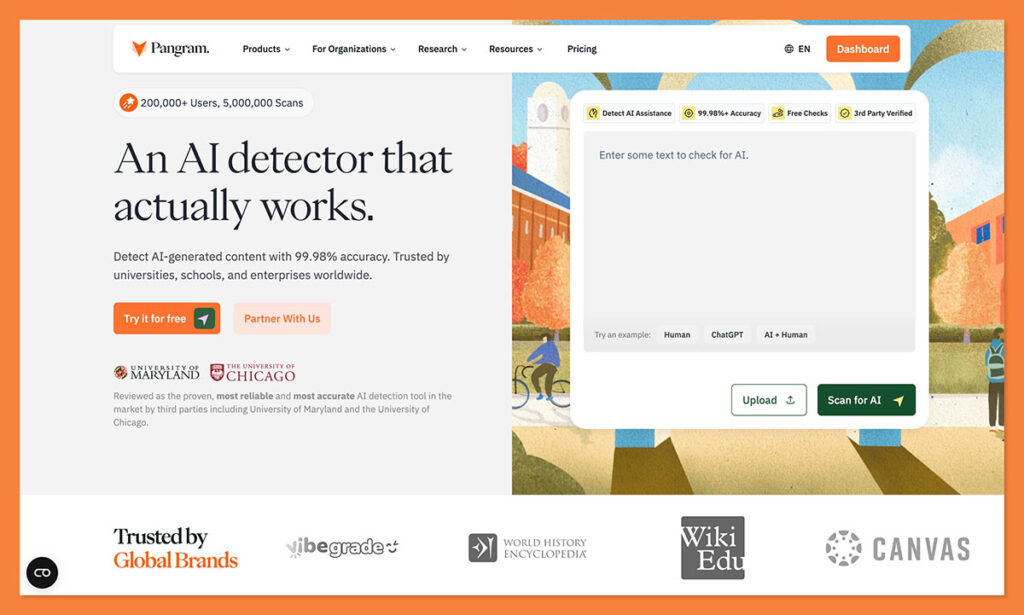
If you’ve read my other AI detection tool reviews, the fact that I’ve put Pangram first probably isn’t a surprise. It’s the only platform so far that’s really made me feel genuinely better about the category in general. Pangram isn’t “gentler” than other platforms in a bad way. It doesn’t let obvious AI slop go through it’s system undetected to make lazy writers feel better.
However, it also doesn’t commit to the belief that the only good AI detector is the one that accuses everything of being machine-made. It looks for evidence of human life just as much as it searches for AI nonsense. That makes it different to Originality.AI right away.
There’s research behind that too. University of Chicago researchers compared Pangram, OriginalityAI, GPTZero, and RoBERTa, and found Pangram achieved near-zero false positive and false negative rates in their test set. The working paper also says Pangram was the only detector that met a strict false-positive cap of 0.5% without losing its ability to detect AI text.
Oh, and the detection itself is great too, Pangram can tell you when something is pure AI slop, rewritten AI, humanized AI, or “AI assisted”. It also has a Chrome extension, so you can review content right there on a web page rather than copy-pasting everything. All around, it’s the most straightforward, efficient, and reliable alternative I tried.
Pros
- Very low false-positive profile
- Strong independent evidence
- Detects AI assistance and humanized AI
- Chrome, Google Docs, LMS, and API support
- Plagiarism detection on paid plans
- More useful reporting than a plain percentage score
Cons
- Free usage is limited
- Short snippets are still harder to judge
- Not built around publisher-style site scanning the way Originality.AI is
2. GPTZero: Best for Quick Checks and Educators
Starting price: Free plan available
Best for: Teachers, students, schools, and quick checks
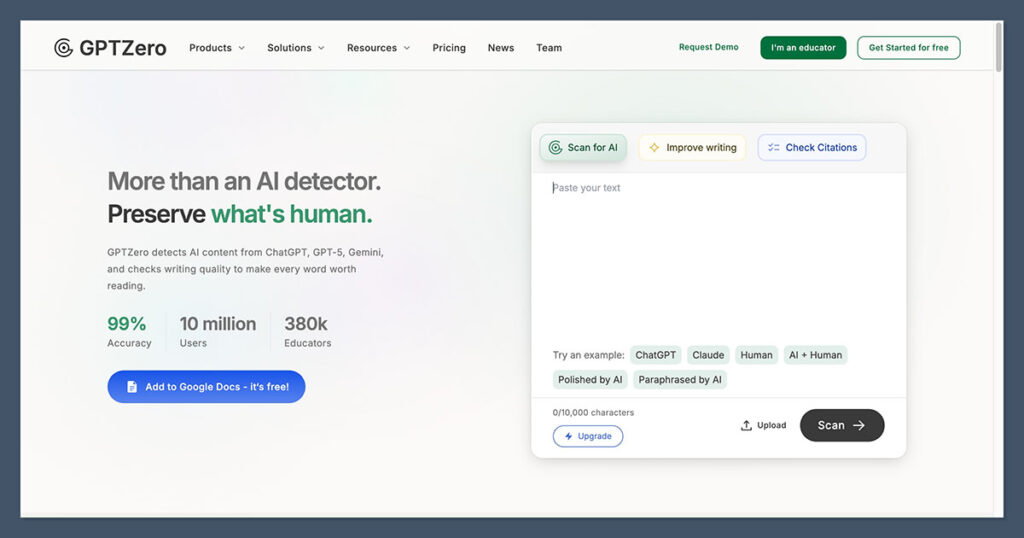
I think GPTZero is usually the AI detector most people try first, even before Originality.AI. I can see why. It’s accuracy claims are really impressive (sometimes averaging around 99.3%), and the false positive rate is lower than you’d get from Originality.ai too, just not as good as Pangram.
GPTZero doesn’t have the same full-site scanning features as Originality.AI, and there are no “readability” scores, but plagiarism detected is included. It also gives you very useful insights when it detects machine-written content, so you’re not just making assumptions based on percentages.
On top of that, it’s very accessible. Nobody I know has had a problem figuring out how this tool works, and the free plan makes it easy to test. You get up to 10,000 words worth’ of checks per month, and you can even scan content that includes multiple languages.
Still, it’s not perfect. It’s good at simple checks, less good at understanding if text has been written, paraphrased, or cleaned up after a GPT has been involved. It’s also not that great at analyzing short snippets of copy, but that’s true of a lot of these platforms.
For a quick classroom check, a student draft review, or a first pass on suspicious text, it’s genuinely useful. For a serious academic integrity case, I’d want something else, like Pangram.
Pros
- Very generous free plan
- Easy to use
- Strong fit for schools and students
- Chrome and Google Docs workflows
- Sentence-level feedback
- Very good at detecting pure AI content
Cons
- Struggles with rewritten or humanized AI
- False positives are still a problem
- Not so great with short text snippets
3. Winston AI: Best for Flexible Inputs
Starting price: Free 14-day trial; paid plans from $18/month
Best for: PDFs, scans, screenshots, handwriting, image checks, and shareable reports
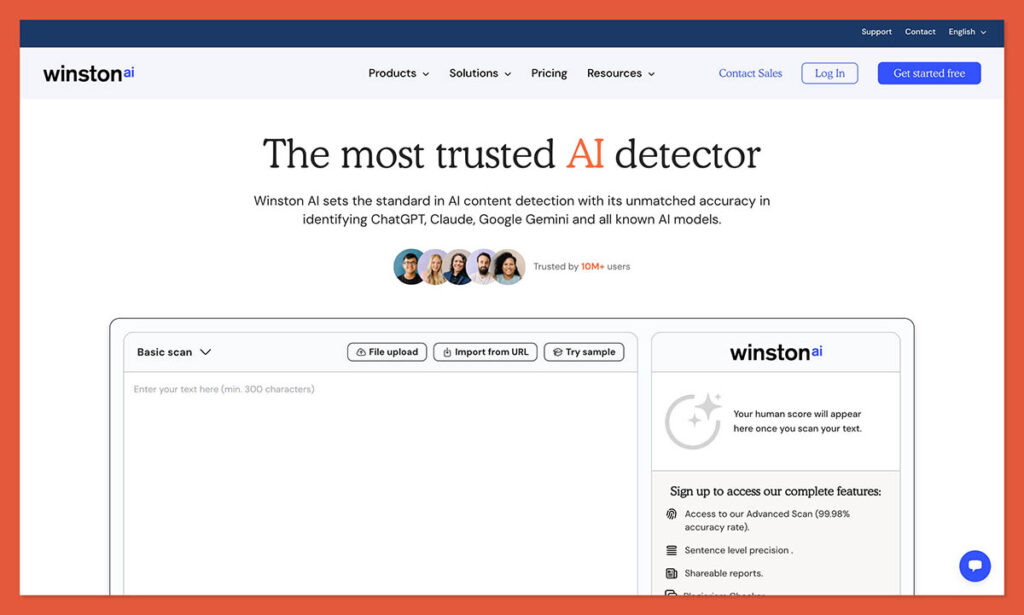
Winston AI is another tool I’ve started to like a lot more these days, mainly because it’s a lot more flexible than most of the other options in this list. Most platforms only look for AI-generated text, Winston can look for machine-made images too, thanks to its OCR capabilities.
The feature list here is pretty decent too. You get AI content detection (obviously), plagiarism detection, deepfake detection, browser scanning, writing feedback, and shareable PDF reports. The free plan isn’t huge (only 2,000 credits for 14 days), but you still get a good initial test out of that.
Winston also claims 99.98% accuracy for detecting AI content from tools like ChatGPT, Gemini, and Claude. I’m always a bit suspicious of claims like that, because accuracy rates can vary depending on who you talk to, but it’s still a good sign.
Again, though, there are a few problems to be aware of. Winston can get expensive fast with it’s credit system, and the false positives are still a major issue you have to watch out for. I’d be happy using it as a flexible review tool. I’d be more cautious using it as the only proof in a serious dispute.
Pros
- Valuable OCR for pictures, scans, and handwriting
- Includes plagiarism detection and shareable PDF reports
- Decent accuracy for machine-generated content detection
- Reasonably user-friendly interface
- Useful insights into readability
Cons
- Still has issues with false positive
- Can struggle to detect heavily edited AI text
- Doesn’t have many integration options
4. Copyleaks: Best for Multilingual and Institutional Checks
Starting price: Credit-based; paid plans vary
Best for: Multilingual teams, schools, institutions, recruiters, LMS users, and API workflows
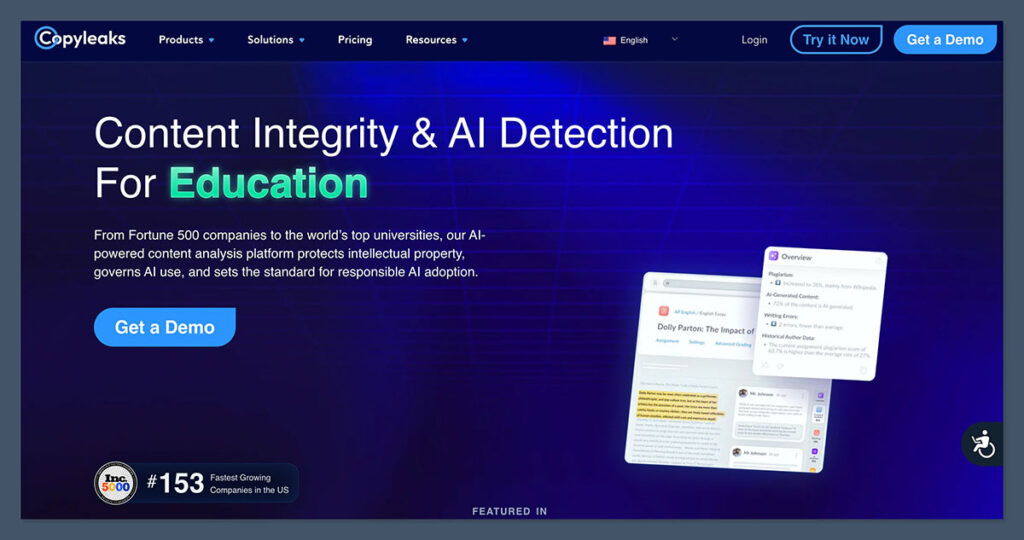
Honestly, Copyleaks feels like it belongs to a different part of the market than Originality.AI, but that’s mainly why I wanted to include it. It didn’t start off focusing on finding GPTisms in copy, it was just a (very useful) plagiarism detection tool. It’s still very good on that front, now it just scans for AI content at the same time.
Like a lot of the alternatives mentioned here, Copyleaks is impressively good at finding copy that’s been produced entirely by a machine. It’s even better than most at doing that on a global scale, because it supports more than 30 languages.
I also love that it has a mobile app, and can connect with tools like Moodle and Canvas, which makes it ideal for some educational teams. The reports are good too, with sentence-level highlighting that even checks for machine content that’s been altered by a human.
Still, it’s more expensive than quite a lot of other detectors, and not quite as agile if you’re analyzing big chunks of copy at once. Plus, again, false positives are still a problem, particularly if human writing is particularly formal or technical.
Pros
- Strong multilingual coverage
- AI and plagiarism detection in one place
- Good fit for schools, recruiters, and larger organizations with LMS and API support
- Reasonably detailed reporting
- Can detect (usually) when AI content has been edited
Cons
- Can get expensive to use quickly
- False positives are a problem again
- Not the fastest tools for large checks
Final Verdict: The Best Originality.AI Alternative
Really, I’d still keep Originality.AI around for the average content team. It’s fast and efficient, and it’s easy to use as part of a team. It’s just not the number one AI content detector for every case.
GPTZero is great if you want something affordable, and easy to use, Winston is better if you want to check for AI influence in more than just written text, and Copyleaks is what I’d pick if I was looking for multilingual reviews and in-depth plagiarism insights.
If I had to narrow it down to one best alternative overall though, it’s Pangram. It gives you the same simplicity as Originality.AI, excellent insights into AI-generated content, fantastic plagiarism detection, and a Chrome extension.
It also makes it less likely you’ll accuse someone of something they didn’t do, with the lowest false positive rate I’ve seen so far. That’s what makes it the best pick for me, the idea that I can be confident that I’m spotting machine influence, without just assuming that everyone’s relying on GPTs far too much.

Comments 0 Responses