

I’ve used Copyleaks for a while now, mostly for quick plagiarism checks when I’m reviewing other work. It’s still very good on that front. Compared to most tools, Copyleaks gives you a lot of the stuff you actually need when you’re “checking” content. It integrates with Learning Management Systems like Moodle and Canvas, and offers pretty good sentence-level reports.
It’s also one of the more versatile options out there, because it supports multiple languages (a lot of detectors still get stuck on English).
What really pushed me to start looking at alternatives were the AI detection features. They’re not terrible. Copyleaks often gets mentioned as one of the most accurate options for identifying AI-generated and even hybrid (human + machine) content.
It also goes beyond the basic “AI” or “not AI” score most cheaper tools give you. But it does have a lot of problems. Occasional false negatives happen (like with most AI detector tools), the free tier is pretty limited, and the potential for false positives is far higher than I’d like.
That’s the main problem really. When I’m using an AI detection tool, I’m not desperately trying to “catch someone out” for using ChatGPT, and I don’t want to accuse someone of generating slop without much real evidence. So, that’s why I started looking around.
The Best Copyleaks Alternatives: My Picks
Most tools that bundle plagiarism, AI detection, and similar tools into one kit struggle with the same drawbacks these days. Nothing you use is going to be 100% accurate. Nothing is going to be perfect for every task. It makes comparing options a bit tougher, really.
You used to compare tools like Copyleaks to other platforms based on the size of their database, the reporting, and the integrations. Now, you’re trying to figure out whether they’re really accurate when they’re flagging AI content, and how often they surface false positives.
So, I kept things pretty simple with my tests. I ran a few “copied” and “unique” articles through these tools, and also checked the AI detection features, by seeing how they responded to:
- 100% human-written content, written before ChatGPT
- Humanized (rewritten) AI content
- Content written with AI help
- Fully AI-written content
Here’s the shortlist I ended up with:
| Tool | Accuracy (real-world) | False positive risk | Best for | Where it beats Copyleaks |
|---|---|---|---|---|
| Pangram | Very strong on mixed + human text | Extremely low | Education, moderation | More careful judgments, better with rewritten AI |
| Originality.AI | Strong on obvious AI | Medium to high | Content teams, agencies | Site scanning, workflow tools |
| Copyscape | Excellent for exact matches | Medium | SEO, bloggers | Simpler plagiarism checks |
| GPTZero | Inconsistent outside simple cases | Medium | Students, basic checks | Free plan, ease of use |
1. Pangram: Best Copyleaks Alternative for Accuracy and Trust
Starting price: Free trial, from $20/month
AI detection: Yes
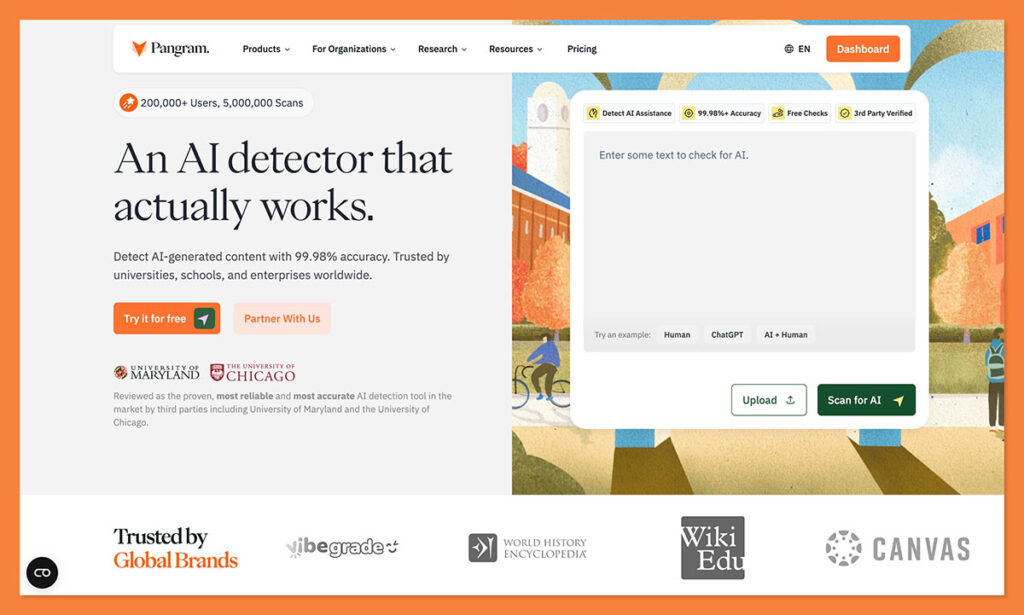
I’m not shy about claiming Pangram as my favorite AI detector. It’s the only one I’ve used that doesn’t make me nervous about every result. That’s not because it doesn’t take finding machine generated content seriously, it just feels a lot less “keen” to suggest everything is AI.
In fact, it has one of the lowest (closest to zero) false-positive scores of any tool on the market, backed up by studies from groups like the University of Chicago. It still does incredibly well at recognizing when something was produced by a tool like ChatGPT, and it can even flag when “some” parts of a piece of content feel more AI-like than others.
It also works better than most tools when it comes to picking up on humanized, or paraphrased text, and AI-assisted content. The plagiarism detection is less of a “core” feature with Pangram than it is with Copyleaks, but I didn’t have any problems with accuracy there either. Also, it supports 20 languages (less than Copyleaks, but more than most).
Obviously, it does have a few downsides, like limited file support, and slightly more expensive pricing at scale. Still, I think it’s the best “all-in-one” option out there if you’re sick of defending yourself when someone proves you’ve hit them with a false accusation.
Pros:
- The lowest false positive rates I’ve seen
- Very good plagiarism detection
- Detects AI-assisted and rewritten text
- Very clear, easy-to-explain results
- Good integrations with LMS tools
Cons:
- Can struggle with short pieces of text
- Limited free plan
2. Originality.AI: Best Copyleaks Alternative for Content Teams
Starting price: $14.95/month
AI detection: Yes
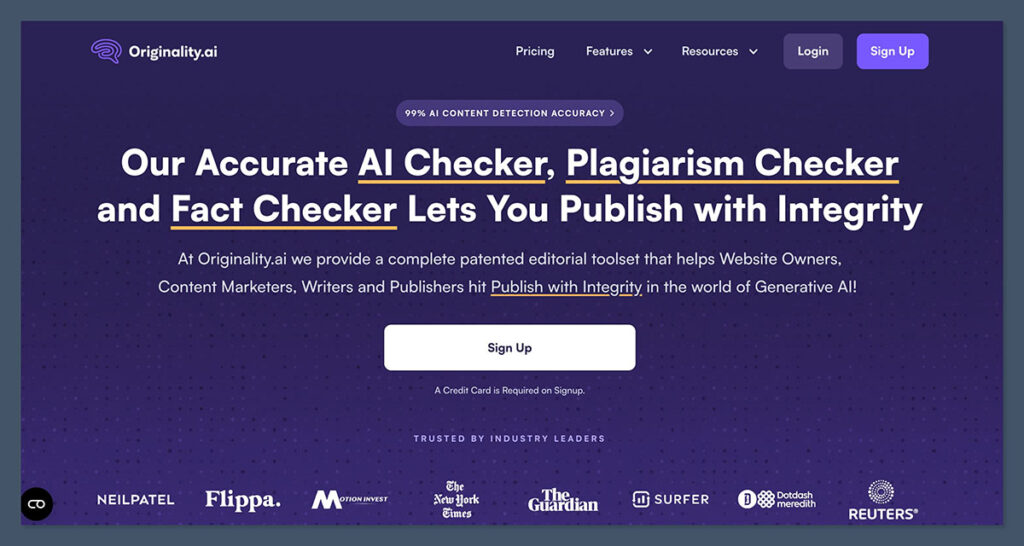
Originality AI is something I’ve kept coming back to for a while now, mostly because the majority of companies I work with already use it. Similar to Pangram, it mostly focuses on detecting AI slop, but it does bundle plagiarism detection and readability insights into the same tool.
In terms of overall accuracy, Originality.AI is about on par with Copyleaks for both plagiarism and AI detection. I do think it’s a bit more prone to false positives than a lot of other tools, though, particularly when you’re reviewing more “creative” writing. Originality sometimes seems to think that anything that isn’t “crisp and concise” might be AI.
It’s also not the best at explaining why something gets flagged. You basically just get a percentage score and a few suggestions, not a real explanation of why something sounds bot-like.
Where it probably has the biggest edge over Copyleaks is how easy it is to check a lot of content at once. You can use the URL scanner to check through entire websites or live pages in a couple of seconds. There are also both subscription and pay-as-you-go options, which is helpful if you prefer flexibility in pricing.
Compared to Copyleaks, this feels less balanced but more productive. You get more tools, more speed, more coverage. You also take on a bit more risk when you’re interpreting results.
Pros
- AI, plagiarism, and readability in one tool
- Site-wide scanning is genuinely useful
- Good for teams and collaboration
- Fast and easy to use
Cons
- Higher false positive risk
- Struggles with paraphrased content
- Pricing adds up with volume
3. Copyscape: Best Copyleaks Alternative for Pure Plagiarism Checks
Starting Price: Pay-as-you-go
AI detection: No
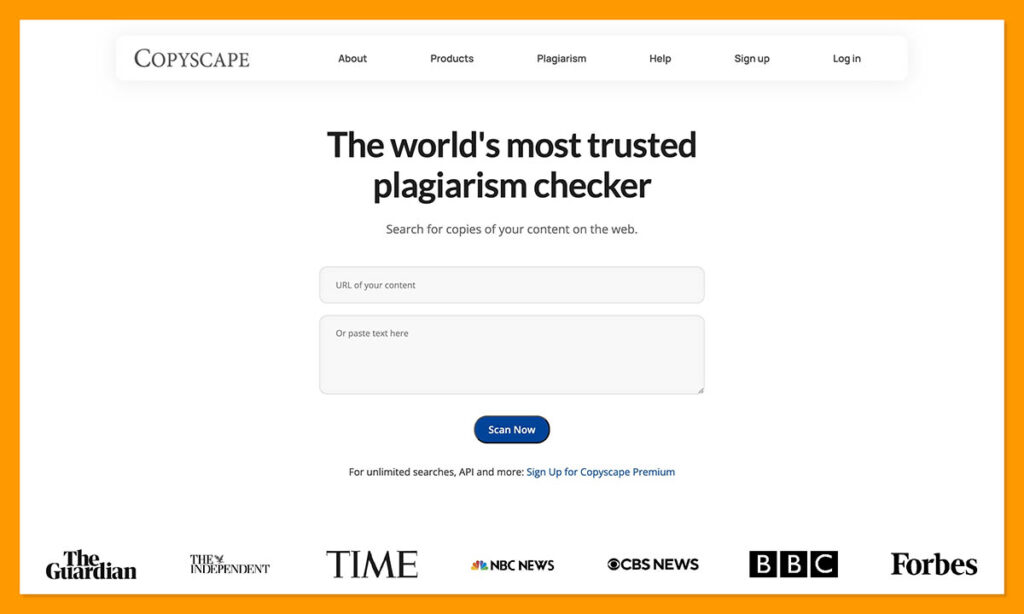
If you didn’t know, Copyscape does have a “Premium AI detector” now, if you’re using the paid plan. I still don’t use it much for that, though. I haven’t really been able to find much information online about how Copyscape generates its “scores”, which is worrying.
When I tried it myself, it seemed to have a real problem with false positives, particularly if content sounds conversational, or uses things like bullet points. It also didn’t really pick up on the AI content I had rewritten very well.
Still, if you’re trying to avoid falling into the AI detection rabbit hole, and you just need help checking for plagiarism, Copyscape is one of the best options out there. I use it all the time to double-check articles. It’s quick, affordable, and easy to use. Plus, there’s an API so you can integrate it into whatever workflow you already have.
I do wish there were more features though. Copyscape seems to have jumped straight into (very basic) AI detection without looking for things like grammar checking, or readability analysis. It also tends to deliver very broad results sometimes, flagging something like a copied URL as plagiarised.
Pros
- Quite accurate for direct plagiarism
- Fast and simple to use
- Pay-as-you-go pricing works well for low usage
- Reliable API for automation
Cons
- No meaningful AI detection
- Limited features beyond plagiarism
- Can miss paraphrased content
4. GPTZero: Best Free Copyleaks Alternative
Starting price: Free plan available
AI detection: Yes
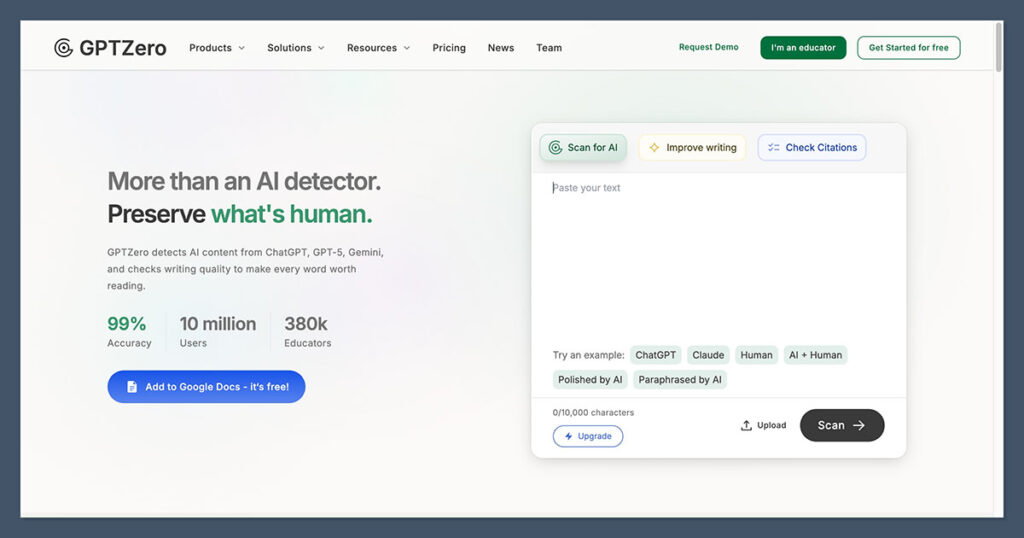
GPTZero is one of those tools people try first, mostly because you can use it for free. It’s clearly very popular, and it doesn’t have the worst accuracy scores I’ve seen, just not the best either. One report showed a detection accuracy of about 87% across various models. Shorter snippets got worse results.
That being said, it does it’s job reasonably well in some areas. It usually catches anything that’s clearly AI-generated, and the sentence level highlights are helpful if you’re trying to figure out which phrases sound most “machine-made”.
If you’re looking for plagiarism detection, GPTZero does okay, but I think it’s pretty obvious that it’s less worried about finding “copied” text than it is about checking for AI. On the plus side, it does show you when text is fully or partially plagiarized, and the free plan works for up to 10,000 characters.
My main issue again here were the false positive scores. This tool has a very high risk of labelling human content as AI, particularly if you’re not writing in English. Overall, I’d say it’s a good affordable pick, not the most reliable one.
Pros
- Free plan is quite generous
- Easy to use with clear highlights
- Good at detecting obvious AI content
- Integrations with Docs and browser tools
Cons
- Weak on rewritten or paraphrased AI
- Less reliable on human writing
- Plagiarism detection is limited
Which Copyleaks Alternative Is Best?
Honestly, I’m not sure there’s a single perfect alternative for Copyleaks, or one best AI and plagiarism detection tool overall, really. Copyscape still works well for plagiarism if that’s all you want. Orginality.AI is good for scanning lots of content at once (if you don’t assume it’s 100% accurate). Even GPTZero is still pretty decent if you want an affordable starting point.
If I had to pick one to really recommend, it’s probably Pangram. It keeps up with Copyleaks for plagiarism detection, still offers integrations, and still gives you a decent number of language options. What it really does better is make AI detection less black and white.
You can see more of where AI “helped out” in content, understand where machine and human text have been blended, and detect AI slop without constantly reacting to false positives. That makes it the most trustworthy, and least problematic tool here in my book.

Comments 0 Responses