

For most small and mid-sized businesses, HubSpot AI (Breeze) will deliver faster results with less overhead than Salesforce Einstein.
If you’ve read any of my articles here before, you already know that I spend more time than most experimenting with AI. My whole job revolves around figuring out what kind of “AI-powered tools” actually help people these days, and which ones just give them another headache to navigate.
What you might not know is that I genuinely believe some of the software we’ve been using in businesses forever, actually should have been AI-infused years ago. CRM systems are a great example. Doesn’t matter if you’re a freelancer, or the owner of a multi-national business, managing relationships with customers is hard work. AI takes a lot of the pressure off – when it’s used properly.
Most business owners agree with me. 65% of businesses are already running AI-powered CRMs, and those teams are 83% more likely to smash their sales goals. So, why do up to 70% of CRM projects still fail? Why are people still struggling to prove their AI investments are paying off?
Mostly, it comes down to adoption. Clever tools are only any good when people use them. That’s why when I compare something like HubSpot AI and Salesforce Einstein AI, I’m not really looking at which platform has the most powerful features. I’m looking at how likely each option is to deliver real results, in a real business setting.
HubSpot AI vs Salesforce Einstein AI: The Basics
HubSpot and Salesforce have been fighting for CRM supremacy for decades; AI just adds another weapon to the roster.
If you want my quick opinion, HubSpot’s AI (Breeze), is easily going to be the best tool for any business that wants to see results fast, without having to hire consultants or expert developers.
Salesforce, with Einstein and now Agentforce is definitely impressive, but it still faces the same problems you might have faced if you were comparing Salesforce and HubSpot before today, looking for the right CRM. It’s complex, expensive, and way too much for most smaller companies.
What is HubSpot AI (Breeze)?
When HubSpot dropped , most people were skeptical. They were promising something most other CRM providers weren’t. This wasn’t just about bringing AI into the CRM, it was about making it actually easy to use.

Breeze AI powers every part of the platform, from the Breeze Assistant that sits in your apps and helps you write responses to emails, to custom Breeze agents (for automating end-to-end work), and Breeze Intelligence, for enhanced data insights.
HubSpot, has of course, stuck to their “MO” of keeping everything connected here. The AI connects to all the data your team already relies on, so you’re not trying to patch things together yourself.
There are tons of features to explore, from content generation tools (with content remix options to turn videos or blogs into different types of media), to AI-powered lead scoring systems.
Ultimately, HubSpot AI is perfect if you:
- Run a smaller or mid-sized business
- Want to deploy AI fast across all of your business functions
- Don’t want to hire consultants or technical staff
- Need to unify all of your data in one place
- Prioritize ease of use over everything else.
It’s not as customizable as Salesforce’s AI stack (more on that later), and it can be expensive, but it does pay off. Agicap closes 20% more deals and gives 750 hours back to customer care with Breeze. Flipsnack handles 60% fewer chats and has a better CSAT score. You get the point.
What is Salesforce Einstein AI?
Salesforce has also made some bold claims with its AI tools over the years. It described Einstein as the “AI everywhere” tool, and that’s pretty accurate.
Einstein’s woven into Sales Cloud, Service Cloud, Marketing Cloud, Commerce Cloud, basically every corner of the Salesforce office building. But it feels like walking into a skyscraper with a hundred floors, each with its own manual. Powerful, yes. Exhausting, also yes.
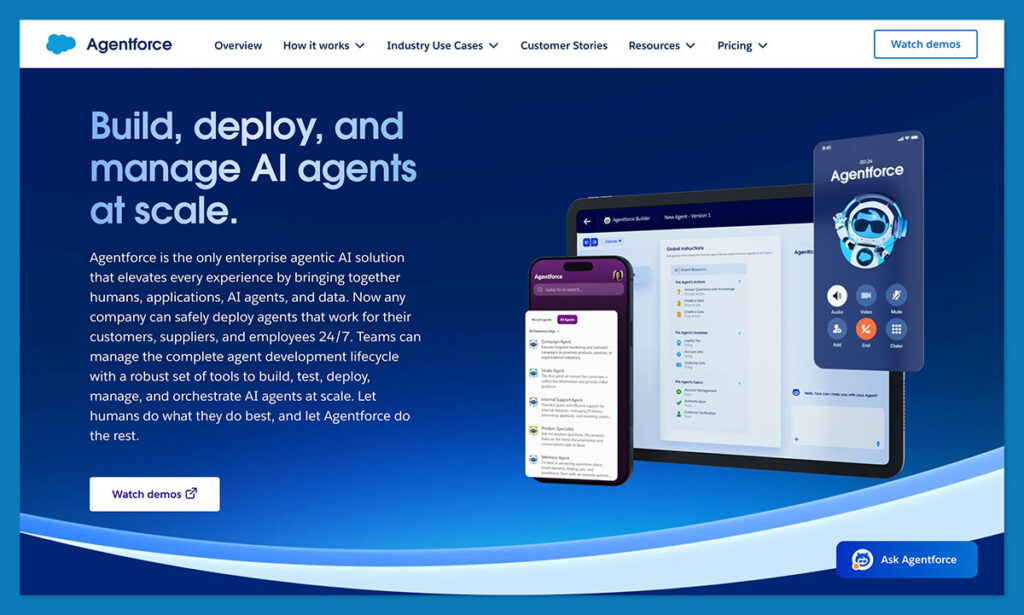
Einstein’s big pitch right now is Agentforce, the platform for building custom AI agents. You can design bots that qualify leads, generate reports, even coach reps mid-call. It’s impressive, but it’s not nearly as simple as HubSpot’s Breeze Studio. You’re probably going to need consulting and setup help. Even getting data ready can be a headache.
Predictive lead scoring, for example, doesn’t even kick in properly unless you’ve got 1,000+ leads and 120+ conversions in the last six months. That’s fine if you’re a Fortune 500 giant, but if you’re a scrappy mid-market team, it’s like being told you can’t play until you’ve already won.
That’s not to say Salesforce AI isn’t valuable. Iron Mountain hit an 80% case close rate with AI-generated replies. FPT Software boosted data quality by 90%. Reddit uses Agentforce to route inbound leads automatically, and OpenTable shaved 40% off manual data entry. Just keep in mind that big wins only come from big effort.
HubSpot AI vs Salesforce Einstein AI: Quick Breakdown
Here’s a quick breakdown to start:
| Feature | HubSpot AI (Breeze) | Salesforce Einstein |
|---|---|---|
| Best For | SMBs and mid-market teams who need speed and simplicity | Large enterprises with complex workflows and admin support |
| Setup Time | Minutes to hours, I’ve spun up agents in the same afternoon | 2–3 months typical, plus consultants if you want it done right |
| Ease of Use | 95% satisfaction rate; feels like part of the workflow | Steep learning curve; you’ll need admins or Trailhead training |
| Lead Scoring | AI scoring baked into Pro/Enterprise; works with smaller datasets | Predictive scoring, but only useful with 1,000+ leads and 120+ conversions |
| Content Generation | Blogs, landing pages, social posts, even podcasts | Mostly email templates and proposals; narrower scope |
| AI Agents | Prebuilt agents (Customer, Prospecting, Content, Knowledge Base) + multi-agent orchestration | Agentforce lets you build custom agents, but requires Enterprise tier and technical setup |
| Forecasting | Predictive analytics that surface trends without fuss | Advanced Einstein Forecasting with deep customization |
| Conversation Intelligence | Summaries and transcripts included in Sales Hub Pro+ | Add-on at $50+/user/month; more enterprise-grade |
| Integrations | 2,000+ curated apps; quality over quantity | 7,000+ AppExchange apps; breadth, but more management overhead |
| Customization | No-code/light-code tweaks anyone can handle | Apex, Flows, Model Builder: limitless, but complex |
| Pricing Model | Seats + credits ($0.01 each); predictable | Per-user + add-ons; costs stack quickly |
My Take:
- HubSpot feels like momentum. You click, it drafts, it scores, it routes. You don’t need to stop and think too hard.
- Salesforce feels like architecture. It’s brilliant if you’ve got the scale and the patience, but every win comes with a layer of setup.
That’s the split: operator-first vs system-first. Breeze is built for the people doing the work. Einstein is built for the people designing the system.
Key Features: HubSpot AI vs Salesforce Einstein
The features for both of these vendors keep evolving, so expect this guidance to change, but right now, here’s what stands out for HubSpot and Salesforce (if you ask me):
HubSpot AI
- Breeze AI Agents: Customizable, specialized agents that can automate end-to-end tasks for customer support, service, and sales teams. You can even access pre-built agents like the content agent, prospecting agent and knowledgebase agent
- AI content tools: The AI content Remix tools mentioned above are great for making your assets stretch further, while the AI Assistant can help you with drafting and fine-tuning everything from landing pages to emails
- Breeze Intelligence: The full AI suite that helps you to refine, fine-tune, and even add insights to your data, so you can make more intelligent decisions. It all works with your existing data and integrations
- Breeze Assistant: The copilot-style assistant that works alongside you, answering questions, helping you prep for meetings, and giving you a more transparent look at all the insights you’ve been gathering
- AI insights: AI-powered analytics tools, lead-scoring solutions, and reports that give you a head start when you’re dealing with complex customer relationships
Salesforce AI:
- Agentforce agents: Similar to the Breeze agents, these can complete a range of tasks for you across sales, marketing, and service functions. You can also customize them however you like with your own data, and use agents as employee copilots
- Einstein forecasting: Intelligent tools for forecasting future trends, predicting opportunities and potentially preventing churn before it happens
- Predictive Lead Scoring: Einstein doesn’t just sort your leads, it sizes them up. By sifting through signals like email opens, on-site behavior, and demographic breadcrumbs, it assigns each lead a conversion likelihood score
- Activity Capture: This feature quietly works in the background, sweeping emails and calendar events into Salesforce to keep your CRM fresh without manual logging. The catch? Einstein Activity Capture isn’t always precise. Activities don’t consistently attach to the right opportunities, which can muddy reporting
- Conversation Insights: Starting at $50 per user per month, Einstein Conversation Insights offers call analytics and keyword tracking. It gets the job done for basic call review, but if you’re chasing advanced, real-time conversation intelligence, it may feel a bit underpowered
Ease of Use & Implementation
I mentioned this above because honestly, the biggest reason AI fails to deliver results, is lack of adoption. If tools are hard to use, no-one uses them. It’s that simple. That’s why I genuinely think HubSpot AI is going to be better for most teams than Salesforce AI.
HubSpot is almost suspiciously easy to get going. You sign up, import your contacts, flip on Generative AI in Settings, and suddenly Copilot is sitting in your email editor waiting to help. I’ve had small teams go from “we should probably get a CRM” to “we’re running AI-powered campaigns” in under a week. No consultants, no architecture meetings, no endless permissions setup.
That’s why the satisfaction rate sits so high for HubSpot AI. People actually use it because it doesn’t feel like homework. You don’t need a dedicated admin; your marketing manager or sales lead can figure it out on the go. And the agents? You install them like apps. Customer Agent, Prospecting Agent, Content Agent: they’re prebuilt, so you’re not reinventing the wheel.
Salesforce AI is just like everything else in Salesforce: powerful but complicated. Einstein is powerful, but it’s not plug-and-play. Most implementations I’ve seen take two to three months, and that’s with admins or consultants guiding the process. You’re defining objects, permission sets, validation rules, and flows before you even get to the really good stuff.
Add in Agentforce, and things just get more complex. More planning, more guardrails, more figuring out which agent does what. It’s amazing once you get it up and running, but it all takes time.
Pricing & Total Cost of Ownership
I wish I could say one option was “way more” affordable than the other. Truthfully, they can both be expensive, what’s different is how easy it is to manage your budget.
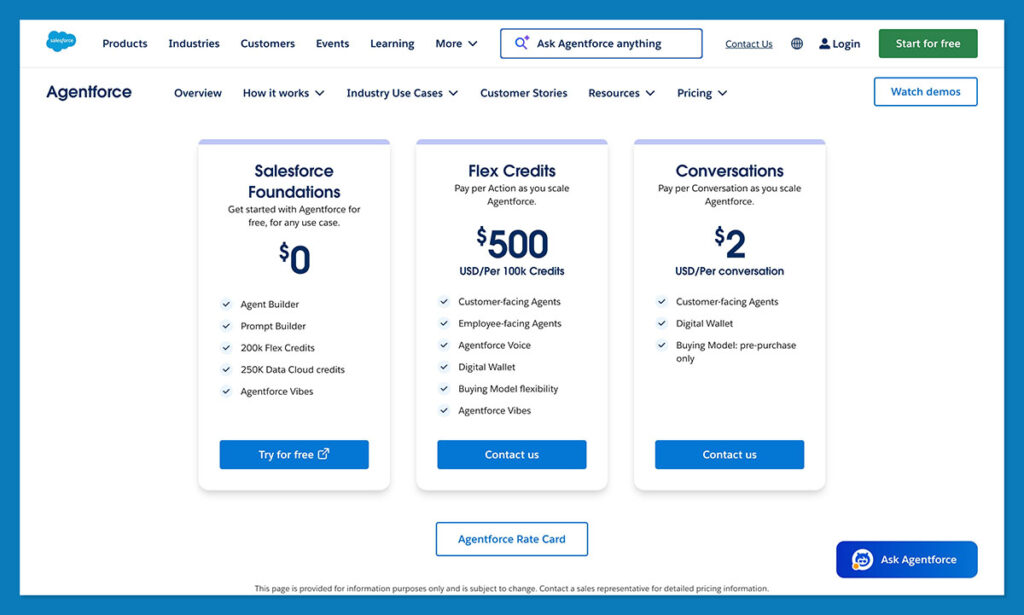
HubSpot’s pricing feels straightforward. You start with a free CRM with up to two free users, contact management, and light AI tucked into editors. Then you layer on seats as you grow:
- Starter: $20 per seat/month
- Professional: $100 per seat/month
- Enterprise: $150 per seat/month
The heavier AI features (like Breeze Intelligence scoring or Customer Agent conversations) run on credits. Each credit is $0.01, with bundles like $10 for 1,000 credits. Most plans include a monthly allowance, and you can buy more if you need them. It’s predictable, and you can usually forecast usage without breaking into a sweat.

Salesforce is different. Licenses start around $200–500 per user/month, and that’s before you add Einstein AI features. Those add-ons range from $50–220 per user/month. If you want the advanced stuff like predictive lead scoring, Agentforce orchestration, Einstein Forecasting, you’ll almost certainly need Data Cloud, which runs $200k–400k annually.
Implementation isn’t cheap either. Professional services often cost $75k–355k just to get Einstein live across a sales org. Training adds more. And because Salesforce pricing is segmented by cloud (Sales, Service, Marketing), you end up stacking licenses like Lego.
HubSpot AI vs Einstein AI: Which is Best?
I hate to be “that guy”, but honestly, I can’t tell you which AI CRM is best for you. Both Salesforce and HubSpot are amazing, there’s no arguing with that. What I can tell you is this.
Einstein is a skyscraper: powerful, sprawling, and built for enterprises with the budget and patience to climb every floor. If you’ve got 200+ reps, dedicated admins, and a compliance team breathing down your neck, Salesforce can bend itself into whatever shape you need. But it’s heavy, it’s expensive, and adoption is a constant battle.
HubSpot Breeze, on the other hand, feels like momentum. You flip a switch, and suddenly your CRM is drafting emails, scoring leads, summarizing calls, and handling support tickets.
So here’s my advice: if you want results this quarter, start with HubSpot. Spin up a free HubSpot CRM account, flip on Breeze AI, and run one workflow with your own data. You’ll know within a week if it feels lighter. And if it does, you’ve found your platform.
Because at the end of the day, AI should remove friction, not add it. And HubSpot’s Breeze is the one CRM AI I’ve seen that actually lives up to its name.
FAQs
What is HubSpot CRM best for?
Honestly, it’s best for teams that want everything in one place without needing an admin army. Sales, marketing, service all tied together with inbound marketing tools and sales automation baked in. It’s the CRM software you can actually get running this week, not next quarter.
How does HubSpot compare to Salesforce?
HubSpot is faster to deploy and easier to use. Salesforce is more customizable but heavier to lift. If you’ve got 200+ reps and dedicated admins, Salesforce makes sense. If you’re under that, HubSpot usually feels like the smarter play.
Does HubSpot AI support multi-agent orchestration?
Yep. Since the 2025 Spotlight release, Breeze Agents can collaborate: Prospecting Agent feeding leads to Customer Agent, Content Agent spinning up campaigns alongside them. It feels less like bots and more like teammates.
Is HubSpot AI included in the free plan?
Light AI is like the Assistant in editors, quick drafts, small assists. The heavier stuff (predictive scoring, Customer Agent, Intelligence) lives in Pro and Enterprise tiers.
Does Salesforce Einstein require Data Cloud?
For the advanced features, yes. And that’s where the hidden cost creeps in: $200k–400k annually just for Data Cloud. It’s powerful, but it’s not cheap.

Comments 0 Responses