

I know plenty of companies that absolutely love DataRobot. It’s powerful, promises quick time to value, and it even has a leaderboard system that tests multiple algorithms side by side. For enterprises looking for deployment confidence, governance, observability, and regulatory support, DataRobot is hard to beat. Still, it has its limitations.
The first one is the price. Enterprise software comes with enterprise pricing, and when 56% of enterprises still say they’re struggling to see higher revenue or lower cost from AI tools, that expense can be difficult to justify. The second thing is the learning curve, which is expected for such a strong tool, but setup does take longer.
So, if you’re looking for something that works better for a different job, like pulling churn scores into Salesforce, demand forecasts into warehouses, or lead rankings into tools sales teams actually use, there are a few alternatives worth considering.
The Best DataRobot Alternatives
The majority of companies looking for DataRobot alternatives probably won’t be looking for a bigger feature list. DataRobot already offers powerful automation, enterprise-grade governance, plus a TEI report suggesting it can deliver about a 514% ROI.
So for this comparison I’m looking at different priorities, things like affordability, algorithmic transparency, and tools that work without data scientists, all the things DataRobot can fall short on.
| Product | Where it wins | What the buyer still deals with | Price and access |
|---|---|---|---|
| Pecan AI | Business teams that need fast, production-ready predictions | You need enough historical data to learn from, and a business outcome you want to predict. | Quote-based (per prediction batch) |
| Dataiku | Companies with data scientists, analysts and engineers working on the same pipelines | Platform setup, permission management, plus compute choices. | Enterprise quote |
| H2O.ai | Organizations interested in AutoML with high levels of control | Infrastructure, surrounding operating models, and machine learning knowledge. | H2O-3 is open source, but Driverless AI needs a quote |
| Alteryx | Companies that need help cleaning up and preparing data | Model monitoring and governance, plus education. | From $4,950 per user per year (roughly $410 per month), three user minimum |
| Zams | Teams building predictive learning models in minutes to embed in workflows | Data management, and integrations. | Enterprise quote |
1. Pecan AI: Best for Business-Led Prediction
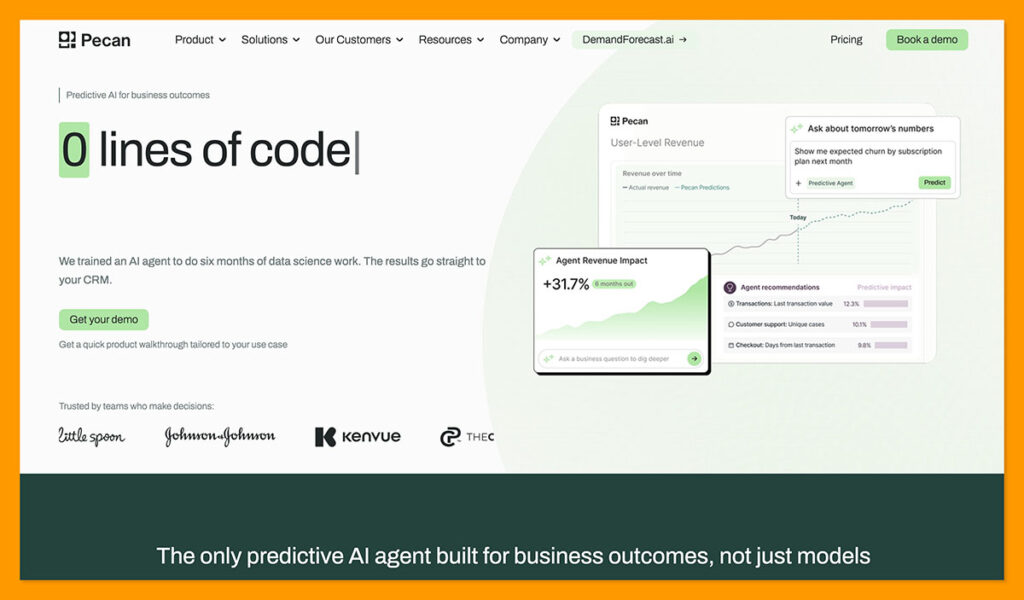
DataRobot still leads in governance, observability, and explainability, but Pecan AI is the better fit for organizations that want to build and deploy predictive AI quickly. If you’re trying to predict churn, customer lifetime value, lead quality, win-back rates, or campaign performance, Pecan helps you get there faster.
The Predictive AI Agent starts with a plain-English request and helps define the prediction you want to make. It automates much of the data preparation, feature engineering, and model-building process, then delivers predictions to your data warehouse or business applications like Salesforce and HubSpot. Validation runs automatically, with guardrails against data leakage and overfitting, and every prediction comes back with an explanation and a confidence score. The workflow is much more guided than a traditional enterprise ML platform: you start by defining what you want to predict, and Pecan takes you through the rest.
This makes Pecan a lot easier for companies to use, but it’s worth remembering that there’s less room for private infrastructure or formal governance, like you get from DataRobot. Still, the results from Pecan’s customers speak for themselves. ShopTJC, for instance, used Pecan to create a prediction model that helped them cut shipping costs by 6%.
Like DataRobot, Pecan uses enterprise pricing, so you’ll need to contact the team for a quote based on your requirements.
Pros
- Complete no-code and low-code platform, for business and analytics teams
- Fast time to value (deploy in a couple of weeks)
- Guided workflows for predictive business use cases
- SaaS setup reduces deployment complexity
- Delivers predictions into existing business tools and workflows
Cons
- Less suited to organizations that need advanced enterprise ML governance and customization
- Focused on predictive AI rather than being a general-purpose enterprise AI platform
2. Dataiku: Best for Shared Data and AI Work
Dataiku is an end-to-end enterprise AI platform that goes beyond the basics with the data lifecycle. The Flow system maps datasets, recipes, models, and agents on a single canvas, so teams can visualize dependencies and better understand how projects are connected.
While DataRobot does go further with automated model development and centralized production control, Dataiku concentrates more on the work surrounding your model, including data preparation, pipelines you can reuse, and collaborative workflows between business and technical users.
You also get some freedom with model portability and customization too, if you want to adjust algorithms or port models into legacy systems. There’s also Deployer to manage project bundles plus API services, and Govern if you need a unified space for agent oversight.
Recently, Dataiku also introduced the Cobuild tool, which can create pipelines and machine learning programs with written instructions. One company, Good Apple, cut the time required to develop their attribution models in half.
Still, Dataiku does come with an enterprise price tag, like DataRobot, and the system is pretty resource intensive, so if you’ve got limited computing resources, you might struggle.
Pros
- Fully unified environment for the AI-driven data lifecycle
- Some support for low-code alongside pro-code
- Excellent governance and security
- Built-in automation capabilities
- Fantastic features for collaboration between teams
Cons
- Steep learning curve for non-data scientists
- Resource intensive compared to some other options
- Potential for a longer time to value than DataRobot
3. H2O.ai: Best for Technical Control
Like DataRobot, H2O.ai is a premium enterprise AI and machine learning platform, but it’s intended more for companies that want an open-source foundation. If you want to automate while maintaining a lot of control over the backend, H2O.ai is a good pick. The H2O-3 system gives you your open-source base, while Driverless AI automates feature engineering, validation, tuning, model selection, and deployment. There’s also an MLOps tool for registry and monitoring.
Where DataRobot packages governance and model operations into a more unified control system, H2O tries to give data scientists more freedom to explore code clients, custom recipes, or portable scoring artifacts. Companies with experienced machine learning teams will probably prefer that freedom.
MOJO scoring is another of H2O’s particularly strong features. It gives you a trained pipeline that lets predictions run quickly inside of other applications, so you don’t have to run every request through Driverless AI. Then the custom recipes let you extend feature engineering, scoring, models, and interpretability even further.
H2O.ai is still fast too. The G5 team, for instance, reduced model development time by 80%, while also improving contact with qualified leads from 14% to 85%. Still, you do need ML expertise if you want to make the most of the tool. Plus, it’s worth remembering that just because one element of the stack is open source, that doesn’t mean the whole toolkit is free to use.
Pros
- Excellent open source system for customization
- Full machine learning interpretability tools
- Speed and scalability, thanks to being built for distributed environments
- Full system of enterprise integrations to deliver data where it’s needed
- Private deployment support for governance
Cons
- Requires significant ML expertise
- Very resource intensive compared to other systems
- Data manipulation limitations in some workflows
4. Alteryx: Best for Data Preparation and Repeatable Analytics
Compared to DataRobot, Alteryx does still fall behind in terms of building and managing complicated AI models and predictive systems at scale. However, Alteryx is a better choice if you’re looking for an analytics platform that specializes in data preparation.
That’s its core focus, getting data ready to excel in a new format, whether that means blending data, or just getting ready for workflow automation. Designer gives users a visual canvas packed with over 300 tools, plus connections to more than 80 data sources. You can send outputs to over 70 destinations too. The features handle things like cleansing, data joins, formulas, spatial analysis, and workflow scheduling, and assisted modeling and predictive tools can sit inside the flow.
Alteryx is excellent at the task it’s built for, and fast at delivering value. 7-Eleven, for example, managed to reduce 100 hours of vendor projects to one hour. It’s also one of the easier systems to use compared to DataRobot, although it still has a learning curve if you’re unfamiliar with data analysis.
DataRobot carries the model a lot further once the training data is ready with its AutoML, registry monitoring, plus governance. That’s generally why most companies don’t end up choosing one or the other. A lot of analysts use Alteryx to clean and shape their data before they feed it into DataRobot to build out their model.
Pros
- Excels at visual workflows for business users and data scientists
- Comprehensive data blending and cleaning tools
- Advanced tools for spatial analysis, predictive modelling, and AutoML
- Broad range of connectors to other tools, including DataRobot
- Workflow automation elements included
Cons
- Less model monitoring and governance than DataRobot
- Licences can be quite expensive according to G2 reviews
- Less effective without another tool for modelling
5. Zams: Best Lightweight Tool for Front Office
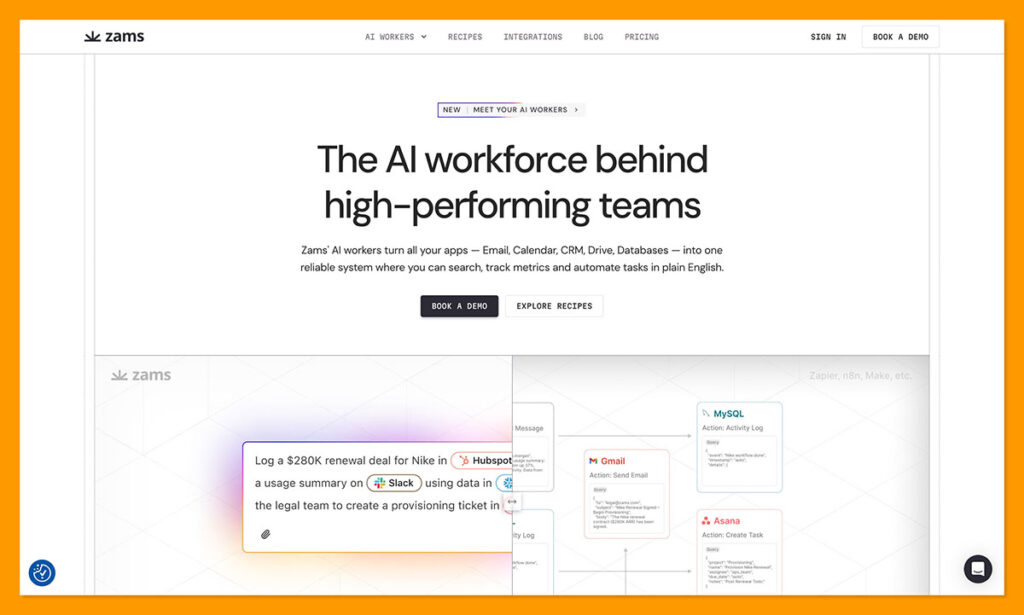
Zams, previously Obviously AI, is a lightweight tool driven by natural language processing, intended to help companies build AI agents that can make decisions based on data, and activate workflows automatically. Like Pecan, Zams is aimed at business users rather than data scientists, though it’s built for workflow automation rather than predictive modeling.
What’s most appealing about Zams is how easy and fast it can be to set up and deploy. People can build agents in a day, particularly if they only want something simple. Zams says that a lot of its clients manage to save up to twenty hours a week just by automating a handful of cross-platform tasks.
Additionally, Zams works well with the tools these employees are probably already using, from Slack and HubSpot to Gong and Apollo. It also offers comprehensive enterprise-level compliance standards, though the overall governance and monitoring capabilities of DataRobot are still a lot stronger, particularly if you want end-to-end observability.
Still, though it’s meant to be simple, Zams can still be overkill for businesses with straightforward prediction needs, and the autonomous agents do need time and contextual data before they can work reliably in every workflow.
Pros
- Capable of saving companies a lot of time on automated cross-platform tasks
- No-code interface making it ideal for non-technical users
- Huge range of integrations with popular business tools
- Enterprise-level compliance standards (though less governance than DataRobot)
- Accessible web-based interface for quick deployment
Cons
- Not intended for deep data science or machine learning
- Limited governance and monitoring capabilities
- Can take a while for AI agents to become effective
Which DataRobot Alternative Should You Choose?
DataRobot remains the strongest choice if you’re looking for a governed MLOps solution, but each of these tools offer something worth considering if you’re tackling a different problem. Zams is a good choice for automating repetitive tasks with quick-to-deploy autonomous agents. Alteryx is the better option if you’re looking for something that can clean and prepare your data before plugging it into another tool.
I’d choose Dataiku if you need something comprehensive that handles the work around the model production lifecycle extremely well. H2O.ai will definitely appeal to companies with strong machine learning expertise, and builders that want to maintain comprehensive control over the data and models they use.
If what you need is a platform that can quickly build and deploy production-ready predictions for use cases like churn, customer lifetime value, lead scoring, demand forecasting, or campaign optimization, Pecan AI is the better choice. It’s designed for analysts and business teams who want to put predictive AI into production without the complexity of a traditional enterprise ML platform.
Frequently Asked Questions
What is the best DataRobot alternative?
It depends on the job you’re hiring the platform to do. Pecan AI is the best alternative for business and analytics teams that want production-ready predictions fast, without needing a data science team behind them. If you need collaboration across analysts, engineers, and data scientists, Dataiku is the stronger pick. If your team has deep machine learning expertise and wants control over the backend, go with H2O.ai.
Why do companies look for DataRobot alternatives?
Two reasons come up most often: cost and complexity. DataRobot is priced for enterprise budgets and doesn’t publish list pricing, so every deal is a custom quote. The platform also carries a real learning curve, and setup takes longer than lighter tools. Companies that only need a handful of predictions delivered into Salesforce or a warehouse often find they’re paying for governance and observability features they’ll never use.
How much does DataRobot cost?
DataRobot doesn’t publish standard pricing. Costs are quoted based on deployment type (cloud or on-premise), user licences, compute capacity, and the volume of predictions or models you’re running in production. A credit-based trial is available if you want to test the platform before committing, though it comes with limits on exports, sharing, and support.
Is there a free DataRobot alternative?
H2O-3, the open-source core of H2O.ai, is free to use. It’s the closest thing to a genuinely free option on this list. Just be aware that the wider H2O stack isn’t free: Driverless AI, the piece that automates feature engineering and model selection, is quote-based. You’ll also be covering your own infrastructure and need machine learning expertise in house to get value from it.
Do I need data scientists to use these platforms?
Not for all of them. Pecan AI and Zams are both built for business users and run on no-code and low-code interfaces, so analysts and operators can use them without writing code. Alteryx sits in the middle, since its visual canvas is approachable but still assumes some comfort with data analysis. Dataiku and H2O.ai realistically need technical staff to get full value.
Can Alteryx replace DataRobot?
Not on its own. Alteryx is a data preparation and workflow automation platform first, and it falls behind DataRobot on model monitoring, registry, and governance. That’s why plenty of teams run both: Alteryx cleans and shapes the data, then feeds it into a modelling platform. If you want one tool that handles preparation and production predictions together, look at Pecan or Dataiku instead.
What’s the difference between Pecan AI and DataRobot?
DataRobot is a general-purpose enterprise AI platform; Pecan is focused specifically on predictive AI for business outcomes. Pecan starts from a plain-English description of what you want to predict, automates the data preparation and modelling behind it, and pushes results into tools like Salesforce and HubSpot. DataRobot gives you more control, more governance, and private infrastructure options, but it takes longer to stand up and costs more to run.
How long does it take to deploy predictions with these tools?
Timelines vary widely by platform and by how clean your data is. Zams users can build simple agents in a day, and Pecan is designed for deployment in a couple of weeks. Dataiku and H2O.ai typically take longer, since you’re configuring infrastructure, permissions, and pipelines before you get to a model. Whatever you choose, the bigger variable is usually your historical data, not the tool.

Comments 0 Responses