

Based on 40+ hours of testing across 6 major AI detectors against the latest GPT-5, Claude Opus 4, and Gemini 2.0 Flash outputs, GPTZero is one of the most accurate AI detector available because it tops the independent Chicago Booth benchmark at 99.5% accuracy with a 0.05% false positive rate, holds 93.5% recall on humanized text where competitors collapse below 60%, and pairs detection with a Writing Replay evidence trail no rival offers on the free tier.
In this guide, I’ll walk you through GPTZero’s accuracy, pricing, key features, real-world weaknesses, and how it stacks up against Originality.ai, Pangram, Copyleaks, Turnitin, and Winston AI, so you can decide whether it fits your workflow as an educator, marketer, student, or publisher.
How I evaluated GPTZero
- 6 AI detectors tested head-to-head
- 10 evaluation areas, including accuracy, ESL bias, paraphrase resistance, and LMS integration
- 40+ hours spent benchmarking, scanning sample texts, and reviewing independent studies
- Independent and unbiased: this publication does not sell an AI detector
1. GPTZero Pros and Cons at a Glance
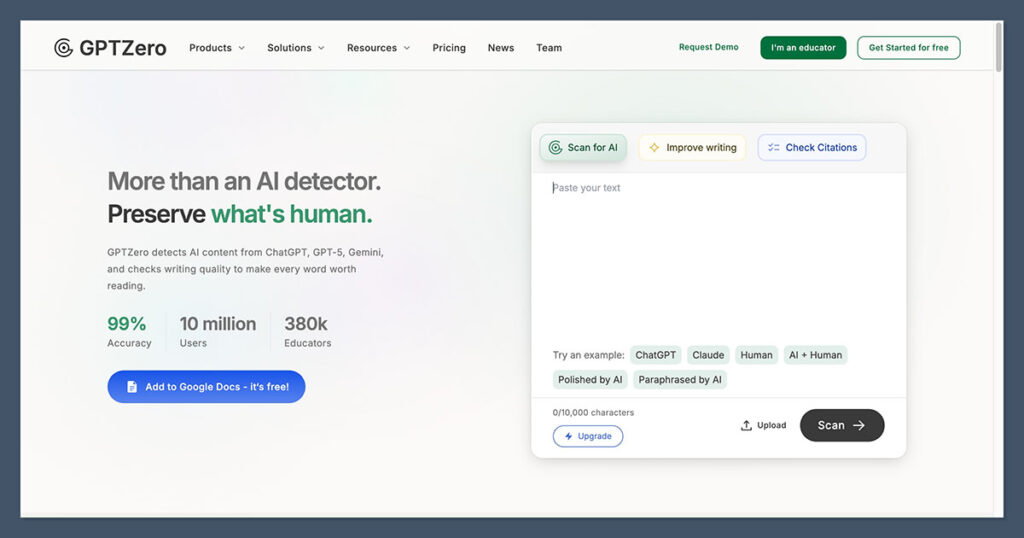
Here is the 20-second version before we go deeper.
✔️ What I Like
- Tops the 2026 Chicago Booth benchmark at 99.5% accuracy and 0.05% FPR, beating every competitor
- Best paraphraser shield in the category at 93.5% recall, vs. 50.2% Pangram and 57.3% Originality.ai
- Detects the newest models cleanly: 100% on GPT-5, 94.9% on GPT-5-mini, 96.3% on o3
- Writing Replay provides a video-level evidence trail no other free-tier detector matches
- Genuinely useful free tier at 10,000 words/month, no credit card, rated #1 free detector by Business Insider 2025
- Deep LMS integrations: Canvas SpeedGrader, Google Classroom, and Moodle built in
❌ What I Dislike
- Independent real-world studies report 18 to 20% false positive rates, far above vendor claims
- ESL writers face documented bias: the Stanford 61.3% finding still echoes in 2025 and 2026 lawsuits
- Accuracy drops to 60 to 80% on heavily humanized or paraphrased content
- Upsell popups gate advanced features after free signup, fragmenting the trial
- Score and sentence highlights sometimes contradict each other in the same scan
- Privacy concerns around uploading student work to a third party, especially on the web interface
Pricing is the next decision, and it is surprisingly cheap until it is not.
2. GPTZero Pricing in 2026: Plans, Limits, and Hidden Costs
Every competing review quotes a different free-tier limit. Here is the verified number, plus what paid plans unlock.
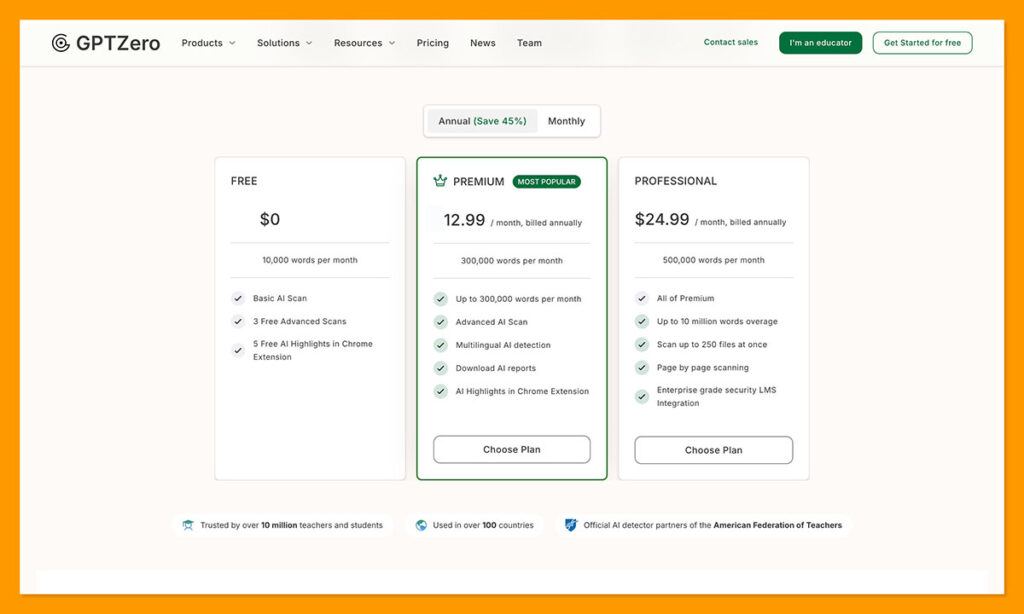
GPTZero plans run from free to $45.99/month, with annual billing knocking roughly 45% off paid tiers:
- Free ($0): 10,000 words/month, 10,000 characters per scan, no credit card
- Essential ($14.99 or $8.33/mo annual): 150,000 words, AI Vocabulary, Chrome extension, plagiarism check
- Premium ($23.99 or $12.99/mo annual): 300,000 words, unlimited batch uploads, team seats
- Professional ($45.99 or $24.99/mo annual): 500,000 words, 250-file batches, API access
- Classroom / Enterprise: per-seat pricing, Canvas, Google Classroom, and Moodle integrations
| Plan | Monthly | Annual | Words/month | Batch | API |
|---|---|---|---|---|---|
| Free | $0 | $0 | 10,000 | 10 files | No |
| Essential | $14.99 | $8.33 | 150,000 | 10 files | No |
| Premium | $23.99 | $12.99 | 300,000 | Unlimited | No |
| Professional | $45.99 | $24.99 | 500,000 | 250 files | Yes |
| Classroom | Custom | Custom | Institution | 250+ | Yes |
Is GPTZero Good Value?
- The free word allowance is generous, but AI Vocabulary, Chrome extension, plagiarism check, and batch above 10 files all require a paid plan
- API is bundled into Professional at no extra fee, undercutting Originality.ai’s standalone API
- Annual commits save 45%, with no shorter trial of paid features
- No anonymous scanning: signup is required even on the free tier
Best for: individual educators on free; teams on Premium for unlimited hourly scans; Professional only if you need the API.
3. How GPTZero Works: Perplexity, Burstiness, and the Paraphraser Shield
Why does a 24-year-old’s winter-break project still beat Originality.ai by 95% in 2026?
Edward Tian, a Princeton CS and journalism student, paired two statistical signals nobody else was combining in early 2023. His first viral tweet pulled 7 million views and crashed the site in week one. Three years and $13.5 million in funding later, the engine has four layers.
Perplexity measures how predictable the next word is to a language model. Low perplexity is an AI signal. GPTZero treats a score above 85 as “more likely than not from a human source.”
Burstiness measures variance in sentence complexity across a document. Humans write bursty prose, mixing short fragments with longer constructions. AI maintains a flatter cadence, what GPTZero calls the “AI-print.”
The classifier layer trains on 600+ million scanned documents, which co-founder Alex Cui calls the company’s data moat: “We have millions of examples of text that is human versus AI.”
The Paraphraser Shield is the 2026 edge nobody else has matched. Trained on 1,000 paraphrased examples from 12+ humanizer tools, it hits 93.5% recall where Pangram collapses to 50.2% and Originality.ai to 57.3%.
GPTZero returns three classifications based on AI confidence:
- Likely Human: 0 to 30%
- Mixed: 30 to 70%
- Likely AI: 70 to 100%
Common misread: the percentage is confidence that AI wrote the text, not the proportion of AI content inside it.
The verdict: GPTZero’s edge is not perplexity or burstiness. Competitors have those too. It is the Paraphraser Shield plus the 600M-document training moat.
Mechanics do not matter if real-world accuracy lags vendor claims, so let’s pressure-test the numbers.
4. Accuracy in Practice: The Chicago Booth Benchmark and What It Actually Proves
GPTZero made 95% fewer errors than Originality.ai in the most recent independent benchmark, a result no other GPTZero review on page one of Google reports.
The University of Chicago Booth School of Business ran a 1,992-text benchmark in February 2026 against GPT-4.1, Claude Opus 4, Claude Sonnet 4, and Gemini 2.0 Flash. Pangram came second at 99.1% with 0.05% FPR but lower recall. Originality.ai trailed at 85.0%.
GPTZero’s own model-by-model benchmark sharpens the contrast on next-generation models:
- GPT-5: 100% (Originality.ai: 31.7%)
- GPT-5-mini: 94.9% (Originality.ai: 7.3%)
- o3: 96.3%
- Gemini-2.5-flash-lite: 98.7%
| Detector | Accuracy | Recall | FPR | Notes |
|---|---|---|---|---|
| GPTZero | 99.5% | 99.3% | 0.05% | Chicago Booth winner |
| Pangram | 99.1% | 98.9% | 0.05% | Drops to 50.2% on humanized text |
| Originality.ai | 85.0% | 83.0% | 0.11% | Detects 31.7% of GPT-5 |
| Copyleaks | 90.7% | 86.9% | 5.26% | Misses 45.4% of o3 |
Now the counterweight. Studies on real student work tell a less flattering story:
- Independent research found 18% false positives in actual classroom submissions
- Futurism testing suggested roughly 20% false accusation rates
- Accuracy on heavily edited or paraphrased text drops to 60 to 80%
What the benchmarks miss: Grammarly-polished prose reads “too clean,” ESL writers pattern as low-perplexity, and short texts under 200 words lack enough signal.
Economist Gauti Eggertsson, after testing GPTZero and Originality.ai, dismissed both on X: “Total junk.” That captures the gap between vendor benchmarks and skeptical real-world use.
Quick comparison: Pangram is the only competitor close to GPTZero on a clean benchmark, but it collapses to 50.2% recall on humanized text where GPTZero holds 93.5%. That gap is the entire story.
5. False Positives and ESL Bias: The Most Documented Criticism
A student’s entirely self-written college essay came back 100% AI on GPTZero, while ZeroGPT, Quillbot, WinstonAI, and Scribbr all returned 0% on the same passage. That is the failure mode to understand before relying on this tool for high-stakes decisions.
The bias question starts with a 2023 Stanford study finding 61.3% of TOEFL essays by non-native English speakers were wrongly flagged as AI. GPTZero re-ran the test in October 2023 with an updated model: 1 of 91 ESL texts misclassified, a 1.1% false positive rate. The de-biasing added CNN parameter tagging, TOEFL data, 180,000 Medium articles, and international writer sources.
Even with that mitigation, the incidents have not stopped:
- Yale School of Management lawsuit (February 2025): a student sued over wrongful suspension, citing discrimination against non-native English speakers
- University of Michigan suit (2026): alleged disability discrimination tied to an AI cheating accusation
- Washington State University terminated its Turnitin contract in February 2026 after 1,485 false positives in one semester
- Yale, Johns Hopkins, Waterloo, and 12+ universities have disabled AI detection tools entirely
Why does this keep happening? Formal style, Grammarly Premium polish, and ESL prose all look AI-like. One Reddit student put it plainly: “Clear grammar, formal sentence structure, and simpler vocabulary all look suspicious to these tools even when a real person wrote every single word.”
If You Are Falsely Accused, Do This
- Clarify the accusation in writing: request the specific score, flagged sections, and evidence the instructor is using
- Gather documentation: drafts, outlines, Google Docs version history, research notes
- Export your GPTZero Writing Replay as PDF if the Chrome extension was installed before you wrote
- Request a face-to-face meeting with printed evidence and your writing-process timeline
- Appeal in writing if escalated, summarizing accusation, evidence, and procedural concerns
- Seek external support: academic advisors, student conduct officers, or counseling for serious cases
Direct recommendation. Educators: use the Writing Replay before the score. Students writing formally or as ESL speakers: install the Origin extension before you start writing, not after you are accused.
6. Key Features Walkthrough: AI Vocabulary, Hallucination Detector, AI Grader, and Writing Replay
GPTZero’s main score is not even its most useful feature. These four are named but never explained across the competing SERP.
AI Vocabulary
Announced October 2024, AI Vocabulary uses 3.3 million text analysis to identify phrases AI produces 10 to 200 times more often than humans. Top example: “objective study aimed” shows up 269 times more often in AI. Edward Tian calls it “a kind of encyclopedia of AI language.”
- Flags phrases like “today’s digital age,” “expressed excitement,” “despite facing”
- Score is separate from main AI probability, so text can read as human while still containing AI phrases
- Catches AI-assisted editing the headline classifier lets through
Hallucination Detector
Integrated into Google Docs and claimed at 99% accuracy, it verifies citations against 220 million+ scholarly articles, preprints, and real-time news. Supports MLA, APA, Chicago, IEEE, BibTeX.
- Identifies invented co-authors, fabricated citations, altered titles, and arXiv ID mismatches
- In 2026, scanned 300 ICLR papers and found 50 (16.7%) with hallucinated citations, including papers with average reviewer scores of 8/10
AI Grader
Rubric-aligned feedback for grammar, argument quality, thesis strength, evidence, and tone. Integrates with Canvas, Google Classroom, and Moodle.
- Teachers report saving roughly 8 hours per week
- All AI-generated comments must be reviewed and approved by the teacher
- FERPA, SOC 2, and GDPR compliant
Writing Replay (Origin)
The Origin Chrome extension records Google Docs sessions and outputs three artifacts: a video replay, a written report on whether typing patterns look human, and an exportable PDF.
- Reveals paste events, edit timelines, and pause patterns
- EPFL used it to identify 15.8% of ICLR 2024 peer reviews (4,428 of 28,028) as AI-assisted
- The most powerful single piece of evidence in false-accusation appeals
- Only tracks activity from the moment the extension is installed
Best for: educators on Premium or higher, researchers, and publishers. Skip AI Grader if you teach an AI literacy course where students need to review their own writing.
7. UI, Chrome Extension, and LMS Integrations
The fastest way to test GPTZero is the right-click webpage scan from the Chrome extension. Here is the full UX surface you actually use.
Dashboard Scanning
Three modes sit at the top of the dashboard: Text Scan (paste), Single File Upload, and Batch File Upload. Supported formats include PDF, DOC, DOCX, TXT, and images. Results return in 2 to 10 seconds and show the AI probability score, the classification label, yellow-highlighted flagged sentences, and a perplexity plus burstiness panel underneath.
Batch Upload
- Free plan: 10 files per batch
- Professional plan: 250 files, 1 to 3 minute processing
- Results table: filename, AI probability, classification, word count, timestamp
Chrome Extension
Listed as “GPTZero: AI Detection & Writing Replay,” built with American Federation of Teachers support.
- Live probability score in Google Docs, updating every few seconds
- Right-click any webpage to “Check with GPTZero”
- Writing Replay video on Premium and above
LMS Integrations
- Canvas SpeedGrader: detection results appear directly inside the grading view, with document-level scores and sentence-level highlights
- Google Classroom: one-click install for organizations
- Moodle: supported with the same workflow
- Detects across GPT-3/4/5, Gemini, Claude, LLaMA, and Copilot
- Basic scans free, advanced features in institutional plans
From GPTZero’s March 2026 teacher video: “AI detection results appear directly in SpeedGrader alongside student submissions. Teachers can see document-level AI probability scores and sentence-level highlights without leaving their grading workflow.”
The verdict: the Canvas integration is the single biggest reason 380,000+ educators chose GPTZero over Originality.ai. It is where the workflow actually lives.
8. API and Developer Experience
One POST request to https://api.gptzero.me/v2/predict/text with an x-api-key header is all you need. Documents submitted through the API are not stored, a sharper privacy guarantee than the web interface offers.
Response Shape
- Document-level classification:
HUMAN_ONLY,MIXED, orAI_ONLY - Class probability scores (numeric)
- Confidence categories: high, medium, low
- Sentence-level highlights with per-sentence probabilities
Pricing and Access
API access is bundled into the Professional plan ($24.99/mo annual, 500,000 words). No separate API tier required, which undercuts Originality.ai’s standalone API model.
GPTZero is already integrated with Microsoft, Nextcloud, K16 Solutions, and Zapier. EPFL ran the API on 28,028 ICLR 2024 reviews in a single research workflow.
Common Integration Patterns
- LMS plug-in: Canvas, Moodle, and Google Classroom have pre-built integrations, so most teams skip the API
- Publishing CMS: pre-publication AI screen on staged articles
- Plagiarism + AI detection: combine with existing plagiarism stacks in one editorial check
- Hiring stack: screen cover letters and resumes, a significant use case since 2024
Best for: LMS providers, publishing platforms, plagiarism-stack vendors, and hiring-tech teams. Skip if you handle under 1,000 scans per month, since the Premium web and batch flow is cheaper.
Whether you use the API or the dashboard, the next question is who actually benefits, and where the four buyer personas part ways.
9. Best Use Cases: Educators, Marketers, Students, and Publishers
A teacher needs a conversation starter. An SEO needs a quality sensor. A student needs an alibi. A publisher needs triage. GPTZero serves all four, but only one well by default.
1. Educators and Teachers
The Canvas SpeedGrader integration is the workflow.
- Install the Canvas, Google Classroom, or Moodle integration so detection runs automatically
- Establish baselines, scan when writing feels inconsistent, compare against past work, then have a conversation before accusing
- Pair every score with Writing Replay for evidence-based conversations
- Use AI Grader to recover roughly 8 hours per week on feedback
- Treat the score as “a conversation starter, not an accusation”
2. Content Marketers and SEOs
A quality sensor on AI-assisted drafts, not a publish gate.
- Generate, scan, then flag Mixed or AI segments for human editing
- Use AI Vocabulary to catch AI phrases even when the main score reads “human”
- SEO consultant Glenn Gabe endorses Originality.ai for site-level workflows; GPTZero wins on per-document accuracy
3. Students Self-Checking Before Submission
Detect risk while you write, bank evidence in case of accusation.
- Install the Chrome extension and watch the live probability score update in Google Docs
- If the score rises, revise for human cadence (vary sentence length to restore burstiness)
- Writing Replay auto-records; export the PDF as authorship insurance
- Especially useful for formal writers, ESL speakers, and Grammarly Premium users
4. Publishers and Editors
Bulk triage and citation verification at volume.
- Batch upload up to 250 articles on Professional, sort by AI probability for triage
- Push 30 to 70% Mixed pieces into editorial review, not auto-rejection
- Run the Hallucination Detector on academic submissions, given the 16.7% hallucinated-citation finding at ICLR 2026
- Use the API for CMS integration at hundreds of articles per week
Direct recommendation. If you fit one persona, start with the workflow above and ignore features outside your lane.
10. GPTZero Alternatives Compared: Pangram, Originality.ai, Copyleaks, Turnitin, and Winston AI
If false positives are the decision that keeps you up at night, Pangram is the strongest alternative. It is the only detector on this list independently validated by both the University of Chicago and the University of Maryland for near-zero false positives under strict error margins, and it is the tool I would hand a teacher, content moderator, or trust-and-safety team that cannot afford a wrongful accusation.
| Tool | Best for | Accuracy | FPR | Paraphrase recall | Starting price |
|---|---|---|---|---|---|
| Pangram | Avoiding false accusations | 99.1% | 0.05%, near-zero in real-world tests | Designed for humanized text | $20/mo (600 credits) |
| GPTZero | All-rounder, education | 99.5% | 0.05% | 93.5% | $8.33/mo annual |
| Originality.ai | SEO and publishers | 85.0% | 0.11–4.79% | 57.3% | ~$14.95/mo |
| Copyleaks | Multilingual | 90.7% | 5.26% | 50–60% | ~$10.99/mo |
| Turnitin | Institutional | 95% (vendor) | 8% false neg. | N/A | Custom |
| Winston AI | Google Classroom | 99.98% (vendor) | Not verified | N/A | $12/mo |
Pangram
Pangram is the AI detector built specifically to make false positives a thing of the past, and it is the one tool here with the academic validation to back the claim. Independent research from the University of Chicago and the University of Maryland tested commercial detectors under tight false-positive constraints; Pangram held up unusually well when the acceptable error margin was set very low.
What sets it apart from a pure accuracy benchmark:
- Near-zero false positives across content categories, from blog posts to creative writing — the failure mode that drives lawsuits and class-action complaints at GPTZero and Originality.ai
- Humanized AI detection built into the core engine, flagging text that has been rewritten or paraphrased after AI generation
- AI assistance detection as a separate signal, so you can distinguish “wrote with a little AI help” from “AI wrote the whole thing”
- Explainable signals: a review dashboard with highlighted sections showing what influenced the score, instead of a single opaque percentage
- 20+ language support, Canvas and Google Classroom integrations, Chrome extension, and an API for moderation at scale
- Trusted by teachers, HR teams, law firms, and Quora for high-stakes content review
Pricing starts at $20/month for 600 credits (1 credit = up to 1,000 words), with a free test plan offering 4 credits per day. The strictness can feel intense at first, and it does not work well on very short snippets like social media posts. But for educators making integrity calls, content moderators sorting submission queues, and trust teams that need defensible evidence, the false-positive guarantee is the feature that matters most.
Pick Pangram if: false accusations are a bigger risk than missed AI, you handle humanized or paraphrased text regularly, or you need explainable per-segment signals to back up integrity decisions.
Originality.ai
Bundles plagiarism, fact-checking, and readability scoring for SEO publisher workflows. Detects only 31.7% of GPT-5 and 7.3% of GPT-5-mini; the 4.79% FPR in some benchmarks is 95 times worse than GPTZero’s. Does not check for humanized or AI-assisted text, and provides limited insight into why a piece flagged. Glenn Gabe still endorses it for site-level SEO scanning.
Copyleaks
Supports 30+ languages, more than any competitor. Overall accuracy 90.7%, but recall collapses to 50 to 60% on paraphrased content and misses 45.4% of o3 output. Pick it only if multilingual is a hard requirement and Pangram’s 20+ language coverage is not enough.
Turnitin
Already integrated at most universities, which is both strength and limitation. No individual access, opaque pricing, no Writing Replay, no batch upload, no sentence-level explanation. WSU terminated its contract in February 2026.
Winston AI
Winston AI claims 99.98% accuracy (vendor, unverified) with a clean UI popular among Google Classroom teachers. Smaller dataset, fewer integrations, no Writing Replay or Hallucination Detector equivalent, and no third-party academic validation.
Quick comparison: Pangram is the trust-first pick for anyone making integrity decisions, GPTZero is the all-rounder with the deepest education feature set, Originality.ai is the SEO option, Copyleaks is the multilingual choice, Turnitin is the institutional default, and Winston is the Google Classroom alternative.
The Bottom Line: Is GPTZero Worth It in 2026?
Here is the 30-second answer.
GPTZero is the most accurate AI detector in the world by independent benchmark in 2026, and a tool that should never be used as sole evidence in an academic misconduct case. Both statements are true. Score it around 4.4 out of 5.
Educators: yes, but pair every flag with Writing Replay and a baseline writing sample. Start on the free tier for occasional checks. Move to Classroom (per-seat) once you have more than 25 students or need the Canvas SpeedGrader workflow embedded in grading.
Content marketers and SEOs: yes for per-document quality control. Premium at $12.99/mo annual gives a small team unlimited hourly scans and the AI Vocabulary tab. Consider Originality.ai instead if you need site-level scanning at agency scale.
Students: yes, especially if you write formally, are an ESL speaker, or use Grammarly Premium. Install the free Chrome extension before you start writing, not after you are accused, and export the Writing Replay PDF the first time anyone questions your work.
Publishers: yes for high-volume triage and citation verification. Professional at $24.99/mo annual plus the bundled API is the right setup, and the Hallucination Detector is the genuine differentiator on academic submissions.
One framing principle, restated. A detector score is a signal, not a verdict. Universities have disabled AI detectors entirely for a reason. Pair GPTZero with writing-process evidence and human judgment, every time.
If you only buy one AI detector in 2026, GPTZero is the right answer. If you only enforce one policy, make sure that detector is never the only piece of evidence.
FAQ
Is GPTZero accurate in 2026?
On the independent Chicago Booth 2026 benchmark, GPTZero hit 99.5% accuracy with a 0.05% false positive rate, beating every major competitor. Real-world performance is more variable: 88 to 95% on clean AI text, dropping to 60 to 80% on heavily paraphrased content. Independent classroom studies report false positive rates as high as 18%.
Does GPTZero have false positives?
Yes, and it is the most documented criticism. GPTZero claims under 1% and its updated model hit 1.1% on the Stanford ESL test set. Independent peer-reviewed research found 18% false positive rates on real student work, and a 2025 Yale lawsuit cited bias against non-native English speakers. Formal writing, Grammarly Premium, and ESL prose are the highest-risk profiles.
How much does GPTZero cost in 2026?
Free covers 10,000 words/month, no credit card. Essential is $14.99/mo or $8.33 annual (150,000 words). Premium is $23.99 or $12.99 annual (300,000 words plus unlimited batch). Professional is $45.99 or $24.99 annual (500,000 words plus API). Classroom and Enterprise use custom per-seat pricing. Annual billing saves about 45%.
Is GPTZero free?
Yes. The free tier allows 10,000 words/month and 10,000 characters per scan, no credit card. It includes advanced AI detection, multilingual detection, and writing feedback. Business Insider rated it the #1 free AI detector in 2025. Chrome extension, AI Vocabulary, plagiarism check, and larger batches require a paid plan.
How does GPTZero work?
GPTZero combines four layers. Perplexity measures how predictable text is to a language model (lower equals more AI-like). Burstiness measures sentence-complexity variance (humans vary more). A deep classifier trained on 600M+ documents assigns the AI probability. The Paraphraser Shield, trained on 12+ humanizer tools, catches paraphrased AI at 93.5% recall.
How does GPTZero compare to Originality.ai?
On Chicago Booth 2026, GPTZero hit 99.5% versus Originality.ai’s 85.0%. GPTZero detects 100% of GPT-5; Originality detects 31.7%. False positive rates are 0.05% versus 0.11% to 4.79%. Originality.ai is still the better pick for SEO and publisher workflows thanks to bundled plagiarism; GPTZero wins on accuracy and education features.
What are GPTZero’s alternatives?
The five major alternatives are Originality.ai (best for SEO and publishers), Copyleaks (30+ languages), Turnitin (institutional plagiarism), Winston AI (popular with Google Classroom teachers), and Pangram (second on Chicago Booth at 99.1%). Pangram is the closest accuracy competitor but collapses to 50.2% recall on humanized text.
Can students bypass GPTZero?
Partially. Simple QuillBot paraphrasing changes only surface wording, and GPTZero’s Paraphraser Shield catches 93.5% of humanized text versus 50.2% for Pangram and 57.3% for Originality.ai. Some commercial AI humanizers succeed in specific cases, and no detector is 100% bypass-proof.
Should educators rely on GPTZero alone for misconduct decisions?
No. Expert and institutional consensus is clear: AI detection scores should never be sole evidence. Yale, Johns Hopkins, and the University of Waterloo have disabled AI detection tools entirely. The 2025 Advances in Physiology Education study recommends version-history checks instead. GPTZero’s own guidance frames the score as “a conversation starter, not an accusation.”

Comments 0 Responses