

I’ve used enough CRMs to know the difference between AI that saves time and AI that just sells hype. There are plenty of tools that “summarize your calls” but still can’t find last week’s lead note.
So when every platform started shouting AI first! this year, I decided to test which ones actually walk the talk. Specifically, two of the loudest names in the room: HubSpot CRM and Freshworks Freddy AI.
Both promised “autonomous agents.” Both said they’d help automate workflows, personalize customer journeys, and basically free my teams from admin hell. But their idea of “smart” couldn’t be more different.
HubSpot’s AI felt like adding a brain to the business that actually connects marketing, sales, and service. Freddy AI, on the other hand, felt like hiring a lightning-fast specialist, great at solving problems, less interested in seeing the big picture.
HubSpot is the AI-connected ecosystem, fusing data, content, and commerce through its new Breeze Agents, AI CPQ, and Data Hub. Freddy AI is the Agentic operator, built to move tickets, process refunds, and handle service tasks at superhuman speed.
In this review, I’ll break down what it’s really like actually using both.
HubSpot CRM vs Freshworks Freddy AI
Before we dive into the details, here’s how they stack up at a glance.
| Feature | HubSpot CRM | Freshworks Freddy AI |
|---|---|---|
| AI Focus | Cross-team intelligence: Breeze Agents, AI CPQ, and Data Hub unify marketing, sales, service, and commerce. | Task-level automation: Freddy Copilot and the Agentic AI Platform handle support and sales actions autonomously. |
| Marketing & Inbound | True inbound engine: dynamic segmentation, automated content, lead scoring, attribution. | Outbound and transactional focus inside Freshmarketer; limited inbound depth. |
| Sales Automation & Analytics | Predictive scoring, AI-generated quotes, pipeline forecasting, and deal-stage insights. | Rapid setup, intent prediction, and guided selling for smaller teams. |
| Customer Support & Service | Breeze Customer Agent resolves 50 %+ of tickets; unified contact timeline. | Freddy AI cuts resolution times by up to 70 %; measurable ROI in real case studies. |
| Ecosystem & Integrations | 2000 + apps; open API; new Breeze Marketplace for custom AI agents. | ~650 apps; strong within the Freshworks suite; quick third-party connections. |
| Pricing & Scalability | Free CRM; AI actions included via monthly credits (3k–5k per tier); scales with usage. | Freemium entry; advanced AI in higher tiers; 48-hour deployment common. |
| Best Fit | Businesses wanting an all-in-one, AI-powered growth platform that connects every department. | Teams focused on quick support automation and measurable service efficiency. |
HubSpot CRM in 2026: A Smart, AI-Connected Growth Engine
If you’ve ever wished your CRM behaved less like software and more like a teammate, HubSpot CRM gets close. It’s what I consider the ultimate smart CRM right now.
Three updates stand out this year: Breeze Agents, Data Hub, and the AI CPQ inside Commerce Hub. Together they turn HubSpot from something you manage into something that quietly helps manage you. Breeze Agents work like extra hands on the team.
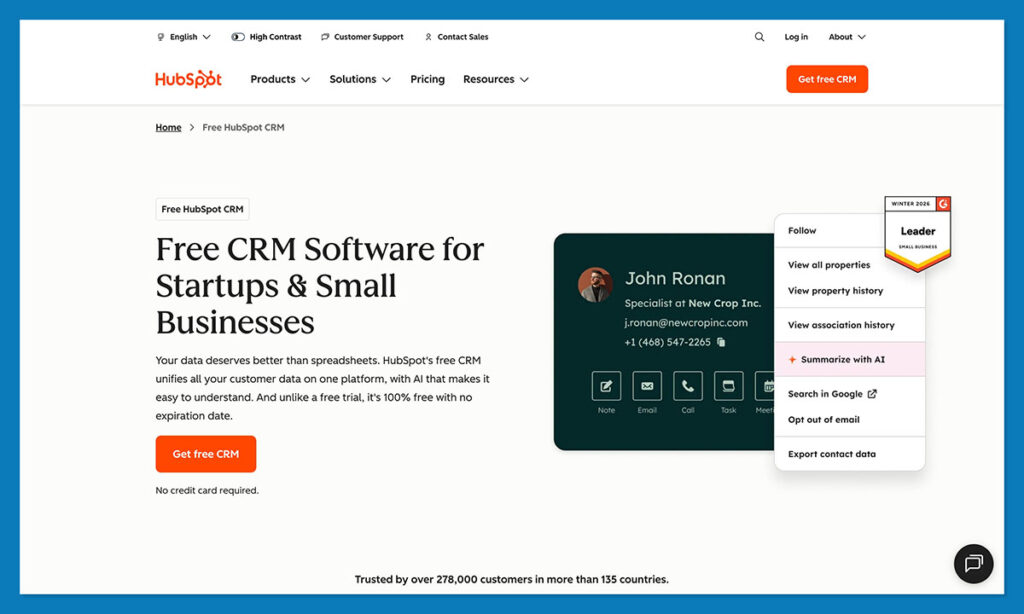
One handles support, another looks for new leads, another writes content, and a fourth builds out help-desk articles. They do the work, not just the reporting, and they already link with Slack, email, and WhatsApp so nothing feels bolted on.
Teams that like to tinker will enjoy Breeze Studio. You can set how each agent behaves, pick the data it uses, then post your version in the Breeze Marketplace so other groups can grab it.
If your CRM data is scattered across spreadsheets, stores, and sales tools, Data Hub is the part that fixes that mess. It unifies and cleans your contact records automatically, connecting data from Shopify, Stripe, and third-party apps into a single source of truth.
Plus, the CPQ (Configure-Price-Quote) in HubSpot’s Commerce Hub, is now powered by AI. You can generate branded quotes, calculate pricing, and push them through approval without leaving the deal record.
Plenty of companies are seeing the benefits. Clearwing, for instance, achieved a 4,200% ROI, and captured more than 250 hot leads with HubSpot and Breeze AI’s help.
Freshworks Freddy AI: The Agentic Challenger
If HubSpot feels like an AI network built around your business, Freshworks Freddy AI feels like an AI engine built inside it. It’s fast, clever, and surprisingly good at spotting patterns in customer behavior, especially when it comes to support and sales tasks that eat hours off your team’s day.
In 2025, Freshworks rebuilt its core AI layer into something they call the Agentic AI Platform. Like HubSpot’s Breeze AI agents, Freddy doesn’t just suggest actions, it takes them.
Freshworks has something similar to HubSpot called the Freddy AI Agent Studio. It lets you build agents that handle real tasks: processing refunds, updating orders, chasing open deals. You drag the pieces into place; no coding, no engineer on call. Behind it, Freddy taps a mix of large language models such as GPT-4o, Llama 3, and Claude 3 to shape responses that make sense in context.
Freddy Copilot lives inside Freshsales and Freshdesk, where it drafts replies, summarizes calls, and creates tasks automatically. It’s particularly useful for frontline reps: you can ask Copilot to prepare a customer update, and it will pull details from the ticket, product, and order data to generate a concise, professional response.
One of the places Freddy AI really stands out is in how much you can see. Every automated task leaves a trace. You can check how many tickets were solved without anyone stepping in, how fast responses went out, and whether customer ratings improved once the system took over. It gives you a real sense of what’s working instead of guessing.
Feature-by-Feature Comparison: HubSpot vs Freddy AI
At first the two systems look alike, both waving the AI banner. But once you run them side by side, the differences show up fast.
Setup & Ease of Use
Setting up HubSpot CRM feels like opening a well-planned workspace. You connect your email, import contacts, and the system quietly organizes itself around your data. Add a sales pipeline, link your forms, and you’re ready to start tracking deals.
AI sits at the center of HubSpot’s setup. From the dashboard you can switch on Breeze Agents to handle prospecting, content, or support. There’s no scripting involved. Pick an agent, give it permission, and it starts learning from the data already in your account. The process feels thought-through and orderly, nothing rushed.

Freddy AI, on the other hand, values speed over structure. If your team already uses Freshdesk or Freshsales, it slides right in. Activate Freddy Copilot, and it begins drafting replies, summarizing chats, and recommending next steps within minutes. It’s all action and minimal setup — ideal for teams that need quick automation without a lot of configuration.
HubSpot takes a little longer to shape, but once it’s running, it grows naturally with your business. Freddy is faster out of the gate, but it’s narrower in focus, great for support and sales teams that want instant productivity.
HubSpot vs Freshworks: AI & Automation
HubSpot uses AI to connect your entire operation. Freddy uses it to get work done faster.
In HubSpot CRM, the automation runs through everything, from marketing emails to deal forecasting. You can set Breeze Agents to handle repetitive work across departments: one pulls leads from your website, another drafts follow-up emails, another answers support questions pulled from your knowledge base.
Because it’s all inside one ecosystem, data flows naturally. If a lead downloads a guide, sales sees it instantly. If a ticket closes, marketing learns what triggered it. It’s a rare kind of cross-team visibility.
Freshworks Freddy AI focuses on the execution layer. It’s built to act quickly, not analyze.
With the Agentic AI Platform, you can build custom automations in minutes for refunds, ticket updates, or simple outreach. Freddy’s Copilot sits beside your team, suggesting next steps or drafting responses as work happens. It’s immediate, reactive, and ideal when your goal is speed.
HubSpot automates coordination. Freddy automates motion. One keeps your departments aligned; the other keeps your tasks moving.
Marketing Integration & Inbound Tools
If marketing plays a big role in your business, this is where the gap starts to widen.
HubSpot CRM was built on inbound marketing, it’s in its DNA. The platform connects content, email, lead scoring, and social all in one view.
Turn on AI, and it doesn’t just write; it adapts. The Breeze Content Agent can draft blog posts, segment audiences, and recommend campaign tweaks based on live performance data. Paired with the Data Hub, those insights feed straight into sales and service. It’s full-funnel thinking, powered by AI.
Freshworks Freddy AI includes Freshmarketer, which covers basic outbound and campaign automation. It’s solid for quick blasts or transactional messages but doesn’t offer the same inbound depth or attribution tracking. You’ll get efficiency, not ecosystem.
If you rely on marketing as your growth engine, HubSpot clearly leads here.
Sales Automation & Revenue Intelligence
If sales is your priority, both platforms bring something valuable to the table, but they take different routes to get there.
HubSpot CRM runs its sales automation through the same data layer that powers marketing and service. That means every quote, every deal, every touchpoint is connected.
The standout here is AI-powered CPQ in the Commerce Hub, which can generate branded quotes, suggest cross-sells, and route approvals in seconds. You can track how long each deal stage takes, predict close probabilities, and automate follow-ups right from the deal view.
Because HubSpot’s AI sits on top of clean, unified data from the Data Hub, its predictions are grounded in actual behavior. It’s learning from patterns that already exist inside your pipeline.
Freddy AI takes a lighter approach. It’s built to help sales reps move quickly. The system flags active leads, writes short follow-up drafts, and alerts you when a deal might be slowing down. Everything runs in real time. It’s simple, responsive, and built for small teams that want less admin and more action.
Customer Support & Post-Sale Experience
Customer support is where Freddy AI starts to stand out. It was built for this. The Agentic AI Platform lets you design bots that resolve full support requests: refunds, password resets, shipment updates, without a human touching them.
Plus, with Freddy Copilot, agents get real-time help: drafted replies, tone suggestions, even next-step recommendations based on similar past tickets.
Freshworks’ 2025 benchmark data shows the impact clearly – resolution times dropping from 32 hours to 32 minutes, and some brands reporting 70% faster support cycles. It’s direct, measurable, and impressive.
HubSpot CRM focuses on keeping the full customer story visible. The Breeze Customer Agent handles repetitive support requests and records every message on the shared timeline. That means marketing, sales, and support all see the same story, who the customer is, what they bought, and what problems they’ve had. It’s less about closing tickets and more about understanding relationships.
If your success is measured in time saved, Freddy’s your ally. If it’s measured in long-term loyalty and lifetime value, HubSpot’s unified view pays dividends.
Integrations & Ecosystem
Every CRM claims to “fit your stack.” Few actually do.
You can connect HubSpot to almost any tool your team uses: Shopify, Slack, Stripe, Gmail, QuickBooks, and many others. The list now runs close to two thousand integrations, and most plug in without any fuss. The newer Breeze Marketplace adds another layer of flexibility. Teams can build their own mini agents, like a lead sorter or a reminder bot, and share them internally so others don’t have to start from zero.
Freshworks Freddy AI keeps things tighter. Its marketplace has around 650 integrations, mostly aimed at users who already run Freshdesk or Freshsales. If your tools live in that world, the setup feels seamless. If not, you’ll spend more time connecting the dots.
HubSpot vs Freddy AI: Pricing & Scalability
Pricing tells you what a company believes about its users.
HubSpot CRM starts free with an actual working setup with contacts, pipelines, and simple automation. When you upgrade, you’re not just paying for new features; you’re unlocking more AI actions. Pro and Enterprise tiers come with a few thousand AI credits each month, which you can top up if automations start taking off. It’s designed to scale gradually, not shock you.

Freshworks sells per seat, not per feature, so it’s easy to understand and quick to budget.
The trade-off is depth: the advanced AI (like Agentic AI and Copilot automations) only appear in higher plans. You get speed early, sophistication later.
If you’re growing fast and want a CRM that expands with you, HubSpot has the longer runway. If you just need AI support that saves time today, Freddy keeps the entry cost low and the math simple.
Real-World AI Performance: What the Data Shows
Let’s look at what actually happened when people started using these tools.
HubSpot CRM first. When teams connect everything, the gains stack up. Sandler Training reported click-throughs up about 25 percent, and roughly four times more qualified leads in the funnel. Deals also moved two or three times faster once the quoting work shifted to HubSpot’s AI CPQ.
Freddy AI tells a different story. Freshworks’ own numbers show it cutting support time dramatically. About a quarter of agents now use Freddy Copilot every day. Average ticket time dropped from 32 hours to 32 minutes. That’s a huge shift for service teams that live in the queue all day.
Real companies back it up. Total Expert logged a 248 percent ROI and more than 1,000 hours saved in half a year. So yes, the automation is doing real work.
The Verdict: HubSpot Leads the Full-Stack AI CRM Race
Both platforms deserve credit. Freddy AI is faster out of the box. You turn it on, and it starts helping immediately, summarizing, replying, closing tickets. It’s quick, clever, and perfect for teams that live in their inbox or help desk.
HubSpot CRM plays the long game. It’s not just about automating a few steps. It’s about connecting everything, so your team finally works from one version of the truth. Once the Breeze Agents, AI CPQ, and Data Hub come together, you get a system that learns from every click and conversation.
If you’re building a company that runs on connected data, one that wants marketing to feed sales and service to feed retention, HubSpot CRM simply gives you more room to grow.
You can begin small, test the AI features, and scale when it feels right. The free version already covers the basics. Paid tiers unlock the full automation stack once you’re ready to grow.
FAQ
Does HubSpot CRM actually use AI now?
Yes. It’s built right into the platform. The main tools are Breeze Agents, Data Hub, and AI CPQ. They help with content, leads, support, and quotes, without needing extra software.
What exactly does Freddy AI do?
Freddy runs inside Freshworks’ apps, like Freshdesk and Freshsales. It automates support replies, processes refunds, updates records: the fast, repetitive work. It’s known for cutting ticket times and giving quick wins to busy teams.
Which CRM works better for ecommerce or B2B?
Usually HubSpot. It connects marketing, quoting, payments, and support in one flow. If you’re running a store or a B2B sales team, that full-funnel visibility matters.
Which platform saves more time on customer service?
Freddy AI does, hands down. It’s designed for that. But HubSpot still handles a big chunk automatically through its Breeze Customer Agent.
Is HubSpot’s AI free?
The base CRM is. Advanced AI tools come with the paid plans: Professional or Enterprise, and include monthly credits for automated actions. You can add more if you need them.

Comments 0 Responses