

GPTZero claims 99% accuracy. An independent PCWorld test gave it 62%. Originality AI scores 100% in one benchmark, then 76% in another. If you’re trying to pick the right AI detector, every comparison you read tells a different story.
The answer to gptzero vs originality ai comes down to what you’re scanning and why. I tested both tools, dug into every independent benchmark I could find, and verified 2026 pricing directly from each platform.
Most comparisons still cite 2024 data and skip the one metric that matters most right now: can these tools actually detect GPT-5 output? This guide covers that question along with paraphrasing evasion, false positive risk, and verified pricing so you can make the call with current data.
Quick Verdict:
- GPTZero: Best ai detector for educators and compliance-sensitive organizations. SOC2, FERPA, sentence-level highlighting, Writing Replay, and a free tier with 10,000 words per month.
- Originality AI: Best for content marketers and publishers. Bundled plagiarism, fact-checking, readability scoring, Chrome extension, and the strongest paraphrasing detection available.
Key Takeaways:
- GPTZero detects GPT-5 output at 100% in its benchmarks. Originality AI catches only 31.7%.
- Originality AI catches 100% of QuillBot-paraphrased AI text. GPTZero returns an inconclusive coin-flip result.
- Both start around $15/mo, but GPTZero has a free tier (10,000 words/mo). Originality AI offers only 50 free credits at signup (roughly 5,000 words for AI-only scanning).
- GPTZero holds SOC2 Type-II and FERPA certifications. Originality AI lacks both.
- Originality AI bundles plagiarism, readability, and fact-checking into every scan. GPTZero is detection-only.
- Both tools produce documented false positives on human-written text, including the US Constitution and The Da Vinci Code.
Seven criteria head-to-head, every source cited, and a use-case verdict at the end.
GPTZero vs Originality AI at a Glance
Here’s a side-by-side snapshot of gptzero vs originality ai before the detailed breakdowns.
| Criterion | GPTZero | Originality AI |
|---|---|---|
| Starting Price | Free (10,000 words/mo) | $14.95/mo (no free tier) |
| Paid Plans | $14.99 – $45.99/mo | $14.95 – $179/mo |
| Detection Scope | AI detection only | AI + plagiarism + readability + fact-check |
| GPT-5 Detection | 100% | 31.7% |
| Claude 4 Detection | 99.0% | 95.1% |
| Paraphrasing Detection | Weak (52% human on QuillBot test) | Strong (100% on QuillBot test) |
| Privacy Certifications | SOC2 Type-II, GDPR, FERPA | None documented |
| Free Tier | Yes (10,000 words/mo) | No |
| API Access | Lower-tier plans | Enterprise only ($136+/mo) |
| Platform Integrations | LMS, Google Classroom | Chrome extension, WordPress plugin |
| Languages | English, French, Spanish | 15 languages |
Who Is GPTZero Best For?
GPTZero fits educators grading student work who need FERPA compliance and LMS integration. It’s the right pick for organizations with strict data-handling policies, since it carries SOC2 Type-II and GDPR certifications.
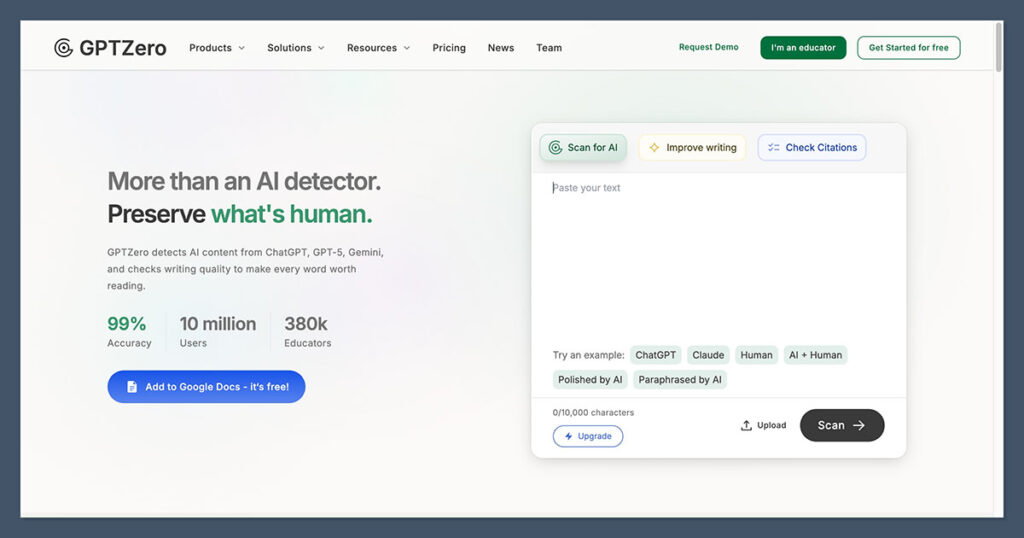
The Writing Replay feature tracks how a document was written, recording typing patterns, copy-paste events, and edit time. This makes GPTZero the only tool offering process-based verification alongside statistical detection. GPTZero has over 3 million users and was ranked the #1 most trusted AI tool on G2 in 2025. If you’re a budget-conscious individual, the free tier (10,000 words/month, no credit card) lets you evaluate before paying.
Who Is Originality AI Best For?
Originality AI was purpose-built for content marketing teams and publishers. Jonathan Gillham, its founder, positioned the product specifically for high-volume content operations, not academic integrity.
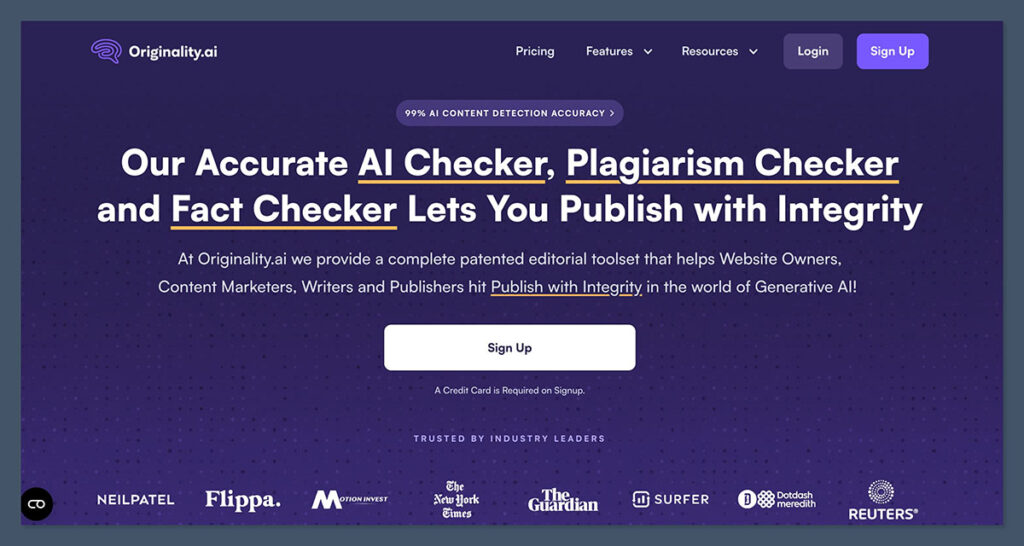
If you manage freelance writers, need paraphrasing detection that actually works, or want plagiarism, readability, and fact-checking in a single scan, Originality AI is built for your workflow. The website URL scanner also makes it the go-to tool for site acquisition due diligence, letting you scan every page on a domain without copy-pasting.
WriterAccess, a major content marketplace, uses Originality AI as its primary verification tool. Team management features include shared credits and role-based access for agencies running multiple editors. The Chrome extension and WordPress plugin bring scanning directly into your publishing workflow.
The first criterion everyone argues about: accuracy.
1. Detection Accuracy: Why Every Benchmark Tells a Different Story
Accuracy claims for gptzero vs originality ai range from 62% to 99% for GPTZero and 76% to 100% for Originality AI. The number you believe depends entirely on who ran the test, what they tested, and how they measured it. I’ll break down the data by source so you can weigh it yourself.
Vendor Benchmarks (Flag the Bias)
GPTZero’s own test across 3,000 samples (50% human, 50% AI-generated) reported 99.3% accuracy with a 0.24% false positive rate. In the same benchmark, Originality AI scored 83% accuracy with a 4.79% false positive rate.
These numbers are useful as a ceiling, not a floor. Vendor-run tests inherently favor the vendor. GPTZero chose the samples, the methodology, and the scoring criteria. Take the relative gap seriously, but not the absolute numbers.
Independent Test Results
The picture shifts when outside researchers run the tests.
PCWorld tested both tools on a 100% AI-generated story from Google Gemini. Originality AI scored 100% on both runs. GPTZero scored 62% on both runs. The reviewer called GPTZero’s result “a lukewarm result, not particularly impressive.”
Scribbr found Originality AI scored 76% overall accuracy across various text samples, but it was the only tool that caught AI paraphrasing more than half the time (60% of paraphrased cases).
Hastewire ran 200 documents (~500 words each) generated by GPT-4o and Claude 3.5. Originality AI hit 94% overall. GPTZero reached 89%. On humanized text, Originality AI averaged a 62% probability score versus GPTZero’s 48%.
Ampifire found GPTZero at 80% overall and Originality AI at 76%, but Originality AI scored 95-97% on paraphrased and edited AI content.
Why Results Diverge
Four factors explain the contradictions:
- Sample type matters. Academic essays, marketing copy, and fiction produce different detection profiles. GPTZero hits 96% on academic essays but drops to 82-85% on blog posts and 65-70% on paraphrased content.
- Text length matters. Short paragraphs penalize both tools. GPTZero’s accuracy drops to 78% on texts under 200 words.
- Model version matters. Tests run on GPT-3.5 output tell you nothing about GPT-5 performance.
- Methodology matters. Balanced versus imbalanced datasets, sample selection criteria, and scoring thresholds all shift the final numbers.
If you need a single accuracy number to make your decision, you’re asking the wrong question. The next section covers the metric that actually differentiates these tools right now.
2. GPT-5 and Claude 4 Detection: The Gap Competitors Won’t Show You
Originality AI catches only 7.3% of GPT-5-mini output. If your writers use the most popular OpenAI model of 2026, Originality AI will miss nearly everything. This is the single largest performance gap between these two tools, and no competing comparison article covers it.
GPT-5 Family Detection
GPTZero’s benchmarks show 100% detection on GPT-5 output and 94.9% on GPT-5-mini. Originality AI manages just 31.7% on GPT-5 and a dismal 7.3% on GPT-5-mini.
Each new LLM generation requires detector retraining. GPTZero appears to have updated its models aggressively for the GPT-5 family.
On the broader RAID benchmark (672,000 texts across 11 domains, 12 LLMs, and 12 adversarial attack types), GPTZero detected 95.7% of AI texts while incorrectly flagging only 1% of human texts. That performance exceeds 99% when you exclude discontinued models like GPT-3.5. Originality AI, as of this writing, has not closed the GPT-5 gap.
Claude Sonnet 4 Detection
On Claude Sonnet 4 output, the picture is much tighter. GPTZero scores 99.0%. Originality AI scores 95.1%.
The 3.9 percentage point difference is unlikely to change your buying decision. Both tools handle Claude-family output competently.
Mixed-Content Detection (Human-Edited AI Drafts)
Both tools struggle here, and most comparisons go silent about it. In real-world workflows, writers rarely submit pure AI output. They generate a draft with GPT-5 or Claude, then edit it substantially.
Hastewire’s test found that in simulated freelance scenarios with 80% human content and 20% AI augmentation, false positives surged to 12% across all tested tools. GPTZero’s detection of heavily edited AI text drops to 45-50%.
Educators on Reddit report 10-15% of their original essays being incorrectly flagged. Neither tool reliably distinguishes AI-assisted editing from fully AI-generated content. This is the realistic workflow for most content teams and classrooms, and it’s the gap neither vendor publicly addresses.
If your concern is GPT-5 output specifically, GPTZero is the only viable option right now. For Claude-family output, both tools perform comparably. For mixed human-AI content, neither tool should be trusted as a sole decision-maker.
3. Paraphrasing and Evasion Detection
A freelancer runs AI text through QuillBot, submits it as original work, and your detector says it’s human. You publish it. Google’s helpful content system flags it months later. This is the exact scenario paraphrasing detection exists to prevent, and it’s where Originality AI pulls ahead decisively.
QuillBot Paraphrasing Test
In a hands-on comparison by tamzidahmed.com, the reviewer generated AI content, ran it through QuillBot’s paraphrasing tool, and scanned the result with both detectors. Originality AI detected the paraphrased AI text as 100% AI. No ambiguity.
GPTZero’s basic scan on the same paraphrased content returned 52% human, 6% mixed, and 42% AI. That’s functionally a coin flip. GPTZero’s deep scan improved the result but still returned 72% human and 22% AI, failing to confidently identify the AI origin.
Scribbr’s Independent Paraphrasing Test
Scribbr’s independent evaluation confirmed the pattern. Originality AI was the only tool that caught AI paraphrasing more than half the time, with a 60% detection rate. Ampifire’s separate test reinforced this: Originality AI scored 95-97% on paraphrased and edited AI content, while GPTZero’s overall weaker performance on rewritten content is consistent across tests.
Originality AI’s Deep Scan
Originality AI offers a Deep Scan feature that runs multiple analysis passes on suspicious text. It targets content that has been rewritten to evade detection, analyzing writing patterns at a granular level beyond standard single-pass scanning. The feature is available on all paid plans. For content teams managing freelancer submissions, Deep Scan adds a second layer of verification before publication.
Verdict: Originality AI wins paraphrasing detection decisively. If evasion is your primary threat vector, whether from freelancers running content through paraphrasing tools or writers using AI “humanizers,” this single capability may justify choosing Originality AI over GPTZero.
4. False Positives: When Detectors Get It Wrong
GPTZero flagged the US Constitution as AI-generated. Originality AI scored The Da Vinci Code as 100% AI. Both tools flagged the Declaration of Independence as AI-written.
These aren’t quirky edge cases. They reveal structural limitations in how statistical detection works.
GPTZero False Positive Patterns
The US Constitution incident was widely reported and became a social media flashpoint. One user on X noted: “GPTZero thinks the US Constitution was written by AI. The founding fathers were ahead of their time.”
Beyond the headlines, GPTZero has a documented problem with ESL student writing. Non-native English patterns, including formal structure and lower vocabulary variation, mimic AI text signals. For educators using GPTZero in diverse classrooms, this is a serious concern.
GPTZero’s own benchmark claims a 0.24% false positive rate (roughly 1 in 400 documents). Independent tests on specific text types suggest the real-world rate runs higher, particularly on formal or structured writing.
Originality AI False Positive Patterns
Originality AI’s Turbo 3.0 model is aggressive. In a fritz.ai test, the reviewer’s own human-written content scored 65% AI on Turbo 3.0 and 71% AI on the Standard 2.0 model. A 2022 blog post written entirely by a human, predating ChatGPT, was flagged as 61% AI by Originality.
Freelancer communities on Reddit are filled with stories of writers losing clients because Originality AI flagged their legitimate work. Originality AI itself acknowledges common triggers: formal/structured writing, any prior AI tool use (even minor grammar checking), and technical documentation.
What Drives False Positives
Three patterns emerge across both tools. Formulaic or structured writing (legal, technical, academic) mimics AI output patterns. Short text samples lack enough signal for reliable classification. ESL and non-native writing often has lower perplexity, which is one of the core metrics both tools use.
How to Reduce False Positive Risk
Never use a single scan as definitive proof of AI use. Cross-check with a second tool. Use GPTZero’s Writing Replay for process-based verification when available. Set organizational thresholds (flag only above 80% AI confidence, for example) rather than treating any detection as conclusive.
GPTZero’s false positive rate is lower in controlled tests, but its ESL bias is a known issue. Originality AI’s rate spiked after its Turbo 3.0 update. Neither tool should serve as a sole decision-maker for high-stakes outcomes like academic misconduct charges or freelancer termination.
5. Pricing and Value for Money (2026 Verified)
Pricing is where gptzero vs originality ai comparisons go stale fastest. I verified these numbers directly from each platform’s pricing page in March 2026. If you’ve seen different figures in other comparisons, those are likely outdated.
GPTZero Pricing (2026)
| Plan | Monthly Price | Annual Price | Words/Month |
|---|---|---|---|
| Free | $0 | $0 | 10,000 |
| Essential | $14.99 | $10/mo | 150,000 |
| Premium | $23.99 | $16/mo | 300,000 |
| Professional | $45.99 | $23/mo | 500,000 |
GPTZero’s free tier is the strongest differentiator in this category. You get 10,000 words per month with no credit card required. For students, individual educators, and anyone evaluating the tool, it removes the barrier entirely.
Annual billing saves roughly 45% across all paid plans. API access starts at lower tiers, and GPTZero does not store submitted content.
Originality AI Pricing (2026)
| Plan | Monthly Price | Annual Price | Credits/Month |
|---|---|---|---|
| Pay-As-You-Go | $30 one-time | N/A | 3,000 (expires in 2 years) |
| Pro | $14.95 | $12.95/mo | 2,000 |
| Enterprise | $179 | $136.58/mo | 15,000 |
One credit equals 100 words for AI-only scans. If you run AI plus plagiarism detection together, one credit covers only 50 words, effectively doubling your cost. Credits on monthly plans don’t roll over. New users receive 50 credits at signup (roughly 5,000 words for AI-only scanning), but there is no ongoing free tier.
Cost-Per-Scan Comparison
At 150,000 words per month, GPTZero Essential ($14.99) and Originality AI Pro ($14.95 for approximately 200,000 words AI-only) are near parity. At 500,000 words per month, the gap widens sharply: GPTZero Professional costs $45.99 versus Originality AI Enterprise at $179. GPTZero is roughly 4x cheaper at high volume.
That comparison isn’t perfectly apples-to-apples. Originality AI’s price includes plagiarism scanning, readability scoring, and fact-checking. If you’d otherwise pay for a separate plagiarism tool, the bundled value matters.
Hidden Costs and Gotchas
GPTZero has Trustpilot complaints about difficult subscription cancellation. Users report unexpected charges after trial periods and slow support response when trying to cancel. Some needed bank intervention to block charges.
Originality AI’s pay-as-you-go credits expire after two years. Monthly plan credits don’t roll over. The credit-doubling on combined scans catches many users off guard.
Best value for light users: GPTZero (free tier). Best value for content teams needing bundled scanning: Originality AI Pro. Skip Originality Enterprise unless you specifically need API access and batch processing at scale.
6. Features, Integrations, and Developer Tools
You’ve picked an AI detector for accuracy. Now the question is whether it fits into your actual workflow. A Chrome extension, an LMS plugin, or an API endpoint can be the difference between a tool you use daily and one you abandon after a week.
Unique Features
GPTZero has leaned into authorship verification as its strategic differentiator. Writing Replay tracks how a document was written, recording typing patterns, copy-paste events, edit time, and even video playback of the writing process. Edward Tian, GPTZero’s CEO, has described this as a shift from detection to authorship verification, verifying the process rather than just analyzing the output.
GPTZero also provides sentence-level highlighting with color-coded confidence scores. You don’t just get a single percentage. You can see exactly which sentences triggered AI flags.
Originality AI bundles more tools into a single subscription. Every scan includes plagiarism checking, readability scoring, and fact-checking alongside AI detection. The website URL scanner lets you scan published pages without copy-pasting.
A Chrome extension and WordPress plugin bring detection into the browser and CMS. Deep Scan runs multiple analysis passes for evasion detection.
API and Developer Experience
GPTZero’s API is accessible on lower-tier plans. It uses a single primary endpoint, does not store submitted documents, and provides code examples in 17 programming languages. For individual developers or startups integrating detection into an app, GPTZero is the accessible choice.
Originality AI’s API is more powerful but locked behind the Enterprise plan at $136-$179 per month. You get 500 requests per minute, batch scanning, URL scan endpoints, and multiple detection models (Lite, Turbo, Academic, Multi-Language). For enterprise-grade integrations with high throughput needs, it delivers more flexibility.
Multi-Language Support
Originality AI supports 15 languages with claimed 90%+ detection accuracy. GPTZero currently covers English, French (94.1% accuracy), and Spanish (95.7% accuracy), with plans to expand. If you need detection for non-European languages, Originality AI has broader coverage today.
For educators: GPTZero’s LMS integration, Google Classroom support, and Writing Replay are purpose-built for the classroom. For publishers managing a content pipeline: Originality AI’s bundled scanning, Chrome extension, and WordPress plugin reduce tool-switching and consolidate your workflow.
7. Privacy, Compliance, and Data Handling
You paste a client’s unpublished manuscript into an AI detector. Where does that text go? Who can access it? Is it used to train models?
For many buyers handling student data, client work, or proprietary content, this question matters more than any accuracy benchmark.
GPTZero’s Data Practices
GPTZero holds SOC2 Type-II certification, meaning its security controls have been independently audited. It is GDPR compliant and FERPA compliant, the latter being critical for any K-12 or higher education deployment in the United States. Documents submitted via the API are not stored. Dashboard submissions are stored in aggregate to improve the service, but GPTZero states it has not sold or shared personal information to third parties.
Originality AI’s Data Practices
Originality AI hosts data on AWS servers in the United States and uses TLS 1.2+ with 256-bit encryption. It does not sell personal information, and content ownership is not transferred upon upload.
However, users are automatically opted into allowing anonymized content to be used for training and improving detection models. You can opt out, but it’s not the default. Originality AI has no SOC2 certification, no FERPA compliance, and ambiguous GDPR documentation.
What This Means for Different Buyers
US educators: GPTZero is the only FERPA-compliant option between these two. Originality AI cannot legally process student data in many school districts without additional data processing agreements.
Enterprise and agency buyers: SOC2 certification is often a procurement requirement. GPTZero passes. Originality AI does not. If your legal or IT team reviews vendor security before approving tools, this distinction may end the conversation.
EU-based teams: GPTZero’s GDPR compliance is documented. Originality AI’s status is unclear in public documentation, and its US-based AWS hosting raises additional questions for organizations handling EU resident data.
Verdict: GPTZero wins privacy and compliance outright. If your organization has a legal or procurement team that reviews vendor security, this section alone may determine your choice.
The Verdict: Which Tool Should You Choose?
Here’s how gptzero vs originality ai stack up across all seven criteria.
| Criterion | Winner |
|---|---|
| Detection Accuracy | Draw (depends on methodology and model) |
| GPT-5 Detection | GPTZero |
| Paraphrasing Detection | Originality AI |
| False Positive Risk | GPTZero (lower FPR, but ESL bias caveat) |
| Pricing and Value | GPTZero (free tier, lower enterprise cost) |
| Features and Integrations | Depends on workflow |
| Privacy and Compliance | GPTZero |
Neither tool is universally better. The right choice depends on what you scan, who sees the results, and what compliance requirements you need to meet.
Choose GPTZero if:
- You’re an educator or institution needing FERPA compliance
- You need to detect GPT-5 output specifically
- You want a free tier for light or exploratory use
- You need process-based verification through Writing Replay
- Data privacy is a procurement requirement
Choose Originality AI if:
- You manage a content marketing team or publish at scale
- Paraphrasing evasion is your primary concern
- You want plagiarism, AI detection, and readability scoring in one tool
- You need a Chrome extension or WordPress plugin for workflow integration
- You value responsive, named customer support
SEO consultant Glenn Gabe has endorsed Originality AI specifically for content marketing workflows. Jonathan Gillham, Originality AI’s founder, built the product for publishers and content agencies, not educators. Edward Tian is building GPTZero toward a future where authorship verification replaces statistical detection entirely.
These are two tools with different visions solving different problems. GPTZero wins four of the seven criteria outright, but Originality AI’s paraphrasing detection and bundled toolset make it the better fit for content operations.
If you’re still undecided, start with GPTZero’s free tier. You get 10,000 words per month at no cost, no credit card required. That’s enough to test it against your real content before committing to either platform.
FAQ
Is GPTZero or Originality AI more accurate?
It depends on the text type. GPTZero leads on GPT-5 detection (100% vs 31.7%). Originality AI leads on paraphrased content. Independent tests place both in the 76-94% range.
Does GPTZero have a free plan?
Yes. GPTZero offers 10,000 words per month free, no credit card required. Originality AI has no free tier.
Can AI detectors identify text written by GPT-5?
GPTZero detects GPT-5 at 100% and GPT-5-mini at 94.9%. Originality AI catches only 31.7% of GPT-5 text. GPTZero is the clear choice here.
Do AI detectors flag human writing as AI?
Yes. GPTZero flagged the US Constitution. Originality AI scored The Da Vinci Code as 100% AI. Neither vendor recommends using results as sole proof.
Is Originality AI safe for scanning student work?
No. Originality AI lacks FERPA compliance and auto-opts users into data contribution. GPTZero is the FERPA-compliant option with LMS and Google Classroom support.
Which tool has better customer support?
Originality AI. Reviewers name specific team members and report fast resolution. GPTZero has complaints about slow responses and difficult cancellation.

Comments 0 Responses