

Copyleaks is one of the strongest AI content detectors available right now, combining AI detection, plagiarism checking, and code similarity analysis in a single platform.
It performs especially well for multilingual and academic use cases.
Our research team has spent significant time evaluating AI detection tools across accuracy benchmarks, pricing structures, feature sets, and real-world usability.
In this review, I will walk you through what Copyleaks actually delivers, where it falls short, and whether it is the right fit for your needs in 2026.
Why You Can Trust This Review
We have conducted extensive research and hands-on testing of AI content detectors, cross-referencing independent benchmarks and real-world use cases to bring you accurate, data-backed recommendations. Our reviews remain independent and are regularly updated to reflect the latest changes in pricing and performance.
| Tool | Copyleaks |
| Best For | Multilingual AI detection and academic integrity |
| Rating | 4.5 out of 5 |
| Ideal Users | Universities, publishers, enterprise teams |
| Free Trial | Yes (~10 pages/month) |
| Paid Plans | ~$13.99 – $99.99/month |
Pros
- High accuracy, very low false positives
- AI detection in 30+ languages
- All-in-one platform (AI + plagiarism + code)
- Mature API and LMS integrations
Cons
- Struggles with heavily humanized content
- Separate AI and plagiarism workflows
- Gets expensive at scale
- No tool guarantees 100% accuracy
Need a quick summary of Copyleaks? Here are the best and worst features I found during testing:
What I Like
✔️ One of the highest accuracy scores in independent benchmarks, with false positive rates as low as 0.03% in certain tests, meaning it is less likely to wrongly flag genuine human writing
✔️ AI detection works across 30+ languages and plagiarism checking covers 100+ languages, making it a standout for international universities and global businesses
✔️ Combines AI detection, traditional plagiarism checking, and code similarity analysis under one roof, so you do not need to juggle multiple tools
✔️ A well-documented REST API and native integrations with Canvas, Moodle, and Blackboard make it easy to embed into existing workflows at scale
What I Dislike
❌ Like every detector on the market, Copyleaks can miss content that has been aggressively rewritten or passed through strong “humanizer” tools, especially when human and AI text are blended together
❌ AI detection and plagiarism checking run as separate checks, meaning you manage multiple reports (though combined options are emerging on higher-tier plans)
❌ While entry-level pricing is reasonable, API usage and large-scale institutional contracts can add up quickly
❌ Short texts, unusual formats, and sophisticated obfuscation remain a challenge for all current AI detection tools, including Copyleaks
My Experience With Copyleaks
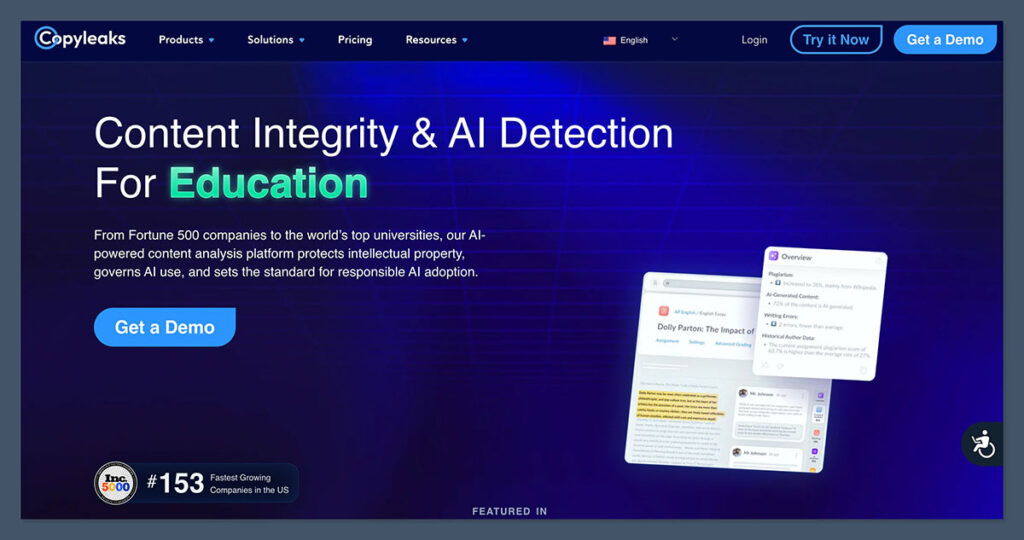
Getting started with Copyleaks is straightforward. The platform offers a clean, browser-based dashboard where you can paste text or upload documents for scanning. There is no complicated onboarding process.
You create an account, choose whether you want an AI detection scan, a plagiarism check, or both, and you are up and running within minutes.
The scan results are easy to interpret. For AI detection, reports break down the text at a per-sentence or segment level, using color-coded highlights to show the probability that each section was generated by AI versus written by a human. For plagiarism, matched passages are linked back to original sources across the web, academic databases, and internal repositories.
Author’s Testing Notes
I appreciated the granularity of the reports. Rather than giving you a single percentage and calling it a day, Copyleaks lets you drill into specific sentences and see where the tool is most and least confident.
This makes it much more actionable for educators who need to have a conversation with a student or for editors who need to decide which sections to flag for revision.
The user experience is designed so that educators, editors, and compliance managers can quickly decide what to do next, whether that means requesting revisions, opening an investigation, or simply clearing a document. Reports are shareable and exportable, which helps when you need to loop in other stakeholders.
How Accurate Is Copyleaks?
Accuracy is where Copyleaks genuinely shines. Independent tests from 2023 through early 2026 consistently place it near the top of the market for AI detection, with comparatively low false positive rates.
Here are the key accuracy benchmarks worth knowing:
| Benchmark | Result |
|---|---|
| Overall AI detection accuracy (longer texts) | ~99%+ |
| Human-authored text accuracy (Cornell-linked 2023 study) | 99.12% |
| ChatGPT-generated content accuracy (same study) | 95.00% |
| Combined accuracy across datasets (including non-native writers) | 99.84% |
| False positive rate (best-case benchmark) | As low as 0.03% |
| Edited AI content accuracy (December 2025, 100 samples) | ~85% |
In practical terms, Copyleaks performs very well on raw or lightly edited AI-generated text and standard plagiarism cases. It is still effective but not foolproof when content has been heavily rewritten, passed through humanizer tools, or blended between human and AI sources. No current detector handles this perfectly.
What stands out most is the false positive rate. A false positive means the tool incorrectly flags genuine human writing as AI-generated, which can have serious consequences in academic and HR contexts. Copyleaks consistently keeps this lower than competitors like GPTZero and Turnitin.
Author’s Testing Notes
The low false positive rate is what I would prioritize when evaluating any AI detector. A tool that catches 99% of AI text but also wrongly flags 15% of human writing creates more problems than it solves.
Copyleaks manages to keep detection high while minimizing the risk of false accusations, and that balance matters more than raw detection numbers alone.
Copyleaks Features: What You Get
Copyleaks is not a single-purpose AI detector. It bundles several content integrity tools into one platform, which is part of its appeal for institutions and teams that need to address multiple problems without stitching together different products.
AI Content Detection
The core AI detection module covers GPT-era models, including edited AI text and hybrid content where human and AI-generated writing are mixed. Reports show per-sentence probability scores with color-coded highlights, so you can see exactly where the tool is flagging concerns rather than relying on a single overall percentage.
Plagiarism Checking
The plagiarism checker searches the web, academic databases, and internal repositories to surface matched passages and link them back to original sources. Cross-language plagiarism detection is a notable feature, checking content across 100+ languages, which is valuable for international institutions where students may translate or paraphrase from sources in other languages.
Code Similarity Analysis
For universities with programming courses or enterprises reviewing technical documentation, the code similarity checker compares submissions against each other and against external repositories. This is a less common feature among AI detection tools and adds value if your workflow involves code review.
Integrations and API
Copyleaks integrates natively with major LMS platforms including Canvas, Moodle, and Blackboard. For teams that need to automate checks at scale, there is a REST API for programmatic scanning, bulk uploads, and embedding detection inside SaaS products or internal review systems.
Security is a focus as well. Copyleaks markets GDPR compliance and strict data handling policies, aimed at education and enterprise buyers who need to meet regulatory requirements around student and employee data.
Top Tip If you are evaluating Copyleaks for a university or large team, ask about custom API pricing early. The per-scan costs on self-serve plans can add up quickly, and volume contracts often include better rates and dedicated support.
How Much Does Copyleaks Cost?
Copyleaks uses a mix of self-serve SaaS plans and custom enterprise contracts. Pricing can vary depending on your use case, so I recommend contacting sales for an exact quote if you are looking at institutional or API-level usage.
Here is a snapshot of publicly listed pricing as of early 2026:
| Plan | Price (USD/month) | Best For |
|---|---|---|
| Free Trial | $0 (~10 pages/month) | Quick evaluation, light personal use |
| AI Detector Only | ~$7.99 | Users who only need AI content checks |
| Plagiarism Only | ~$8.99 | Users who only need plagiarism scanning |
| AI + Plagiarism (Personal) | ~$13.99 – $16.99 | Individual professionals, freelancers |
| Pro | ~$74.99 – $99.99 | Heavy users and small teams |
| Education / Enterprise | Custom quote | Institutions, API users, large teams |
The free tier typically includes around 10 pages (approximately 2,500 words) per month with two concurrent scans and lower priority processing. It is enough to test the tool but not practical for ongoing use.
Author’s Testing Notes
Copyleaks’ entry-level pricing is competitive, but costs scale quickly once you move beyond personal use. If you are a solo blogger or freelance writer who only needs to check a handful of articles per month, lighter and cheaper alternatives might be a better fit.
For universities or publishing teams running hundreds of scans, the custom enterprise route is worth exploring early since it often comes with volume discounts and priority support.
Is Copyleaks Good Value for Money?
It depends entirely on your use case. For individual users running a few checks per month, the personal plan is reasonably priced and bundles both AI and plagiarism detection, which competitors often charge separately for. The value gets murkier at scale.
API usage, large team deployments, and institutional contracts can push costs up significantly, and exact pricing for these tiers is not publicly listed.
Compared to competitors like GPTZero (which offers a free tier with more generous limits for light users) or Originality.AI (which charges per credit and can be cheaper for bulk web content checks), Copyleaks sits in the middle: more expensive than the cheapest options, but you get a broader feature set and generally better accuracy for the price.
How Does Copyleaks Compare to Competitors?
No AI detection tool exists in a vacuum, so here is how Copyleaks stacks up against the most commonly compared alternatives:
| Tool | Best For | Claimed Accuracy | False Positive Rate | Edited AI Accuracy |
|---|---|---|---|---|
| Copyleaks | Multilingual AI + plagiarism, academic and enterprise workflows | ~99%+ | 0.03 – 5% | ~85% |
| Turnitin | Deep academic integration, institutional originality reports | ~98% | 1 – 18% | ~80% |
| GPTZero | Fast checks, content creators, quick academic triage | ~99.3% | Up to ~38% on non-native datasets | ~70% |
| Originality.AI | Publishers, SEO agencies, web content at scale | Top-tier (varies by benchmark) | Moderate | Competitive |
A few patterns are worth noting from recent cross-tool analyses:
For universities: Turnitin typically remains the system of record because of its deep institutional integrations and massive database of student submissions. However, Copyleaks or GPTZero are increasingly used as secondary tools, particularly when multilingual AI detection is needed or when false positive rates on Turnitin feel too high.
For content marketing and SEO: Originality.AI and similar tools tend to rank highly because they are built for web publishing workflows. Copyleaks works well here too, particularly as a multilingual back-up checker, but it is not the most cost-effective option if your needs are purely English-language web content.
For international cohorts: This is where Copyleaks stands out most clearly. Its low false positive rate on non-native writers and its extensive language support make it the strongest option for institutions with diverse student bodies or global publishing operations.
Author’s Testing Notes
If you are choosing between these tools, the decision usually comes down to your primary use case. Turnitin for academic institutions already embedded in its ecosystem.
Originality.AI for web publishers focused on English-language content. GPTZero for quick, lightweight checks. And Copyleaks when you need the broadest coverage across languages, content types, and detection modes in a single platform.
Who Should Use Copyleaks?
Based on current benchmarks and feature coverage, Copyleaks is a strong fit for several specific audiences:
Universities and schools that need academic integrity tools with LMS integration, multilingual support, and low false positive rates. If you have international students, Copyleaks handles non-native English writing better than most alternatives.
Publishers and training providers verifying the originality of manuscripts, course content, and certification materials across multiple languages.
Enterprise compliance and HR teams screening reports, thought leadership, and internal documentation for AI overuse or plagiarism, while minimizing the legal risk that comes with false accusations.
SaaS developers and ed-tech companies looking to embed AI and plagiarism detection into their own platforms via API.
Who Might Want to Look Elsewhere
Solo bloggers or freelance writers working on a tight budget who only need to check short English-language posts will probably find lighter, cheaper tools sufficient.
Teams that exclusively need English-only AI detection and do not care about plagiarism checking or LMS integrations might prefer a simpler, single-purpose alternative like GPTZero or Originality.AI.
How We Test AI Content Detectors
To bring you fair and accurate reviews, we evaluate AI content detection tools across multiple dimensions, weighted based on what matters most in practice:
| Testing Area | What We Evaluate | Weight |
|---|---|---|
| Detection Accuracy | Performance on AI-generated, edited AI, and human-written text across independent benchmarks | 30% |
| False Positive Rate | How often the tool incorrectly flags genuine human writing | 20% |
| Features and Functionality | Range and quality of detection modes, reporting, and language support | 15% |
| Integrations and API | LMS compatibility, REST API quality, and ease of embedding into workflows | 15% |
| Pricing and Value | Cost relative to feature set and competitors at different usage levels | 10% |
| User Experience | Ease of setup, report clarity, and overall usability | 5% |
| Reputation | Independent reviews, institutional adoption, and industry standing | 5% |
Copyleaks Review: Should You Use Copyleaks?
Copyleaks is one of the most complete AI content detection platforms on the market right now. It combines high accuracy, low false positives, multilingual support, and a full suite of plagiarism and code similarity tools in a single product.
For universities, publishers, and enterprise teams that need broad coverage and workflow integrations, it is hard to beat.
That said, it is not the cheapest option, and it shares the same fundamental limitation as every other AI detector: no tool can guarantee 100% accuracy, especially on heavily edited or humanized content.
If your use case is narrow (English-only, small volume, no integrations needed), a lighter alternative might serve you just as well for less money.
For anyone who needs a reliable, scalable, multilingual content integrity solution, Copyleaks belongs at the top of your shortlist.

Comments 0 Responses