

After researching and analyzing 13 of the leading AI B2B lead generation tools, our team has shortlisted our top seven recommendations for 2026.
Amplemarket is our number one choice, offering the most complete signal-driven platform that combines contact data, intent signals, multichannel outreach, and deliverability infrastructure in a single workflow.
In this guide, I’ll walk you through the key features, pricing, and drawbacks of each top-rated AI lead generation tool, so you can find the right fit for your sales team.
Our Top 7 AI B2B Lead Generation Tools
- Amplemarket – Best all-in-one, signal-driven platform
- Clay – Best for custom data orchestration
- Apollo – Best budget pick for small teams
- Instantly – Best for high-volume cold email
- ZoomInfo – Best enterprise B2B data provider
- 6sense – Best for account-level intent and ABM
- Cognism – Best for EU/UK compliance-sensitive teams
For this guide, we tested 13 major AI lead generation platforms across 150+ unique areas of investigation, spending over 200 hours analyzing features, pricing, and real-world performance. All recommendations are independent and unbiased.
In addition to showing the latest features and positioning from each tool, I’ve recently updated the recommendations to reflect how each platform can support B2B sales teams in 2026.
AI B2B Lead Generation Tool Comparison Table
Take a look at our top picks side by side to see which best suits your needs:
| Tool | Best for | Core role | Starting price | AI features |
|---|---|---|---|---|
| Amplemarket | All-in-one signal-driven outbound | Data + signals + multichannel outreach + deliverability | $600/mo (annual, 2 users) | Duo AI Copilot, signal detection, AI copywriter |
| Clay | Custom data workflows | GTM data orchestration layer | $185/mo (Launch plan) | Claygent AI research agent |
| Apollo | SMB email-first outbound | Contact database + basic sequencer | $49/user/mo (annual) | Apollo AI, campaign suggestions |
| Instantly | High-volume cold email | Prospecting + email infrastructure | Tiered (email-centric) | AI email writer, Supersearch, waterfall enrichment |
| ZoomInfo | Enterprise data standardization | B2B data + enrichment + intent | Custom (enterprise) | AI intent models, firmographic scoring |
| 6sense | ABM at enterprise scale | Account-level intent and predictive | Custom (enterprise) | Predictive buying-stage models |
| Cognism | Compliance-sensitive EU/UK teams | Data-as-a-service with AI research | Custom (quote only) | Cortex AI brand research |
#1. Amplemarket: Best All-in-One, Signal-Driven Platform
| Starting price | $600/month (Startup plan, 2 users, billed annually) |
|---|---|
| Free trial | 14 days |
| AI features | Duo AI Copilot, AI Copywriter, AI Replier, signal detection, voice cloning |
| Best for | Mid-market and enterprise outbound teams |
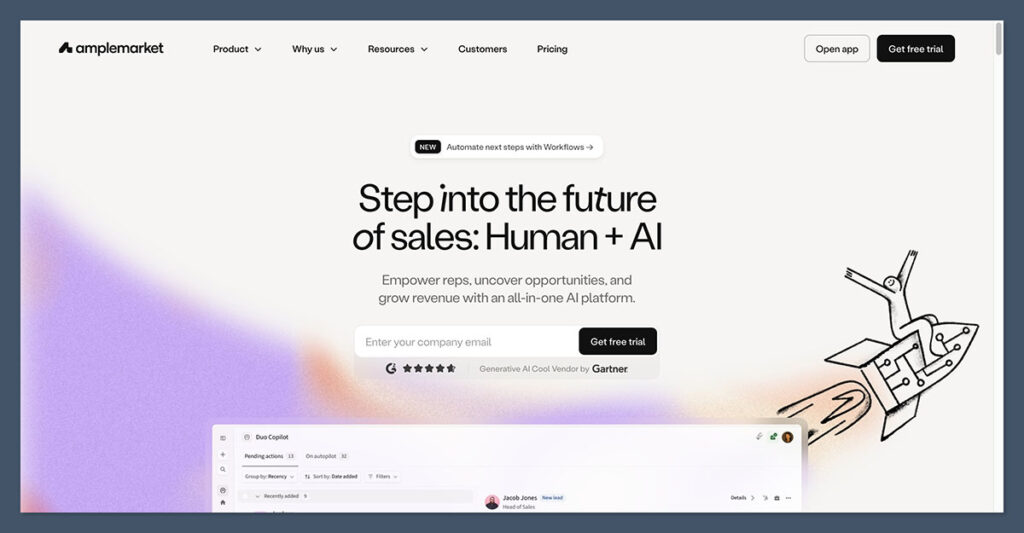
Amplemarket is the most complete AI B2B lead generation platform I’ve evaluated.
It’s built around the idea of signal-based selling, which means it surfaces contacts who are actually in-market right now and explains why the moment matters, rather than dropping you into a filter-driven contact database and wishing you luck.
The core of the product is Duo, an AI sales copilot that researches prospects, surfaces contact-level signals, drafts multichannel sequences across email, phone, and LinkedIn, and hands the final decisions back to the rep.
Around that copilot, Amplemarket bundles a global B2B contact database, multichannel outreach, deliverability infrastructure (warm-up mailboxes, domain health, spam checks), and native CRM integrations with HubSpot and Salesforce.
Pros 👍
- Signal-based prospecting identifies in-market buyers
- Duo AI Copilot drafts personalized multichannel sequences
- Built-in deliverability stack (warm-up, domain health, spam checks)
- Replaces 3–5 separate tools in most stacks
- Strong G2 rating (4.6/5 with 580+ reviews)
Cons 👎
- Annual contracts only, no monthly billing
- Extra user seats typically run $300–400/month each
- Not a full CRM; still need Salesforce or HubSpot
- Pricing for Growth and Elite tiers requires a sales call
- Learning curve for teams moving from point tools
What we like about Amplemarket
The signal engine is the real differentiator. Most platforms still ask you to define an ICP and then push you into a contact database with filters like industry, headcount, and job title.
Amplemarket does that too, but it also tells you which contacts inside those filters are showing buying signals right now, whether that’s a job change, a funding round, a hiring trigger, or intent on relevant topics.
For sales teams that have already tried “more volume” and hit a wall, that shift in decision logic is what actually moves reply rates.
The consolidation story also holds up under scrutiny. Teams we’ve seen switch to Amplemarket typically replace a data provider, a sequencer, a warm-up tool, a social automation tool, and sometimes an intent signal platform, ending up with one contract instead of five.
Amplemarket pricing
- Startup: $600/month billed annually (2 users included, 15,000 email credits per user per year)
- Growth: Custom pricing (typically $2,000–5,000/month based on public reports)
- Elite: Custom pricing for teams of 10+ SDRs
- Free trial: 14 days
- Add-ons: Extra users ~$300–400/month each, phone credits at $0.50, Duo Inbox as an add-on on Startup
Amplemarket is suitable for:
- Mid-market and enterprise teams scaling SDR or outbound motions
- Teams running coordinated multichannel sequences (email + LinkedIn + phone)
- Orgs looking to consolidate 3–5 point tools into one platform
- Sales teams with a clear ICP and defined outbound motion
Amplemarket isn’t suitable for:
- Solo founders or teams optimizing purely for lowest sticker price
- Single-channel cold email operations (cheaper tools will do)
- Teams without a defined ICP yet
- Orgs that need monthly billing flexibility
Amplemarket is the strongest option in 2026 for teams that want one platform to run their entire top-of-funnel motion, with AI doing the research and prioritization work that used to chew up an SDR’s morning.
#2. Clay: Best for Custom Data Orchestration
| Starting price | $185/month (Launch plan, billed monthly) or $167/month billed annually |
|---|---|
| Free plan | Yes – 100 data credits and 500 actions per month |
| AI features | Claygent AI research agent, multi-provider waterfall enrichment |
| Best for | RevOps teams, agencies, and growth engineers |
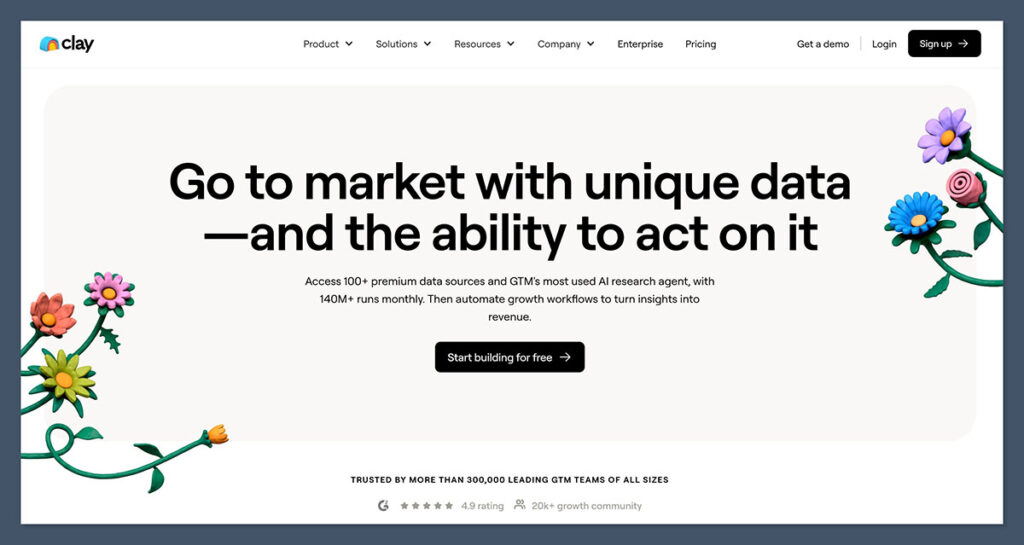
Clay isn’t a classic lead generation tool in the sense that it doesn’t hand you leads. It’s a data orchestration layer that sits on top of 150+ data providers and gives you a spreadsheet-like canvas to build custom enrichment, scoring, and research workflows.
For advanced GTM teams, that flexibility is the entire point.
The headline feature is Claygent, an AI research agent that can read websites, scan LinkedIn, pull recent news, and return structured outputs back into your table.
That means you can build workflows that look up a company’s latest funding round, extract the names of their engineering leaders, summarize their product positioning, and score the account, all without a human opening a browser.
Pros 👍
- Connects 150+ data providers in a single workflow
- Claygent automates human-like research tasks
- Unlimited users on every plan (usage-based pricing)
- Waterfall enrichment improves match rates across providers
- March 2026 pricing overhaul dropped data costs 50–90%
Cons 👎
- No rep-facing outbound UI; needs a downstream sequencer
- Steep learning curve (reports of weeks to master)
- Failed lookups still consume credits
- Needs ops or growth engineering ownership to maintain
- Dual credit system (Data Credits + Actions) adds complexity
What we like about Clay
Clay is what you reach for when off-the-shelf tools stop bending to your process. If you want to score accounts using a custom formula that blends technographic data, hiring signals, and a read of their careers page, Clay will let you build it. If you want to run ten different data providers in a waterfall and only pay for the ones that return a result, Clay will let you build that too.
The March 2026 pricing update also rebalanced the product. The old Starter, Explorer, and Pro tiers were replaced with Free, Launch ($185/mo), and Growth ($495/mo), and Clay negotiated volume discounts with its data partners that passed through as meaningful per-credit savings.
For teams that were already on a legacy plan, existing pricing is grandfathered, but new customers land on the new tiers.
Clay pricing
- Free: 100 data credits and 500 actions per month, unlimited users
- Launch: $185/mo monthly, $167/mo annual (2,500 data credits, 15,000 actions)
- Growth: $495/mo monthly, $446/mo annual (unlimited credits and actions)
- Enterprise: From $30,000/year, custom quote
Clay is suitable for:
- RevOps and growth engineering teams building custom workflows
- Agencies running repeatable prospecting processes per client
- Teams that want to combine multiple data providers in one flow
- Orgs with clear technical ownership and time to invest in setup
Clay isn’t suitable for:
- Sales reps who want to live in one rep-facing interface
- Teams without ops or technical capacity
- Anyone looking for a turnkey outbound solution
- Very small lists that don’t justify the setup investment
#3. Apollo: Best Budget Pick for Small Teams
| Starting price | $49/user/month (Basic, billed annually) |
|---|---|
| Free plan | Yes – limited credits, 2 active sequences |
| AI features | Apollo AI, campaign recommendations, AI-assisted sequences |
| Best for | SMB and early-stage sales teams doing email-first outbound |
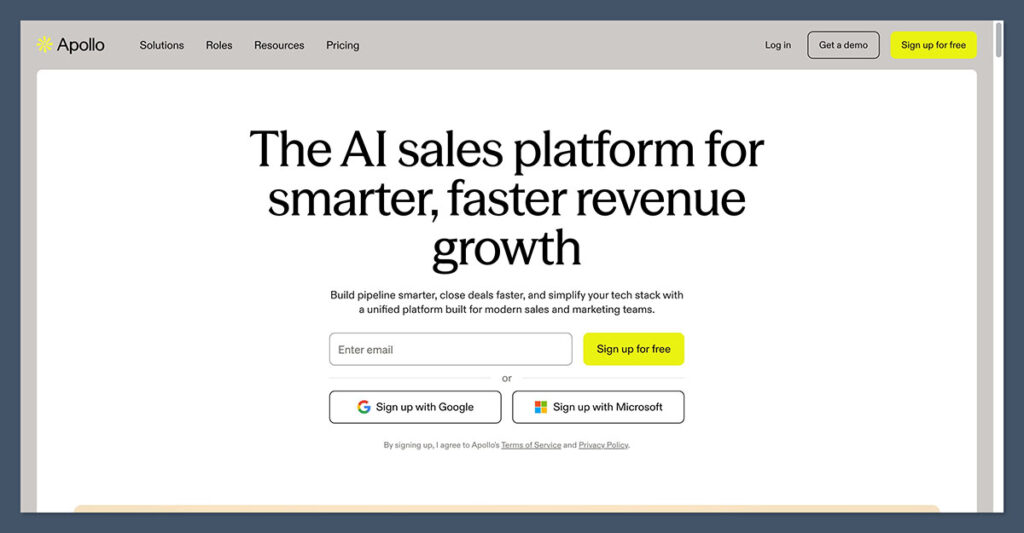
Apollo is the budget-friendly pick in this list, and the one most small teams land on first. It bundles a 275 million+ contact database with multichannel outreach tools, a free plan that’s genuinely usable, and paid tiers starting at $49 per user per month on annual billing.
For SMBs and early-stage teams doing primarily email outbound in the US, the value is real.
That said, Apollo’s pricing page only tells part of the story. The platform runs on a credit-based system, and phone number lookups cost 8 credits each against email’s 1 credit. Active teams routinely report real monthly costs of $150–400 per user once credit overages are factored in, and credits expire monthly without rolling over.
Pros 👍
- Largest affordable contact database (275M+ contacts)
- Usable free plan for testing
- Built-in sequencer reduces tool sprawl
- Lowest sticker price in this list
- Accessible for solo founders and small teams
Cons 👎
- Credit overages push real costs to 2–3x sticker price
- Email warm-up discontinued in 2024
- Email accuracy reported around 65–70% by user audits
- Prioritization is filter-driven, not signal-driven
- International dialer locked behind the Organization plan
What we like about Apollo
For a lean sales team that needs a contact database and a sequencer without committing to enterprise contracts, Apollo is hard to beat on price. The free plan alone has enough functionality to validate an ICP before you spend anything, and the Basic plan at $49 per user per month on annual billing covers most email-first outbound workflows.
Where Apollo runs out of road is when you need signal-driven prioritization, real-time deliverability tooling, or heavy phone prospecting. The credit math gets unfriendly fast, and the absence of native warm-up means you’ll likely bolt on a tool like Instantly or Lemwarm to protect your sender reputation.
Apollo pricing
- Free: 60 emails/month, 5 mobile credits, 10 export credits
- Basic: $49/user/mo annual, $59/user/mo monthly
- Professional: $79/user/mo annual, $99/user/mo monthly
- Organization: $119/user/mo annual, $149/user/mo monthly (3-user minimum)
- Overage credits: $0.20 each, 250-credit minimum purchase
Apollo is suitable for:
- Small teams (under 10 reps) doing email-first outbound
- Startups validating their ICP on a tight budget
- US-focused prospecting with moderate volume
- Solo founders testing outbound for the first time
Apollo isn’t suitable for:
- Heavy cold-calling teams (mobile credits burn fast)
- International teams (international dialer locked to top tier)
- Orgs that need real-time signal-based prioritization
- EU-focused teams with strict GDPR requirements
#4. Instantly: Best for High-Volume Cold Email
| Starting price | Tiered, starting with entry-level email plans (custom quote for full platform) |
|---|---|
| Free trial | Available |
| AI features | Supersearch (natural-language ICP), AI email writer, AI enrichment, warm-up AI |
| Best for | Agencies and growth teams running email-centric outbound at scale |
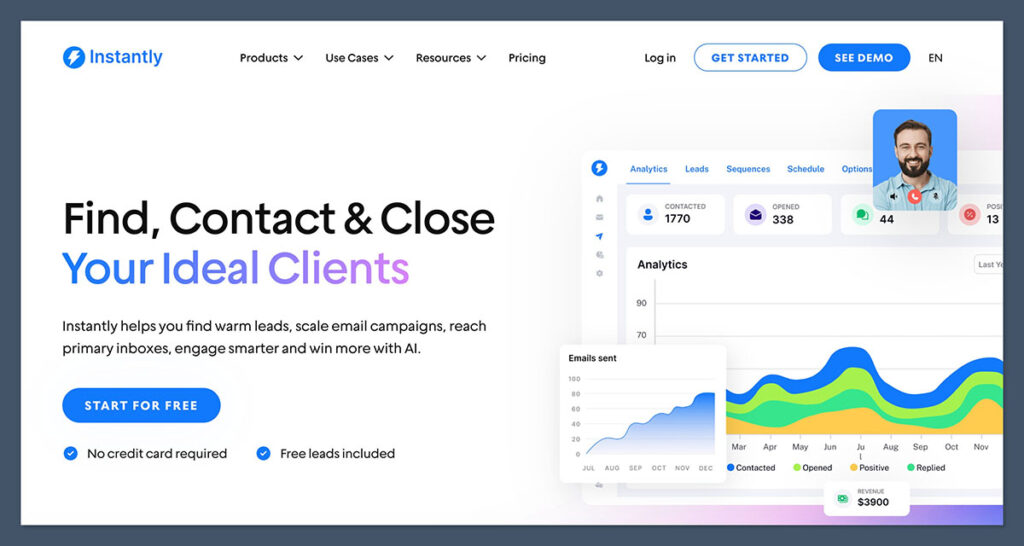
Instantly has positioned itself as the go-to tool for teams that live and die by cold email. It combines a 450 million+ verified contact database, AI-driven prospecting through its Supersearch feature, waterfall enrichment across seven+ data providers, and one of the strongest email deliverability stacks on the market.
The pitch is simple: define your ICP in natural language or filters, pull leads from the database, let AI enrich with firmographics and intent signals, let the AI email writer draft your copy, and let the warm-up infrastructure protect your sender reputation.
For an agency running 20 client campaigns in parallel, that end-to-end consolidation matters.
Pros 👍
- 450M+ verified contact database built into the platform
- Natural-language ICP search via Supersearch
- Waterfall enrichment across 7+ data providers
- Strong warm-up and deliverability infrastructure
- AI email writer integrated into the campaign flow
Cons 👎
- Heavily email-centric; weaker on phone and LinkedIn
- Less sophisticated on contact-level signal orchestration
- Pricing structure can be complex at scale
- Best value requires using the full platform (prospecting + email)
What we like about Instantly
Instantly’s deliverability stack is the main reason teams pick it over alternatives. Cold email lives and dies on whether your messages land in the inbox, and Instantly invests heavily in warm-up accounts, domain health, and sender reputation management.
Teams running thousands of emails per day can’t afford to ignore that.
The Supersearch + AI enrichment + AI writer combination also meaningfully shortens the path from “we need to launch a campaign” to “the campaign is live.” For agency owners and in-house growth teams with high throughput, that compression is the whole value proposition.
Instantly pricing
Instantly splits pricing across its email infrastructure tier and its lead database tier, with bundles that vary based on email volume, active inboxes, and contact credits. Because plan structure is frequently updated and pricing on the enterprise tier is customized, the best path is to pull current pricing directly from their site before committing.
Instantly is suitable for:
- Agencies running high-volume, email-centric outbound
- Growth teams that need a single environment for prospecting + sending
- Teams where inbox placement is a first-order priority
- Orgs that want AI-assisted email copy and enrichment bundled in
Instantly isn’t suitable for:
- Teams running balanced multichannel (phone + LinkedIn + email)
- Enterprise ABM programs with complex signal orchestration
- Orgs that need deep CRM-native workflows
- Sales teams where email is a secondary channel
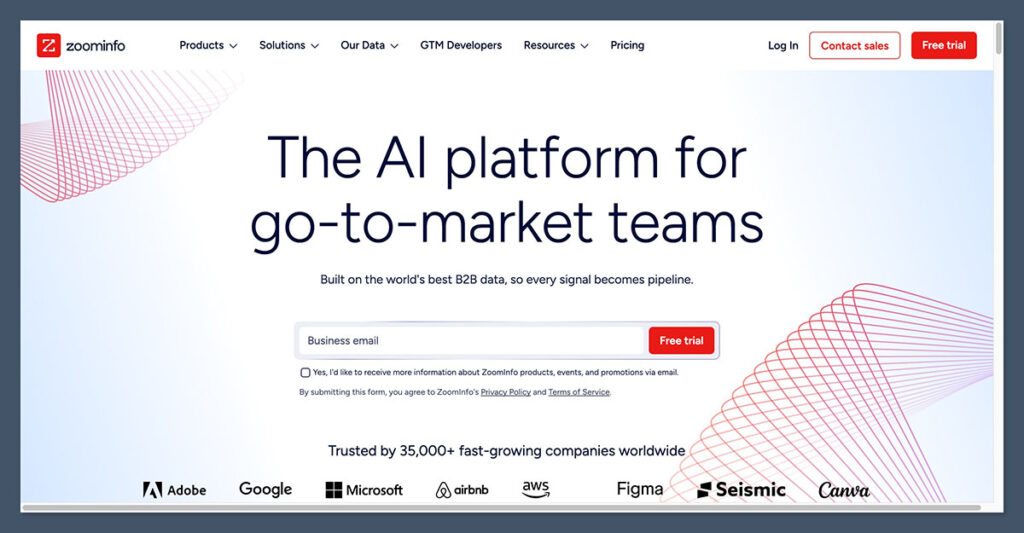
#5. ZoomInfo: Best Enterprise B2B Data Provider
| Starting price | Custom (typical contracts $15,000+ per year) |
|---|---|
| Free plan | No, but demo available |
| AI features | AI-driven intent models, firmographic scoring, CopilotGPT features |
| Best for | Mid-market and enterprise orgs needing a core data standard |
ZoomInfo is the incumbent in enterprise B2B data and the platform most sales orgs over a certain size end up with by default.
Its advantage is breadth: a deep, verified company and contact database, firmographic and technographic data, intent signals, and enrichment tooling that keeps CRM data clean. Increasingly, ZoomInfo is layering AI on top of that foundation to surface in-market accounts based on behavioral data like tech adoption and hiring trends.
Pros 👍
- Broadest coverage of enterprise B2B contact and company data
- Strong firmographic, technographic, and intent layers
- Enterprise-grade data governance and enrichment
- Deep integrations with Salesforce and HubSpot
- Reliable system-of-record for clean CRM data
Cons 👎
- Opaque pricing, requires a sales cycle and annual commitment
- Data is refresh-based rather than truly real-time
- Weak on native outbound execution
- Typically paired with a separate sequencer (Salesloft, Outreach, Amplemarket)
- High entry cost relative to Apollo or Cognism
What we like about ZoomInfo
If you run a mid-market or enterprise GTM org and you want one clean data layer feeding Salesforce, your sequencer, and your ABM tools, ZoomInfo is still the safest pick. It’s the tool that most of the rest of the stack is designed to integrate with, and the enrichment and governance features make it defensible as a system of record.
The limitation is execution. ZoomInfo isn’t where reps run their day, and the signal quality, while improving, is less real-time than platforms designed from the ground up around signal-based selling. Most orgs end up pairing it with an outbound-first tool to close that gap.
ZoomInfo is suitable for:
- Mid-market and enterprise orgs standardizing CRM data
- Teams feeding a broader stack (sequencers, ABM, analytics)
- Revenue ops functions that prioritize data governance
- Sales orgs running Salesforce at scale
ZoomInfo isn’t suitable for:
- Startups and SMBs on a tight budget
- Teams that want outbound execution built in
- Orgs that need real-time, contact-level signals as the primary input
- Teams uncomfortable with annual enterprise contracts
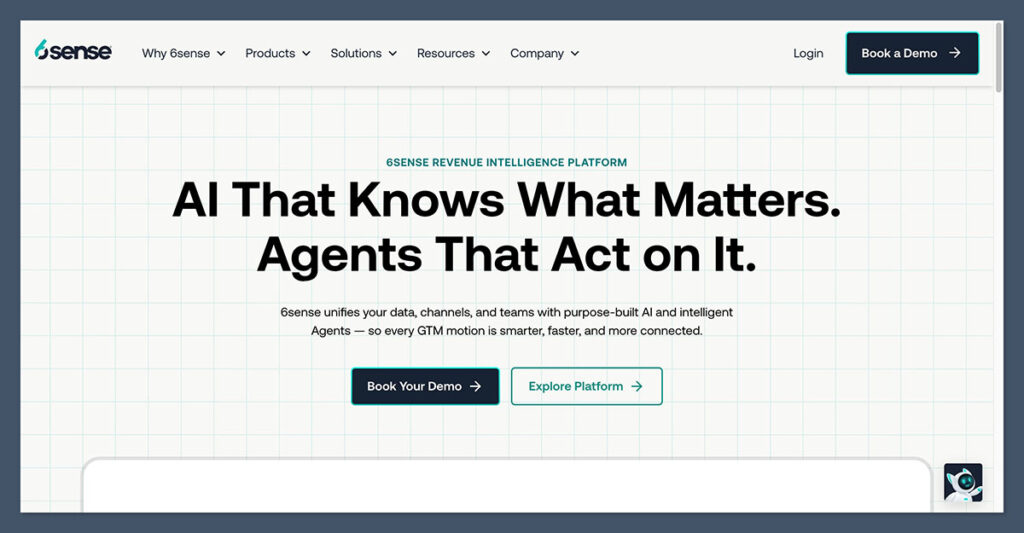
#6. 6sense: Best for Account-Level Intent and ABM
| Starting price | Custom (enterprise only) |
|---|---|
| Free plan | Limited free tier available for testing |
| AI features | Predictive buying-stage models, intent aggregation, AI-driven account scoring |
| Best for | Enterprise ABM and RevOps teams |
6sense is the category-defining platform for account-based marketing and predictive intent. It aggregates behavioral signals across content consumption, third-party intent data, ad engagement, and web visits to tell you which accounts are moving through buying stages, and when they’re likely to be ready for sales outreach.
For enterprise teams, the value isn’t about generating individual leads. It’s about deciding which accounts to prioritize before you build contact lists, and then aligning marketing and sales around a shared view of in-market opportunity.
Pros 👍
- Strongest account-level intent data on the market
- Predictive models identify accounts in active buying stages
- Aligns marketing and sales around shared target accounts
- Deep integration with Salesforce, HubSpot, and major ad platforms
- Best-in-class for enterprise ABM programs
Cons 👎
- Signals are account-level; still need other tools for contacts and outreach
- Implementation and ROI realization skew enterprise
- Not a fit for SMBs or startups
- Custom pricing only, significant annual commitment
- Requires mature RevOps to get full value
What we like about 6sense
6sense changes the first question a sales team asks from “who should we email today?” to “which accounts are actually in-market right now?” That reframing is especially valuable for enterprise sellers running long, multi-threaded deal cycles where timing matters more than volume.
The flip side is that 6sense is the opposite of plug-and-play. You need a mature ABM strategy, RevOps capacity to configure and maintain the platform, and a sales motion where account-level timing genuinely changes decisions. Without all three, the investment is hard to justify.
6sense is suitable for:
- Enterprise orgs with mature ABM or RevOps functions
- Sales teams selling complex, high-ACV deals
- Marketing teams that need to align ads, content, and sales around shared accounts
- Orgs where “which accounts to pursue” is a real strategic question
6sense isn’t suitable for:
- SMBs and startups
- Transactional, high-volume outbound motions
- Teams without dedicated RevOps or marketing ops capacity
- Orgs looking for contact-level execution out of the box
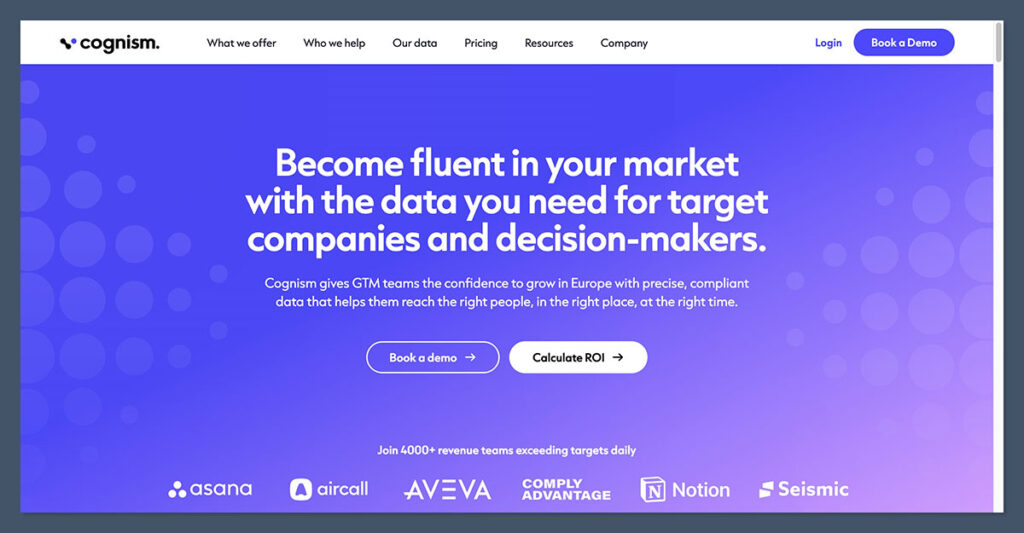
#7. Cognism: Best for EU/UK Compliance-Sensitive Teams
| Starting price | Custom (quote only) |
|---|---|
| Free plan | No |
| AI features | Cortex AI brand research, buyer signals, sales companion |
| Best for | European and UK-centric sales teams in compliance-sensitive industries |
Cognism is the closest direct competitor to ZoomInfo in the data-as-a-service category, with a stronger focus on European and UK coverage and a reputation for compliance in industries where GDPR is a first-order concern.
The platform pairs its “Diamond Data” contact database with Cortex AI, which automates brand and account research to accelerate list building.
Pros 👍
- Strongest emphasis on data quality and GDPR compliance
- Solid European and UK contact coverage
- Cortex AI automates repetitive research tasks
- Buyer signals and sales companion features
- Good fit for regulated industries
Cons 👎
- No native outreach module
- Opaque pricing (quotes only)
- Mirrors ZoomInfo’s dependency on external sequencers
- Less breadth than ZoomInfo in the US market
- Sales-led buying cycle
What we like about Cognism
For European and UK sales teams, Cognism is often the better default than ZoomInfo, purely on the strength of regional coverage and the company’s positioning around data compliance.
The Cortex AI layer is a useful addition that handles the slog of brand and company research before outreach, though the platform still leans on external tools for execution.
Cognism is suitable for:
- Sales teams with EU/UK-heavy ICPs
- Compliance-sensitive industries (finance, healthcare, legal)
- Orgs that want a ZoomInfo-style provider with stronger regional coverage
- Mid-market and enterprise with data quality as a top priority
Cognism isn’t suitable for:
- US-only teams (ZoomInfo has broader coverage)
- Teams that want outbound execution built in
- Buyers who need transparent, self-serve pricing
- Startups and SMBs on constrained budgets
How to Choose the Right AI B2B Lead Generation Tool
To choose the right tool, you should evaluate six key factors that map to how each platform fits in your workflow. While this guide can help you compare options, you have to determine your own needs and identify what you can live without.
Below is a checklist to work through when researching or trialing AI lead generation tools:
- Decision locus: Where in the workflow does this tool make decisions? Is it picking accounts (6sense), contacts (Amplemarket, Apollo, Cognism, ZoomInfo), message content (Instantly, Amplemarket), or data flow (Clay)? Overlapping tools in the same locus usually means you’re overpaying.
- Signal quality: Does the tool use real-time buyer signals, or is prioritization filter-driven? Signal-based tools cost more but often produce better reply rates on low-volume, high-value outbound.
- Execution channels: Does the tool execute outbound itself (email, phone, LinkedIn), or does it feed a downstream sequencer? Single-channel execution is fine if email is your primary motion; complex ABM motions need multichannel.
- Data coverage: Where is your ICP located? US-focused teams have more options; EU/UK teams should prioritize Cognism or vendors with strong regional coverage.
- Pricing model: Is it per-seat, credit-based, or usage-based? Credit-based tools (Apollo, Clay) can spike unexpectedly; per-seat tools (Amplemarket) are more predictable but commit you to annual contracts.
- Ownership and setup cost: Who owns the tool in your org? Tools like Clay require RevOps or technical ownership; tools like Apollo can be run by a single SDR.
How We Test AI B2B Lead Generation Tools
For this guide, we evaluated 13 of the leading AI B2B lead generation platforms across the categories that matter most to modern sales teams. We focused on six core criteria, each weighted to reflect what sales leaders value the most:
| Criterion | Weight | What we assessed |
|---|---|---|
| Signal quality and prioritization | 25% | How well the tool identifies in-market buyers and surfaces timely triggers |
| Data coverage and accuracy | 20% | Contact and company data breadth, email/phone verification accuracy, refresh cadence |
| AI features and automation | 20% | AI copywriting, research agents, predictive scoring, and workflow automation |
| Execution and deliverability | 15% | Multichannel outreach, warm-up infrastructure, and sender reputation tooling |
| Pricing transparency and value | 10% | Published pricing, credit systems, hidden costs, and predictability |
| Integrations and ecosystem | 10% | CRM integrations, ecosystem fit, and compatibility with adjacent tools |
Key Takeaways
- Amplemarket is our top-rated AI B2B lead generation tool in 2026, combining signal-based selling, an AI copilot (Duo), multichannel outreach, and deliverability tooling in one platform
- Pricing ranges from $49 per user per month (Apollo) to $600+ per month for full platforms (Amplemarket), with enterprise tools like ZoomInfo, 6sense, and Cognism requiring custom quotes
- Clay is the clear pick if you have ops capacity and want to build custom enrichment and scoring workflows on top of multiple data providers
- All seven tools include AI features, but their role differs: some use AI for copywriting (Amplemarket, Apollo, Instantly), others for research (Clay), and others for predictive account scoring (6sense, ZoomInfo)
- For teams doing account-based marketing at enterprise scale, 6sense remains the strongest option for identifying in-market accounts before you build contact lists
Final Verdict: Which AI B2B Lead Generation Tool Do I Recommend?
Our research process points to Amplemarket as the best AI B2B lead generation tool in 2026. It’s the most complete signal-driven platform on the market, combining contact data, real-time signals, an AI copilot, multichannel execution, and deliverability infrastructure in a way that genuinely replaces three to five point tools in most sales stacks.
That said, the right tool depends on your motion.
Clay wins for teams with ops capacity who want to build custom workflows on top of multiple data providers.
Apollo is the sensible budget pick for small US-focused teams doing email outbound. Instantly is the strongest option for agencies running high-volume cold email.
ZoomInfo and Cognism remain the defaults for enterprise data standardization, with Cognism taking the edge on European coverage and compliance.
And 6sense is still the category-defining platform for enterprise ABM.
If you’re unsure where to start, I recommend free trials or free plans on Amplemarket, Clay, and Apollo to see which decision locus fits your workflow before you commit to annual contracts.

Comments 0 Responses