

Best forecast upgrade

DemandForecast.ai
Visit Website →Quote-based after a demo
- Works with your existing planning system
- Managed forecasts without a data science team
- Stockout correction and drift monitoring
Best for replanning

Kinaxis Maestro
Visit Website →Quote-based
- Concurrent planning as conditions change
- What-if scenarios across demand and supply
- Connect data from multiple ERP systems
Best for complex demand

o9 Solutions
Visit Website →Quote-based
- Connect planning signals with a knowledge graph
- New-product forecasts using comparable items
- Model cannibalization and collaborate across teams
The trouble with comparing supply chain forecasting tools is most comparison lists don’t differentiate between two very different needs. They’ll put a specific forecasting and analytics product right beside a massive planning suite and assume they’re reviewing the same thing.
Talk to a handful of people who run supply chain operations (like I have) and you start to see how odd that is. If your S&OP process works but planners don’t trust the forecasts going into it, you probably don’t need to replace your whole technology stack.
That’s still true if you’re one of the many executives feeling pressure to implement AI, by the way. Gartner found that only 17% of supply chain organizations are pursuing an immediate, transformational redesign of their processes. The other 83% are applying AI to specific use cases or scaling it up gradually.
So this is really two articles in one. The first half reviews the 10 supply chain forecasting tools I’d recommend to business leaders, and the second half is my advice on choosing between them.
The Best Supply Chain Forecasting Tools: My 10 Picks
I’m going to run through my suggestions first, because undoubtedly, plenty of you will already have a basic idea of what you need and you’ll just want a smaller shortlist. I’ve kept each review fairly short, since going in depth on every type of forecasting software would make this a much longer article.
I put DemandForecast.ai first because it’s built around the business questions supply chain teams ask, it doesn’t need a data science team to run, and it fits best when you already have a workable planning process.
Kinaxis, o9 solutions, and Blue Yonder are a little different. Kinaxis is great when a demand change creates endless conversations about production or inventory, while o9 is really good if demand sits within a web of products, or external signals. Blue Yonder takes the biggest commitment of all, but it’s also one of the more comprehensive if you need a full suite update.
| Supply Chain Forecasting Software | Best For | The Biggest Benefit |
|---|---|---|
| DemandForecast.ai | Teams that already have a planning system, but need better forecasts | Easy-to-explain ML forecasts delivered as a managed service to feed your existing processes |
| Kinaxis Maestro | Enterprise-size companies that tend to have to consistently replan | Concurrent planning so you can change tactics when a change shows up |
| o9 Solutions | Larger enterprises with a lot of complicated signals to respond to | Digital Brain and knowledge graph for connecting signals to planning |
| Blue Yonder | Large manufacturers and retailers looking for a full suite | Complete coverage of everything from demand planning to fulfillment |
| SAP IBP | Global companies already running SAP S/4HANA | Broad statistical and ML forecasting toolbox inside the SAP stack |
| Oracle Fusion Cloud SCP | Organizations standardized on Oracle Cloud ERP | Demand, supply and scenario planning native to Oracle’s cloud suite |
| RELEX Solutions | Retail and grocery, including fresh and short shelf life goods | Store and DC level forecasting tied to replenishment, promotions and allocation |
| ToolsGroup | Distributors and manufacturers with long-tail or intermittent demand | Probabilistic forecasting paired with inventory optimization |
| Logility | Mid-size to large manufacturers and distributors | Demand, inventory and supply planning on one decision intelligence platform |
| Manhattan Associates | Retailers already on Manhattan WMS or order management | Forecasts that connect to omnichannel inventory and fulfillment |
1. DemandForecast.ai: Best for Upgrading Your Forecast
Pricing: Quote-based after a demo
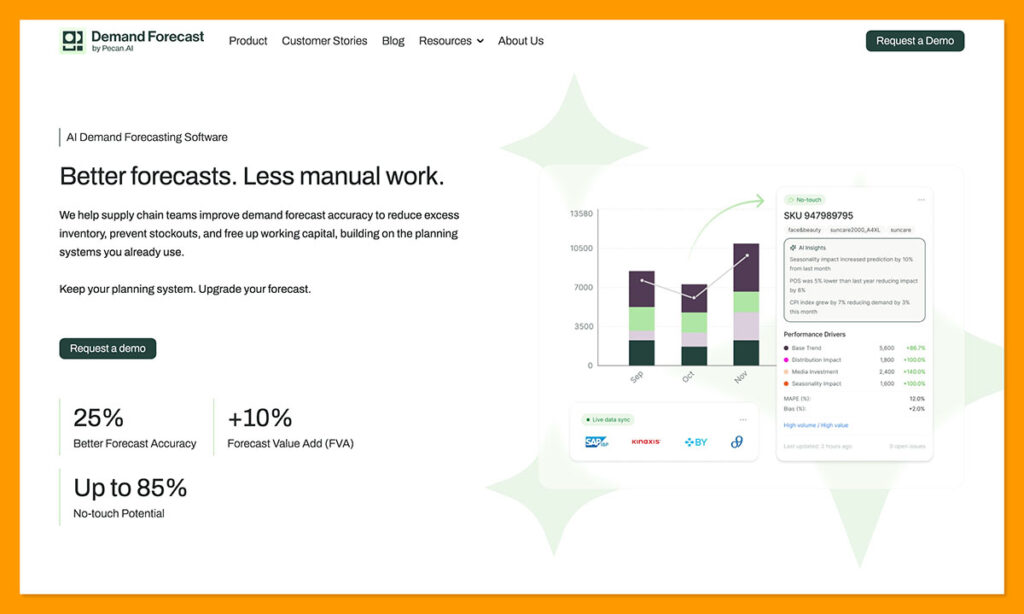
I put DemandForecast.ai first because there are plenty of companies that already have processes they feel comfortable with, and they don’t want to start again with a full new suite of tools. It comes from Pecan AI and runs on the same predictive engine as the rest of Pecan’s platform, so you can answer business questions with ML forecasts without hiring a data science team.
With DemandForecast.ai you keep your planning system and upgrade the forecast that feeds it. Forecasts plug into your existing planning stack, and the system corrects for stockouts and anomalies, so the forecast reflects what customers wanted to buy, including the sales you missed while out of stock.
It also accounts for demand drivers like promotions, pricing shifts, and inventory levels, and forecasts across hierarchies, from regions down to location and SKU. New and seasonal products with limited history are supported too.
You also get business explainability, change monitoring, and alerts for stale source data or model drift. For a real example, DemandForecast.ai’s 2026 accuracy report describes how Nanit, a maker of smart baby monitors, started out with more than 20 variables its team was confident drove demand. The model narrowed them to the four that carried predictive signal. Clarity like that can save you a lot of time.
In the same report, the AI forecast beat the incumbent in all 15 benchmarked deployments, and forecast error fell by 32% on average.
Pros:
- Managed service with no need for a data science hire
- Works with your existing planning system
- Excellent at identifying true demand, even with messy data
- Explainable forecasts and exception flagging
- Included monitoring and drift alerts
Cons:
- Not a full planning and execution suite
- Does rely on a decent amount of historical data
- Pricing is quote-based
2. Kinaxis Maestro: Best for Concurrent Replanning During Disruption
Pricing: Quote-based (can be over $200,000 per year)
Kinaxis Maestro seems to reward companies that recognize their plans are probably going to have to change frequently. It’s focused on scenario analysis and replanning when demand, inventory, or supply changes. For example, ScottsMiracle-Gro uses it to plan for what changes when the weather changes or a retailer runs a promotion.
You can model a potential spike against material limits and production trade-offs while things are still changing in a convenient “what-if” sandbox, and the system updates data continuously across your entire network. Companies can even pull information from various ERP systems at once.
The forecasting engine uses historical demand along with seasonality, POS data, promotions, product attributes, and anything else you might need. You’ll also see the factors that change the forecast explained to you, rather than just a prompt for what to do next. There are AI agents, too. Kinaxis says about 10% of its customers have a paid or trial subscription to them.
This can be a pricey tool, and extras like Solver Studio, which lets you build in your own ML models, heuristics, or decision logic, are worth asking about when you get a quote. Plus, the implementation and setup isn’t exactly straightforward, especially for beginners, but it’s a valuable tool for unpredictable businesses.
Pros:
- Great for real-time concurrent planning with advanced data links
- Scenario modelling sandbox built-in
- Advanced AI agents and analytical tools
- Reasonably familiar interface (like Microsoft Excel)
- Plenty of room for your own planning logic
Cons:
- Can be very expensive for some businesses
- Difficult to implement, especially if you have large data sets
- Higher learning curve than some tools
3. o9 Solutions: Best for Complex, Multi-Signal Enterprise Demand
Pricing: Quote-based
o9 Solutions falls closer to the “planning suite” end of the scale than something like DemandForecast.ai, which may be why some companies consider it to be a little too much. Its planning tools sit on what o9 calls the Digital Brain, which uses an Enterprise Knowledge Graph to connect products, locations, customers and planning assumptions.
Some companies, like Teleflex, find that kind of setup really useful when they’re coming into a planning strategy with fragmented systems and very few standardized processes. For supply chain forecasting, one of the better tools is the NPI Planning feature, which finds comparable products using attributes like price or material, then translates patterns into a starting forecast. It can also model cannibalization, so you’re not stealing volume from another SKU in the same range.
There’s plenty of other things to like about this system too, from the team workspaces that help employees work together across departments, to the full suite of simulation tools. Still, it takes quite a lot of work to get everything setup with this platform, especially if you’re customizing a lot. It’s also not a full execution suite with warehouse or transport management tools.
Pros:
- Excellent NPI forecasting capabilities
- Good unified tools for connecting demand, supply, inventory and finance
- Cannibalization recognition built into the model
- Useful collaboration tools for teams
- Plenty of support for customization
Cons:
- Can be quite expensive (quote-based pricing)
- Not the easiest tool to implement and maintain
- No native warehouse or transport management
4. Blue Yonder: Best for Planning and Execution in One Supply Chain Suite
Pricing: Quote-based
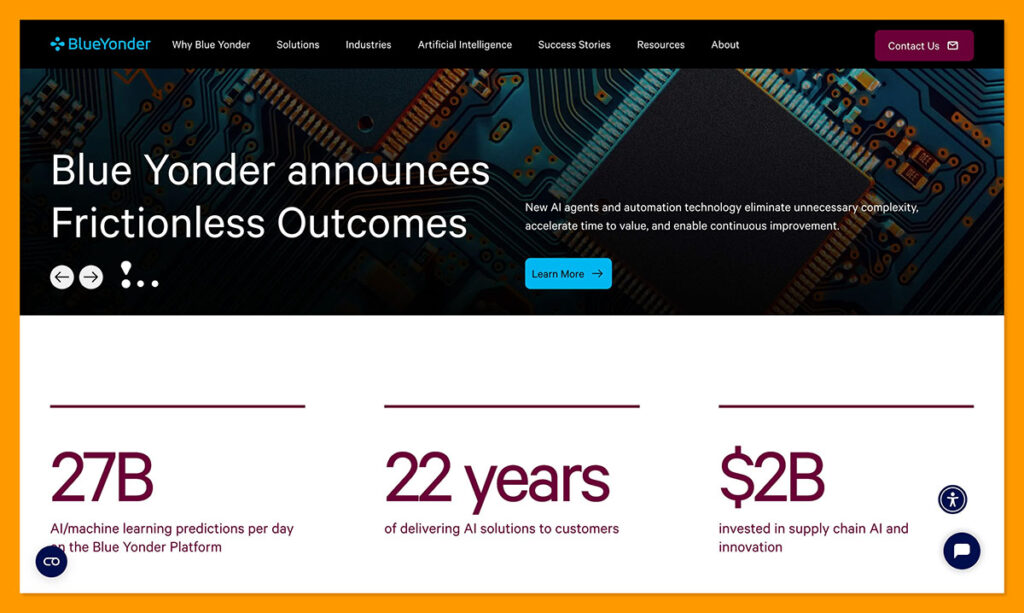
Blue Yonder is my full-suite pick for when you’re ready to rework most of your planning setup. You’ll still need an ERP connection, but Blue Yonder covers planning through execution, including replenishment and fulfillment.
The forecasting tools are strong too. In 2026 the company added Forecast Transparency, which separates event effects from typical demand. There’s also Forecast Override Reliability to lock in high-risk new-product overrides when history is limited. Blue Yonder’s new-product forecasting has customer results behind it. ReaderLink, for instance, introduces up to 100 new titles a week, and Blue Yonder says its forecasting improved new-title accuracy by up to 30% for some retailers and segments.
That breadth, plus AI features like virtual assistants and predictive pricing, makes this one of the better choices for large enterprises ready for an overhaul. If your wider planning setup doesn’t need that much work, Blue Yonder is going to feel like far too much.
It’s also one of the most expensive and complex platforms of the bunch, for obvious reasons. It’s worth being prepared for that before you commit to a demo.
Pros:
- Comprehensive planning, inventory optimization, and warehouse management
- Advanced AI and machine learning tools included
- Excellent system stability and inventory accuracy
- Reliable forecasting insights and transparent explanations
- Very good at simplifying logistics and warehouse workflows
Cons:
- Requires a lot of setup and maintenance work
- Challenging if you need to customize a lot
- Very high cost of ownership if you don’t need a full suite
5. SAP IBP: Best for Global Companies Already Running SAP S/4HANA
Pricing: Quote-based, depending on the planning applications and scale
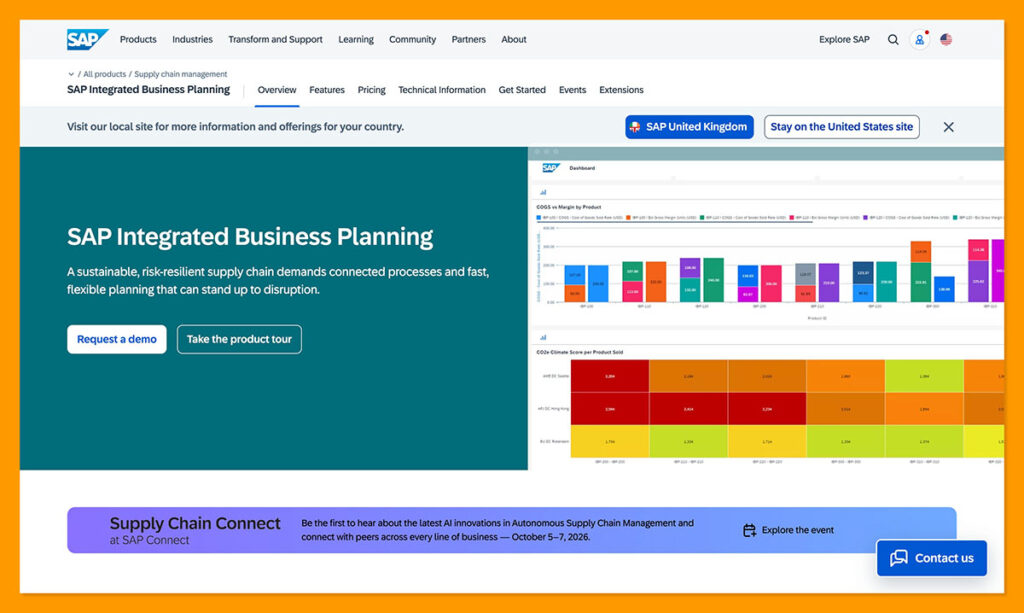
SAP Integrated Business Planning, or SAP IBP, is one I’d put high on the shortlist if your company already runs on SAP S/4HANA. The attraction is pretty straightforward: you can build demand, inventory, and supply planning around the business systems your teams already use. For a global manufacturer with several regions planning in slightly different ways, that’s a more useful starting point than another isolated forecast.
The forecasting toolbox is broad, too. There are statistical methods for trends and seasonality, algorithms for intermittent demand, and machine learning options that can account for additional demand drivers. Automated model selection helps you compare approaches instead of expecting one model to work for every product. Demand sensing then brings more recent signals into the short-term picture, which is useful when the monthly plan starts falling behind actual orders.
What I like about that setup is the room it gives different planning teams. You can work across product and location hierarchies, bring commercial input into the demand plan, and use the wider IBP applications to understand the inventory and supply consequences. There’s an Excel add-in as well, so planners don’t necessarily have to leave the environment where they’re comfortable working.
Still, already using SAP doesn’t make this a quick switch you can turn on. Master data, integration, forecast settings, and planning responsibilities all need proper attention, and the applications you license affect what you actually get. I’d be much more inclined to recommend it for an SAP business standardizing planning across regions than a small team that just wants a better forecast next month.
Pros:
- Strong fit for companies already using SAP S/4HANA
- Broad choice of statistical and machine learning forecasting methods
- Automated model selection and short-term demand sensing
- Connected demand, inventory, and supply planning applications
- Excel add-in for planners who prefer familiar tools
Cons:
- Implementation needs substantial data and integration work
- Capabilities depend on the applications you license
- Too much planning infrastructure for many smaller teams
6. Oracle Fusion Cloud Supply Chain Planning (SCP): Best for Companies Already Using Oracle Cloud ERP
Pricing: Enterprise subscription; final pricing depends on modules and contract
Oracle Fusion Cloud Supply Chain Planning makes the most sense to me when Oracle is already where your company handles its financial and operational data. Demand Management builds the forecast, while the wider planning suite helps you work out what that forecast means for supply and inventory. That’s useful if your current problem is getting the demand plan and the operational plan to agree with each other.
The demand tools combine statistical forecasting and machine learning with inputs such as promotions and other causal factors. You can plan across product, customer, and location dimensions, and use a similar existing product’s history or forecast to help plan new items. I like that this gives you somewhere to start when a product launch doesn’t have a neat set of last year’s sales to work from.
The more interesting part, though, is what happens after the forecast changes. Supply planning can weigh demand against material and capacity constraints, while simulation tools let teams compare alternative plans. If a promotion pushes demand beyond what a plant can produce, you can explore the supply consequences before committing everyone to the sales target. That’s where the connection to the wider Oracle suite becomes valuable.
I’d still be careful about treating the Oracle name as a guarantee that everything is included. Demand Management, Supply Planning, and Sales and Operations Planning have their own scope, and you need to check the subscription and implementation work for the combination you want. For an Oracle business, that can be a sensible investment. For a team looking for a lightweight forecasting layer, there’s a lot more here to set up and maintain.
Pros:
- Natural fit alongside Oracle Fusion Cloud ERP
- Statistical and machine learning demand forecasting
- New-product forecasting based on comparable products
- Supply planning accounts for material and capacity constraints
- Scenario comparisons across demand and supply decisions
Cons:
- Module scope and subscription costs need careful checking
- Requires reliable shared data and implementation support
- More complex than a dedicated forecasting tool
7. RELEX Solutions: Best for Retail and Grocery with Fresh Products
Pricing: Quote-based
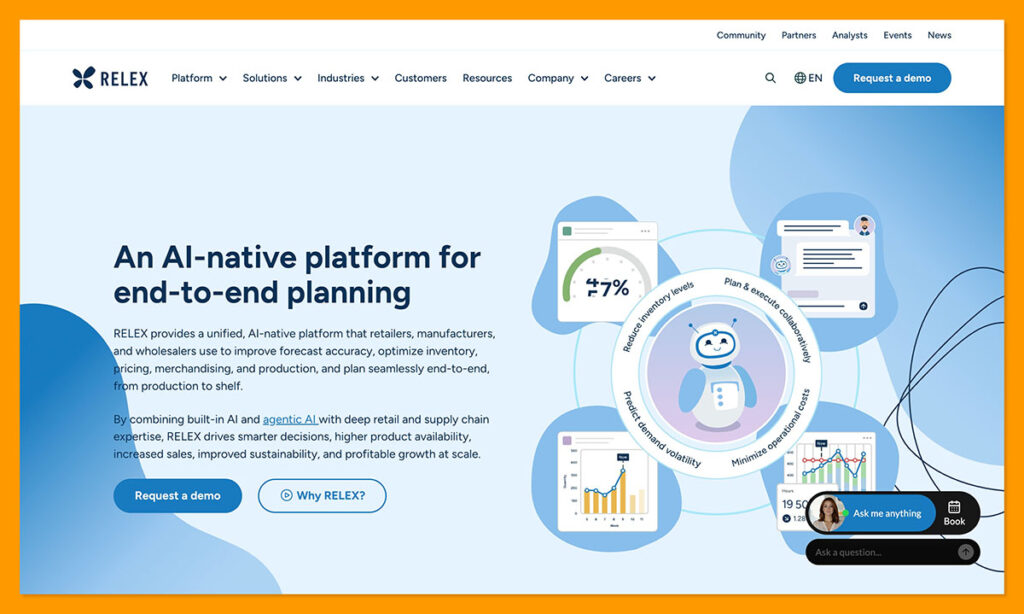
RELEX Solutions is the one I’d look at closely if the cost of a bad forecast shows up as empty shelves on Monday and food waste on Wednesday. It’s particularly well suited to retail and grocery, where knowing how much you’ll sell isn’t enough. You also need to know which store needs the stock, when it should arrive, and whether it will still be sellable by the time someone wants it.
The forecasting tools work at a detailed product and location level, accounting for patterns such as promotions, weather, and local demand. Those forecasts feed replenishment across stores and distribution centers, rather than sitting in a separate planning report. For fresh products, shelf life and spoilage matter alongside availability, so the ordering decision can reflect the risk of buying too much as well as too little.
What stands out to me is how much of the surrounding retail work RELEX can connect. Promotion planning, allocation, and replenishment can use a more consistent view of demand, which helps when a campaign needs stock in the right places before it starts. A promotion that looks great on a national forecast can still disappoint if the extra inventory goes to the wrong stores.
That retail focus is also how I’d narrow the audience. A manufacturer trying to resolve complex production constraints may have a different set of priorities, and a small retailer may not need this much planning machinery. You’ll also need dependable store-level stock, sales, and product data. If shelf-life information or inventory records are wrong, even a strong forecasting engine has a difficult job.
Pros:
- Strong fit for grocery, fresh food, and short shelf-life products
- Detailed forecasting across stores and distribution centers
- Replenishment decisions account for spoilage and availability
- Promotion and weather effects feed into demand planning
- Connected allocation, promotion, and replenishment tools
Cons:
- Depends on accurate store-level inventory and product data
- Broader rollout needs coordination across retail teams
- Broad planning scope may be excessive for a forecast-only project
8. ToolsGroup: Best for Distributors and Manufacturers with Intermittent Demand
Pricing: Quote-based
ToolsGroup is particularly interesting if you have thousands of products that don’t sell in a nice, predictable pattern. Think of a distributor carrying replacement parts, where an item might sit for weeks before several customers suddenly need it. I’d be cautious about judging that business by the same forecasting approach you’d use for a product selling steadily every day.
The main differentiator in ToolsGroup’s SO99+ platform is probabilistic forecasting. Rather than relying only on one expected sales number, it models a range of possible demand outcomes and their likelihood. That’s useful for slow-moving and intermittent items because an average can hide the uncertainty that makes inventory decisions difficult in the first place.
What I like is that the forecast feeds inventory optimization, so uncertainty can influence stock targets and replenishment. You can set service goals for different products and optimize inventory across multiple stocking locations. A critical spare part and an easily substituted accessory don’t necessarily deserve the same buffer, even if they sell at a similar rate.
The trade-off is that you need to be clear about those service goals and the information behind them. Lead times, inventory positions, and ordering constraints still matter, and planners need to understand why a recommended stock level might differ from their usual rule of thumb. I’d shortlist ToolsGroup for the balance between availability and inventory investment, rather than expect it to replace every execution system a manufacturer or distributor uses.
Pros:
- Probabilistic forecasts make demand uncertainty useful for planning
- Strong fit for slow-moving and intermittent products
- Inventory targets linked to service-level goals
- Multi-echelon inventory optimization across stocking locations
- Forecasting and replenishment work together in SO99+
Cons:
- Requires trustworthy lead-time and inventory data
- Teams need to understand probabilistic planning and service targets
- Doesn’t replace a full warehouse or manufacturing execution system
9. Logility: Best for Midsize to Large Manufacturers and Distributors
Pricing: Quote-based
Logility would make my shortlist for manufacturers and distributors whose demand, inventory, and supply plans have grown apart. You might have a decent sales forecast, but still end up arguing about safety stock or discovering that production can’t support the plan. I like the appeal of having those decisions connected, especially for a business that has outgrown a collection of spreadsheets and separate planning tools.
The demand planning capabilities include DemandAI+, which brings machine learning into forecasting and helps explain the effect of drivers such as promotions and events. It can also flag unusual historical data for planners to review and tag, rather than quietly carrying those anomalies into the next forecast. I like that combination of automation and visibility, because a forecast is much harder to trust when nobody can explain why it moved.
The broader Decision Intelligence Platform connects that demand picture to inventory optimization and supply planning. You can evaluate inventory policies across the network and look at the resources needed to support demand. For me, that’s the real reason to consider Logility: the forecast becomes part of a decision about stock and supply, rather than another number someone has to copy into a different system.
There’s still a meaningful implementation job here, particularly if different sites use different product definitions or planning rules. Logility is now part of Aptean, so I’d also ask how the proposed modules, support arrangements, and roadmap fit your rollout. It’s a sensible option for a broader planning upgrade, but I wouldn’t buy the whole platform just to improve one forecast that already feeds a workable process.
Pros:
- Connected demand, inventory, and supply planning
- Statistical and AI forecasting for varied product portfolios
- Visibility into forecast drivers and historical anomalies
- Multi-echelon inventory optimization
- Exception-based workflows help focus planner attention
Cons:
- Data standardization across sites can take substantial work
- Module scope and implementation costs require a tailored quote
- Broader platform may be excessive for a forecast-only project
10. Manhattan Associates: Best for Retailers Already Using Manhattan WMS or OMS
Pricing: Quote-based
Manhattan Associates is worth a look when forecasting is part of a bigger retail inventory problem, particularly if you already use its warehouse management or order management software. You might have stock somewhere in the network, but still struggle to put it where customers want to buy or collect it. I’d be interested in how Manhattan’s planning tools help close that gap between expected demand and actual fulfillment.
The current planning offering is Manhattan ActivePlanning, also described as Manhattan Active Supply Chain Planning. It brings demand forecasting, replenishment, and allocation together, with statistical models and machine learning supporting the forecast. Planners can see the drivers behind demand changes, too, which is useful when you need to explain why stock should move to a different location.
What I like is that the planning software can work with existing execution systems as a standalone product, or connect with Manhattan’s Active warehouse, transport, and order management solutions. Retailers can use demand expectations to decide how much stock different locations need, with execution information feeding back into planning. For an omnichannel business, that’s more useful than treating online orders and store demand as completely separate planning problems.
I’d make the integration discussion a big part of the demo, though. Ask which planning capabilities you need, how they exchange data with your particular WMS or OMS deployment, and how frequently stock and demand changes flow through. Existing Manhattan customers have a clear reason to investigate, but having its WMS or OMS doesn’t automatically mean forecasting is included, or that an older installation will connect without additional work.
Pros:
- Strong fit for retailers already using Manhattan systems
- Dedicated demand forecasting with statistical and ML methods
- Visibility into the drivers behind forecast changes
- Forecasts connect to replenishment and allocation decisions
- Relevant to stock placement across omnichannel retail networks
Cons:
- Forecasting isn’t automatically included with WMS or OMS
- Integration scope depends on your existing products and deployment
- Less natural fit for a standalone forecasting project outside retail
What Is Supply Chain Forecasting Software?
If you’ve got through all that and you’re still feeling like you’re not sure where to start, we might need to take a step back. That’s why I split this guide up in the first place, just in case you’re coming into supply chain optimization with a little confusion about what you actually need.
First of all, supply chain forecasting software is something that can estimate future product demand at the level your company tends to plan around, such as an SKU, store, or a specific family of products. It aligns the historical information you give it about demand with current signals, then gives your inventory, product, and purchasing teams a number they can plan towards.
What Makes Choosing Supply Chain Software Difficult?
There are a lot of different tools that can help with inventory optimization and supply chain operations, which is why it’s so helpful to think about what you need to fix before you start listing vendors for teams to review.
A four-week SKU-store forecast, for instance, might help you decide on the kind of reorder quantities you’re going to focus on next week, while a 12-month product family forecast might determine your supplier or capacity commitments. Different jobs need different kinds of software; they also need different kinds of data.
Historical orders and shipments can give you a baseline for just about any tool, but you might need POS and returns data for more insights into what customers are really doing. Some teams also need to think about promotions, price changes, and how the weather explains how demand changes, which brings demand sensing into the discussion.
If you’re wondering how much you need, think of it this way. A forecasting tool gives your team a reliable number to work from. A planning suite adds the tools that turn that number into stock, capacity, and purchasing decisions.
How to Choose a Supply Chain Forecasting Tool
It’s surprising when a reviewer gives readers a list of tools they “objectively love” and then spends virtually no time helping them make a better decision. That feels like a very efficient way to nudge companies into trying out a lot of vendors before they’ve even decided what they need to fix.
So, at this point, before we get into a “final verdict” explaining what I think, I’d prefer to give you five questions you should probably be thinking about before you grab the company credit card.
Do You Need a Better Forecast or a New Planning Suite?
The supply chain forecasting software you choose should solve a specific problem, and not every company is going to need a full suite. If you’ve got a team of planners that absolutely trust the current S&OP process but keep overriding the baseline, you need more reliable forecasting.
That’s probably when I’d recommend looking at DemandForecast.ai, as the forecasting layer for your existing IBP and S&OP work that brings in explainability and ongoing monitoring. It doesn’t ask you to replace the whole planning system.
If your problems are spreading into supply, inventory, or execution, and you’re not just worrying about forecasts you can rely on anymore, that’s when you’d start thinking about Kinaxis, o9 Solutions, and finally Blue Yonder (for the bigger commitment).
You might even end up deciding that you need something completely different, like a tool that focuses on supplier visibility or risk detection, which takes you into a brand new category of software. It’s better to figure that out now than to spend two months paying for a tool you don’t really need.
How Ready Is Your Data?
Real supply chain data is messy, and a good forecasting tool should be able to cope with that. What you do need is enough history for the models to learn from, and an agreed way to measure forecast accuracy before you start.
Going in, ask what the software does with stockouts, missing periods, outliers, old feeds, and sudden spikes caused by promotions. For example, DemandForecast.ai deliberately corrects gaps and out-of-stocks when the system’s estimating true demand, then uses extra variables like pricing shifts or inventory levels.
It’s also worth thinking about the additional inputs you’re going to need to get ironed out, such as supplier lead times, regional variation, or promotional calendars. Hopefully, you already have some kind of preparation process in place at this stage, but if not, agree on the measurement method before you start piloting tools.
MAPE, WMAPE, bias, and FVA answer very different questions, and you need to know exactly what matters most to you before you can guarantee your data’s ready for a new tool.
How Fast Do You Need a Forecast Planners Trust?
A lack of trust can throw even the best planning system out of the window. People can respect your process and still correct every forecast or insight you get out of habit. A good strategy is to always ask for a real insight into why the forecast changed.
Certain tools will automatically help with this. DemandForecast.ai, for instance, shows the drivers behind each forecast and alerts planners when a change needs a closer look. Kinaxis also explains the signals that feed the machine learning forecasts, and Blue Yonder gives you a ton of visibility around event effects and override history.
Getting an idea of what people can trust early is a good way to avoid judging the best supply forecasting tools by features or accuracy percentages. Explainability really needs to be one of the first things you consider to help your team stick to the process going forward. If everyone gets great forecasts but they can’t believe or explain them, you just end up with more manual work.
Who Will Build and Maintain the Models?
No matter whether you choose a more focused forecasting tool or an entire suite, someone’s going to be responsible for setup and maintenance. One of the reasons I picked DemandForecast.ai first on my list is because it takes less work if you already have a system in place.
You get model maintenance included, and nobody expects you to hire a new team of data scientists, although you still need a reasonable amount of historical data.
Both Kinaxis and o9 give companies much more planning machinery to get their heads around, which means more preparation and training, and Blue Yonder essentially replaces your whole suite, which is why it requires the most commitment overall.
Having more work to do isn’t necessarily a bad thing if the toolkit you choose actually helps your business grow, but you need to be specific about who’s going to handle the recurring work upfront. Who deals with model drift, or decides whether an odd forecast needs retaining or a planner override? Do you actually have the talent you need? Gartner found that 50% of CSCOs say they have limited in-house expertise or talent to implement and manage AI.
What Does the Total Cost Really Look Like?
All of the tools I’ve talked about here come with quote-based pricing, which obviously makes it a lot harder to budget plan. Still, you can usually get a quote pretty soon after a demo, and when you do, it’s important to make sure you’re not just comparing licensing costs.
Outside of the cost of the software, there are going to be expenses for preparing your data, hiring consultants, training team members, integration work, and other little extras. The more of your system you’re replacing or updating, the more you can usually expect to pay.
Of course, the bigger suite can still end up being the cheaper decision long-term if it retires a bunch of broken systems, you just don’t need it if you’re dealing with a single forecast that needs work. Also, don’t get carried away assuming more AI is automatically worth it. Gartner still says about 55% of CSCOs are unclear about the returns from their AI spending.
Which Supply Chain Forecasting Software Is Best for You?
I know it might be a bit frustrating for some to reach the end of this article and still not have a single definition of the overall “best tool”, but really, only you can make that choice.
I ranked DemandForecast.ai first, but only because I think it’s the tool that delivers the most value if you already have a process and system you can trust in place, and you want to improve the forecast. It leaves your surrounding systems alone and concentrates on the forecast itself, including stockout distortion, changing demand drivers, model drift, and explainability.
If your real concern is figuring out what forecasts should do to supply, Kinaxis Maestro is the better choice, especially if you need to recalculate the consequences of various changes that might happen through the course of the year. Alternatively, if your company struggles with a bunch of meetings that start with people arguing about whose demand data is correct, o9 Solutions with its Knowledge Graph approach might be the better pick.
Blue Yonder is the overall suite I’d think about choosing if you’re reinventing your planning strategy, and you need all the connected resources and tools that go alongside that.
No single tool is automatically best for everyone, it’s more about finding out what’s best for the current supply chain strategy you’re working with.
FAQs
What Is Supply Chain Forecasting?
Supply chain forecasting uses historical data, market trends, as well as statistical models to try and predict future inventory needs, product demand, and pricing requirements for companies. Most good forecasting tools don’t just tell you if sales should increase next month, though, they also predict demand by SKU, location, and week, and account for things like promotions, weather, or stockouts when they might change behavior.
What Is the Most Popular Supply Chain Software?
It depends on who you ask. SAP and Oracle come up a lot, and both are in this roundup. Popularity matters less than what the tool fixes for you. DemandForecast.ai suits teams that want a better forecast, Blue Yonder suits a full suite replacement, Kinaxis works well for replanning, and o9 Solutions is good at connecting a lot of data signals.
What Is the Best Forecasting Software for Supply Chain Teams?
I’ve picked DemandForecast.ai as my first choice for supply chain teams that already have a good planning process, but need to improve forecasting. Kinaxis is better when every demand revision creates a new supply or capacity problem, while o9 is good for more complicated enterprise cases and data alignment. Blue Yonder is good if your forecasting system is being replaced while you’re reworking your whole planning program.
Will AI Replace Supply Chain Planners?
Probably not entirely, even if bots do start handling some extra work. Gartner predicts that by 2030, only 5% of organizations using some form of supply chain planning automation will make at least 10% of their planning decisions autonomously.
Some things like routine replenishment will be easy to automate, while decisions involving policy, unusual demand, or specific commercial judgment will still depend on people who understand the thinking behind the numbers.
What’s the Difference Between Supply Chain Forecasting and Supply Chain Planning?
A forecast predicts what the future will hold, telling you whether you can expect to sell a specific number of units at a specific time, for instance. Planning is the strategy you use to prepare for that number afterwards, working out what to order, whether your current inventory is enough, what suppliers can deliver, and whether your current capacity model can cope.

Comments 0 Responses