

After years of running both platforms on live client projects, here is my verdict on the Semrush AI vs Ahrefs AI features question. Semrush wins on bundled economics and interpreted intelligence. Ahrefs wins on raw data scale. And neither is the precision AI visibility tracker its marketing implies.
The real question is not “which suite is bigger.” It is which AI features actually work, and which are expensive theater. Neither tool tracks Claude natively. Both bolt AI onto a legacy SEO stack.
You will make three decisions by the end of this piece: how you want AI visibility data served (interpreted vs raw), whether you need a writer or an editor for content AI, and the bundling math that swings from $199 to $828 per month. I cover visibility tracking, content AI, copilots, MCP servers, keyword AI, pricing, agency scale, and the limitations both vendors would rather you skim past.
The AI Feature Landscape at a Glance
Both platforms ship roughly the same AI categories in 2026. The implementations could not be more different.
| Feature | Semrush | Ahrefs | Entry price | Notes |
|---|---|---|---|---|
| AI visibility tracking | AI Visibility Toolkit | Brand Radar | $99/mo base, $199 in Semrush One | Ahrefs full bundle is $828/mo with Lite base |
| AI content generation | AI Writing Assistant | None | $60/mo standalone | Ahrefs has no direct generator |
| AI content optimization | SEO Writing Assistant | AI Content Helper | Bundled / $228/mo minimum | Different paradigms, same job |
| AI assistant / copilot | Semrush Copilot | None (chat inside Content Helper only) | Free with any plan | Ahrefs has no dashboard copilot |
| AI keyword clustering | Keyword Strategy Builder | Parent Topic | Bundled in base plans | Semrush clusters; Ahrefs labels |
| MCP server | Semrush MCP Connector | Ahrefs MCP Server (Oct 2025) | Plan-gated | Both read-only |
| AI platform coverage | 3 confirmed (ChatGPT, Google AI, Perplexity) | 6 (adds Gemini, Copilot, Grok) | N/A | Neither tracks Claude |
| Sentiment analysis | Built in, strong in my checks | None (share-of-voice only) | Bundled | Semrush wins outright |
The matrix reveals one structural difference. Semrush packages AI as interpreted intelligence: recommendations, sentiment labels, priority rankings, daily alerts. Ahrefs ships raw scale and leaves the analysis to you. It is not a question of superiority but of fit.
Pricing tells the same story in reverse. Semrush One Starter bundles AI visibility, full SEO, and content AI at $199 per month. Ahrefs’ equivalent stack (Lite plus the full Brand Radar bundle) hits $828, and adding AI Content Helper pushes it to $927. Roughly 4:1 at entry level, straight from the two public price lists.
One caveat. Neither tool monitors Claude. If precise LLM visibility tracking is your only need, specialist tools like Profound and Rankscale beat both on every axis that matters.
1. AI Visibility Tracking: Semrush AI Toolkit vs Ahrefs Brand Radar
Here is the stat vendor marketing will not mention. I asked ChatGPT and Perplexity the questions my client’s buyers ask and logged every brand mention myself. Brand Radar surfaced only a small fraction of the mentions I counted by hand, on both platforms. If you are buying Brand Radar for ChatGPT accuracy, do not.
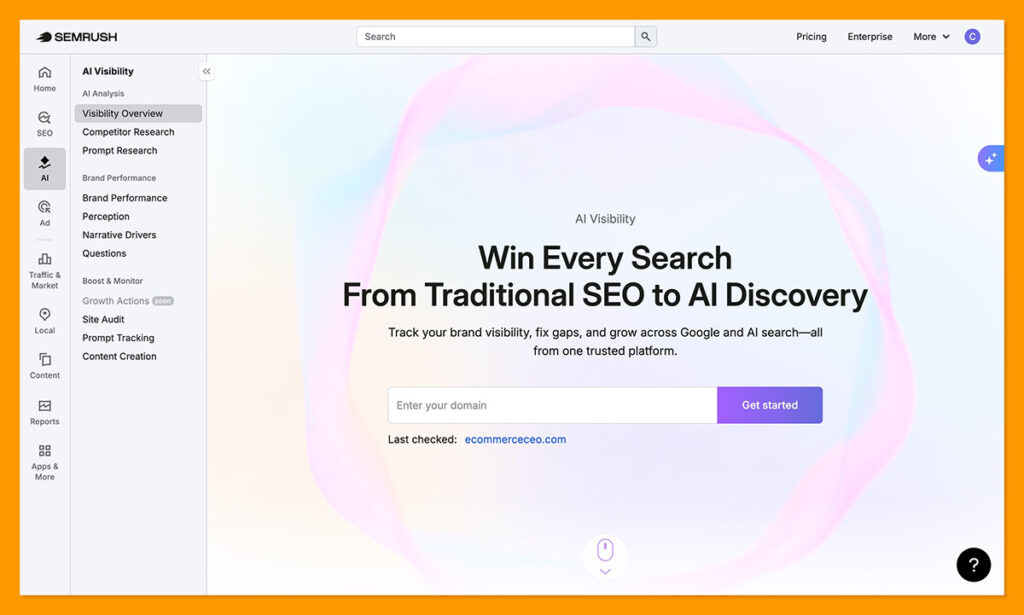
Semrush AI Visibility Toolkit runs on five report types: Visibility Overview, Competitor Research, Prompt Research, Brand Performance, and Prompt Tracking. Updates are daily. It tracks ChatGPT, Google AI Overviews, Google AI Mode, and Perplexity (Gemini “coming soon”), leaning on a 100M prompt database. Pricing starts at $99 per month for one domain (25 custom prompts, 300 daily queries), or $199 inside Semrush One. Sentiment analysis is the standout of the five.
Ahrefs Brand Radar looks like Site Explorer with dedicated reports for Cited Domains, Cited Pages, and Share of Voice. It covers six platforms including Grok. The prompt database is 365M-plus per month, built from real Google keywords rather than synthetic prompts. Updates are monthly. Pricing is $199 per month per index, or $699 for the full bundle. Minimum real cost with Lite base is $828 per month.
Neither tool tops my AI-visibility shortlist, and sentiment is the reason Semrush still earns a place on it. On one client, most of the ChatGPT mentions the toolkit flagged framed the brand negatively, something raw counts would have hidden entirely. Ahrefs’ counterweight is Cited Domains. Ahrefs’ own published example: 16 pages on Zapier’s site mentioning Ahrefs drove 1,431 AI citations. That is real citation-pattern intelligence Semrush cannot match.
Best for Semrush: teams who want sentiment, priority-ranked recommendations, and daily tracking on a $199 bundled budget. Best for Ahrefs: brands that need multi-platform citation pattern research and can absorb $828 per month. Skip both if: you need ChatGPT-accurate tracking. Use Profound or Rankscale.
2. AI Content Creation: Semrush AI Writing Assistant vs Ahrefs AI Content Helper
Semrush writes the article. AI Content Helper tells you if your article covers enough topics. One sentence, the whole comparison. Every review I have read fudges this by treating them as equivalents.
Semrush AI Writing Assistant runs $60 per month standalone (or bundled into higher Semrush plans). It handles the full pipeline: keyword to brief to draft to optimization to WordPress publish. Seven languages, fifty brand voices, a Chrome extension. You get 5 SEO-boosted articles per month standalone, or 20 with a full Semrush subscription. Articles cap around 3,000 words even when you request 5,000. Powered by OpenAI.
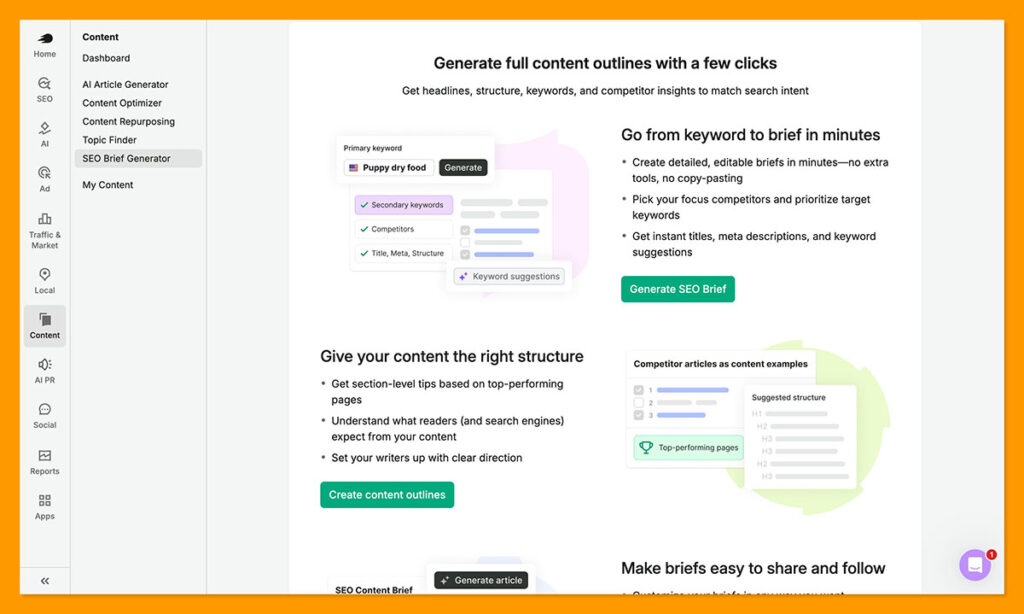
Ahrefs AI Content Helper is a $99 per month add-on on top of Ahrefs Lite ($129), for a $228 per month minimum. You get color-coded topical gap analysis, a 0-100 content score against top-ranking pages, and an AI chat with access to both your draft and competitor articles. It supports 173-plus languages. It does not generate articles. You write; it refines.
Via.studio’s deep-dive test flagged the honest flaw: ACH’s scoring is “arbitrary” (thin content scores well, comprehensive content scores poorly), and the AI chat requires excessive prompting. ContentShake has its own failures: InfoTech reviewers found “content can feel repetitive,” it struggles with specialized topics, requires heavy editing, and occasionally fabricates facts. Rankability summed up ACH cleanly: “If Ahrefs is already the center of your SEO workflow, AI Content Helper is a logical extension. If you are not an Ahrefs user, it is harder to justify.”
The verdict: If you need drafts at volume and you will ruthlessly edit them, ContentShake at $60 per month is the better deal. If you already pay for Ahrefs and want a topical coverage checker to harden pieces your writers produce, AI Content Helper earns its $99. Do not buy Ahrefs just to get it.
3. AI-Powered Keyword and Topic Research
Every SEO has exported a 5,000-keyword list and thought: now what? The two platforms reveal opposite philosophies here, and a Semrush advantage most comparisons underplay.
Semrush Keyword Strategy Builder handles clustering natively. Click “Cluster this list” and it groups keywords by SERP similarity across multiple top-ranking results, assigns primary and supporting keywords, labels intent, and generates AI prompt suggestions. Semrush reports “40% more actionable clusters” on tested SaaS campaigns. Ahrefs Parent Topic identifies the main topic a page could rank for based only on the top-ranking result. Quicker, yes. Shallower, also yes.
Drop the same seed keyword into both tools and the divergence is immediate. Semrush returns a cluster map with grouped primary and secondary terms and intent labels. Ahrefs returns a single Parent Topic pointer. If you are building a topic-cluster content calendar, Semrush wins without contest. If you want a fast “is this the right target?” gut check, Parent Topic is a one-click answer that does not pretend to be anything else.
The honest callout on “AI in backlinks”: there is not much genuine AI there on either platform. Semrush Authority Score, Ahrefs UR/DR, and Toxic Score metrics all use machine learning, but these are not new-generation AI features. Nobody is doing anything interesting with LLMs in link analysis yet. Skip the hype.
Quick comparison: Neither tool matches Frase or MarketMuse for pure content-brief clustering. For SEOs who want clustering inside the same platform they already run competitor research in, Semrush Keyword Strategy Builder is the clear winner. Parent Topic is a bookmark, not a clusterer.
4. AI Assistants and Dashboard Intelligence: Semrush Copilot vs Ahrefs’ Distributed AI
Open Semrush on Monday morning and Copilot has already analyzed your site overnight. Open Ahrefs and you analyze it yourself. The gap is bigger than it sounds, and it is the most honest Semrush-only win in this comparison.
Semrush Copilot is free with every subscription. It pulls data from six tools (Site Audit, Position Tracking, Backlink Analytics, Organic Research, Keyword Gap, Backlink Gap) and surfaces prioritized daily alerts ranked by urgency and impact. Fourteen languages. A thumb up/down feedback loop that actually affects future recommendations. It is a reactive recommendation engine, not a chat interface.
Ahrefs takes a fundamentally different approach. AI is distributed, not centralized. Chat lives inside AI Content Helper (with context on your draft and competitor articles). External AI agents connect via the MCP server. There is no dashboard-level advisor and no daily alerts engine. Ahrefs users typically want raw data and prefer their own analysis.
The honest Copilot caveats: it is reactive not conversational, recommendations can be generic for specific verticals, and it does not touch AI visibility data. Brand Performance and Prompt Tracking sit outside Copilot’s scope, which is a real gap if you want one AI assistant covering everything.
Direct recommendation: If you want a daily AI briefing on what to fix, Semrush wins by default. Ahrefs does not compete here. If you would rather pull insights yourself through natural-language queries against live data, the next section is where Ahrefs closes the gap.
5. MCP Server and AI Agent Workflows
In October 2025 Ahrefs shipped an MCP server. Semrush has a competing connector. Neither can actually write or optimize anything, and that is the single most important thing to know before wiring one into an agent pipeline.
Ahrefs MCP Server is hosted by Ahrefs (no local install) and available on Lite plans and above ($129 per month minimum). It lets ChatGPT, Claude, or Copilot pull live Ahrefs data (backlinks, keywords, Brand Radar citations) via natural language. Row limits and API unit quotas vary by plan tier. Custom scripts and bridges are prohibited.
Semrush MCP Connector supports a longer client list: ChatGPT, Claude, Claude Code, Cursor, and VS Code. It exposes keyword metrics, traffic breakdowns, and competitive intelligence via the Trends API. Semrush positions it as “one secure, callable data layer” replacing CSV exports, and enables scheduled autonomous agent workflows.
Here is the constraint both share. Both MCPs are read-only. Frase’s MCP comparison put it bluntly: “Neither can write, score, or optimize content. That is the difference between read-only and read-write.” Agents can pull data; they cannot act. The concrete use case Ahrefs demonstrated was prompting Claude with “find high-volume, low-competition keywords for the gardening niche” and getting live Ahrefs data back. Useful. Not transformational. The Semrush edge for Claude Code and Cursor users is that both are explicitly listed as supported clients, which matters for dev-heavy SEO teams.
Best for Semrush MCP: teams already on Claude Code or Cursor who want keyword metrics exposed to existing agent pipelines. Best for Ahrefs MCP: Ahrefs customers whose agents need backlink and Brand Radar data live. Skip both if: you expected AI agents to write or publish content. Neither does.
6. Pricing and Bundling: What AI Features Actually Cost in 2026
Every comparison article quotes a different price. Here is the real April 2026 math, and the 4:1 ratio nobody makes explicit.
Semrush’s minimum bundled stack (AI visibility plus SEO plus content AI) is Semrush One Starter at $199 per month. That includes AI Visibility Toolkit (50 prompts, 5-plus platforms claimed), the full SEO suite, and the Content Toolkit (ContentShake plus SEO Writing Assistant, a $60 per month standalone value). Standalone AI Visibility is $99 per month for a single domain. ContentShake on its own is $60.
Ahrefs’ minimum stack is layered. Ahrefs Lite at $129 plus Brand Radar single index at $199 equals $328 per month at entry. Lite plus the full Brand Radar bundle at $699 equals $828. Add AI Content Helper at $99 for $927 per month of full content AI coverage. Custom prompt add-ons on Ahrefs run $47 (Basic), $93 (Growth), or $234 (Scale).
The ratio is roughly 4:1 at entry, and Brand Radar’s bundle alone costs well above what the rest of the AI tracking market charges. Even comparing single-index Ahrefs ($328) to Semrush One ($199) leaves Ahrefs 65% more expensive for less integrated coverage. Both platforms share a hidden cost: AI visibility data requires in-house expertise or a $1,000 to $10,000 per month agency retainer to actually act on insights. Semrush’s introductory pricing is “subject to change,” so screenshot what you see before signing.
The verdict: If budget is the tiebreaker, Semrush One at $199 per month is untouchable for bundled AI plus SEO. Ahrefs’ pricing model only makes sense if you already pay for Ahrefs and Brand Radar is the one piece you are adding.
7. AI at Agency Scale and Enterprise Reality
Tracking ten clients in Ahrefs Brand Radar costs more than $8,000 per month. Semrush is cheaper, but still per-domain. For agencies, both tools have a scale problem neither vendor wants you to notice.
Semrush math: AI Visibility Toolkit is $99 per domain per month, on top of the base plan. Five clients equals $594 per month in AI add-ons alone. The per-domain model does not flex, and there is no volume discount on the public pricing page. Ahrefs math: ten clients with Brand Radar runs $8,000-plus per month. Per-index and per-brand pricing compounds fast.
White-label AI visibility reporting is the silent gap. Neither platform offers it natively. Semrush’s enterprise tier includes white-label reporting and unlimited seats, but requires custom pricing. Ahrefs has no documented white-label AI option in public product materials.
For agency use the pricing is a non-starter: several times what more capable specialized competitors charge. The specialist alternative makes itself. Profound starts at $399 per month, and closed a Series C at a $1B valuation. Rankscale tracks Claude, ChatGPT, Perplexity, and Google AI at $20 per month entry. Both scale per-client in ways Semrush and Ahrefs refuse to.
Direct recommendation: If you run an agency and AI visibility is a client deliverable, do not lead with Semrush or Ahrefs. Lead with Profound or Rankscale for the AI visibility reports, then layer Semrush One for internal SEO work. This is the one category where specialist tools genuinely dominate the legacy platforms, and pretending otherwise costs your agency money.
8. Honest Limitations: Where Both Tools Fail
On my client projects, two months of tracking produced clear gains in mentions and citations and almost no attributable revenue. That is the honest ceiling of what these tools deliver in 2026, and it is the stat every competitor comparison leaves out.
The failure modes stacked together:
Brand Radar accuracy. My hand counts on ChatGPT and Perplexity ran far ahead of what Brand Radar reported, and that gap reframes every other Brand Radar claim. Directional, not precise.
Semrush “AI gobbledygook.” Copilot handed me nonsensical recommendations more than once: mathematical errors, misreadings of Semrush’s own ranking data, and competitor suggestions that had nothing to do with the client’s market. Treat its daily cards as prompts to verify, not instructions.
The dark queries blind spot. Both tools derive prompts from keyword data, but a large share of what AI assistants actually retrieve comes from sub-queries with zero Google search volume, generated during query fan-out. Neither tool can see them. A structural limitation, not a fixable bug.
ContentShake generic output. Articles cap around 3,000 words despite 5,000-word requests. Heavy editing required. AI has made incorrect factual claims in reviewer tests.
The traffic ceiling. On the client projects I tracked, AI-sourced traffic was a low single-digit share of organic, and attributable revenue was smaller still. Traditional search drove the overwhelming majority of revenue. Read that twice before committing to an annual contract.
No GSC integration for AI visibility. Semrush lists GSC-to-AI-visibility integration as “coming soon.” Without it, AI scores float disconnected from actual business outcomes.
Quick comparison: None of this means avoid both tools. It means set expectations. AI visibility tracking in 2026 is directional intelligence, not precision measurement. If you need precision, use Profound. If you need a starting point and already run Semrush or Ahrefs, that starting point is fine. Just do not build a revenue strategy on data that undercounts this badly.
The Bottom Line
One sentence: Semrush wins on bundled economics and dashboard intelligence; Ahrefs wins on platform breadth and data scale for power users already on the Ahrefs stack. Neither is the best AI visibility tracker in 2026 (Profound is). Here is what to buy.
Content-heavy teams and small agencies: Semrush One at $199 per month. You get ContentShake for drafts, SEO Writing Assistant for optimization, Copilot for daily priorities, and AI Visibility Toolkit for monitoring. Roughly 4:1 cheaper than the Ahrefs equivalent. Only skip if your content quality bar rejects generic AI drafts outright.
Link-focused agencies on Ahrefs: Stay on Ahrefs. Add Brand Radar single index ($199 per month, $328 total), not the full bundle. Add AI Content Helper only if you refresh topic clusters regularly. Do not switch to Semrush for AI features alone. Your link workflow is worth more than the AI delta.
AI-visibility-obsessed brands: Skip both. Buy Profound or Rankscale. Use Semrush or Ahrefs for the SEO work underneath. Brand Radar’s ChatGPT counts fall too far below what I found by hand to trust for precision work, and Semrush’s data scale is not competitive with specialist tools.
Agent-workflow SEOs (Claude Code, Cursor): Semrush MCP edges ahead for dev-heavy teams, mainly because Claude Code and Cursor are explicitly supported clients. If you already pay for Ahrefs, Ahrefs MCP works fine. Do not switch platforms just for MCP. The capability gap is small.
Whatever you choose, test on a 30-day trial before committing annually. Pricing and feature sets shift monthly in this category.
FAQ
Which tool tracks more AI platforms: Semrush or Ahrefs?
Ahrefs wins on breadth. Brand Radar covers six platforms: ChatGPT, Perplexity, Gemini, Microsoft Copilot, Google AI Overviews plus AI Mode (bundled), and Grok. Semrush tracks three confirmed in third-party testing (ChatGPT, Google AI Overviews, Perplexity), with Gemini listed as “coming soon.” The critical gap: neither tool monitors Claude natively. If Claude coverage matters, use Rankscale (from $20 per month) instead of either platform’s native AI visibility tool.
Should I buy Semrush AI Visibility or Ahrefs Brand Radar if I’m a small brand?
Probably neither yet. My advice after two months: do not invest until you (1) rank top-10 for core terms, (2) publish regularly, (3) have the resources to act on the insights, and (4) have verified AI actually sends you traffic. On the client projects I tracked, AI-sourced traffic was still a low single-digit share of organic, and attributable revenue was smaller still. Both tools are premature for brands without active content programs producing real organic traffic.
Can AI agents actually do SEO work via Ahrefs or Semrush MCP?
Only read-only data retrieval. Both MCP servers (Ahrefs launched October 2025, Semrush MCP connector) let ChatGPT, Claude, Cursor, VS Code, or Claude Code pull live data via natural language, including keyword metrics, backlinks, traffic breakdowns, and Brand Radar citations. Neither can write, score, or optimize content. Agents can query; they cannot act. Treat MCP as a CSV-export replacement, not an autonomous SEO.
Does Ahrefs AI Content Helper replace a writer the way ContentShake does?
No. AI Content Helper is a topical gap analyzer and optimizer. You write the content; it refines and scores it against top-ranking pages. ContentShake AI auto-generates full drafts from a brief (typically 1,000 to 3,000 words in practice, despite requests for longer). Different jobs: ContentShake produces first drafts for heavy editing; AI Content Helper hardens drafts your writers produce. Buying ACH expecting article generation will disappoint.
Is Semrush Copilot a real competitor to ChatGPT for SEO work?
No, and it is a different category entirely. Copilot is a reactive recommendation engine analyzing your existing Semrush project data across six tools, surfacing prioritized daily alerts. It has no conversational interface. For ChatGPT- or Claude-style SEO chat work, pair Semrush’s MCP connector with Claude or ChatGPT as your AI and Semrush as the data source. Ahrefs has no Copilot equivalent; its dashboard AI is distributed across Content Helper chat plus the MCP server.

Comments 0 Responses