

Semrush is the industry-standard SEO suite, and it has been for years.
But in 2026, a growing number of marketing teams are asking a different question: how do we show up when someone asks ChatGPT or Perplexity instead of Google?
That question is what Profound was built to answer. It is a dedicated Generative Engine Optimization (GEO) platform designed specifically to track and improve brand visibility across AI answer engines.
I spent several weeks testing both platforms side by side. What I found is that they solve fundamentally different problems, and comparing them head-to-head requires understanding what each one is actually built for.
Semrush is your operating system for Google-era search. Profound is your radar for AI-era conversations.
In this comparison, I’ll break down features, pricing, ideal use cases, and limitations so you can decide which one your team actually needs, or whether the answer is both.
How I tested these tools
I evaluated both Semrush and Profound across their core feature sets, pricing structures, and documented user feedback.
I also cross-referenced independent reviews, G2 data, and third-party pricing analyses to verify claims. Where specific pricing or feature availability has changed, I’ve noted the most recent information available as of April 2026.
Quick Verdict
- Semrush is still the better all-around choice if your primary growth lever is Google organic and paid search, and you need keyword research, backlink analytics, site audits, and competitive intelligence in one platform.
- Profound is the better choice for AI visibility if your team needs to track brand mentions, sentiment, and citations across ChatGPT, Perplexity, Gemini, and other LLMs, and you have the budget for at least the Growth tier.
- Advanced teams in 2026 use both. Semrush handles the crawl-centric search layer. Profound handles the conversation-centric AI layer. They complement each other rather than competing directly.
Semrush vs Profound at a Glance
| Area | Semrush | Profound |
|---|---|---|
| Primary focus | SEO, PPC, content marketing, competitive research | Generative Engine Optimization / AI visibility |
| Classic SEO toolkit | 50+ tools: keyword research, backlinks, site audit, rank tracking, content tools | Minimal to none. No keyword database, backlink index, or site audit |
| AI visibility depth | Basic to intermediate (AI Overviews, some LLM tracking via Semrush One) | Advanced multi-LLM visibility, sentiment analysis, citation tracking |
| AI platform coverage | Google search, AI Overviews, some ChatGPT and Perplexity tracking | ChatGPT, Perplexity, Gemini, Claude, Copilot, Grok, DeepSeek, Meta AI, Google AI Overviews (full coverage on Enterprise) |
| Prompt intelligence | Relies on search-derived keyword tools. No native prompt volume data | Conversation Explorer, prompt volume, query fan-outs, trending AI topics |
| AI crawler analytics | Limited | Agent Analytics tracks AI bots crawling your site (paths, engines, engagement) |
| Best for | Agencies, SMBs, in-house SEO teams managing Google-centric search | Enterprise brands where AI answers influence discovery, consideration, or support |
| Starting price | $139.95/mo (Pro, monthly) or $117.33/mo (annual) | $99/mo (Starter, ChatGPT only). Effective entry: $399/mo (Growth) |
The takeaway: Semrush wins as the broader, more mature marketing suite. Profound wins the depth game in AI search intelligence. They target different layers of the same visibility problem.
What I Like and Dislike About Each Tool
Semrush Pros and Cons
Pros
- The most comprehensive SEO toolkit available, with deep keyword, backlink, and technical audit capabilities
- Well-documented workflows, strong integrations, and a large user community built over years
- Predictable pricing for SMBs and agencies, with three clear tiers that scale logically
- AI Overviews tracking and Semrush One bundles add a baseline layer of AI visibility
- PPC research, social tools, and competitive intelligence included alongside SEO
Cons
- AI visibility features are still add-ons layered onto an SEO core, not purpose-built for multi-LLM tracking
- Cannot answer questions like “What are the top prompts in our niche across ChatGPT and Perplexity this week?”
- No native prompt volume dataset or conversation-level intelligence
- Plans can get expensive quickly when adding extra users and toolkits
Profound Pros and Cons
Pros
- Best-in-class AI visibility analytics: brand share of voice, sentiment, and citation sources across multiple LLMs
- Prompt volume data is genuinely unique. No other platform shows actual AI search demand by topic and demographics
- Conversation Explorer surfaces what real users ask AI engines, not just what they type into Google
- Opportunities panel generates specific, named actions rather than generic recommendations
- SOC 2 Type II compliant and built for Fortune 500 procurement workflows
Cons
- Not a replacement for a classic SEO stack. You still need a tool like Semrush for keyword, backlink, and technical work
- The $99/mo Starter tracks only ChatGPT with 50 prompts, making it too limited for a real program
- Effective entry price is $399/mo (Growth), and full multi-LLM coverage requires Enterprise custom pricing
- Steep learning curve. Multiple users describe the dashboard as data-heavy and unintuitive without dedicated analyst support
- No free trial. You need to apply for access and go through a sales process
Data and Intelligence: Two Different Worlds
This is where the fundamental difference between these two platforms becomes clear, and it is worth spending time on because it shapes everything else.
Semrush’s intelligence layer is built on top of traditional search data. Its massive keyword database, rank tracking, and competitive domain analytics power the insights you get.
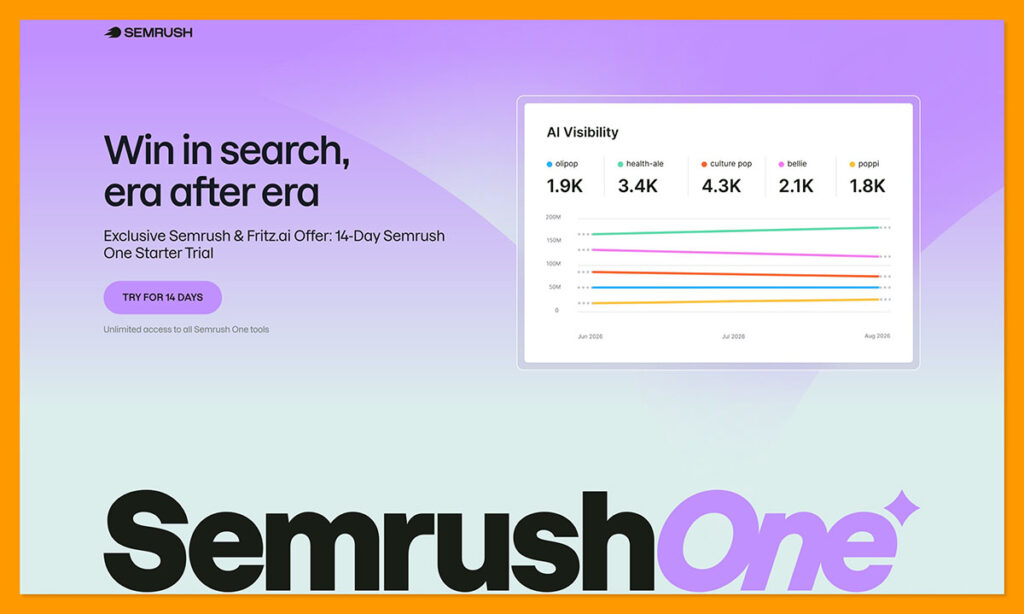
When Semrush added AI features through its AI Visibility Toolkit and Semrush One bundles, those features were layered on top of this existing SEO data infrastructure. The result extends Semrush into AI Overviews and some AI-based content workflows, but the foundation remains Google search behavior.
Profound starts from a completely different data source. Instead of search queries, it works with a large dataset of real AI conversations, hundreds of millions of them, to model what it calls “prompt volume.”
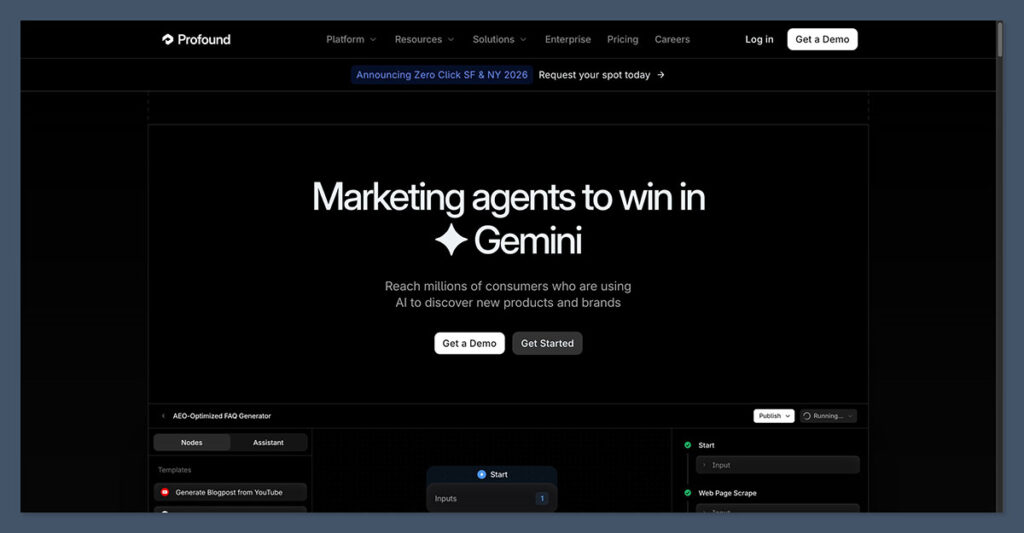
This means Profound can show you which questions people are actually asking ChatGPT or Perplexity about your industry, what the AI engines say in response, which sources they cite, and what sentiment they carry about your brand.
Why this matters
AI answers only partially overlap with Google search queries. The questions people ask ChatGPT about, say, project management software are not the same as what they type into Google.
Classic keyword tools do not capture most of this AI-driven demand, and that is the gap Profound targets.
If your team is making content decisions based purely on search volume data, you are missing the AI conversation layer entirely.
AI-Specific Features Compared
| AI / GEO Feature | Semrush | Profound |
|---|---|---|
| AI Overviews tracking | Yes. Monitors when sites appear in Google AI Overviews, share of voice, and traffic impact (via Semrush One GEO components) | Yes, included as part of its broader AI visibility dashboard |
| Multi-LLM brand tracking | Limited. Primarily Google, with some coverage for major LLMs | Extensive. ChatGPT, Perplexity, Gemini, Claude, Copilot, Grok, DeepSeek, Meta AI (full coverage on Enterprise) |
| Prompt / conversation intelligence | Relies on search-derived queries and keyword tools. No true “prompt volume” dataset | Conversation Explorer, prompt volume, query fan-outs, trending AI topics, intent clustering |
| AI crawler analytics | Limited AI bot tracking | Agent Analytics to track AI bots crawling your site: paths, engines, engagement patterns |
| Content generation for AI visibility | AI-powered content workflows through Semrush’s Content Toolkit (separate subscription) | Agents feature generates AEO-optimized content briefs and full article drafts (capped on lower tiers) |
| Shopping visibility | Not available | ChatGPT Shopping visibility tracking (Enterprise tier) |
The winner for AI visibility: Profound, by a significant margin.
It was purpose-built for this exact use case, while Semrush is extending an SEO platform into AI territory. If multi-LLM brand tracking is your priority, Profound is the deeper tool.
Classic SEO Toolkit Compared
There is no real contest here. Semrush is one of the most established SEO platforms on the market, and Profound intentionally does not try to replicate its capabilities.
Semrush provides keyword research with a massive keyword database, SERP feature tracking, intent classification, keyword difficulty scores, and topic clustering. Its backlink analytics include a historic index, toxic link detection, and competitor link profiles.
The site audit tool runs 140+ checks for technical SEO issues. On top of that, you get rank tracking, a content marketing toolkit, PPC research, and social and competitive intelligence.
Profound does not offer any of this. No keyword database, no backlink index, no site audit, no rank tracker for traditional search results. The platform was designed with the assumption that you already have an SEO stack in place, and it focuses exclusively on the AI visibility layer that traditional SEO tools do not cover.
The winner for traditional SEO: Semrush, without question.
If you need keyword research, backlink analysis, technical audits, and competitive intelligence, Semrush is the tool for the job. Profound does not compete in this category.
How Much Does Semrush Cost?
Semrush offers three core SEO Toolkit plans, with the option to bundle AI visibility through Semrush One.
SEO Toolkit (Classic Plans)
| Plan | Monthly price | Annual price (per month) | Projects | Tracked keywords | Best for |
|---|---|---|---|---|---|
| Pro | $139.95 | $117.33 | 5 | 500 | Freelancers, small teams, solo SEOs |
| Guru | $249.95 | $208.33 | 15 | 1,500 | Growing agencies, content teams needing historical data |
| Business | $499.95 | $416.66 | 40 | 5,000 | Large agencies, enterprise teams needing API access and Share of Voice |
Semrush also offers its AI Visibility Toolkit as a standalone add-on at $99/mo. The Semrush One bundles (Starter, Pro+, Advanced) combine the SEO Toolkit with AI Visibility features, with entry pricing around $165 to $199/mo depending on the tier.
My take on Semrush pricing
For most serious users, the Guru plan offers the best balance of features and value. Pro is a fine starting point, but you will outgrow it quickly if you manage multiple sites or need content marketing tools.
The Business plan only makes sense if you genuinely need API access or Share of Voice tracking at scale. If AI visibility matters to your strategy, look at the Semrush One bundles rather than paying separately for the AI Visibility Toolkit.
How Much Does Profound Cost?
Profound’s pricing has shifted toward enterprise positioning.
As of early 2026, the official pricing page describes the platform as available through customized enterprise pricing. However, several independent sources and review platforms report a tiered structure:
| Plan | Price | AI platforms covered | Prompts | Key limitations |
|---|---|---|---|---|
| Starter | $99/mo | ChatGPT only | 50 | Single platform. Too limited for a real AEO program |
| Growth | $399/mo | ChatGPT, Perplexity, Google AI Overviews | 100 | 3 platforms only. Content generation capped at 3 articles/mo |
| Enterprise | Custom (reported $2,000-5,000+/mo) | 10+ platforms including Claude, Gemini, Grok, DeepSeek, Meta AI | Custom | Requires sales conversation. Includes SSO, SOC 2, dedicated support |
There is no free trial on paid plans. Profound offers a free AEO report as an alternative, but you need to apply for access and go through a sales process before using the platform.
My take on Profound pricing
The $99/mo Starter exists to let you experience the platform, but 50 prompts on a single AI engine is not enough to run a meaningful AI visibility program.
The effective entry price is $399/mo at the Growth tier, and even that only covers three platforms. If you need full cross-platform intelligence (including Claude, Gemini, and Grok), you are looking at Enterprise pricing in the low-to-mid four figures. Budget accordingly.
When Semrush Is the Better Fit
Choose Semrush if:
- Your primary growth lever is still Google organic and paid search
- You are an agency managing multiple sites and need keyword research, backlink auditing, rank tracking, and reporting in one suite
- You treat AI Overviews as “one more SERP feature” to monitor rather than a core channel
- Your team is earlier in AI adoption and wants AI features without needing granular multi-LLM visibility
- Budget is a consideration. Semrush offers more tools per dollar than Profound at comparable price points
Skip Semrush if:
- You already have a different SEO stack you are happy with and only need AI visibility
- Your executive team is asking for AI share-of-voice metrics across ChatGPT, Perplexity, and Gemini
- You need prompt-level intelligence to understand what real users are asking AI engines about your industry
When Profound Is the Better Fit
Choose Profound if:
- Your brand operates in a space where AI answers materially influence discovery, consideration, or support (SaaS, fintech, healthcare, developer tools)
- Your team is explicitly investing in GEO/AEO and needs prompt volume, conversation topic mapping, and AI share-of-voice as core KPIs
- You want to understand which sources AI engines rely on when recommending competitors over you
- Your technical SEO team needs data on how AI crawlers interact with your site
- You have the budget for at least the $399/mo Growth plan, and ideally Enterprise
Skip Profound if:
- You are a freelancer, small agency, or small business without a dedicated AI visibility budget
- You need traditional SEO capabilities. Profound does not replace keyword research, backlink tools, or site audits
- Your team is not ready to act on AI visibility data. Profound is monitoring-heavy, and the content generation tools are limited on lower tiers
- You need a self-serve trial before committing budget. Profound’s sales process adds friction
Can You Use Both Together?
Yes, and for advanced teams in 2026, this is increasingly the recommended approach.
The logic is straightforward. Semrush handles the crawl-centric search layer: keyword research, backlink building, technical health, and Google rank tracking.
Profound handles the conversation-centric AI layer: what prompts mention your brand, what sentiment they carry, which citations AIs use, and how AI crawler behavior correlates with your visibility in AI answers.
These are two different datasets that barely overlap. The questions people type into Google are not the same as the questions they ask ChatGPT. A brand that is strong in traditional search can be completely invisible in AI answers, and vice versa.
If your organization has reached the point where AI Overviews volatility, noticeable AI referral traffic, or executive demand for AI share-of-voice metrics are part of your reality, that is the signal to consider adding Profound alongside your existing SEO stack.
Key Takeaways
- Different tools for different layers. Semrush is an SEO operating system. Profound is an AI visibility radar. They solve different problems.
- Semrush is the safer starting point for most teams because it covers the full SEO stack and is adding AI features through Semrush One.
- Profound is the deeper AI tool with capabilities (prompt volume, multi-LLM sentiment, conversation intelligence) that Semrush does not offer.
- Budget matters. Semrush starts at $117/mo (annual). Profound’s effective entry is $399/mo, with full coverage at $2,000+/mo.
- Profound is not a replacement for Semrush. It is an additional layer that sits on top of an existing SEO stack.
- Advanced teams use both: Semrush for search, Profound for AI answers.
How I Compared Semrush and Profound
Methodology
| Testing area | What I evaluated | Weight |
|---|---|---|
| AI visibility features | Multi-LLM tracking, prompt intelligence, citation analysis, sentiment tracking, AI crawler analytics | 25% |
| Traditional SEO features | Keyword research, backlink analytics, site audit, rank tracking, content tools | 25% |
| Pricing and value | Entry price, feature-to-cost ratio, tier transparency, hidden costs | 20% |
| Ease of use | Onboarding process, dashboard clarity, learning curve, documentation | 15% |
| Integrations and support | Third-party integrations, customer support channels, community resources | 15% |
I cross-referenced independent reviews on G2, third-party pricing analyses, and direct platform documentation. Where pricing or features were ambiguous, I used the most recently verified sources available as of April 2026.
Semrush vs Profound: Final Verdict
Semrush remains the essential tool for any team doing SEO in 2026.
Its depth in keyword research, backlink analytics, technical audits, and competitive intelligence is unmatched, and the addition of AI features through Semrush One makes it a solid all-in-one platform for teams that want everything in a single suite.
Profound is the tool to add when AI visibility becomes a strategic priority, not just a curiosity. If your brand is in a space where ChatGPT, Perplexity, and Gemini answers are shaping how customers discover and evaluate your product, Profound gives you data and intelligence that no traditional SEO platform can match.
Its prompt volume data, conversation explorer, and multi-LLM citation analytics are genuinely unique.
For most teams, Semrush is where you start. Profound is where you graduate to when AI search becomes a meaningful part of your visibility strategy.
The most advanced teams in 2026 are not choosing between them. They are using Semrush for search and Profound for AI answers.

Comments 0 Responses