

Deepfakes are no longer a niche research curiosity. Synthetic media is now a real operational risk for banks, media organisations, governments, and any platform that relies on identity verification or user-generated content.
The question in 2026 is not whether you need deepfake detection, but which tool fits your specific threat model and workflow.
To help you cut through the noise, we’ve mapped the current landscape of AI deepfake detection tools, covering enterprise platforms, identity-focused solutions, and open-source options.
Whether you’re protecting a financial onboarding flow, moderating content at scale, or building a custom detection pipeline, here’s what you need to know.
Key Takeaways
- The market has shifted from single-model video detectors to multimodal enterprise platforms covering video, image, audio, and increasingly text
- Leading tools now emphasise APIs, KYC/AML integrations, and fraud-prevention workflows rather than standalone scanners
- Reality Defender and Sensity AI are the most widely cited platforms for media organisations and enterprise trust-and-safety teams
- For identity verification and onboarding fraud, Microblink and AuthBridge are the go-to options
- Open-source tools remain valuable for research and custom pipelines, but are not turnkey anti-fraud solutions
- Pricing is almost universally enterprise-negotiated; very few tools publish public rate cards
Our Top AI Deepfake Detection Tools for 2026
We’ve evaluated tools across accuracy benchmarks, modality coverage, deployment options, and real-world use case fit.
Here are our top picks.
AI Deepfake Detection Tools: Side-by-Side Comparison
| Tool | Modality coverage | Primary use case | Key differentiator |
|---|---|---|---|
| Reality Defender | Video, image, audio, text | Enterprise, government, media | Multimodal single-platform coverage, real-time APIs |
| Sensity AI | Video, image, audio | Law enforcement, media, brand protection | Threat-intelligence monitoring plus forensic reports |
| Microblink | Selfie video, documents | Banks, fintech, digital onboarding | On-device processing, KYC/AML compliance |
| Intel FakeCatcher | Video only | Media, broadcasters, data centres | Physiology-based detection, multi-stream hardware acceleration |
| CloudSEK XVigil | Web-wide monitoring | Security ops, brand protection | Deepfake detection inside a full DRP/CTI suite |
| Hive AI | Image, video | Social platforms, UGC moderation | API-first, bundled with broader content moderation |
| AuthBridge | Selfie, documents | Indian enterprise KYC | Integrated into background verification, regional compliance |
Reality Defender – Best overall

Reality Defender sits at the top of our rankings because it covers the widest threat surface of any platform we reviewed.
It handles video, image, audio, and text through a single probabilistic scoring API, making it genuinely useful as a horizontal “trust and safety” layer rather than a narrow point solution.
The platform has been adopted by broadcasters in Asia and large financial institutions, and was a finalist at RSAC 2024’s Innovation Sandbox, which signals real enterprise credibility. If you’re evaluating tools for a government, media organisation, or financial services environment, Reality Defender is the natural first conversation to have.
Pros 👍
- Covers video, image, audio, and text
- Real-time screening APlsStrong enterprise and government track record
- RSAC 2024 Innovation Sandbox finalist
Cons 👎
- No public pricing; enterprise-only contracts
- Overkill for simple single-modality use case
Why use Reality Defender in 2026?
As deepfake threats expand from video to voice cloning and synthetic text, having a single platform that scores risk across all modalities removes the need to stitch together multiple point solutions. That architectural simplicity matters for compliance and incident response workflows.
Best for: Enterprises, government agencies, and media organisations that need a comprehensive, API-accessible trust-and-safety layer across all content types.
Sensity AI – Best for threat intelligence
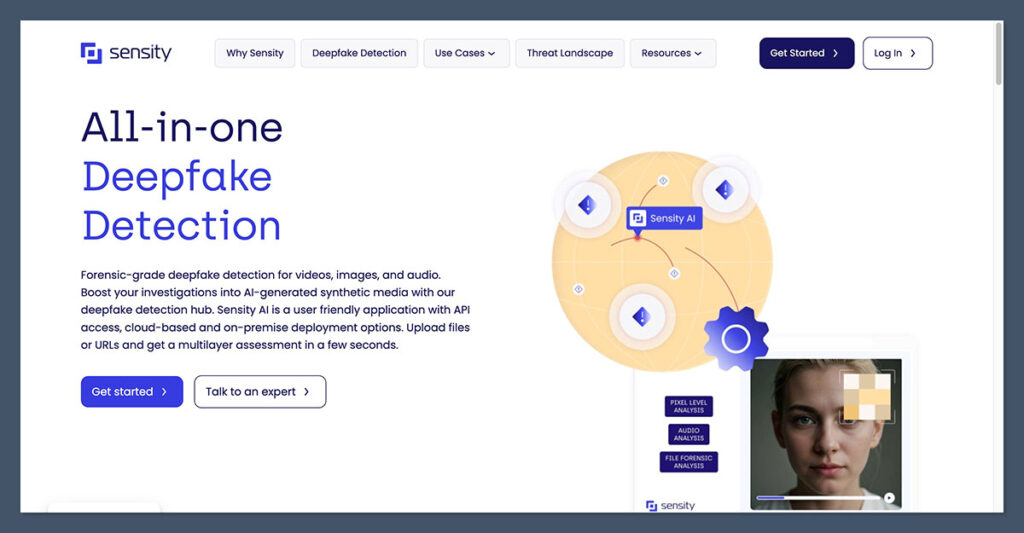
Sensity AI approaches deepfake detection from a threat intelligence angle rather than a pure detection-API model.
Beyond flagging synthetic content, it actively monitors thousands of online sources for malicious deepfakes, generates court-ready forensic reports, and provides SDKs for integration into existing security workflows.
Internal benchmarks cite accuracy in the 95 to 98% range. More importantly, the platform produces the kind of documented evidence chain that law enforcement, legal teams, and journalists actually need, which is something a basic detection API cannot deliver on its own.
Pros 👍
- Continuous monitoring of online sources
- Court-ready forensic reports
- APIs and SDKs for integration
- Strong fit for law enforcement and media
Cons 👎
- Accuracy figures are vendor-reported benchmarks
- Monitoring scope may exceed needs for smaller teams
Why use Sensity AI in 2026?
Detection alone is not enough when the same deepfake circulates across dozens of platforms simultaneously. Sensity’s monitoring layer gives security and communications teams early warning, not just reactive confirmation.
Best for: Journalists, law enforcement, brand protection teams, and media organisations that need both detection and proactive synthetic media monitoring.
Microblink – Best for KYC and onboarding

Microblink is not primarily marketed as a deepfake detection tool, but that framing undersells it.
Its on-device liveness detection and document verification are specifically designed to be deepfake-resistant, which makes it one of the most practical options for any organisation running digital onboarding at scale.
Independent testing cited by Microblink reports 100% deepfake detection with 0% false acceptance on a large public dataset.
Those are vendor-reported numbers and should be treated accordingly, but the on-device processing architecture is a genuine differentiator for organisations with latency and data-privacy constraints.
Pros 👍
- On-device processing for low latency and privacy
- Strong KYC/AML compliance focus
- Deepfake-resistant liveness and document checks
- Designed for high-volume onboarding flows
Cons 👎
- Narrower scope: selfie and document modalities only
- Not suitable for social-media or broadcast monitoring
Why use Microblink in 2026?
Deepfake detection is becoming synonymous with modern liveness detection for fintech, banks, and Web3 platforms. Microblink addresses this directly, with a compliance-ready architecture that integrates into existing KYC/AML workflows rather than sitting outside them.
Best for: Banks, fintech platforms, and any organisation running digital onboarding that needs deepfake-resistant identity verification baked into the process.
Intel FakeCatcher – Best technical approach

Intel FakeCatcher takes a meaningfully different approach to detection: instead of hunting for visual artefacts, it analyses subtle blood-flow patterns in the face using photoplethysmography signals.
Real human faces show these physiological responses; synthetically generated faces typically do not.
Intel reports approximately 96% accuracy in controlled settings and around 91% on real-world videos.
The platform runs on Xeon-based servers and can handle dozens of simultaneous streams, which makes it a practical option for newsroom or platform-level pre-publication verification rather than a developer curiosity.
Pros 👍
- Novel physiology-based detection method
- Harder for deepfake generators to fool than artefact detection
- Multi-stream processing capability
- Backed by Intel’s hardware ecosystem
Cons 👎
- Video only, no image or audio support
- Requires Xeon-based server infrastructure
- “In the wild” accuracy dips to ~91%
Why use Intel FakeCatcher in 2026?
As deepfake generation models get better at eliminating visual artefacts, detection tools that rely on artefact analysis become less reliable. Physiological signal detection represents a more durable approach as the generation arms race continues.
Best for: Media organisations, broadcasters, and data-centre-scale platforms that need real-time video verification and can deploy on Intel Xeon infrastructure.
CloudSEK XVigil – Best for digital risk protection
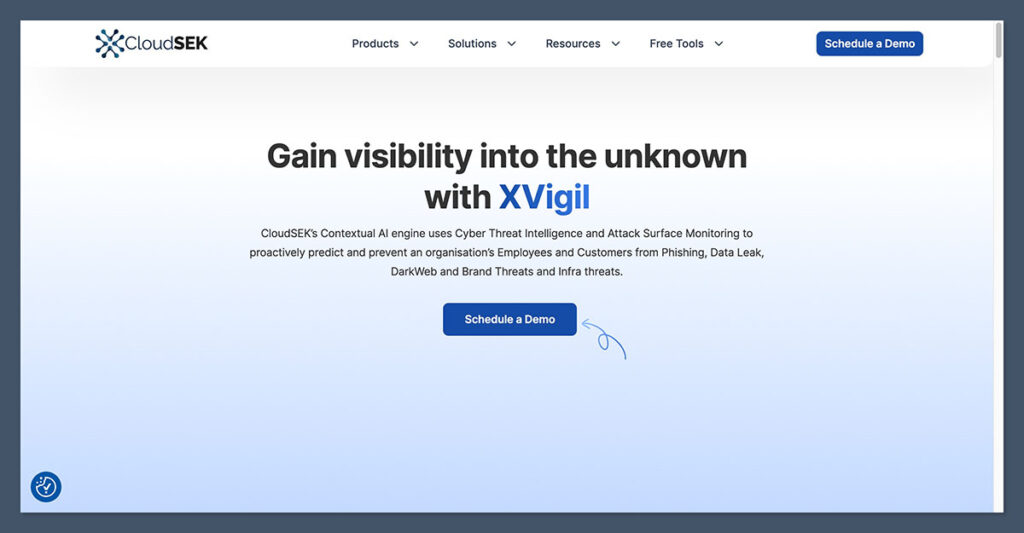
CloudSEK’s XVigil platform treats deepfake detection as one signal inside a wider digital risk protection suite, rather than as a standalone product.
It monitors domains, social media profiles, and dark web sources for synthetic media, brand impersonation, and executive-impersonation fraud in a single dashboard.
For security operations and brand protection teams, this integration is the key differentiator. You’re not adding a deepfake scanner to your stack; you’re getting deepfake alerting embedded inside the threat intelligence workflow your analysts already use every day.
Pros 👍
- Deepfake detection inside a full DRP/CTI suite
- Monitors dark web, social, and domain sources
- Real-time alerting and workflow integration
- Ranked among top tools in 2026 market lists
Cons 👎
- Not a pure deepfake detection play
- Platform breadth may be unnecessary for narrow use cases
Why use CloudSEK in 2026?
Deepfakes targeting executives and brands don’t live in isolation, they appear alongside phishing domains, fake social profiles, and impersonation campaigns. CloudSEK’s correlation of these signals gives security teams a more complete picture than any single-purpose detector can.
Best for: Security operations teams, brand protection professionals, and digital risk analysts who need deepfake monitoring as part of a wider threat intelligence workflow.
Hive AI – Best API-first option

Hive AI is built for platforms that need to moderate content at high volume, not for security analysts or identity verification workflows.
Its deepfake detection API covers images and video, and is typically bundled with Hive’s broader moderation models covering nudity, violence, and hate speech, which is a practical advantage for social platforms that need a single moderation stack.
The API-first architecture means minimal integration friction, and the bundled moderation capabilities reduce the number of vendor relationships a platform needs to manage. It’s a pragmatic choice for teams where deepfake detection is one of several content safety requirements rather than the primary one.
Pros 👍
- API-first, easy to integrate
- Bundled with broader content moderation models
- Scales for high-volume UGC platforms
Cons 👎
- No audio deepfake detection
- Less suited to forensic or enterprise security use cases
Why use Hive AI in 2026?
Content moderation demands have never been higher, and managing multiple vendor relationships for different violation types adds real operational overhead. Hive AI’s bundled approach, combining deepfake detection with nudity, violence, and hate speech models in a single API, lets trust and safety teams consolidate their moderation stack rather than stitching together point solutions. For platforms dealing with high volumes of user-generated content, that simplicity compounds over time.
Best for: Social platforms and UGC products that need deepfake detection as part of a broader content safety stack, delivered via API
AuthBridge – Best for regional KYC

AuthBridge is an India-based verification provider that has embedded AI deepfake detection into its background check and digital onboarding products.
It handles real-time identity verification with deepfake screening as part of the check, rather than as a separate layer, and is built specifically around Indian regulatory compliance requirements.
For enterprises operating in or expanding into the Indian market, AuthBridge’s localised compliance focus and high-volume verification capacity are genuinely useful.
For purely international deployments, Microblink or Reality Defender are likely a better fit.
Pros 👍
- Deepfake detection integrated into background checks
- Real-time status updates for high-volume verifications
- Strong Indian regulatory compliance focus
Cons 👎
- Primarily relevant to Indian enterprise context
- Less established for international deployments
Why use AuthBridge in 2026?
India’s digital onboarding market is expanding rapidly, and so is regulatory scrutiny around identity fraud. AuthBridge’s advantage is not just that it detects deepfakes, but that it does so within a verification workflow already built around Indian compliance requirements. For enterprises operating in the Indian market, that means fewer integration headaches and a shorter path to audit-ready documentation compared to adapting a global tool to local regulatory context.
Best for: Indian enterprises and organisations that need deepfake detection embedded within regulatory-compliant background verification workflows.
Notable Open-Source Deepfake Detection Tools
If you’re a researcher, data scientist, or engineering team building a custom detection pipeline, open-source options provide useful building blocks. They are not production-ready anti-fraud solutions out of the box, but they offer transparency, adaptability, and no licensing cost.
- DeepfakeDetector (PyTorch, EfficientNet-B0) – An open-source project with a web UI for image and video analysis, pre-trained models, and a full training pipeline. A practical starting point for teams that want to understand how detection models work before evaluating commercial options.
- GitHub “deepfake-detection” topic – Hundreds of repositories covering approaches from Xception-based baselines to transformers and frequency-analysis models. Useful for surveying the methodological landscape.
- Awesome-Deepfakes-Detection – A curated catalogue of datasets (FaceForensics++, DFDC, DFD), academic papers, and code repositories. The best single reference point for anyone doing research or building an in-house detector.
The honest summary: open-source tools are excellent for learning and experimentation, but the operational gap between a research model and a production-grade fraud prevention system is significant. Most enterprises will find commercial APIs faster to deploy and easier to maintain.
How to Choose the Right Deepfake Detection Tool
The right tool depends almost entirely on your threat model and where detection needs to happen in your workflow. Before shortlisting vendors, it’s worth being specific about a few key questions.
What modalities are you trying to detect? Video-only tools like Intel FakeCatcher are not useful if your primary exposure is voice-cloning fraud in call centres. If you need coverage across multiple content types, a multimodal platform like Reality Defender is worth the higher entry cost.
Where in the workflow does detection need to sit? Identity verification at onboarding requires low-latency, on-device processing, which points toward Microblink. Real-time broadcast verification requires multi-stream hardware acceleration, which is Intel FakeCatcher’s domain. Post-publication monitoring of social media requires a threat-intelligence platform like Sensity or CloudSEK.
Do you need forensic-grade outputs? If detected deepfakes might end up in legal proceedings or regulatory investigations, you need a platform that generates documented evidence chains, not just a confidence score. Sensity AI is the clearest choice for this requirement.
Is this a standalone requirement or part of a broader security workflow? If your team is already running a digital risk protection or cyber threat intelligence platform, adding a standalone deepfake tool creates unnecessary fragmentation. CloudSEK’s integrated approach is worth evaluating in that context.
Our Methodology
Our evaluation of AI deepfake detection tools covered the following criteria, weighted to reflect real-world enterprise decision-making rather than benchmark performance alone.
- Modality coverage (25%): Does the tool cover the content types relevant to enterprise threat models, including video, image, audio, and text?
- Deployment and integration (25%): How easily does the tool integrate into existing workflows via APIs, SDKs, or native connectors?
- Accuracy and robustness (20%): What does third-party or independent testing show, and how does performance hold up on real-world rather than controlled datasets?
- Use-case fit (20%): Is the tool genuinely suited to its stated use case, whether that is KYC, content moderation, threat intelligence, or forensics?
- Market credibility (10%): What does the vendor’s track record, customer base, and third-party recognition indicate about long-term reliability?
Pricing was noted as a factor but not weighted heavily in rankings because almost all enterprise deepfake detection tools operate on negotiated contracts without public rate cards.
Frequently Asked Questions
What is AI deepfake detection and how does it work?
AI deepfake detection uses machine learning models to identify synthetic or manipulated media, typically by looking for statistical inconsistencies, visual artefacts, or physiological signals that differ between real and AI-generated content. More advanced approaches, like Intel FakeCatcher, analyse biological signals such as blood-flow patterns that synthetic faces typically cannot replicate. Enterprise platforms combine multiple detection methods and score content probabilistically rather than returning a simple binary verdict.
Can deepfake detection tools keep up with advances in deepfake generation?
This is the central tension in the field. As generation models improve, artefact-based detection methods become less reliable because the artefacts they look for get eliminated. This is why physiological-signal approaches and multimodal platforms that can adapt their models regularly are increasingly favoured over tools that rely on a single fixed detection method. No tool currently offers perfect accuracy on real-world content, and accuracy figures from vendors should always be contextualised against the specific datasets used in their benchmarks.
Is open-source deepfake detection good enough for enterprise use?
Open-source tools are excellent for research, building internal understanding, and prototyping custom pipelines. They are not turnkey anti-fraud solutions. The gap between a well-trained detection model and a production-grade system with monitoring, alerting, API reliability, compliance documentation, and support is significant. Most enterprises will reach their operational requirements faster with a commercial platform, even if they use open-source tools for internal evaluation and benchmarking.
How much does deepfake detection software cost?
Almost all enterprise-grade deepfake detection platforms operate on negotiated contracts, and very few publish public pricing. Costs typically scale with volume (number of verifications or API calls per month), modalities covered, and the level of support and SLA required. Organisations should expect a significant procurement conversation rather than a self-serve sign-up flow for most of the tools in this guide.
Which deepfake detection tool is best for financial services?
For financial services, the primary use case is onboarding and identity verification, which means the tool needs to integrate cleanly into KYC/AML workflows and operate at low latency. Microblink is the most purpose-built option for this, with on-device processing and explicit compliance focus. Reality Defender is the stronger choice for broader enterprise coverage that extends beyond onboarding to fraud monitoring and communications verification.

Comments 0 Responses