

If you’ve looked into AI chatbots for customer service, chances are you’ve come across Tidio and their AI agent called Lyro.
I’ve used it, studied their pricing structure, and spoken to others who have implemented it across ecommerce and SaaS businesses.
And let me tell you this upfront: Tidio’s Lyro pricing can be surprisingly tricky if you just skim the site.
So in this post, I’m going to break down exactly what Tidio Lyro costs, how it fits into your broader Tidio subscription, what’s included, and what isn’t. I’ll also walk you through common pricing examples based on real-world use cases.
Let’s get into the details.
1. Tidio Gives You 50 Free Lyro Conversations — But Just Once
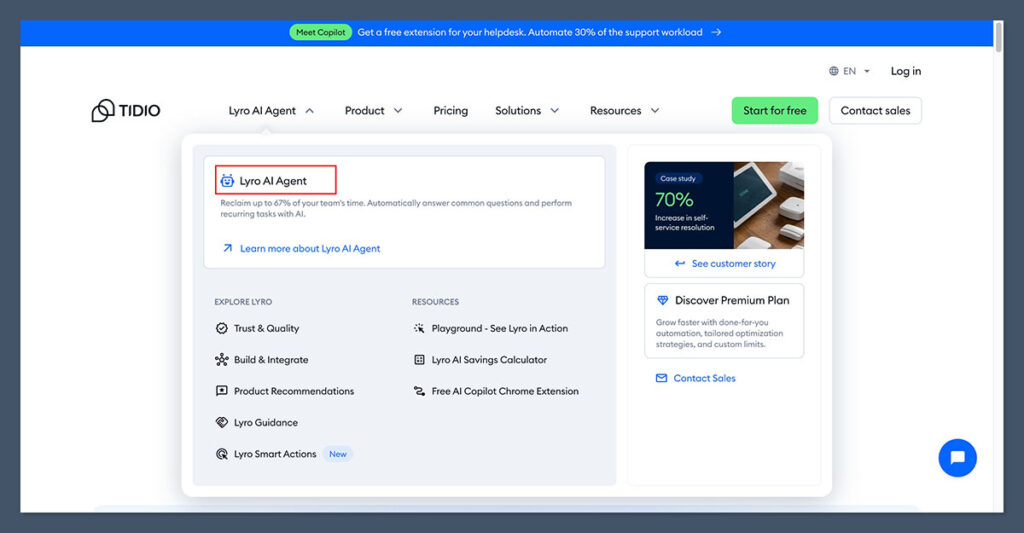
Tidio makes a strong first impression by giving you free access to Lyro. Every account comes with 50 Lyro AI conversations that you can use to try out the tool. But what they don’t always make super clear is that this isn’t a recurring allowance.
You only get that batch of 50 conversations once. It doesn’t reset monthly. It’s not tied to any billing plan. It’s simply a free test run.
What counts as a “Lyro conversation”?
Tidio defines a Lyro conversation as any time a customer interacts with Lyro and gets at least one AI-generated reply. Even if the customer comes back to that same chat later or if Lyro sends multiple replies, it still counts as one conversation.
This is actually pretty fair. You’re not charged for each message, only for the full interaction.
Here’s a quick example to make it clearer:
- A customer visits your store, asks about return policy, and Lyro responds: 1 conversation
- That same customer comes back two hours later to ask about shipping, and Lyro replies again: still 1 conversation, if it’s part of the same thread
- A customer asks a question but Lyro doesn’t respond (because the human agent picks it up): not counted as a Lyro conversation
So you can test Lyro with up to 50 different customer interactions, totally free. But once those are gone, you need to buy a quota.
2. How Much Does Lyro Actually Cost After the Free Trial?
After you burn through the free conversations, you’ll need to subscribe to Lyro to keep using it.
The pricing starts at $32.50 per month, but that’s based on annual billing.
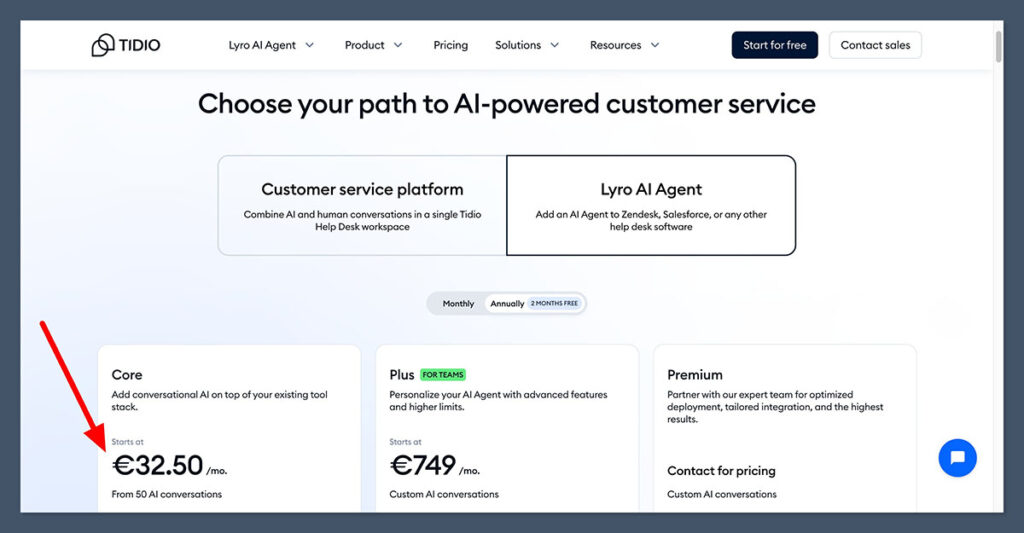
If you’re paying monthly, the price is higher.
Tidio presents its pricing using a Monthly vs Annual toggle. The lower prices that most people see are based on the annual commitment, where you effectively get 2 months free. So keep that in mind when budgeting.
Lyro AI Agent Plan (Standalone or Bundled)
Lyro is offered both as a standalone addon and as part of Tidio’s bundled Customer Service platform. Here’s how it breaks down:
| Monthly Conversation Limit | Monthly Price (billed annually) | Available As Addon? | Bundled in Plan? |
|---|---|---|---|
| 50 conversations | $32.50 | Yes | No |
| 100–1,000 conversations | Scales up by volume | Yes | No |
| 1,000+ conversations | Custom pricing | Yes | Yes (on Plus) |
If you only need a small number of AI conversations per month, the $32.50/month plan will probably be enough.
But if you’re running a high-volume ecommerce site or a SaaS product with constant chat inquiries, you’ll likely need a higher tier, and that’s when the pricing starts scaling quickly.
What’s helpful is that you can increase your conversation limit without switching plans. Tidio lets you customize how many AI convos you get per month.
You Can Buy Lyro Separately or with a Tidio Plan
Tidio’s pricing model is modular. You can use Lyro on its own if you only want AI support, or you can pair it with their Customer Service platform if you also need live agents, ticketing, and automation tools.
This setup is good for flexibility but confusing at first. Many people don’t realize they need two plans: one for Lyro and one for human agent support.
3. Understanding Tidio’s “Per Conversation” Positioning
One of the most confusing things about Lyro pricing is Tidio’s marketing message: “Only $0.50 per conversation”.
This number isn’t inaccurate, but it doesn’t tell the whole story.
That $0.50/conversation figure is more of an average or a theoretical minimum. In reality, the cost per conversation you’ll experience depends on:
- Your plan level
- How many conversations you’re buying
- Whether you’re on monthly or annual billing
- Whether you’re bundling with other Tidio tools
Let’s do the math.
Real-World Example: 50 Conversations/Month
If you’re on the entry-level Lyro plan at $32.50/month for 50 conversations, here’s your real cost per conversation:
- $32.50 / 50 conversations = $0.65 per conversation
That’s already more than the advertised $0.50.
Real-World Example: 1,000 Conversations/Month
Let’s say you scale up to 1,000 AI conversations per month. At this volume, pricing becomes more competitive and is likely to align with or drop below the $0.50 mark. But this requires either:
- A custom pricing arrangement
- A bundled enterprise plan (like the “Customer Service Plus” plan at $749/month)
In short, you won’t really hit that $0.50/convo unless you’re operating at scale.
That being said, the per-conversation structure is helpful because it lets you predict how far your quota will go.
And unlike some competitors, Tidio doesn’t charge for each message or each customer reply. Just one charge per session where Lyro replies at least once.
4. What’s the Difference Between Lyro and Helpdesk Conversations?
This part trips people up.
Tidio tracks two different types of conversations:
- Lyro conversations: These are chats handled by the AI agent. You pay for these based on your Lyro plan.
- Billable conversations: These are chats handled by human agents. These are tied to your Customer Service plan.
So, if you have a hybrid setup where Lyro handles simple questions and humans jump in when things get complex, you’re effectively operating two separate quotas.
Why This Matters
Let’s say you sign up for:
- Tidio’s Starter Customer Service plan: $24.17/month (100 billable conversations)
- Lyro AI Agent (50 convos): $32.50/month
Your total monthly cost would be $56.67.
But you’d still need to monitor:
- Whether you’re running out of Lyro conversations
- Whether your human agents are exceeding their billable convo limit
Tidio’s dashboards do a decent job of tracking this, but it’s important to understand what’s being counted — and what isn’t.
One thing worth noting is that Lyro conversations do not count against your billable helpdesk quota. If Lyro handles it, you’re only using up your Lyro plan.
5. Real-World Pricing Scenarios: What Most People Actually Pay
Based on my experience and discussions with other users, most businesses fall into one of three pricing scenarios.
Scenario 1: Light Use, Small Store or SaaS
You only expect a few chats per day. You want Lyro to handle the basics like shipping FAQs, login help, or basic setup questions.
Recommended setup:
- Lyro AI Agent (50 convos/month): $32.50
- Starter Helpdesk plan (100 billable convos/month): $24.17
- Total: $56.67/month
Great for stores with low chat volume or teams testing AI chat support for the first time.
Scenario 2: Growing Business With Mixed AI + Human Support
You’re seeing more than 50 convos per month handled by Lyro, and your team steps in for more detailed customer issues.
Recommended setup:
- Lyro AI Agent (200 convos/month): ~ $80/month (estimated)
- Customer Service Growth Plan (250 billable convos): $49.17/month
- Total: Around $129/month
In this setup, you’ll start to appreciate the value Lyro brings in reducing the load on your human agents.
Scenario 3: High Volume Support Operation
You run a high-traffic site or SaaS app with thousands of users and frequent support requests.
Recommended setup:
- Custom Lyro quota (1,000+ conversations): Custom price
- Customer Service Plus Plan: $749/month
- Total: Likely $800 to $1,200/month
You’ll need to speak with sales to fine-tune this. But if you’re supporting thousands of users, the ROI on AI can be significant — especially if Lyro deflects even 60% of inbound chats.
6. How Tidio Lyro Compares to Other AI Chatbot Pricing
To give you some perspective, here’s how Lyro stacks up against other popular AI support tools:
| Tool | Starting Price | Free Plan | Charges Per Conversation? | AI Features Included? |
|---|---|---|---|---|
| Tidio Lyro | $32.50/month | Yes | Yes | Yes |
| Zendesk AI | $50+/month | No | No | Add-on only |
| Intercom | $74+/month | No | No | Some AI in base plan |
| Freshchat AI | $29/month | Yes | No | Limited |
| Drift AI | $2,500+/month | No | Custom | Enterprise only |
Lyro wins on affordability and simplicity. The pay-per-conversation model is more transparent than the usage-based models some competitors use.
What’s missing from Lyro right now is deep integration with CRMs or advanced data triggers.
It’s designed more for handling frontline questions, not doing full-fledged AI workflows or ticket automation.
But for the price, it’s one of the most scalable AI support tools for small to medium businesses.
Final Thoughts: Is Tidio Lyro Worth It?
If you’re trying to bring AI into your support workflow without going full enterprise, Lyro is one of the best-value options on the market.
You’ll need to pay attention to your monthly conversation usage, and understand that your total cost usually includes both:
- A Lyro AI plan
- A human helpdesk plan
But once you’ve mapped that out, you can scale fairly predictably. Most ecommerce stores, SaaS tools, and digital service providers I’ve worked with start small, and as volume increases, they gradually increase the Lyro quota.
The key is to keep a close eye on your AI usage so you don’t overpay or run out of conversations mid-month.

Comments 0 Responses