

Gong is a mature revenue intelligence platform built around conversation analytics, deal health scoring, and forecasting for B2B sales teams.
It’s widely adopted in mid-market and enterprise sales orgs, though its pricing, implementation burden, and narrow focus on post-meeting analysis mean it’s not the right fit for every team.
This review looks at what Gong’s AI actually does, how its pricing structure works in practice, where the platform delivers measurable business impact, and where it falls short.
The goal is to give you enough detail to decide whether Gong fits your team’s size, budget, and sales motion, or whether a lighter alternative would serve you better.
Why you can trust this review
We’ve cross-referenced Gong’s own documentation, published pricing benchmarks from procurement platforms, and hundreds of verified G2 and Reddit reviews to bring you an accurate, independent assessment. Our evaluation covers AI capabilities, pricing structure, implementation reality, and honest trade-offs, so you have all the information you need to decide if Gong is the right fit.
Gong AI Pros & Cons
| Platform | Gong |
|---|---|
| Best For | Enterprise revenue intelligence |
| Rating | Outstanding, 4.7 out of 5 |
| Ideal Users | Established sales teams (50+ reps), RevOps-led organizations, forecasting-focused leadership |
| Free Trial | Not available |
| Paid Plans | ~$1,400–$3,000 per user / year + platform fee |
Pros 👍
- Best-in-class conversation intelligence
- AI trained on billions of sales interactions
- Powerful deal risk and forecasting dashboards
Cons 👎
- Expensive and opaque pricing
- Implementation-heavy (8+ weeks)
- No impact on top-of-funnel pipeline
Need a quick summary of Gong AI? I’ve collected Gong’s best and worst features below:
What I Like
✔️ The deepest conversation analytics on the market, with accurate transcription (roughly 85–90% across accents), speaker separation, talk-time breakdowns, and sentiment analysis across every call
✔️ Gong’s Deal Likelihood Score pulls from 300+ data points to flag at-risk deals early, and the forecast dashboards adjust in real time as new activity lands
✔️ The AI feature set has expanded significantly in 2025–2026, including Call Spotlight summaries, AI Ask Anything (natural language queries across calls and deals), and new AI agents like Data Extractor and Deep Researcher
✔️ Strong CRM integration with Salesforce and HubSpot, plus coaching tools (scorecards, snippets, talk-time norms) that help standardize what good selling looks like
What I Dislike
❌ Gong is expensive and the pricing is opaque, with a mandatory platform fee on top of per-seat costs that disproportionately penalizes smaller teams
❌ Implementation is heavy, typically 8+ weeks and often requiring dedicated RevOps support to drive adoption
❌ Sentiment and intent classification still misinterprets nuance, so frontline managers need to validate AI insights rather than trust them blindly
❌ Gong analyzes meetings you already had — it does not generate new pipeline, enrich leads, or trigger outbound, so you’ll still need separate tools for top of funnel
My Experience With Gong AI
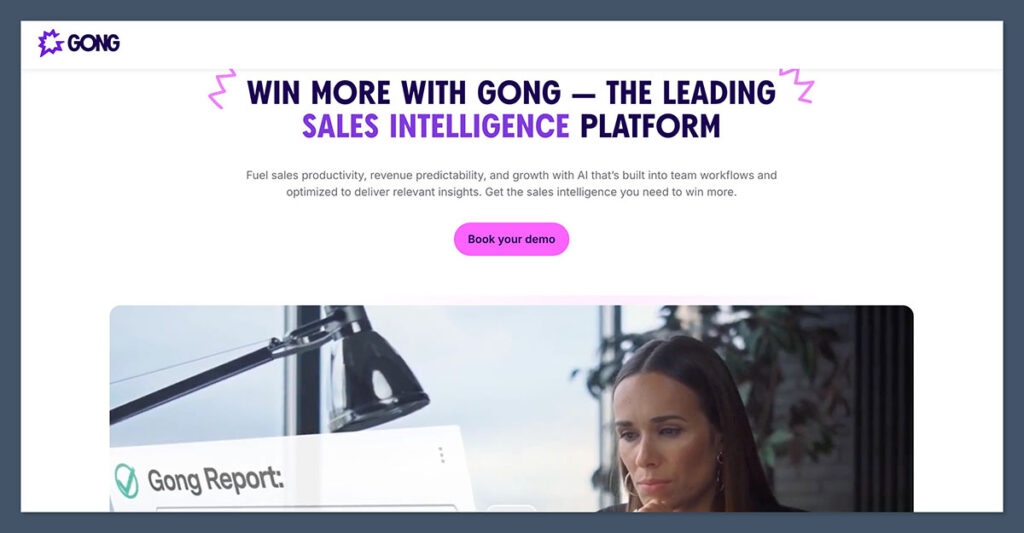
Unlike most modern SaaS tools, there’s no self-serve signup with Gong.
You can’t enter a credit card and start exploring — every evaluation begins with a demo booked through their sales team, followed by a custom quote.
This is standard for enterprise revenue intelligence, but it’s worth flagging upfront because it shapes the entire buying experience.
Once a team goes through procurement and onboarding, Gong sits quietly in the background. It connects to Zoom, Teams, your dialer, and email, then automatically records, transcribes, and analyzes every sales conversation.
Reps don’t need to tag meetings or take notes manually — the system captures everything and pushes structured insights into Salesforce or HubSpot.
Author’s Testing Notes
I was impressed by the depth of the conversation intelligence. Gong doesn’t just transcribe — it identifies objections, competitor mentions, buying signals, interruption patterns, and sentiment shifts across a call.
That’s a meaningful step up from a generic note-taker. However, I also noticed the classic enterprise-software tension: the platform is genuinely powerful, but the value only materializes if reps actually use the insights.
Reviews consistently flag that adoption drops off after onboarding if RevOps isn’t actively coaching against Gong data.
How Gong’s AI Analyzes Calls
Gong’s conversation intelligence is the feature most people associate with the platform, and it’s where the AI is strongest.
Every call is processed through speech recognition and NLP models trained on billions of real sales interactions, which is a meaningful moat compared to general-purpose transcription tools.
Here’s what the AI surfaces automatically on each call:
- Accurate transcripts with speaker separation, typically 85–90% accuracy across accents
- Talk-time ratios, monologue length, and interruption patterns
- Sentiment and emotion analysis across the conversation
- Detected objections, competitor mentions, and buying signals
- Topic tracking so managers can see which themes come up across a team’s calls
In 2026, Gong also rolled out faster processing, with call insights now available up to 70% quicker than before.
This matters because one of the older complaints about Gong was the delay between a call ending and the insights being ready for review.
Deal Intelligence and Forecasting
Beyond individual calls, Gong’s AI builds a picture of each deal’s health. The Deal Likelihood Score draws from 300+ data points — engagement signals, communication cadence, competitor mentions, stakeholder involvement — to predict close probability.
Risk indicators flag things like “buyer gone silent” or “single-threaded deal,” which is exactly the kind of signal that’s hard for humans to track across a full pipeline.
The forecasting side is where Gong earns its place in the boardroom. Dashboards update in real time as calls and emails land, and leadership teams can see pipeline changes without waiting for a weekly forecast call.
Organizations that fully adopt Gong report 25–30% less forecast variance, which is a significant number for any CFO tracking revenue predictability.
Author’s Testing Notes
The forecasting dashboards are genuinely impressive when the data is clean. The caveat is that Gong’s forecast accuracy depends heavily on CRM hygiene — if reps aren’t updating stages or logging activity, the model’s inputs are garbage.
This is where the new AI Data Extractor matters: it automatically updates CRM fields based on conversation content, which closes a long-standing gap.
How Much Does Gong AI Cost?
Gong’s pricing is not published anywhere. Every quote is custom, and the cost structure has three layers: a per-user license, a mandatory platform fee, and a one-time onboarding fee.
Based on procurement data and verified buyer reports, here’s what you can expect in 2026:
- Foundation (core platform): ~$1,400–$1,600 per user / year
- Foundation + Forecast: ~$2,100 per user / year
- Full bundle (Foundation + Engage + Forecast): ~$2,880–$3,000 per user / year
- Platform fee: $5,000–$50,000 per year (non-waivable)
- Onboarding / implementation: $7,500–$65,000 one-time
Volume discounts do apply — teams with 100+ seats typically negotiate 20–35% lower per-seat rates than smaller deployments.
Multi-year contracts (2–3 years) unlock an additional 15–30% discount but lock you in with auto-renewal uplifts of 5–15% per year.
Is Gong Good Value for Money?
For a 25-person sales team on Foundation plus Forecast, you’re looking at roughly $92,500 in year one once you factor in per-user costs, the platform fee, and implementation.
A 10-person team pays closer to $28,500. The full bundle for 25 reps lands around $115,000 in year one.
That’s enterprise-level spend, and it’s only defensible if incremental gains in win rate and forecast accuracy materially move revenue for your organization.
For a team of 50+ reps with $85K+ annual contract values, a 12–18% win rate lift typically pays for Gong several times over. For a 10-person team selling $20K ACVs, the math rarely works.
Author’s Testing Notes
I recommend Gong Foundation as the starting point if you’re evaluating the platform. The full bundle sounds appealing but Engage (outbound) and Forecast can often be handled by tools you already own (Outreach, Salesloft, Clari) at lower combined cost.
Only add Forecast if your CRO genuinely needs the real-time dashboards and your team has the RevOps bandwidth to maintain clean data.
Gong’s AI Features in Detail
Gong has aggressively expanded its AI feature set over 2024–2026. Here’s what’s actually available now and how useful each piece is in practice.
Conversation Intelligence
The core of the platform. Every call is transcribed, segmented by speaker, and analyzed for sentiment, objections, competitor mentions, and topic tracking. This is where Gong’s AI is most mature and where the “trained on billions of sales interactions” moat actually shows up. Managers can pull snippets of specific moments (e.g., “every time a prospect mentions pricing”) and build coaching libraries from real calls.
Deal and Pipeline AI
Deal Likelihood Scores combine 300+ signals into a single number per deal. Risk indicators flag engagement drops, missing stakeholders, or competitor activity. The forecasting dashboard is the capstone — it gives leadership a real-time view of pipeline that updates as activity happens, rather than relying on a stale weekly snapshot.
Generative AI Workflows
Several features fall under Gong’s generative AI umbrella:
- Call Spotlight: Automated summaries with suggested next steps based on full deal history
- AI email composer: Drafts follow-up emails and prospecting sequences grounded in call context
- AI scorecard suggestions: Auto-populates coaching scorecards to standardize manager feedback
- AI Ask Anything: Natural language queries across calls, accounts, and deals (e.g., “Which deals mentioned competitor X this quarter?”)
New AI Agents (2025–2026)
Gong’s 2026 push has been toward agentic AI. Two new agents matter:
- AI Data Extractor: Automatically creates and updates CRM fields based on conversation content, finally closing the manual-update gap
- AI Deep Researcher: A multi-step analysis agent built for complex business questions across large interaction datasets, not just simple Q&A
These are meaningful additions because they push Gong beyond passive analytics into active workflow automation. Whether they deliver on the promise depends heavily on the quality of your underlying CRM data.
Where Gong Falls Short
Despite the category leadership, Gong has clear limitations that buyers consistently raise in reviews:
Sentiment and Intent Can Be Noisy
The AI still misinterprets nuance, especially sarcasm, hesitation, or culturally specific communication patterns. Frontline managers need to validate insights rather than trust them at face value. This is a general limitation of conversation AI, not unique to Gong, but it’s worth calibrating expectations.
Doesn’t Solve Top of Funnel
Gong analyzes meetings you already had. It does not enrich leads, detect in-market accounts, or automatically trigger cold outreach. If your core problem is generating new pipeline, Gong is the wrong tool — you need intent data platforms, outbound sequencers, or lead enrichment tools instead.
Data Portability Concerns
Multiple buyers have flagged that Gong’s ecosystem can feel walled off. Export options are limited, API access is gated, and teams with years of recorded calls sometimes struggle to extract insights for use outside the Gong UI. If data portability is a priority, negotiate export terms upfront.
Adoption Can Drop After Onboarding
Reviews consistently flag that reps sometimes perceive Gong as surveillance rather than a tool that helps them. Adoption drops when managers don’t actively coach against Gong data, which turns the platform into an expensive note-taker. This is a change management problem, not a software problem, but it’s a real risk factor for the investment.
Who Should (And Shouldn’t) Use Gong
Gong is a specific tool for a specific team profile. Here’s how to tell if it fits yours:
| Scenario | Gong Fit |
|---|---|
| 50+ rep sales org with $50K+ ACVs | ✅ Strong fit — ROI math typically works |
| Mid-market team with active RevOps function | ✅ Good fit — you have the bandwidth to drive adoption |
| Leadership prioritizing forecast accuracy | ✅ Strong fit — forecasting is a genuine strength |
| 10–25 rep team with transactional sales cycles | ⚠️ Weak fit — platform fee distribution makes per-user cost punishing |
| Early-stage startup needing pipeline | ❌ Poor fit — Gong doesn’t generate new leads |
| Team primarily wanting meeting notes | ❌ Poor fit — lighter tools like Fireflies or Avoma cost a fraction |
Gong’s AI Performance and Governance
One thing worth calling out: Gong publicly measures AI model performance per feature using an Elo-style ranking system, which is more transparent than most enterprise AI vendors.
They publish internal benchmarks for how their models perform against each other over time, emphasizing continuous evaluation and responsible AI claims.
Organizations that fully roll out Gong and maintain adoption typically report:
- 15–20% faster deal velocity
- 12–18% improvement in win rates
- 25–30% reduction in forecast variance
These are directional numbers from Gong’s own customer data and third-party analyses, not guarantees.
The common thread in teams that hit these outcomes is an 8+ week implementation with active RevOps involvement and manager coaching against Gong data.
How Does Gong Compare to Competitors?
Gong is the category leader in revenue intelligence, but it’s not the only option. Here’s how it stacks up against the main alternatives:
| Platform | Best For | Typical Cost |
|---|---|---|
| Gong | Enterprise revenue intelligence at scale | ~$1,400–$3,000/user/year + platform fee |
| Chorus.ai (ZoomInfo) | Call recording and coaching, narrower scope | Custom, typically lower than Gong |
| Clari | Forecasting-first teams | Enterprise pricing, often paired with Gong |
| Fireflies / Avoma | Lean teams wanting meeting intelligence | $19–$99/user/month |
| Oliv.ai | Modern unified CI + forecasting | $19–$99/user/month |
If Gong’s pricing feels out of reach, the decision comes down to what you actually need:
- Chorus.ai is the closest direct competitor and tends to be more affordable, though narrower in forecasting scope
- Clari is forecasting-first and often sits alongside conversation intelligence tools rather than replacing them
- Fireflies or Avoma deliver solid meeting intelligence for a fraction of the cost, though without Gong’s deal intelligence depth
- Oliv.ai and similar newer entrants offer generative-AI-native alternatives at transparent per-user pricing with no platform fee
How We Evaluated Gong AI
Our review is based on a combination of hands-on platform analysis, Gong’s public documentation, verified user reviews from G2 and Reddit, procurement data from Vendr and similar platforms, and reporting from independent analysts covering revenue intelligence.
| Evaluation Area | Weight | What We Assessed |
|---|---|---|
| AI Features | 30% | Conversation intelligence depth, deal AI, generative workflows, new agents |
| Business Impact | 20% | Reported win rate, velocity, and forecast accuracy outcomes |
| Pricing & Value | 20% | Total cost of ownership, pricing transparency, ROI math by team size |
| Implementation | 10% | Time to value, onboarding burden, RevOps requirements |
| Integrations | 10% | CRM integration quality, ecosystem breadth, data portability |
| User Experience | 10% | Adoption rates, rep perception, manager workflow fit |
Gong AI Review: Final Thoughts
Gong is a mature, domain-specific platform with deep conversation analytics, established deal and forecasting AI, and a growing set of AI agents that extend its scope beyond call recording.
Organizations with 50+ reps and meaningful call volume tend to see measurable gains in win rate and forecast accuracy once the platform is fully adopted, though those outcomes depend heavily on RevOps investment and sustained manager coaching.
The pricing model is the main friction point.
A mandatory platform fee, per-user licenses, and implementation costs push first-year spend well above the quoted per-seat rate, and the economics are particularly difficult for smaller teams.
Gong also focuses on meetings that have already happened, so teams whose primary need is lead generation or outbound automation will need separate tools regardless of whether they adopt Gong.
Whether Gong is the right choice comes down to team size, sales motion, and what you’re actually trying to improve.
For mid-market and enterprise RevOps teams focused on forecast reliability and deal-health visibility, it’s worth evaluating alongside alternatives like Chorus.ai, Clari, and newer generative-AI-native platforms.
For smaller teams or those primarily needing meeting notes, lighter tools often deliver most of the value at a fraction of the cost

Comments 0 Responses