

Whop is one of the most mature all-in-one creator commerce platforms on the market, offering everything from courses and communities to SaaS sales and digital downloads under a single backend.
In this review, I’ll take a closer look at Whop’s pricing, features, mobile apps, and marketplace, so you can see exactly why it stands out (and where it falls short) for creators building digital businesses in 2026.
Why you can trust this review
I’ve spent hours researching Whop across independent reviews, creator breakdowns, Trustpilot feedback, and the platform’s own changelogs, cross-referencing claims with real user experiences on Reddit and the App Store.
My goal is to give you an honest, practitioner-level look at what Whop actually does well and where it struggles, so you can decide whether it fits your business before you commit time to building on it.
Whop Pros & Cons
| Platform | Whop |
|---|---|
| Best for | Selling multiple digital products from one backend |
| Rating | 4.5 out of 5 |
| Ideal for | Creators selling courses, communities, and software together; mobile-first community businesses; sellers who want marketplace discovery built in |
| Pricing | No monthly subscription for core usage. Transaction-based pricing with roughly 3% platform fee plus standard card processing |
Pros
- All-in-one backend for digital products
- Excellent iOS and Android apps
- No monthly fee for core usage
Cons
- Cluttered, modular UX with a learning curve
- Marketplace quality varies by niche
- Fee stack gets expensive at scale
Need a quick summary of Whop? I’ve collected Whop’s best and worst features below:
What I Like
- ✔️ A genuine all-in-one stack: courses, communities, SaaS, memberships, and digital downloads managed from one dashboard, which can replace several separate tools
- ✔️ Strong mobile experience with highly rated iOS and Android apps that feel more polished than the desktop build
- ✔️ Powerful software and licensing support, including API access, automated license keys, and subscription access control for SaaS sellers
- ✔️ No monthly subscription for core usage, making it friendly for early-stage creators with variable revenue
- ✔️ Built-in marketplace (Whop Discover) that can drive incremental sales for creators in the right niches
What I Dislike
- ❌ The modular app-store architecture makes the dashboard feel cluttered and initially overwhelming compared to simpler alternatives
- ❌ Marketplace product quality varies widely, with some verticals attracting spammy or low-quality communities that can hurt buyer trust
- ❌ Fees compound at scale: the platform cut plus payment processing can become expensive once revenue grows
- ❌ Trustpilot feedback flags recurring issues around account suspensions and fund holds, which matter for creators relying on steady cash flow
My Experience With Whop
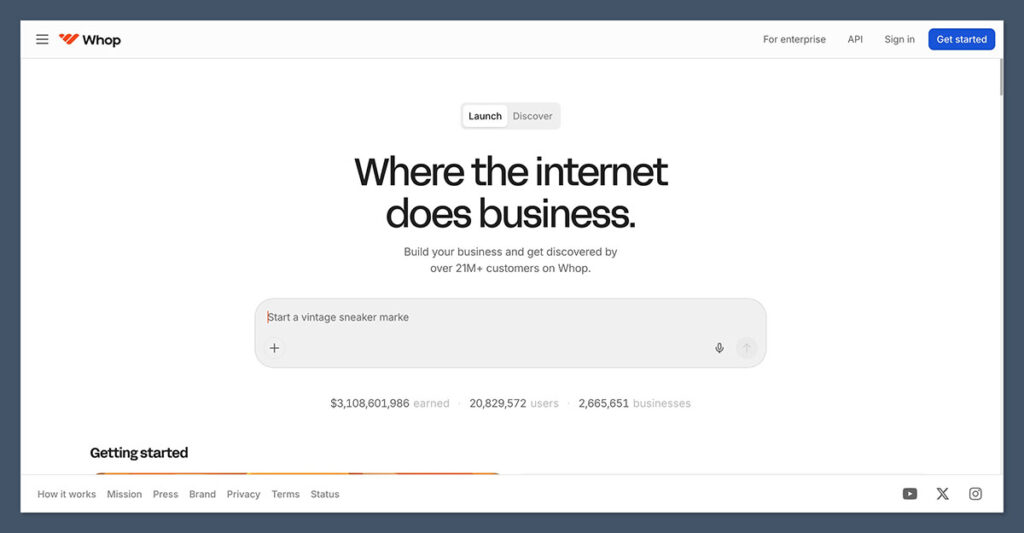
Getting started on Whop is free and fast. There’s no monthly subscription to sign up for the core platform, which immediately lowers the barrier compared to subscription-based course tools.
After creating an account, the onboarding flow asks what you want to sell, whether that’s a community, a course, software, or digital files, and then drops you into the dashboard to start configuring your first product.
What struck me early on is that Whop doesn’t really try to hold your hand. Instead of pushing you through a guided AI setup like Wix or Squarespace would, it hands you a modular toolkit and lets you build. That’s both the appeal and the problem.
Author’s Testing Notes
The biggest mental shift with Whop is that you’re not building a “store” in the traditional sense. You’re assembling a product experience from a library of apps: Chat, Forums, Courses, Events, Video Calls, affiliate tools, and more.
It’s incredibly flexible, but if you’ve come from Skool or Teachable, expect to spend your first few hours just figuring out which modules you actually need.
How I Set Up Products
Adding products on Whop is straightforward once you understand the model. You create a “whop” (the platform’s term for a product or community), then attach apps to it. Want a paid Discord community with a course attached? Add the Discord app and the Courses app. Selling software with license keys? The licensing tools are built in and work through Whop’s API.
I found this modular approach genuinely powerful for creators running hybrid offers. You can bundle a course, a community, and access to software or indicators into a single checkout without needing Zapier, a separate membership plugin, or a custom payment integration. That’s not something most course platforms can do natively.
Customizing the Storefront
Whop’s storefront customization is functional but not where the platform shines. You get control over branding, product layout, and how your offers are presented, but it’s not a design playground. If you’re coming from Shopify or Squarespace expecting fine-grained visual control, you’ll find Whop more restrictive.
The tradeoff is that Whop’s storefronts are designed for conversion first and aesthetics second. Checkout flows, upsells, and access delivery are tight and well-engineered, which matters more for digital product sales than pixel-perfect design.
Author’s Testing Notes
Whop’s storefront editor is fine. It’s not going to win design awards, and creators who care deeply about visual branding will probably feel boxed in. But for most digital product sellers, the question isn’t “does my storefront look beautiful?” It’s “does my checkout convert and does my product deliver cleanly?” On both counts, Whop holds up well.
How Much Does Whop Cost?
Whop uses a transaction-based pricing model rather than a classic SaaS subscription. There’s no monthly fee to access the core platform, which is unusual in this category and a real advantage for early-stage creators.
Here’s how the fees actually break down in practice:
| Fee Type | Cost | When It Applies |
|---|---|---|
| Monthly subscription | $0 | Core platform access, no recurring fee |
| Platform fee | ~3% per transaction | On every sale processed through Whop |
| Payment processing | Standard card rates | Applied on top of the platform fee |
| Marketplace cut | Variable | When sales come through Whop Discover |
Is Whop Good Value for Money?
Whether Whop is actually good value depends heavily on your revenue and how many tools it’s replacing. For a creator running a $500/month community who would otherwise stitch together a membership tool, a community platform, and a payment processor, Whop’s percentage fee is almost certainly cheaper than paying multiple monthly subscriptions.
The calculation changes as you scale. Once you’re doing serious monthly volume, that 3% platform fee plus processing plus any marketplace cuts starts adding up fast compared to running your own stack on Stripe with a self-hosted community. Several creator breakdowns have flagged this scaling concern, especially for Telegram-based communities where fee stacking gets noticeable.
Author’s Testing Notes
I’d recommend Whop’s transaction-based model for creators under roughly $10k/month in digital sales, or for anyone running a hybrid offer (course plus community plus software) that would genuinely need three or four separate tools otherwise.
Above that revenue level, it’s worth doing the math on whether a self-hosted stack with lower transaction costs would save you enough to justify the extra complexity.
Designing With Whop
Whop’s design approach is less about templates and more about modular composition. Instead of picking from hundreds of themes like you would on Shopify, you assemble your product experience from a library of apps and configure how they’re presented to members.
The core design elements you control include your branding (logo, colors, name), your product landing pages, the layout of your community and content apps, and the checkout experience. It’s enough to look professional, but you won’t be producing a highly custom visual brand the way you might with a dedicated website builder.
Where Whop genuinely excels on the design front is the member-facing experience, particularly on mobile.
The iOS and Android apps present content, community, and courses in a clean, consistent interface that members seem to actually enjoy using.
Selling Digital Products With Whop
This is where Whop is strongest. The platform was purpose-built for digital product sales, and it shows in the depth of the feature set.
Multi-Product Support
Whop supports courses, communities, SaaS and web apps, digital downloads, memberships, and even hybrid products that combine several of these. You can bundle a course with a Discord community, gated software access, and downloadable files into a single offer, with one checkout and one access system managing everything.
For creators running hybrid businesses, this is genuinely hard to replicate elsewhere without stitching together three or four separate tools.
Payments and Monetization
Whop handles the entire payment flow, including global VAT, multi-currency support, and payouts to creators. You don’t need to set up Stripe separately or configure tax compliance manually, which removes a significant chunk of operational work for international sellers.
The monetization tools have been expanding recently. Whop now supports order bumps before checkout, custom post-checkout upsell pages, and in-product upsells via locked apps. These are the kinds of revenue-expansion features you’d normally need a dedicated funnel builder to pull off.
Software and Licensing
If you’re selling software, SaaS, or any kind of license-gated product, Whop’s licensing system is one of the strongest in the creator commerce space. It handles automated license key generation, usage tracking, subscription access, and API-driven integrations with your product.
For indie SaaS founders or trading indicator sellers, this alone can justify the platform.
Community and Engagement
Community features include Chat, Forums, Events, Video Calls, and livestream support. Members can participate in discussions, join live events, and access recorded content directly inside Whop. The community experience isn’t as opinionated as Skool’s “classroom plus feed” model, but it’s more flexible and composable.
One honest limitation: Whop doesn’t offer the same depth of gamification that Skool does. If progress tracking, leaderboards, and gamified learning are central to your community model, Skool is probably a better fit.
Mobile Apps
Whop’s mobile apps are a genuine differentiator. The iOS app holds around a 4.8-star rating on the App Store, and the Android app sits at approximately 4.7 stars across more than 50,000 reviews. Users consistently praise the content organization, stored livestreams, and overall mobile-first polish.
There are some real gripes in the Android reviews worth knowing about.
The video player doesn’t always keep the screen awake during longform content, and it doesn’t reliably resume from the last timestamp, which makes watching longer courses on mobile less convenient than it should be.
International and Localization
Whop has been investing in localization throughout 2025 and 2026. The iOS app now auto-adapts based on phone language for German, Spanish, French, Portuguese, Simplified Chinese, Italian, and Dutch.
Combined with built-in VAT handling and multi-currency support, this makes Whop a reasonable choice for creators with international audiences.
Whop’s Newer Features (2025–2026)
Whop has been actively shipping updates, which is reassuring for a platform you’d be building a business on. Recent additions from the official changelog include:
- Voice messages on iOS: you can send and play voice notes directly in DMs and group chats
- Improved search: newly created whops appear instantly in search, with more accurate results for users and products, plus trending sections
- Message search: you can now search DMs and group chats, with an iMessage-style long-press preview
- Advanced upsell flows: order bumps, post-checkout upsell pages, and in-product locked-app upsells
- Notification improvements: more accurate unread counts and smoother chat navigation
- App localization: iOS support for seven additional languages based on phone settings
How Does Whop Compare to Competitors?
The most common comparison creators make is Whop versus Skool, since both target digital communities and creator businesses. Here’s how they stack up on the factors that actually matter:
| Factor | Whop | Skool |
|---|---|---|
| Primary model | Marketplace and all-in-one storefront for digital products | Course and community platform with opinionated structure |
| User experience | Modular, powerful, more cluttered at first | Clean, minimal, focused on classroom plus community |
| Discovery | Built-in marketplace (Whop Discover) can drive new buyers | No meaningful marketplace layer |
| Mobile experience | Very strong iOS and Android apps, mobile-first design | Good mobile experience, generally considered a step behind |
| Monetization tools | Bundles, upsells, affiliate apps, API-driven software sales | Courses, communities, subscriptions, fewer marketplace tools |
| Pricing model | No monthly fee, percentage per transaction | Flat monthly subscription, no marketplace cut |
| Best for | Creators selling multiple digital formats from one backend | Creators focused primarily on courses and community |
The short version: Skool is better if you want a simple, opinionated classroom-plus-community experience and you’re fine paying a flat monthly fee.
Whop is better if you need to sell multiple types of digital products (especially software), want marketplace discovery, or prefer transaction-based pricing with no monthly commitment.
Reputation, Support, and Trust
Whop holds a mixed-to-positive rating on Trustpilot across more than 2,400 reviews, with most reviewers landing in the “somewhat happy” range.
The positive feedback consistently highlights helpful support staff, quick responses, and the ease of selling digital products and managing payouts.
The negative feedback is worth paying attention to. Recurring complaints center on payment issues (fund availability, withdrawal clarity), account suspensions, and access to funds. For a platform where your revenue flows through their infrastructure, these are legitimate concerns to weigh.
There’s also the marketplace quality question. Independent reviewers and Reddit users agree Whop itself is legitimate, essentially functioning as “Shopify for digital goods.” But the open marketplace model means product quality varies widely.
Some verticals, particularly trading and “make money online” niches, attract low-quality or scam-adjacent offers. From a consumer perspective, the line between “Whop has a bad seller” and “Whop let me down” can feel blurry, and that perception can bleed into how buyers view your brand when you list on the marketplace.
Author’s Testing Notes
The marketplace quality issue is the thing I’d think hardest about before committing to Whop as your primary platform.
If you’re in a premium niche (high-ticket coaching, serious SaaS, professional education), Whop Discover can actually be a liability because it puts your brand next to low-quality offers in similar categories. \If you’re selling something clearly differentiated or in a niche that doesn’t attract bad actors, this matters much less.
How I Evaluated Whop
To put together this review, I looked at Whop across the factors that actually matter for creators running digital product businesses.
Here’s what I weighted and why:
| Evaluation Area | Weight | What I Looked At |
|---|---|---|
| Product and sales features | 30% | Range of digital products supported, checkout flow, upsell tools, licensing |
| User experience | 20% | Creator dashboard, learning curve, day-to-day management |
| Mobile and member experience | 15% | iOS and Android app quality, member-facing polish |
| Pricing and fees | 15% | Fee structure, cost at scale, value versus alternatives |
| Community and engagement tools | 10% | Chat, forums, events, engagement depth |
| Reputation and trust | 10% | Trustpilot feedback, Reddit discussions, support quality |
Whop Review: Should You Build Your Business on Whop? Final Verdict
Whop is the most capable all-in-one platform I’ve seen for creators selling multiple types of digital products from one backend.
If you’re running a business that combines courses, a community, software, and digital downloads, it can genuinely replace three or four separate tools, and the mobile experience is a real differentiator for community-driven businesses.
It’s not the right fit for everyone. The modular UX has a real learning curve, the marketplace quality varies enough to matter for premium brands, and the fee stack gets expensive as you scale.
Creators who want a simple, opinionated classroom-plus-community experience will probably be happier on Skool, and established businesses with high volume should do the math on whether a self-hosted stack would save enough to justify the extra operational work.
For hybrid digital businesses, mobile-first communities, and software sellers who value built-in licensing, Whop is one of the strongest options available in 2026.

Comments 0 Responses