

Kore.ai is an enterprise-level conversational AI platform that helps companies automate customer service and streamline contact center operations.
With support for chat, voice, and agent-assist features, Kore.ai is designed to handle high volumes of interactions across multiple channels while maintaining a high standard of governance, security, and scalability.
I spent time analyzing Kore.ai’s features, pricing, and positioning to understand where it stands out, and where it may not be the right fit.
In this Kore.ai review, I’ll walk you through what the platform offers, how much it costs, and who it’s best suited for, so you can decide whether it’s the right solution for your business.
Kore.ai Pros and Cons
Pros
- Built specifically for enterprise automation and agent support
- Strong omnichannel capabilities including voice, chat, and messaging apps
- Detailed governance and plan structure for scaling usage safely
- Includes agent assistance and contact center AI in one platform
Cons
- Pricing lacks transparency and requires custom quotes
- Implementation can be resource-heavy and time-consuming
- Voice experience may require custom tuning in some environments
- Overpowered for small teams or basic chatbot needs
Quick Summary of Kore.ai
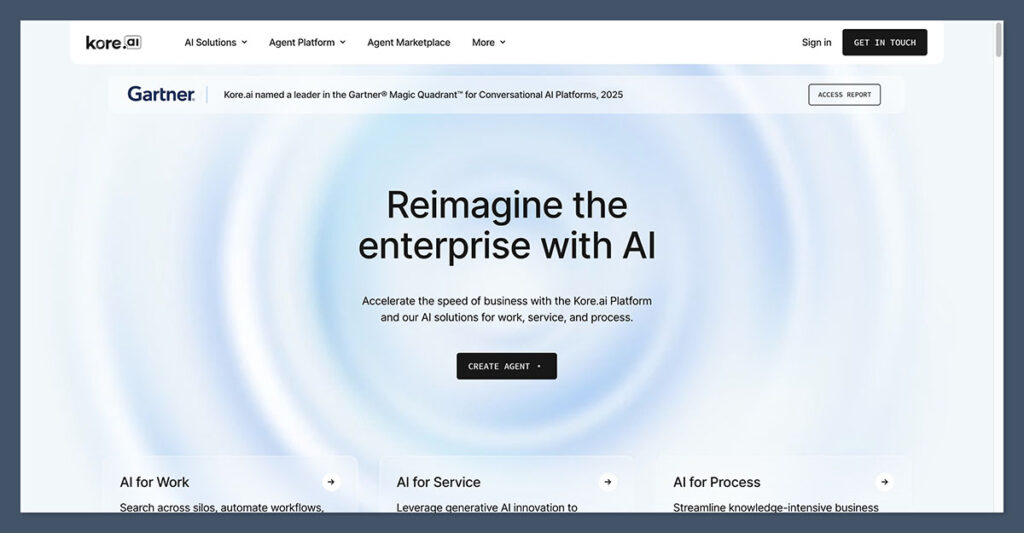
Kore.ai is a full-featured conversational and generative AI platform built for businesses that need to automate interactions across web, voice, and mobile.
The platform allows you to build and manage AI-powered assistants that can interact with users, assist agents, retrieve information, and integrate with your back-end systems.
This is not a chatbot tool aimed at startups or freelancers. Kore.ai is built for larger teams and enterprise clients with significant infrastructure needs and compliance requirements.
It’s designed to support both customer-facing automation and internal operational workflows.
Key Use Cases for Kore.ai
| Use Case | Functionality Available |
|---|---|
| Customer service automation | Multichannel bots, automated workflows, AI-powered routing |
| Agent augmentation | Real-time coaching, suggested replies, knowledge retrieval |
| Contact center transformation | Voice AI, IVR upgrades, unified dashboards, reporting |
| Internal knowledge support | Employee-facing virtual assistants, enterprise search |
| Custom integration workflows | Connect to CRMs, ticketing tools, ERP, voice stacks |
Kore.ai supports a range of deployment models, including cloud, hybrid, and on-premise, making it particularly attractive for regulated industries like finance, healthcare, and telecom.
My Experience With Kore.ai
Unlike some conversational AI tools that are quick to set up, Kore.ai has a steeper learning curve.
Getting started requires planning, a clear understanding of your business workflows, and a dedicated implementation phase.
The platform is designed for scalability, so it can handle sophisticated needs—but that also means it’s not beginner-friendly.
During onboarding, Kore.ai provides documentation and developer resources to help you set up bots, agents, and automations.
Depending on your use case, you may need to connect external systems, define roles and governance layers, and work with a solutions architect from their team.
The design interface for building bots is highly customizable. You can define intents, responses, and transitions, and even create multilingual flows.
Features like context management, tool invocation, and natural language understanding are built into the bot engine.
Once configured, the platform allows you to manage conversations across platforms like WhatsApp, SMS, webchat, Microsoft Teams, and voice.
Kore.ai also includes sentiment detection and intent correction to make conversations more fluid and responsive.
Kore.ai Pricing
Kore.ai’s pricing model is usage-based and varies depending on how you deploy the platform.
There are no public plan pages on the website, and pricing is generally only available through direct consultation or via developer documentation.
Based on official documentation, here’s how Kore.ai structures its billing:
Core Pricing Model
| Product Area | Pricing Method |
|---|---|
| Automation AI and Search AI | Per 15-minute activity session (~$0.20) |
| Contact Center AI and Agent AI | Per seat (named or concurrent licensing) |
| Support Plans | Starts at $1,000 per month (estimate) |
| Add-ons and integrations | Priced separately based on usage |
Example Monthly Cost
If you’re using session-based pricing:
- 10,000 sessions per month × $0.20 = $2,000
- Support plan = $1,000
- Add-ons = Variable based on channel and data volume
Estimated total: $3,000 to $5,000 per month, depending on feature scope and support needs.
Are the $50–$150 Plans Real?
Some third-party directories list “Essential” and “Advanced” plans at $50 and $150 per month, but these appear to be simplified pricing tiers for marketing purposes.
Actual deployments often require custom terms and volume-based discounts.
Kore.ai does mention “Essential,” “Advanced,” and “Enterprise” tiers in its documentation, but the final cost is usually tailored to your configuration.
Key Features of Kore.ai
Kore.ai’s strength lies in the breadth and depth of its platform. Here are the main features you can expect.
1. Multichannel AI Assistants
Kore.ai allows you to build assistants that can be deployed across:
- Web chat
- Mobile apps
- WhatsApp, Facebook Messenger, and other messaging apps
- Voice assistants and IVR systems
- Internal tools like Microsoft Teams or Slack
These assistants are trained using natural language understanding (NLU) and can be customized with task flows, API calls, and knowledge base queries.
2. Agent Assistance and Contact Center Tools
In addition to self-service bots, Kore.ai includes Agent AI functionality, which supports live agents during active conversations.
Features include:
- Real-time coaching and suggestions
- Automated summarization of customer interactions
- Sentiment tracking and escalation logic
- Agent dashboards with insights and analytics
These tools can help reduce training time, improve first contact resolution, and lower average handle time in large support teams.
3. Customization, Integration, and Governance
Kore.ai includes features typically required for enterprise rollouts, including:
- Integration with CRMs, ITSMs, and telephony providers
- Data governance tools to manage role-based access and compliance
- Multilingual support for over 30 languages
- Customizable usage plans and support tiers
- Deployment flexibility (cloud, on-premise, or hybrid)
Whether you’re working with Salesforce, Zendesk, Genesys, or Microsoft Dynamics, Kore.ai provides built-in connectors or API options for full integration.
Performance and Real-World Results
Kore.ai is used by global brands including Coca-Cola, HSBC, P&G, and Cigna. These organizations have implemented Kore.ai to manage millions of conversations per month and reduce operational costs.
Here are a few key stats from published use cases and official documentation:
- Kore.ai claims up to 80 percent reduction in call volume after implementing AI assistants
- Contact centers using Agent AI report up to 50 percent decrease in average handle time
- Over 30 languages supported across chat and voice channels
- Standard per-session pricing starts at $0.20 for Automation AI
- Support plans for business users typically start at $1,000 per month
Kore.ai’s clients include both customer-facing businesses and internal IT and HR departments looking to automate support operations.
Who Should Use Kore.ai
Kore.ai is best suited for mid-sized to large enterprises that:
- Handle high volumes of customer interactions across multiple channels
- Have dedicated contact centers with 25+ agents
- Need both automation and live agent support tools
- Operate in regulated or compliance-heavy environments
- Require multilingual, omnichannel support at scale
It’s an excellent fit for companies in banking, insurance, healthcare, telecom, and retail.
Who Should Avoid Kore.ai
Kore.ai is not the right solution for everyone. If your needs are simple or your team is small, the platform may be too complex or expensive.
You should consider other options if you:
- Only need a chatbot for a single website
- Are looking for low-cost, self-serve pricing
- Don’t have developer resources or IT support
- Require quick setup with limited customization
- Are operating on a startup or solopreneur budget
In these cases, tools like Intercom, Tidio, Chatfuel, or Botpress may offer faster time-to-value and easier onboarding.
Final Verdict: Is Kore.ai Worth It?
Kore.ai is a powerful, flexible, and highly scalable conversational AI platform built for enterprises that need to manage complex customer service and internal support needs.
Its pricing model is designed for usage-based scaling, and the feature set reflects the needs of global organizations.
While the platform requires a significant investment in time and resources to implement, the payoff can be substantial if you are managing large-scale interactions.
For teams that need AI-driven automation and agent assistance in one platform, Kore.ai stands out as a top-tier solution.
That said, it’s not a one-size-fits-all platform. If your use case is simple or your team is small, there are better, lighter-weight tools to consider.

Comments 0 Responses