

BrightEdge added its first AI feature in 2015. Adobe paid $1.9 billion for Semrush in November 2025. The two platforms are moving at completely different speeds toward the same destination, which makes this the worst possible year to rely on a generic Semrush vs BrightEdge comparison.
Here’s why. AI Overviews now appear in 11% of Google queries. AI search visitors convert 4.4x better than traditional organic (per Semrush’s own study of 500+ topics). And 88% of AI Mode citations don’t come from the organic top 10 at all, according to Moz’s analysis of 40,000 queries. The job your enterprise SEO platform has to do looks completely different than it did 18 months ago.
The two tools take opposite bets on that shift. BrightEdge has ten years of AI infrastructure, 2,000+ enterprise AI customers since August 2023, and average contract values around $51,000 a year. Semrush has shipping velocity (10+ AI features in 2025 alone), transparent pricing, a free AI visibility checker, and an Adobe acquisition that could reshape the entire enterprise SEO stack.
I’ve pulled apart both platforms across AI citation tracking, content automation, Adobe integration, enterprise pricing, and the legacy SEO fundamentals. If you’re weighing these against each other alongside the wider field, this sits within the broader best SEO tools landscape. Here’s the honest comparison.
Semrush vs BrightEdge at a Glance: Two Platforms, Two Bets on AI Search
BrightEdge has 2,000+ enterprise AI customers as of 2023. Semrush’s AI Visibility Toolkit launched in late 2024. The head start is real. It also doesn’t mean BrightEdge wins on every AI feature.
BrightEdge is an enterprise-only SEO platform founded in 2007 in the San Francisco Bay Area, with roughly $120 million in annual revenue, 350+ employees, and offices in New York, Europe, and APAC. It serves 57% of the Fortune 100 and 9 of the top 10 international digital agencies. The entire stack runs on a proprietary deep-learning engine called DataMind, operational since 2015. Copilot, Autopilot, Generative Parser, and AI Catalyst are all home-grown products that sit on top of that data layer.
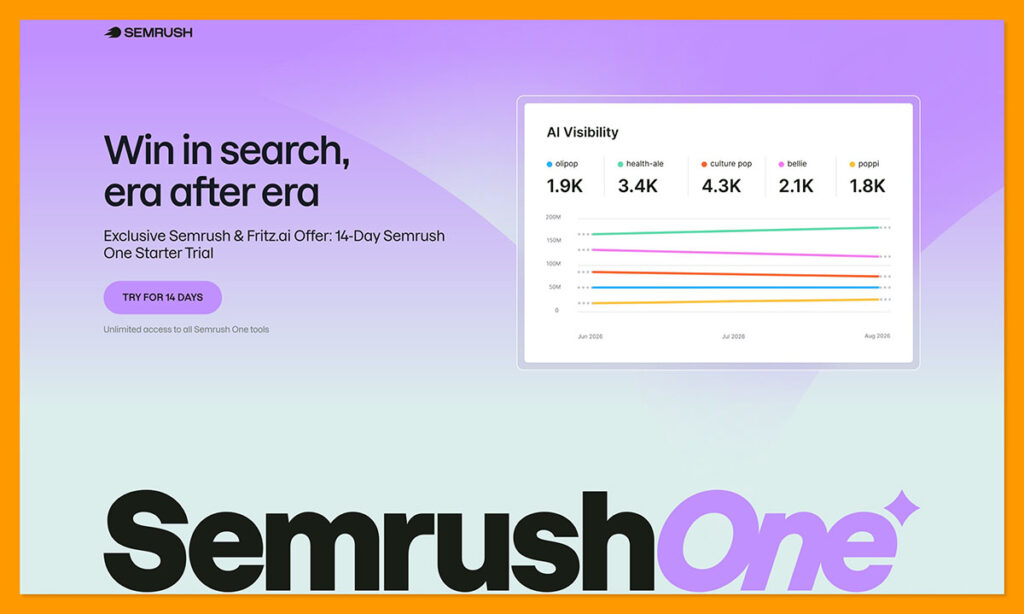
Semrush is the broader platform. Founded in 2008, projected 2025 revenue of $443 to $445 million (roughly 3.7x BrightEdge), 100,000+ business users, and 35% of the Fortune 500. Adobe announced its $1.9 billion acquisition on November 18, 2025, with close expected in the first half of 2026. The AI Visibility Toolkit, Semrush One bundled platform, and Enterprise AIO (with a 213M+ prompt database) now form Semrush’s AI stack.
Here’s the quick comparison before the deep dive.
| Dimension | BrightEdge | Semrush Enterprise |
|---|---|---|
| Founded | 2007 | 2008 |
| AI-first launch | 2015 (DataMind), 2019 (Autopilot) | 2024 (AI Visibility Toolkit) |
| Est. 2025 revenue | ~$120M | ~$443 to $445M |
| Enterprise AI customers | 2,000+ (Aug 2023) | Growing; TikTok, SAP, Salesforce, NBCU named |
| Fortune footprint | 57% of Fortune 100 | 35% of Fortune 500 |
| Keyword database | 5B across 170 countries | 25.3B+ |
| AI platforms tracked | 7 (ChatGPT, Perplexity, Gemini, Bing Copilot, Claude, DeepSeek, Google AIO) | 3 to 4 in base (ChatGPT, Google AI Mode, AIO); 213M+ prompts in Enterprise AIO |
| Starting price | $30K+/yr (Vendr avg $51K) | $99/mo AI Toolkit; Business $499.95/mo; Enterprise custom |
| Free entry | None (demo required) | Free AI Visibility Checker + 7-day Semrush One trial |
| Adobe integration | Live (5-yr partner, 250+ brands) | Coming post-acquisition (12 to 24 months) |
| G2 rating | 4.4/5 (200+ reviews) | 4.5/5 (1,800+ reviews) |
That’s the shape of it. Now the criteria that decide which one you actually buy.
1. AI Search Visibility and Citation Tracking: AI Catalyst vs AI Visibility Toolkit
AI Overviews cite URLs that aren’t even in the organic top 10 roughly 66% of the time, per BrightEdge’s own Generative Parser data. That single stat rewires the job of an enterprise SEO platform. Here’s how each does it.
BrightEdge AI Catalyst launched in March 2026 and tracks seven AI platforms in a single dashboard: ChatGPT, Perplexity, Google AI Overviews, Gemini, Bing Copilot, Claude, and DeepSeek. Prompt research runs through Copilot, AI Journey Analysis maps how users move from AI search to brand discovery, and an Audience Intelligence module handles persona and intent mapping beyond the keyword level. AI Catalyst is included in every BrightEdge subscription at no add-on cost. March 2026 referral data from the same platform shows ChatGPT referrals up 19%, Perplexity up 12%, Gemini up 19%, and Claude up a striking 166% compared to prior months.
Semrush AI Visibility Toolkit launched in late 2024. Base tier covers ChatGPT, Google AI Mode, and AI Overviews, with Gemini noted as “coming soon” and Claude and Perplexity absent from the base product. Pricing starts at $99 per month standalone or $165 per month bundled in Semrush One. You get an AI Visibility Score, Prompt Tracking across 220+ countries, Brand Performance reports covering Share of Voice and sentiment, and Prompt Research framed as “keyword research for AI.” The underlying prompt database holds 100 million+ prompts, with the Enterprise AIO tier scaling to 213 million+ for broader coverage.
Where Semrush clearly wins is accessibility. The free AI Brand Visibility Checker requires no signup, covers five AI platforms, and produces an AI Visibility Score competitor teams can benchmark against in an afternoon. BrightEdge has no free entry point at all. No trial, no freemium, custom quote required.
The case study evidence is real on both sides. Jordan Brannon of Coalition Technologies reports a 429% increase in AI referral traffic and a 547% boost in LLM conversions using the Semrush toolkit. Sure Oak’s Andrea Schultz hit a 286% increase in Google AI Overview appearances, with 40% of new leads now originating through AI visibility. On the BrightEdge side, Carla Suarez at Stewart Insurance says Copilot “provides well-written and helpful suggestions which allow me to optimize my pages in a faster and more efficient way.”
The Verdict: AI Search Visibility
BrightEdge AI Catalyst wins on raw platform coverage and unified dashboard value. Semrush wins on accessibility, price transparency, and the free entry point that lets you prove AI visibility ROI before signing any contract.
2. AI-Powered Content and Automation: BrightEdge Copilot plus Autopilot vs Semrush AI Writing Assistant
Campbell’s Soup Company used BrightEdge Autopilot to auto-optimize 75,000 images and move 4,000 keywords to page one within weeks. No developer time after the initial CMS integration. Semrush has no equivalent, which is the single biggest AI differentiator between these two platforms.
BrightEdge Copilot launched in 2023. It’s an AI assistant embedded in the BrightEdge platform, built on the DataMind deep-learning engine and combining ChatGPT, other LLMs, and proprietary data science. Copilot collaborates with marketers on SEO optimization, page titles, descriptions, and content recommendations. BrightEdge reports 98% of customers saw significant productivity improvements, and 85% of new customers adopted generative AI features within the first 90 days.
BrightEdge Autopilot is the category-defining differentiator. Launched at Share19 in 2019, it’s a zero-touch content optimization engine. One-time CMS integration activates ongoing automated updates trained on petabytes of data via Data Cube, DataMind, and Instant. The average performance uplift across customers is 65%. It operates independent of development cycles. You retain override control. Named case studies include Campbell’s Soup (the 75,000 images and 4,000 keywords moved to page one) and an unnamed beauty retailer that achieved 308% non-brand traffic growth and a 2.95% conversion rate lift through internal linking automation alone.
Semrush’s AI content side is different. SEO Writing Assistant scores readability and keyword density in real time. ContentShake drafts blog posts from keywords and integrates with Google Docs and WordPress. Semrush Site Audit detects blocked AI crawlers including ChatGPT-User, OAI-SearchBot, Perplexity-User, Claude-User, Claude-SearchBot, and Google-Extended, which is a technical AI-readiness capability BrightEdge doesn’t directly parallel. Semrush shipped 10+ AI features in 2025 so the content side is moving fast, but nothing in the catalog matches Autopilot’s zero-touch automation model.
The Verdict: Content and Automation
Compared to Semrush’s Writing Assistant, BrightEdge’s Copilot is broadly comparable on content generation. Autopilot has no Semrush peer. If your enterprise SEO team is stretched thin and a 65% average performance uplift without developer time is attractive, that alone can justify BrightEdge’s price premium.
3. AI Shipping Cadence and the 10-Year AI-Native Question
BrightEdge added AI to its platform in 2015. Semrush got AI Visibility Toolkit in 2024. That sounds like a nine-year head start. But 2025 alone saw Semrush ship 10+ AI features while BrightEdge shipped one major release (AI Catalyst in March 2026). Which metric actually matters more?
BrightEdge’s 10-year AI depth isn’t marketing copy. The DataMind deep-learning engine has been operational since 2015. The AI-First strategy was formalized in 2018. Autopilot launched in 2019. Generative Parser launched December 2023. AI Catalyst shipped March 2026. The 2,000+ AI customers milestone was announced in August 2023, with 85% of new customers adopting AI features within 90 days. This isn’t bolt-on AI. It’s a platform with AI infrastructure predating the LLM boom.
Semrush’s 2025 shipping velocity is equally real. In one year the platform shipped the AI Visibility Index (free tool), Prompt Tracking, Brand Performance reporting, AI Search Site Audit with crawler detection, AI Traffic Dashboard, Domain Overview AI integration, Visibility Overview, Competitor Research in AI, and the Semrush One bundled platform, among others. WebFX’s Trevin Shirey put it bluntly:
“What felt like a year’s worth of SEO evolution in 2018 now happens in about two weeks.”Trevin Shirey, WebFX
Semrush is playing catch-up with speed. BrightEdge is compounding depth.
Neither framing is complete on its own. Ridge Anderson of Rock Salt Marketing argues even after the Adobe acquisition that “Semrush is already behind the curve on AI search capabilities,” and it’s unclear whether Adobe brings data advantages that close the gap. For buyers, the real question is roadmap risk. Semrush will likely close feature gaps fast but creates version-churn risk as the product evolves monthly. BrightEdge’s gaps (no free trial, no Autopilot equivalent) stay closed because the lead keeps compounding.
The Verdict: Shipping Cadence
If your procurement model can absorb quarterly product updates and you need the latest AI feature the day it ships, Semrush wins on velocity. If you want battle-tested AI infrastructure with 2,000+ enterprise customers already deployed, BrightEdge’s ten-year lead is the harder fact to ignore.
4. The Adobe Acquisition: What It Means for Semrush vs BrightEdge Buyers
Adobe paid $1.9 billion for Semrush on November 18, 2025. BrightEdge has been an Adobe Accredited Application Partner for five years, with 250+ brands already running the integration. Both facts matter for your decision.
The deal specifics: $12 per share, all cash, a 77% premium over the prior closing price. Semrush shareholders approved the deal February 3, 2026, with 75%+ voting power committed. Germany cleared antitrust review March 20, 2026. The UK CMA review was still pending as of April 2026. Expected close is the first half of 2026. Semrush’s 2025 projected revenue is $443 to $445 million with 18% year-over-year growth and enterprise ARR up 33%.
Adobe’s stated integration roadmap covers four products: Adobe Experience Manager (real-time SEO and GEO recommendations embedded in the CMS), Adobe Analytics (unified discovery reporting), Real-Time CDP (customer enrichment with search behavior data), and Brand Concierge (automated AI visibility monitoring). The rationale Adobe cites publicly is that traffic from generative AI to US retail sites grew 1,200% year over year in October 2025. WebFX’s Trevin Shirey summarized the strategic logic:
“Whoever controls the data on how brands get discovered in AI environments will control a huge piece of marketing spend.”Trevin Shirey, WebFX
Here’s the BrightEdge angle nobody else covers. BrightEdge is already the incumbent Adobe integration partner. Content Optimizer is embedded directly in Adobe Experience Manager. 250+ brands have integrated Adobe Analytics data with BrightEdge. This is a live, five-year-old partnership shipping in production. For enterprises on the Adobe stack today, BrightEdge is the operational choice. Semrush becomes the 12-to-24-month roadmap bet.
Multiple experts have flagged the risks on the Semrush side. Jessica Stanley of Baunfire: “The next 24 months will determine whether Adobe keeps Semrush open or closes the walls.” Michael Melen of SmartSites is more reassuring near-term: “Nothing will change for Semrush customers immediately; no significant changes until at least mid-2026.” The pattern to watch is the Magento precedent, where similar enterprise acquisitions didn’t trigger waves of immediate competitive moves.
The Verdict:
BrightEdge if you’re already on Adobe stack and want production-grade integration today. Semrush Enterprise AIO if you believe the post-close Adobe integration across AEM, Analytics, and Real-Time CDP will be worth the 12-to-24-month wait and some pricing architecture risk.
5. Enterprise Pricing Reality: Transparent Tiers vs Custom Quotes
Vendr data from 31 BrightEdge purchases puts the average contract at $51,294 a year. Semrush’s average across 37 purchases sits at $9,667. But enterprise Semrush contracts can reach $49,844. The 100x price gap story other comparisons push is wrong.
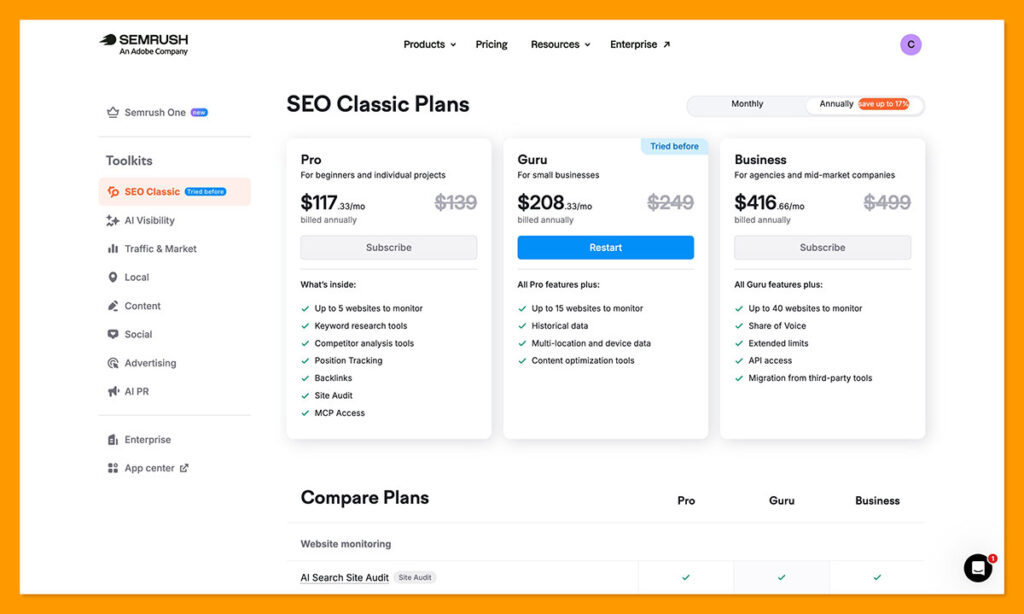
Semrush’s real pricing (not just the $499 Business tier most competitor reviews stop at) runs like this. Published self-serve tiers: Pro $139.95/month, Guru $249.95/month, Business $499.95/month. Semrush One, the unified SEO + AI Visibility bundle, runs Starter at $165.17/month, Pro+ at $291.67/month, Advanced at $583.33/month, with Enterprise custom-quoted above.
AI Visibility Toolkit standalone is $99/month with $99 per additional domain, $99 per user seat, and $60 per 50 extra prompts. Enterprise AIO has no published price at all. Annual prepayment saves 16 to 20%. Multi-year commitments unlock further discounts. For more on the published Semrush tiers, the full Semrush review breaks down each SKU.
BrightEdge pricing is quote-based end to end. Vendr benchmark across 31 contracts: average $51,294/yr, median $43,200 to $69,233. SpendHound pegs the enterprise average at $127,080/yr. The industry range is $30K to $150K+ per year. Primary cost drivers are domains tracked, keyword volume, user seats, and modules (DataMind, ContentIQ, Instant, Data Cube). Annual escalators are typically 3 to 7%. A 24-to-36-month commitment unlocks a 15 to 30% discount versus a 12-month contract. The 12-month minimum is non-negotiable.
There’s a hidden cost on the Semrush side that closes more of the gap than most reviews admit: add-on fatigue. For an agency managing 10 client domains, the AI Visibility Toolkit alone runs $990+/month on top of base Semrush plans. That’s before adding seats or extra prompts. For a single-brand enterprise, Semrush is still clearly cheaper. For multi-brand holding companies and agencies, the pricing math tightens fast once you start adding AI visibility tracking per client.
The Verdict:
At enterprise scale: Semrush Enterprise AIO runs roughly $30K to $50K per year. BrightEdge runs roughly $50K to $130K per year. The gap is real, but the framing that Semrush is free and BrightEdge is expensive is misleading. What you trade for the premium is transparency and contract flexibility versus custom quotes and multi-year lock-in.
6. Enterprise Customer Track Record: Who Actually Runs Each Platform
BrightEdge powers SEO for 57% of the Fortune 100. Semrush runs at Amazon, JPMorgan, TikTok, and Salesforce. The logo question isn’t whether either has enterprise customers. It’s which has customers that match your profile.
BrightEdge’s enterprise footprint is concentrated at the top of the market. 57% of the Fortune 100. 9 of the top 10 international digital agencies. Named customers include Campbell’s Soup Company and Stewart Insurance. The focus verticals are finance, retail, automotive, and ecommerce.
The 2,000+ AI customers milestone (announced August 30, 2023) made BrightEdge the first enterprise SEO platform at that scale, with 3X year-over-year AI product adoption growth at the time. 350+ employees, headquartered in the San Francisco Bay Area with a New York office at 575 Lexington Avenue and additional presence in Europe and APAC.
Semrush’s enterprise footprint is broader and more modern. 35% of the Fortune 500 (per the Adobe deal announcement). The November 2025 press release named Amazon, JPMorganChase, and TikTok as active enterprise customers.
Semrush Enterprise AIO’s public case study list is extensive: Roche, Hertz, Bitget, a major online travel agency, TikTok, Temu, SAP, Samsung, Salesforce, NBCUniversal, and Hallmark. The user base crosses 100,000 businesses and 10 million marketers. If you’re already looking at the broader competitive set, a comparison of Ahrefs vs Semrush covers where Semrush sits against the other major SEO platform.
The procurement signal from these lists is clear. Both platforms clear the “has enterprise logos” bar. The differentiator is vertical fit. BrightEdge is stronger in traditional enterprise finance, automotive, and retail. Semrush Enterprise AIO is adopted by the emerging giants (TikTok, Temu) and diversified Fortune 500 tech names your AI-forward team probably recognizes (SAP, Samsung, Salesforce).
The Verdict:
For traditional enterprise logos and Fortune 100 density, BrightEdge. For modern enterprise, TikTok-and-Temu-class customers, and tech brands your product team recognizes, Semrush Enterprise AIO. Both clear the board-review bar.
7. Legacy SEO Foundations: Keyword Data, Site Audit, and Onboarding
All the AI talk aside, 85% of search still happens on Google. Enterprise SEO teams still need to track 50,000 keywords, run site audits on million-page sites, and prove ROI to CMOs who want rank charts. Here’s how the platforms compare on the legacy work.
Keyword research and rank tracking
Semrush Keyword Magic Tool holds 25.3 billion+ keywords with daily rank updates and intent clustering. BrightEdge DataCube covers 5 billion keywords across 170 countries with weekly updates and AI forecasting. Semrush wins on raw database volume and refresh frequency. BrightEdge wins on revenue attribution modeling, with one ecommerce retailer reporting a 38% keyword list reduction alongside organic revenue gains after switching.
Site audit and technical SEO
Semrush Site Audit crawls up to 20,000 pages on mid-tier plans, with 130+ technical checks, and detects eight types of AI crawlers for AI-readiness. BrightEdge ContentIQ crawls millions of pages with fix-to-revenue attribution. In one documented case, a media publisher had 500,000 URL indexation issues; ContentIQ identified the 120 URLs causing 70% of lost impressions.
Onboarding and support
Semrush takes roughly 30 minutes to connect Google Analytics and start tracking, with chat support, Semrush Academy, and 2 to 4 hour response times on Business plans. G2 support score: 8.6/10. BrightEdge requires 4 to 6 weeks for API integrations. Enterprise contracts include dedicated Customer Success Managers with Slack channels and quarterly business reviews. Mid-market BrightEdge drops to email-only with 24 to 48 hour lag. G2 support score: 9.3/10.
The Verdict:
Best for fast evaluation and broad keyword research: Semrush, clear winner. Best for audit-at-scale on enterprise-size sites and white-glove CSM support when you’re paying the enterprise rate: BrightEdge. On the legacy SEO core jobs, the gap is smaller than the AI gap.
The Bottom Line: Who Should Pick BrightEdge and Who Should Pick Semrush Enterprise
Pick BrightEdge if you’re an Adobe Experience Manager enterprise that values zero-touch automation and a 10-year AI track record.
Pick Semrush Enterprise if you want shipping velocity, transparent pricing, a free AI visibility entry point, and a bet on Adobe’s post-acquisition roadmap.
Buy BrightEdge if:
- You’re already deployed on Adobe Experience Manager (live integration, 250+ brands)
- Your enterprise SEO team is small and Autopilot’s 65% average uplift replaces headcount
- You track rankings across 100K+ keywords with global scope
- You need AI citation tracking across 7 platforms (ChatGPT, Perplexity, Gemini, Claude, DeepSeek, Bing Copilot, Google AI Overviews) in one dashboard
- Your procurement can absorb a 12-to-36-month contract and a custom quote
- Board-level reporting with revenue attribution matters more than shipping speed
Buy Semrush Enterprise AIO if:
- You want to start with the free AI Visibility Checker and graduate into paid in weeks, not months
- You value the 10+ AI features shipped in 2025 and expect that velocity to continue
- Your team is already familiar with Semrush Business or Pro and you’re scaling up
- You’re betting on the Adobe-Semrush integration (H1 2026 close, 12 to 24 months to full AEM + Analytics + CDP rollout)
- You’re a holding company or agency running many domains where add-on pricing still beats BrightEdge’s multi-module contract
- Transparent published pricing matters to your procurement and finance teams
Some enterprises run both. Semrush Enterprise AIO for fast AI experimentation and BrightEdge for production Autopilot automation. Expensive, but valid during the 12-to-24-month Adobe integration window if you can justify the combined spend.
The honest AI-era read is this. BrightEdge wins on current AI infrastructure depth. Semrush wins on future-state Adobe integration optionality and shipping velocity. Pick based on when you need AI visibility to work, today or in 24 months, and your Adobe stack reality.
Semrush vs BrightEdge FAQ
Is Semrush Enterprise the same as the $499.95/month Business plan?
No. The Business plan is a self-serve tier with fixed limits: 5 users, 40 projects, 5,000 tracked keywords, and API access. Semrush Enterprise and Enterprise AIO are separate, quote-based products with custom tracking limits, dedicated account management, GA4 and Adobe Analytics integration, and a 213M+ prompt database for AI visibility. Semrush One (the SEO + AI Visibility bundle) runs $165 to $583 per month for published tiers with custom Enterprise above. The Vendr benchmark average across all Semrush contracts is $9,667 per year; enterprise contracts can reach $49,844 or more depending on scope.
Does BrightEdge actually track AI citations in ChatGPT and Perplexity or just Google AI Overviews?
BrightEdge AI Catalyst, launched March 2026, tracks seven AI platforms simultaneously: ChatGPT, Perplexity, Google AI Overviews, Gemini, Bing Copilot, Claude, and DeepSeek. The earlier Generative Parser (December 2023) focused first on Google SGE and AI Overview patterns and detected 22 critical new content formats. AI Catalyst expanded coverage to full cross-platform monitoring in one dashboard, included in every BrightEdge subscription at no add-on cost. March 2026 referral data showed Claude referrals up 166% and ChatGPT up 19% in a single month.
Should we wait out the Adobe-Semrush acquisition before buying Semrush Enterprise?
Not for short contracts. The deal is expected to close in H1 2026, and near-term Semrush subscriptions won’t change. Germany cleared antitrust review in March 2026; UK CMA review is still pending. For multi-year contracts, negotiate exit clauses and renewal dates that land before the 12-to-24-month post-close integration window. Experts including Michael Melen of SmartSites and Jessica Stanley of Baunfire flag the 24-month horizon as the critical period for pricing architecture shifts and potential Adobe ecosystem lock-in.
Can we migrate historical data when switching between Semrush and BrightEdge?
Not easily. Neither platform offers a formal migration tool from the other. Semrush supports keyword and report CSV export; BrightEdge keeps ranking history inside its platform. Rebuilding dashboards, re-exporting keyword lists, and retraining teams takes 3 to 6 months in either direction. BrightEdge Autopilot baselines reset on migration, which means any zero-touch automation gains restart from zero. Semrush Prompt Tracking history doesn’t transfer either, so AI visibility benchmarks need to be re-established from scratch in the new platform.
Does BrightEdge offer a free trial or any free AI tool?
No. BrightEdge has no free trial, no freemium tier, and no self-serve access to any AI features. Evaluation requires a sales-led demo and a custom quote, with a 12-month minimum contract once you sign. Semrush offers the free AI Brand Visibility Checker (no signup required, covers five platforms including ChatGPT, Gemini, AI Overviews, SearchGPT, and Perplexity) plus a 7-day Semrush One trial that often grants Business-tier access. That’s the clearest entry-point advantage Semrush has over BrightEdge for any team that wants to validate AI visibility before signing a contract.
Is BrightEdge’s price premium worth it over Semrush Enterprise?
Yes if you run multiple global teams, need Autopilot’s zero-touch automation (65% average performance uplift), already have Adobe Experience Manager deployed, and report SEO revenue attribution to the C-suite. The Vendr-benchmarked $51K to $127K annual contract becomes defensible when Autopilot replaces SEO headcount. No if you need fast feature shipping, already know Semrush’s interface, haven’t yet deployed Adobe integration, prefer monthly pricing flexibility, or want to run a low-risk AI visibility pilot before committing to a 12-to-36-month contract.

Comments 0 Responses