

AI-driven data analysis is a big deal these days, and for good reason. Companies are tired of collecting terabytes of data without being able to turn it into useful insights, at least not without burning through time, talent, and money.
Pecan AI and Amazon AWS SageMaker both help organizations get more value from their data, but they go about it in very different ways. Pecan is built for organizations that want answers from their data without having to build and manage an entire machine learning workflow. Pecan’s Predictive AI Agent helps build and evaluate predictive models for use cases like churn prediction, campaign performance, lead conversion and more.
SageMaker is a managed machine learning platform where technical teams can build, train, and deploy custom models. At a high level, that’s the key difference: Pecan focuses on helping organizations solve predictive business use cases, while SageMaker is designed for data scientists and ML engineers building custom ML systems.
Quick Verdict: Which Platform Is Best for What?
I’d choose Pecan AI for teams across marketing, customer success, and sales with business questions they need answered quickly. This is the low-code, focused platform that lets you build predictive models that deliver insights straight into the tools you already use, without extensive technical expertise.
Pick SageMaker if your main goal is to build and control AI systems from end-to-end. It takes a lot of technical skill, but it gives you full control over your machine learning infrastructure. It’s also handy if you’re already using parts of the AWS stack.
What Are Pecan AI and Amazon SageMaker?
| Category | Pecan AI | AWS SageMaker |
|---|---|---|
| Best for | Business teams that need AI-powered answers from their 1st party data | Technical teams building and running AI/ML systems |
| Primary users | Data analysts, BI teams, ecommerce, marketing, RevOps, sales, CS | Data scientists, ML engineers, developers, AWS teams |
| Ease of use | Guided, lower-code, business-friendly | Technical, though Canvas and Autopilot reduce some of the lift |
| Data prep | The agent helps prepare data, generate SQL, build training sets | Data Wrangler, Feature Store, notebooks, pipelines, processing jobs |
| Model work | Guided models for churn, LTV, ROAS, demand, lead scoring, fraud | Custom training, Autopilot, JumpStart, HyperPod, model tuning |
| Deployment | Predictions sent into CRMs, warehouses, dashboards, and business workflows | Real-time endpoints, batch transform, async inference, serverless inference |
| Governance | Business-grade security, access controls, model safeguards | IAM, VPC, KMS, Model Monitor, Clarify, Model Registry, Model Cards |
| Pricing | SaaS plans from $760/month billed annually | Pay-as-you-go across compute, storage, training, inference, and related AWS services |
Calling both of these tools “AI platforms” is technically correct, but it doesn’t really explain how different they are.
Pecan AI is a low-to-no-code predictive analytics platform. You approach the Predictive AI agent with a question, it clarifies that question for you, prepares the data you need to answer it, builds the model, checks performance, and delivers answers where you want them, like in your CRM, or a data warehouse.
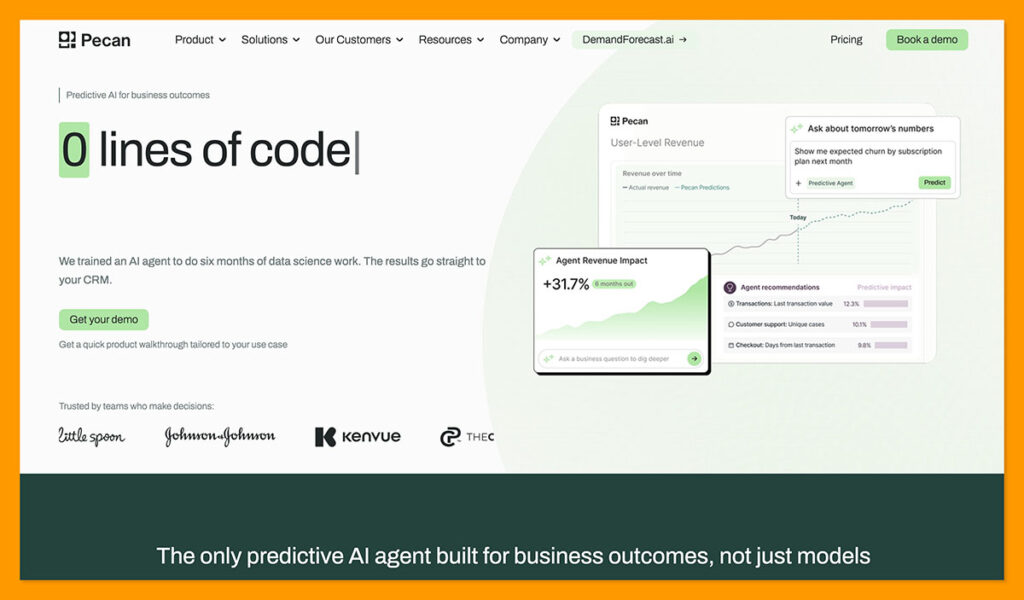
It’s cloud-agnostic, unlike SageMaker, which is strongly tied to the AWS ecosystem, and Pecan isn’t reliant on you having an experienced data science team with ML and Python expertise.
Amazon SageMaker is a machine learning workbench where you build and run models from scratch, with custom technical controls. You can, theoretically, build models for any use case, which is a strength and a weakness. It’s a strength for the versatility factor. A weakness because SageMaker assumes you already have a clearly defined problem, know what data you want to use, and have taken the time to clean up that data in advance.
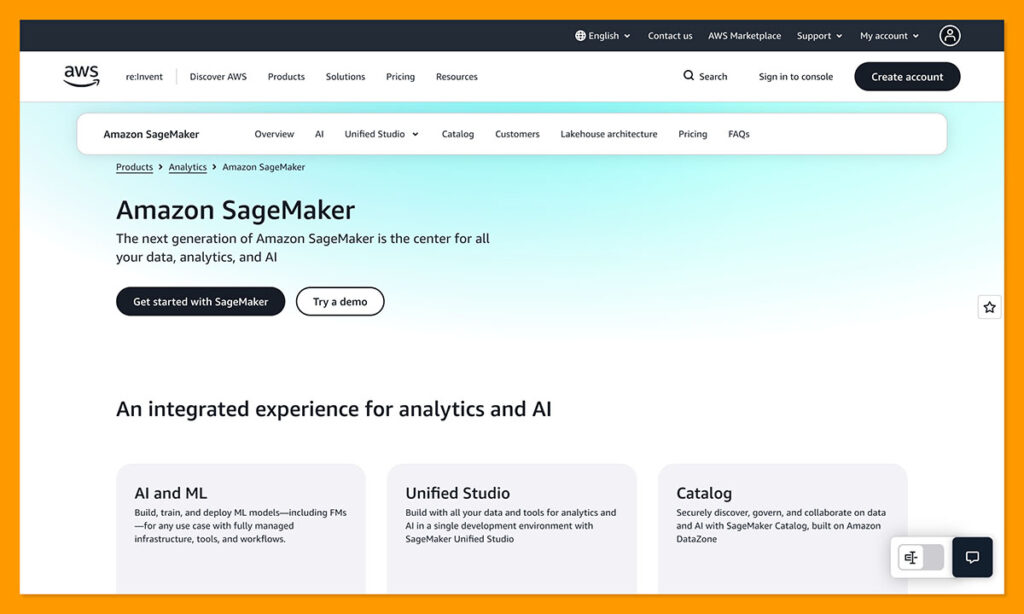
If you already work in AWS, SageMaker is probably going to be much easier to use. If you’re looking for something more flexible, Pecan is the better choice.
Main Use Cases: Where Each Platform Makes Sense
One of the things I like about Pecan AI is that the use cases are clear. Pecan’s AI agent can help you build models that answer questions that assist with:
- Protecting revenue, predicting churn, or flagging risky transactions
- Growing revenue with win-back strategies, lead scoring, upselling and cross-selling
- Reducing inefficiencies with campaign ROAS and demand forecasting insights
- Refining workflows with employee attrition, retention, and workforce predictions
You don’t need a “fully defined” business question, Pecan’s AI Agent will help you define the goal, pick the data to support your model, transform it into a real training set, and evaluate your model’s performance. It can even help reduce the risk of common pitfalls like data leakage and overfitting with built-in safeguards.
Once you have your model, predictions are sent directly to your day to day business systems (Salesforce, HubSpot) where people can actually act on them.
For insights into how valuable those actions can be, check Pecan’s Whistle Express case study, which shows the company reducing churn by 30% in competitive markets. Or look at the DME Acquire case study, where Pecan’s model improved campaign response prediction by 40%.
That’s the whole value: fast results, without undue stress on your team.
SageMaker is a tool you use when you want to completely build and govern your own machine learning and AI systems. It’s the full toolkit, with custom model development, foundation model projects (through JumpStart), batch prediction, serverless inference, real-time inference, endpoint scaling and production MLOps.
The use cases are broader, ranging all the way from code generation, to question answering and information retrieval. It’s a huge tool, and it keeps growing (with more than 380 capabilities added since launch so far).
Ease of Use, Data Prep, and Model Building
SageMaker is designed primarily for technical users.
It has plenty of help built-in for users. Autopilot, for instance, can handle data analysis, add missing values, and deal with feature selection, model choice, normalization, hyperparameter tuning, deployment and reporting. Canvas gives you a no-code route for data prep, feature engineering, demand forecasting, and generative AI tasks, too.
But this isn’t a low-effort system. SageMaker assumes organizations have the expertise needed to design, deploy, and maintain machine learning workflows. It also needs you to have a decent understanding of how the whole AWS ecosystem works, otherwise, you’re going to spend months getting up to speed.
Pecan AI takes a more guided approach. You don’t need the whole data science team, just a basic question. Send it to the AI Agent, and let it build the training set, generate SQL, create predictive features, check the model, then explain performance in business terms.
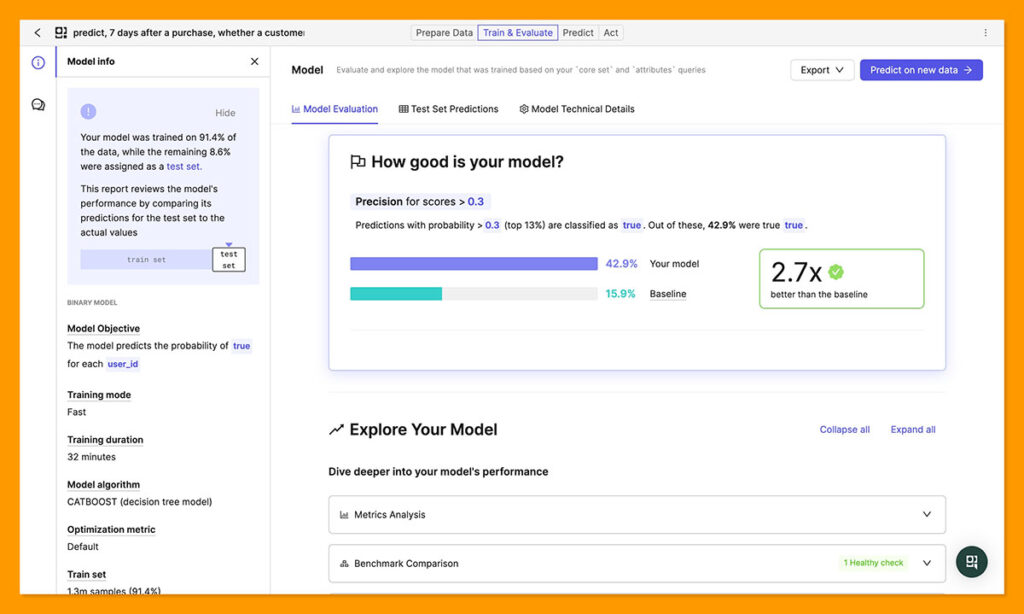
You end up with a model you can use much faster than you would using the traditional ML route. Pecan is designed to work with the messy, real-world data you already have, no clean-up project required. That makes it more accessible to marketers, sales leaders, and business executives that feel locked out of platforms like SageMaker.
Deployment, Integrations, and Workflow Delivery
Pecan AI is built to get the predictions you need into a place where people can use it. It integrates with CRMs like Salesforce, or HubSpot. It can also connect with data warehouses (Snowflake or Databricks for instance), databases (like Google BigQuery), and other platforms like Shopify through an API connection.
Those connections are part of why Pecan is so useful for commercial teams. You get the data where you need it, when you’re most likely to use it, rather than having to stop work and search for the details you need on another platform.
SageMaker has an arguably deeper deployment menu. You can connect to real-time endpoints for low-latency requests, or serverless endpoints for workloads with traffic gaps. There are asynchronous endpoint connections for larger, longer-running requests, and batch transform options.
You can also deploy through JumpStart, the SageMaker Python SDK, Boto3, CloudFormation, and CI/CD tooling. There are plenty of options here if you want your team to own the architecture. You just need the team to support it.
Pricing and Total Cost
These two companies approach pricing very differently. Pecan AI gives you tiered plans, starting at $760 per month for the Starter plan (2 monthly prediction batches and 500 million storage rows). Then there’s Team at $1,400 per month, billed annually (10 batches and 2 billion storage rows), and Business at $2,000 per month, billed annually (60 batches and 5 billion storage rows). For predictive AI at scale, Pecan also offers custom enterprise deployments with options like special deployment, granular explainability, and advanced monitoring.
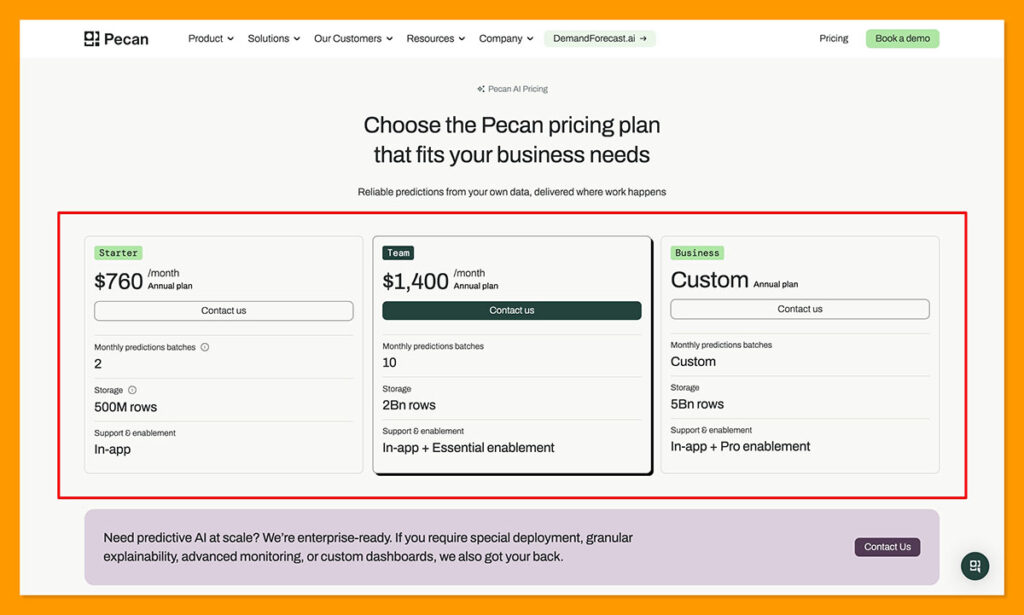
When evaluating cost, it’s important to look beyond the subscription price. If your predictions are helping reduce churn, optimize marketing spend, or improve demand forecasting, the return can quickly outweigh the subscription cost. Plus, you don’t have to pay the extra costs associated with hiring and training data scientists, or testing and maintaining models.
SageMaker uses pay-as-you-go pricing, which sounds attractive, because there are no minimum upfront commitments for your usage. The catch is that you can have a lot of “billable parts” inside of a single ML project: notebooks, Data Wrangler, Feature Store, training jobs, MLflow, inference endpoints, batch transform, serverless inference, async inference, JumpStart, HyperPod, storage, processing, and CloudWatch logs.
Costs can add up quickly once you factor in infrastructure, monitoring, storage, and engineering time.
Governance, Security, and Reliability
For business teams, Pecan AI covers the essentials. Customer data is isolated (never shared between models), and you don’t need to share PII to build anything. You can control what your models can access, and Pecan adheres to both GDPR and CCPA standards. It’s also ISO 27001 and SOC 2 Type II compliant.
SageMaker does go a little deeper. The Model Monitor tracks models in production and lets you know when quality issues ramp up. There’s Clarify to detect bias and explain predictions. You also get Model Cards to document details for reporting, and Model Registry for versioning, lineage, metadata, approval status, and deployment workflows.
Pecan AI gives you enough control to use predictive AI responsibly, without drowning in governance. SageMaker gives you the end-to-end control you might need on a particularly sensitive project.
Final Verdict: Pecan AI or AWS SageMaker?
I’d choose AWS SageMaker for highly technical teams that want complete control over their AI models within AWS. It’s a powerful platform, deeper than many others on the market, with extensive governance and security capabilities. You can build what you want, manage everything according to your requirements, and integrate it with your existing AWS environment.
Pecan AI is what you pick if you don’t need that level of ML complexity. It’s not for the data science team that wants to tune every model choice and rewrite pipelines from scratch. It’s for companies that want to improve the decisions they make about customers, campaigns, inventory, risk, revenue, sales, and workflow management.
If you have sufficient historical data, and a clear business question, Pecan helps you get to predictive insights faster, without the complexity of building and managing traditional machine learning workflows. That’s where it delivers the most value.
If you’re ready to ask real business questions, and get actionable answers, book a demo with Pecan AI.

Comments 0 Responses