

Semrush is a mature, all-in-one SEO and digital marketing suite, while Gumshoe AI is a specialist AEO platform that shows you how AI engines like ChatGPT, Gemini, and Perplexity talk about your brand.
I tested both to help you figure out which one makes sense for your marketing stack, and whether you actually need both.
As a result of my research and hands-on testing, here is my take: these two tools solve fundamentally different problems. Semrush is the clear choice if you want to win in traditional search. Gumshoe is the tool to pick if you want to know whether AI-generated answers even mention you at all.
Semrush vs Gumshoe AI: Quick Verdict
Our Picks
- Semrush – Best for traditional SEO, PPC, content marketing, and all-in-one digital marketing campaigns
- Gumshoe AI – Best for AI search visibility monitoring and understanding how LLMs describe your brand
In this comparison, I will take a closer look at what separates Semrush from Gumshoe AI, covering data sources, features, pricing, ease of use, and the kinds of teams each platform serves best.
Quick Comparison: Semrush vs Gumshoe AI
Get a quick overview of both platforms in the table below:
| Dimension | Semrush | Gumshoe AI |
|---|---|---|
| Primary goal | End-to-end SEO and digital marketing | AI search / AEO visibility monitoring |
| Data sources | Traditional SERPs, backlinks, traffic estimates, keyword databases | Live conversations with multiple AI models (ChatGPT, Gemini, Claude, Perplexity, Grok, DeepSeek, AI Overviews, and more) |
| Keyword research | Deep keyword database with 26+ billion keywords, intent data, SERP features, PPC data | No classic keyword tool; focuses on prompts, personas, and AI queries |
| Technical SEO | Full site audit for crawlability, Core Web Vitals, on-page issues | Page audit beta focused on AI-friendliness and AIO score |
| Competitive intel | Domain vs domain, keyword gaps, backlink gaps, traffic shares | Share of LLM, competitor mention tracking inside AI answers, cited source analysis |
| Starting price | $139.95/month (Pro plan) | Free for first 3 report runs; then $0.10 per conversation |
| Free trial | 14-day free trial (credit card required) | 3 free report runs (no credit card required) |
| Best for | SEO professionals, agencies, in-house marketing teams | Brands and agencies focused on AI search visibility |
Best for Data and Coverage: It Depends on Where You Want to Be Visible
This is not a case where one platform beats the other. Semrush and Gumshoe AI track entirely different things, so the “winner” depends on what kind of visibility matters to you.
Semrush draws from traditional search engine result pages. It maintains a keyword database of over 26 billion keywords, tracks backlink profiles, estimates organic traffic, and monitors SERP features across Google and Bing.
If you want to know where you rank for a specific search term and why, Semrush gives you that data with years of historical depth behind it.
Gumshoe AI does not touch traditional SERPs at all. Instead, it runs live conversations with 11 AI models, including ChatGPT (multiple versions), Gemini, Claude, Perplexity, Grok, DeepSeek, and Google AI Overviews.
It tracks how often your brand gets mentioned, what sources get cited, and whether you appear in the answer set when real buyer personas ask AI engines for recommendations. The main gap worth noting is that Microsoft Copilot was still missing from Gumshoe’s engine coverage at the time of my testing.
Here is a practical way to think about it: Semrush tells you “you rank #4 for ‘best project management tool’ on Google.” Gumshoe tells you “when a CTO asks ChatGPT to recommend project management tools, your brand appears in 23% of responses, but your competitor shows up in 71%.”
The Verdict
Semrush wins for traditional SERP data and historical depth. Gumshoe wins for AI-generated answer coverage.
Most teams will eventually need both types of visibility data, but where you start depends on whether traditional search or AI recommendations drive more of your pipeline today.
Best for Keyword and Topic Research: Semrush
If classic keyword research is a core part of your workflow, Semrush is the only real option here. Gumshoe AI does not have a keyword research tool and was never designed to be one.
Semrush offers deep keyword analytics, including search volume, keyword difficulty, cost-per-click data, SERP feature analysis, and intent classification.
You can find keyword gaps between your domain and competitors, build topic clusters, and get content templates based on top-ranking pages. The Keyword Magic Tool alone lets you start with a seed term and explore thousands of related queries with filtering by intent, questions, and phrase match.
For agencies running SEO campaigns, this kind of granular keyword data is essential. Semrush also ties keyword research directly into its content marketing toolkit (available on the Guru plan and above), which means you can go from keyword discovery to content brief to optimization scoring without leaving the platform.
Gumshoe takes a different approach entirely. Instead of keywords, it works with prompts and personas. You define buyer personas (or let the platform generate them using AI), and it tests how AI models respond to natural-language questions those personas would ask.
There is no search volume data, no CPC, and no keyword difficulty score. The value is in understanding which prompts trigger mentions of your brand and which ones surface your competitors instead.
The Winner
Semrush wins this category outright.
If your marketing relies on keyword-driven content strategy, there is no substitute for its database depth and research tools. Gumshoe is solving a different problem and does not attempt to compete on keyword research.
Best for AI Search Visibility: Gumshoe AI
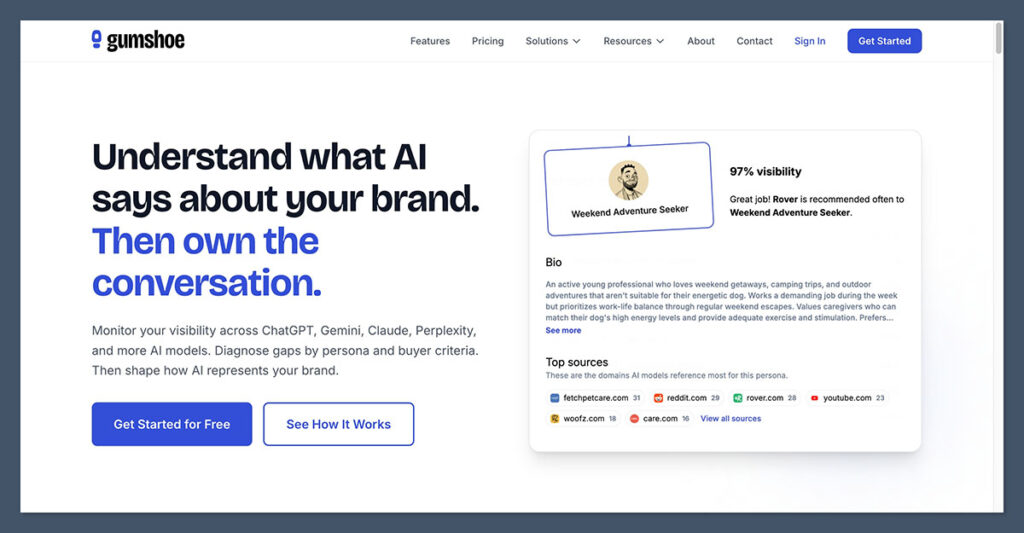
This is Gumshoe AI’s core strength, and Semrush does not have a native equivalent, at least not in its classic SEO toolkit.
Gumshoe tracks what major AI engines say about your brand by running realistic buyer conversations across 11 models.
The platform builds AI-inferred personas complete with roles, goals, pain points, and decision-making context, then runs prompts through each model to see how recommendations change by persona and by engine. You get visibility scores, “share of LLM” benchmarks, competitor mention tracking, and citation source analysis.
The persona-driven methodology is one of Gumshoe’s key differentiators. A generic prompt like “best CRM software” might give you one answer, but the same question asked by a persona framed as a “startup CTO evaluating tools for a 15-person team” will produce a different set of recommendations.
Gumshoe captures those differences and lets you see where your brand wins and loses by audience segment.
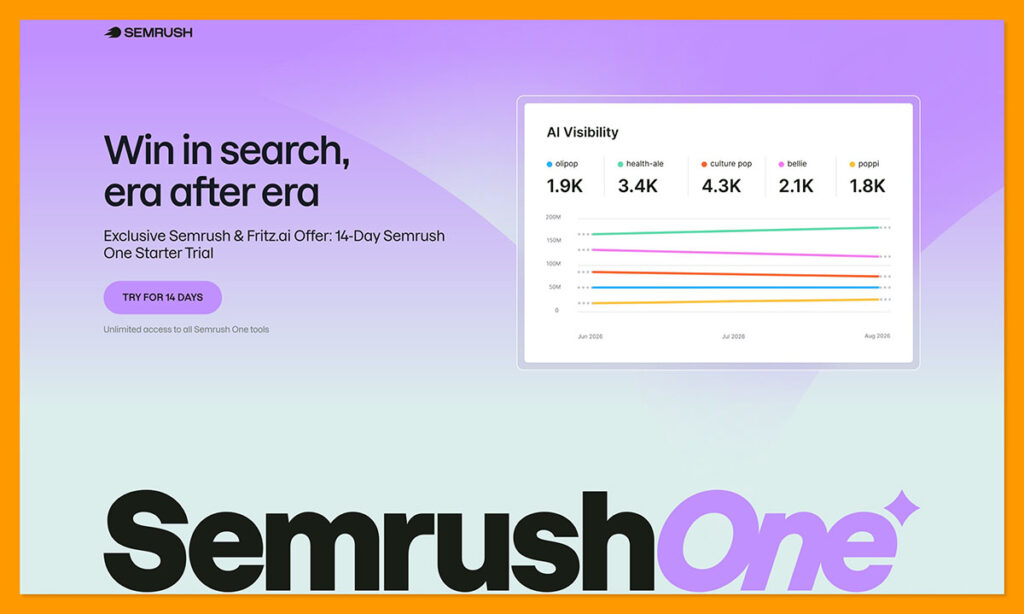
Semrush has started to acknowledge this space. In late 2025, it launched Semrush One, which bundles the classic SEO toolkit with an AI Visibility toolkit for tracking brand presence in Google AI Overviews, ChatGPT, Gemini, and Perplexity.
The Semrush One Starter plan begins at $199/month. However, Semrush’s AI visibility features are still newer and less mature than Gumshoe’s dedicated platform, which has been built around AI search monitoring from day one.
The Winner
Gumshoe AI wins for dedicated AEO monitoring.
Its persona-driven testing, 11-model coverage, share-of-LLM metrics, and citation analysis are more developed than what Semrush currently offers in its AI Visibility toolkit. That said, Semrush One signals that the gap will likely narrow over time.
Best for Technical SEO: Semrush
Semrush’s site audit tool is one of the most thorough in the industry. It crawls your site and flags issues related to crawlability, indexability, Core Web Vitals, broken links, redirect chains, duplicate content, HTTPS implementation, and more.
You can run audits on up to 100,000 pages per month on the Pro plan, scaling to 1,000,000 on the Business plan.
The audit reports are actionable. Semrush categorizes issues by severity (errors, warnings, notices) and provides explanations and fix suggestions for each one. For agencies managing multiple client sites, the ability to run scheduled audits and track progress over time is a significant workflow advantage.
Gumshoe AI has introduced a page audit feature, but it is focused specifically on AI-friendliness rather than traditional technical SEO.
Its “AIO Score” evaluates whether your pages are structured in a way that helps AI models understand and cite your content, including recommendations for JSON-LD markup, schema improvements, and content changes. This is useful, but it is a narrow, specialized audit rather than a full technical SEO sweep.
The Winner
Semrush wins for technical SEO by a wide margin.
Its site audit tools cover everything from crawl health to Core Web Vitals, while Gumshoe’s page audit is limited to AI optimization recommendations.
Best for Competitive Intelligence: It’s a Tie
Both platforms give you competitive intelligence, but the intelligence they surface is completely different.
Semrush lets you compare domains side by side, identify keyword gaps (terms your competitors rank for but you do not), analyze backlink profiles, and track traffic share within your market.
You can benchmark organic and paid performance against specific competitors and spot trends over time. The “Domain vs Domain” and “Keyword Gap” tools are especially useful for building competitive content strategies.
Gumshoe AI shows you how competitors perform inside AI-generated answers. Its brand leaderboard ranks up to 30 competitors by visibility across AI models, and its heatmaps let you see exactly where you win and lose by persona, topic, and engine.
The “share of LLM” metric tells you what percentage of AI-generated responses mention your brand versus competitors, which is a data point that simply does not exist in traditional SEO tools.
Neither type of competitive intel replaces the other. Knowing that a competitor outranks you on Google for “best accounting software” is useful. Knowing that the same competitor gets mentioned in 68% of ChatGPT responses when a CFO asks for accounting tool recommendations is a different, equally valuable insight.
The Verdict
Semrush and Gumshoe AI deliver competitive intelligence across different surfaces.
Semrush covers SERP-based competition. Gumshoe covers AI answer-based competition. For a complete competitive picture, you would ideally use both.
Best for Pricing: Gumshoe AI (for Flexibility)
Semrush and Gumshoe AI use completely different pricing models, which makes direct comparison tricky.
Semrush follows traditional SaaS tiers with fixed monthly fees. Gumshoe uses a pay-as-you-go model based on conversation volume.
Semrush Pricing
Semrush offers three main SEO toolkit plans:
| Plan | Monthly Price | Annual Price (per month) | Key Limits |
|---|---|---|---|
| Pro | $139.95 | $117.33 | 5 projects, 500 tracked keywords, 100K pages crawled |
| Guru | $249.95 | $208.33 | 15 projects, 1,500 tracked keywords, Content Marketing Toolkit, historical data |
| Business | $499.95 | $416.66 | 40 projects, 5,000 tracked keywords, API access, Share of Voice |
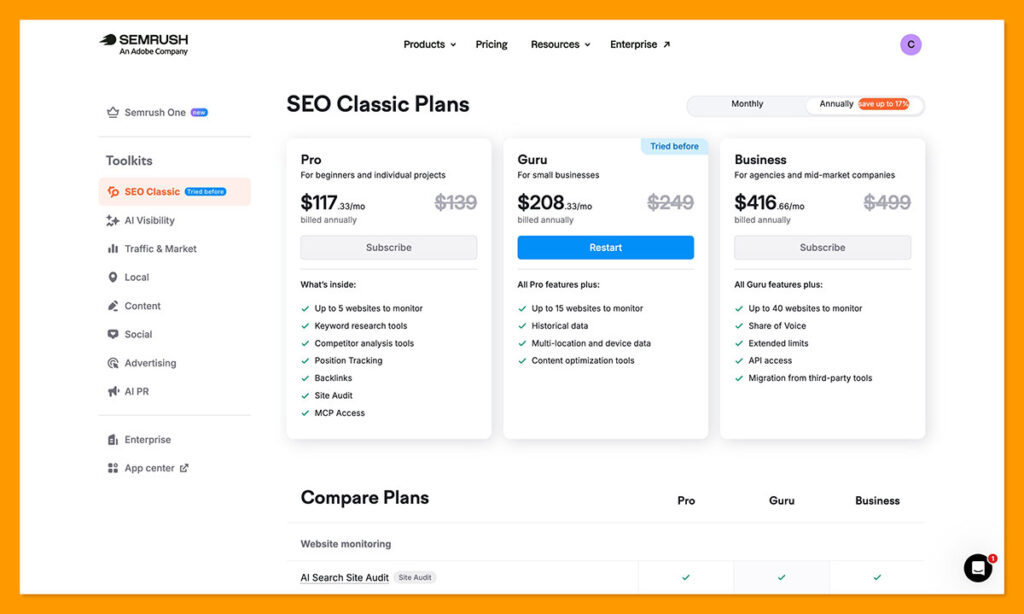
Semrush also offers Semrush One plans that bundle the classic SEO toolkit with AI Visibility features, starting at $199/month for the Starter tier.
A 14-day free trial is available for the Pro and Guru plans, though you will need to provide credit card details to activate it.
Each Semrush account is limited to a single user. Adding extra users costs between $45 and $100 per month depending on the plan, which can push costs up quickly for teams.
Gumshoe AI Pricing
Gumshoe AI takes a different approach:
| Tier | Price | What You Get |
|---|---|---|
| Free | $0 | First 3 report runs free, unlimited report setups, no credit card required |
| Pay-as-you-go | $0.10 per conversation | Scheduled reports, trend tracking, full model coverage |
| Enterprise | Custom pricing | Volume discounts, API access, dedicated customer success manager |
In practice, a single report with 100 conversations (prompts x models) costs $10. Real-world monthly costs vary depending on how aggressively you monitor.
Weekly monitoring across a moderate set of prompts and engines can run roughly $60 to $224 per month. Full daily monitoring across many personas and engines can push costs to $450 per month and beyond.
The pay-as-you-go model is an advantage for smaller teams or agencies running periodic audits. You only pay for what you use. But if you try to replicate the always-on monitoring that Semrush provides out of the box, Gumshoe’s costs can escalate quickly.
The Verdict
Gumshoe AI offers more pricing flexibility, a lower entry point, and no annual commitment required. Semrush gives you predictable, fixed costs with a broader feature set included at each tier.
If budget matters and you need strategic, periodic AI visibility checks, Gumshoe is cheaper. If you want a comprehensive SEO suite with predictable billing, Semrush’s tiered model is easier to plan around.
Easiest to Use: Gumshoe AI
When testing Gumshoe AI, the onboarding experience was notably smooth. The platform uses an AI-assisted setup that generates buyer personas, suggests prompts, and identifies competitors automatically based on your brand and industry.
I was able to go from sign-up to my first report in about three minutes without needing to configure anything manually. The interface is clean, visual, and not overwhelming despite the density of the data.
Semrush is a powerful platform, but that power comes with complexity. The dashboard presents 50+ tools across SEO, PPC, content, social, and competitive research. For new users, figuring out where to start can be intimidating.
Semrush does offer onboarding resources, a detailed Help Center, and Academy courses, but there is a genuine learning curve before the platform clicks, especially for teams that only need a subset of its features.
That said, once you learn Semrush’s interface, the depth is a strength. Everything is interconnected: keyword data feeds into content tools, which link to position tracking, which connects to site audit recommendations.
The initial learning investment pays off if you are using the platform daily for comprehensive SEO work.
The Winner
Gumshoe AI is easier to pick up and start using immediately, thanks to its AI-assisted setup and focused feature set. Semrush has a steeper learning curve but rewards that investment with deeper cross-tool workflows once you know your way around.
Best for Reporting: Semrush
Semrush’s reporting capabilities are built for agencies and in-house teams that need to present data to stakeholders. You can create custom dashboards, schedule automated PDF reports, and use white-label branding (on the Business plan).
Reports can pull data from any Semrush tool, including position tracking, site audits, backlink analytics, and competitive analysis, and you can combine multiple data sources into a single client-facing document.
Gumshoe AI offers scheduled visibility reports with trend tracking, conversation transcripts, and competitive benchmarks. The reports are visually clean and export well. However, the platform does not yet offer white-label options or the kind of multi-source reporting that agency teams rely on for client deliverables.
Gumshoe’s reporting is best suited for internal strategy discussions and periodic AI visibility snapshots rather than comprehensive marketing performance reviews.
The Winner
Semrush has the more mature and flexible reporting suite, especially for agencies that need branded, multi-tool reports for clients. Gumshoe’s reports are useful for AI visibility tracking but are narrower in scope.
Who Should Use Semrush
Strengths
- 50+ tools covering SEO, PPC, content, social, and competitive research in one platform
- Deep keyword database with 26+ billion keywords and years of historical SERP data
- Powerful site audit with crawlability, Core Web Vitals, and on-page issue detection
- Agency-friendly reporting with white-label options and scheduled PDF exports
- Position tracking, backlink analysis, and keyword gap tools for competitive strategy
- 14-day free trial on Pro and Guru plans
Weaknesses
- No native “share of LLM” or multi-AI engine visibility dashboard in the classic toolkit
- Optimizes primarily for Google and Bing SERPs, not for how AI models compose answers
- Steep learning curve due to the sheer number of tools and features
- Gets expensive quickly when adding extra users ($45-$100/month per seat)
- Single-user accounts by default, which can be limiting for teams
Best for: SEO professionals, digital marketing agencies managing client retainers, in-house marketing teams that need keyword research, site audits, position tracking, and competitive analysis in a single platform. If traditional search is your primary traffic driver, Semrush is the industry standard for a reason.
Who Should Use Gumshoe AI
Strengths
- Tracks 11 AI models including ChatGPT, Gemini, Claude, Perplexity, Grok, DeepSeek, and AI Overviews
- Persona-driven methodology that shows how recommendations shift by buyer role and context
- Share-of-LLM benchmarks and competitor mention tracking across AI answers
- Citation source analysis showing which domains AI models actually reference
- AI-assisted onboarding that generates personas and prompts in minutes
- Free tier with no credit card required
Weaknesses
- No traffic or lead attribution from AI engines; you need GA4 and manual tagging to connect the dots
- No deep keyword database, backlink index, or broad technical SEO toolkit
- Pay-as-you-go pricing can get expensive for daily, full-funnel monitoring
- Microsoft Copilot is still a notable gap in engine coverage
- Limited agency-specific features compared to some competitors (no white-label reporting)
Best for: Brands and agencies that want to understand and improve their visibility in AI-generated answers. Particularly valuable for teams already investing in content and SEO that want to see whether those efforts translate into AI mentions and citations. Also a strong fit for AEO-focused agencies building new service offerings around AI search optimization.
How to Choose: Recommendations by Team Type
Solo marketer or small ecommerce brand: Start with Semrush Pro if traditional SEO is your main growth channel. Use Gumshoe’s free tier to get an initial read on your AI visibility before committing budget there.
Mid-size in-house marketing team: Run Semrush Guru as your SEO backbone for keyword research, content planning, and technical audits. Layer in Gumshoe at weekly monitoring frequency to track AI visibility trends and identify gaps that content strategy can address.
SEO or AEO agency: Semrush Business gives you the project limits, reporting features, and API access to manage multiple clients. Gumshoe works as a specialized overlay for AI visibility audits, competitive benchmarking in AI answers, and building case studies around AEO performance. Consider Semrush One if you want both traditional and AI visibility data under one subscription.
Brand-focused team (PR, product marketing): If your primary concern is how AI tools describe your brand to buyers, Gumshoe is the more immediately useful tool. Its persona-driven insights and citation analysis are directly actionable for content and PR teams.
How We Evaluated Semrush vs Gumshoe AI
We compared Semrush and Gumshoe AI across the categories that matter most when deciding between an all-in-one SEO platform and a dedicated AI visibility tool:
| Category | What We Tested |
|---|---|
| Data and Coverage | Range of data sources, search engines and AI models tracked, database depth, historical data availability |
| Keyword and Topic Research | Keyword database size, intent data, content planning features, topic clustering capabilities |
| AI Search Visibility | AI model coverage, persona-driven testing, share-of-LLM metrics, citation source analysis |
| Technical SEO | Site audit depth, crawlability checks, Core Web Vitals, AI-friendliness assessments |
| Competitive Intelligence | Domain comparisons, keyword gaps, backlink gaps, AI mention tracking, brand leaderboards |
| Pricing and Scalability | Plan structure, cost per user, pay-as-you-go economics, free trial availability, team scaling costs |
| Ease of Use | Onboarding flow, time to first insight, interface complexity, learning curve |
| Reporting | Dashboard customization, scheduling, white-label options, export formats, client-readiness |
I tested both platforms hands-on, using real brand data where possible, to make sure the insights and recommendations shared here are based on actual experience with both tools rather than just feature lists.
Semrush vs Gumshoe AI: Our Verdict
Semrush and Gumshoe AI are not direct competitors in the way two SEO platforms would be. They serve different layers of the same visibility problem.
Semrush remains the gold standard for traditional SEO workflows: keyword research, site audits, competitive analysis, position tracking, and agency reporting. If you run SEO campaigns, you almost certainly need Semrush (or a platform like it) as your foundation.
Gumshoe AI occupies a newer, more specialized space. It shows you whether the SEO and content work you are doing actually translates into visibility inside AI-generated answers.
For brands and agencies that care about how ChatGPT, Gemini, and Perplexity recommend products and services, Gumshoe provides data that Semrush’s classic toolkit simply does not surface.
For most marketing teams, the practical question is not “Semrush or Gumshoe?” but rather “Do I need Gumshoe alongside Semrush?”
If AI-driven recommendations are becoming a meaningful part of your audience’s discovery process, the answer is likely yes, starting with Gumshoe’s free tier and scaling to weekly monitoring as your AEO strategy matures.

Comments 0 Responses