

Turnitin is the most widely used academic integrity platform in higher education. But with AI detection now at the center of its pitch, how well does it actually work? We tested it to find out.
Turnitin has been around since 1998, long before anyone was worried about ChatGPT.
For years, it was the go-to tool for catching copy-paste plagiarism in student papers. Universities embedded it into their LMS platforms, students learned to dread the similarity percentage, and the whole thing became part of academic life.
Then generative AI arrived, and everything changed.
Since 2023, Turnitin has pivoted hard into AI-writing detection, positioning itself as the answer to a problem that didn’t exist when the company was founded. That pivot is now the core of its value proposition for institutions renewing contracts or buying in for the first time.
So the question is: does it deliver?
After digging into the platform’s features, testing its detection capabilities, and reviewing what educators and researchers are saying, here is our full take.
What to Expect from Turnitin?
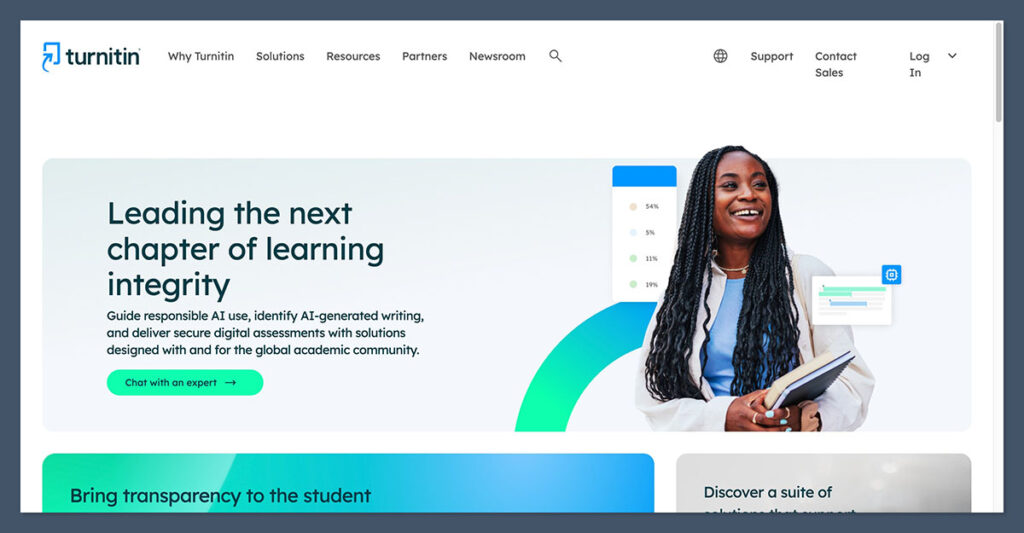
Turnitin is a SaaS platform sold to institutions (universities, schools, publishers), not directly to students. It integrates with LMS platforms like Canvas, Moodle, and Blackboard.
The core product bundles similarity checking, AI-writing detection, grading tools, and admin analytics. Students interact with it through their school’s submission portal; there is no individual license you can buy.
Background Check: What Is Turnitin?
Turnitin started as a plagiarism detection tool built at UC Berkeley. The original concept was simple: compare a submitted paper against a database of web content, academic publications, and previously submitted student work, then flag any matches.
Over the years, Turnitin grew into a broader ecosystem.
It acquired Gradescope (AI-assisted grading), iThenticate (manuscript checking for publishers), and built out products like Feedback Studio (similarity plus inline grading), Originality (advanced integrity checks), and Draft Coach (a writing assistant for students).
The biggest shift came in 2023 when Turnitin launched its AI-writing detection feature.
Since then, the company has released rapid updates focused on improving accuracy, adding “AI bypasser” detection (targeting tools that rephrase LLM output), and giving institutions granular controls over how the feature is used.
How Does Turnitin Work?
There are two sides to Turnitin: the original similarity checking engine and the newer AI-writing detection system. They work differently, so it helps to understand each one.
Similarity Checking
This is the classic Turnitin feature. When a student submits a paper, Turnitin compares the text against its database, which includes web pages, academic journals, and a massive repository of previously submitted student work.
It generates a “similarity report” showing what percentage of the paper matches existing sources, with color-coded highlights pointing to the specific passages.
The similarity score is not a plagiarism score. A paper could have a high percentage because it properly quotes and cites sources. That distinction is important, and Turnitin has always stressed that results need human interpretation.
AI-Writing Detection
The AI detection engine works differently. Instead of comparing text against a database, it analyzes linguistic patterns: how predictable the word choices are, variation in sentence length, and other stylometric signals that tend to differ between human and machine-generated prose.
The system was trained on large corpora of both human-written and LLM-generated academic text.
When a paper is submitted, Turnitin highlights segments it suspects were AI-generated and reports an overall AI-writing percentage. Since mid-2025, it also includes detection for “AI bypassers,” tools like paraphrasers and humanizers that rephrase LLM output to evade detectors.
Important: Turnitin stresses that its AI detection scores are probabilistic, not binary verdicts. They are designed to be one data point among many, not a standalone judgment of academic misconduct.
Key Features in 2024 to 2026
| Feature | Details |
|---|---|
| Similarity Checking | Compares against web, academic, and student paper databases. Color-coded similarity report with source-level breakdown. |
| AI-Writing Detection | Segment-level analysis using linguistic signals (predictability, burstiness, stylometry). Outputs probability percentages. |
| AI Bypasser Detection | Since August 2025, targets paraphraser and humanizer tools used to disguise LLM output. |
| Granular Admin Controls | Sub-accounts can independently enable/disable AI detection and access department-level usage stats. |
| Data Export | Since November 2025, admins can export AI detection data and assignment analytics as CSVs. |
| Large-Class Support | Handles classes with over 1,000 students. Improved search and ZIP uploads up to 1,000 files. |
| Gradescope Integration | AI-assisted grading for STEM and handwritten work. Bundled into many institutional licenses. |
| Draft Coach | Browser extension for students to check similarity and get writing feedback before final submission. |
Pros and Cons of Turnitin
Pros
- Massive source database: Decades of indexed web pages, journals, and student submissions make similarity checking very thorough.
- LMS integration: Works natively with Canvas, Moodle, Blackboard, and others, so the submission workflow is seamless for students and instructors.
- Low false-positive target: Turnitin aims to keep the false-positive rate under 1% for documents with more than 20% AI-flagged text.
- Granular controls: Institutions can enable or disable AI detection at the department level, which helps with policy flexibility.
- Rapid updates: The team ships frequently, with major feature drops throughout 2024 and 2025 addressing AI bypasser tools and admin reporting.
- Ecosystem breadth: Gradescope, iThenticate, Draft Coach, and Feedback Studio cover a wide range of academic integrity and grading needs.
Cons
- No individual access: Students cannot purchase their own license. If your institution does not subscribe, you are out of luck.
- Opaque pricing: No public price sheet. Costs vary significantly between institutions, and investigative reporting has found notable disparities.
- AI detection is imperfect: Short texts, mixed authorship, and heavily revised AI drafts can produce unreliable results.
- False-positive risks: Non-native English writers and formulaic genres (lab reports, business memos) can trigger false AI flags.
- Cross-tool inconsistency: Different AI detectors often give wildly different scores on the same text, and Turnitin is no exception.
- Student trust issues: The “guilty until proven innocent” dynamic can be stressful, especially when scores are misinterpreted by instructors.
Rating Details
| Category | Assessment |
|---|---|
| Similarity Checking | Excellent. The largest database of its kind, built over 25+ years. Highly reliable for traditional plagiarism detection. Nuanced source-level reporting helps instructors distinguish between plagiarism and proper citation. |
| AI-Writing Detection | Good with caveats. Strong on long, unedited LLM essays with a consistent “AI voice.” Weaker on short assignments, mixed-authorship documents, and heavily revised drafts. Accuracy degrades significantly for non-English or formulaic writing. |
| Ease of Use (Instructors) | Very good. Dashboard is clean, reports are easy to read, and the LMS integration means most instructors never leave their existing workflow. |
| Ease of Use (Students) | Good. Submission is typically invisible since it is built into the LMS. The similarity report is understandable, though AI detection scores can cause confusion without instructor guidance. |
| Admin Features | Strong. Granular sub-account controls, CSV exports, and usage analytics are solid for policy monitoring at scale. |
| Pricing Transparency | Poor. No public pricing, significant variation between institutions, and reports of preferential deals for larger or more prestigious schools. |
| Support | Good. Turnitin offers institutional support with documentation, training resources, and a help center. Individual student support is limited since the relationship is with the institution. |
AI Detection: How Accurate Is It Really?
This is the question everyone asks, and the honest answer is: it depends.
Turnitin has stated a design goal of keeping the false-positive rate under 1% for documents where more than 20% of the text is flagged as AI-generated. That threshold was validated against a corpus of roughly 800,000 academic papers written before ChatGPT existed.
To maintain that low false-positive rate, the system accepts that it will miss some AI use. Estimates suggest around 15% of AI-generated content goes undetected, and reported percentages tend to be conservative.
Where it performs well
Turnitin is strongest when analyzing long-form academic prose that closely resembles typical LLM output in tone and structure. If a student submits a multi-page essay generated entirely by ChatGPT with minimal editing, the detector will likely catch it.
Consistency helps: when the entire document has a uniform “AI voice,” the statistical signals are strong.
Where it struggles
Several scenarios give the detector trouble:
Short texts. Paragraph-length responses or brief reflections do not provide enough data for reliable analysis. The indicators become noisy, and confidence drops.
Mixed authorship. Documents that blend human and AI-written sections produce uneven percentages that are hard to interpret. A student who writes their introduction and conclusion but uses ChatGPT for two body paragraphs may get a moderate score that does not clearly indicate what happened.
Heavily revised AI drafts. If a student generates a draft with an LLM and then substantially rewrites it, the editing introduces enough variability to obscure the patterns detectors rely on. This is the gray area that educators find most challenging.
Non-native English writers. Students writing in a second language often use simpler vocabulary and more rigid sentence structures, patterns that can resemble LLM output. This has been a persistent concern in the academic community, and Turnitin acknowledges the limitation.
Formulaic genres. Lab reports, methods sections, business memos, and other templated writing can trigger false flags because the predictability of the prose mimics AI patterns.
The broader context: In 2025, users frequently report that different AI detectors give divergent percentages on the same text. Turnitin is one signal among many, and most universities now instruct staff to interpret AI indicators alongside drafts, notes, version histories, and supervision records rather than making high-stakes decisions on scores alone.
Pricing and Access
Turnitin does not sell licenses to individual students. Access comes through institutional subscriptions that are typically embedded in LMS platforms. If your university pays for Turnitin, you use it automatically when submitting assignments.
If they do not, you cannot buy your own access.
- ~$2-3 per student / year (typical): Based on public procurement records. Actual rates vary widely by institution size, contract scope, and region.
- $2,000+ small institution minimums: Smaller schools often pay more per student due to minimum contract thresholds and less negotiating leverage.
- Enterprise / custom bundles (varies): Large universities negotiate custom packages bundling Originality, Gradescope, iThenticate, and Feedback Studio.
Because official price sheets are not publicly available, the exact cost for any given institution is opaque. Investigative reporting in 2025 found notable disparities: some U.S. universities pay just over $2 per student per year while others pay more than triple that for comparable products.
Critics argue that larger, more prominent institutions receive preferential rates.
This lack of transparency has also fueled a parallel market of third-party “access” sites and shared accounts, which raise compliance and data-privacy concerns.
Turnitin Features Review
Let me walk through the major product areas in more detail.
Feedback Studio
This is the primary interface most instructors interact with. It combines the similarity report with inline commenting and grading tools. You can highlight passages, drop rubric-linked comments, and assign scores without leaving the document view. It is functional and gets the job done, though the interface feels more utilitarian than modern compared to standalone grading tools.
Originality
Turnitin’s advanced integrity product bundles similarity checking and AI-writing detection into a single report. This is the version that includes the AI bypasser detection rolled out in 2025. For institutions that want the full suite of detection tools, Originality is the product to look at.
Gradescope
Acquired by Turnitin, Gradescope focuses on AI-assisted grading for exams and assignments, particularly in STEM courses. It handles handwritten submissions, auto-groups similar answers, and supports rubric-based grading at scale. For large lecture courses, it is genuinely useful and a strong differentiator in the Turnitin ecosystem.
iThenticate
This is the publishing-focused product. Journals and publishers use iThenticate to check manuscripts against academic databases before publication. It is a separate product from the student-facing tools but draws on the same underlying similarity database.
Draft Coach
A browser extension that lets students check their work against Turnitin’s similarity database before submitting. The idea is to encourage originality during the writing process rather than catching problems after submission. It is a nice concept, though adoption depends on whether institutions include it in their license.
The AI Bypasser Problem
One of the most interesting developments in 2025 is the arms race between AI detection tools and the “humanizer” or “bypasser” tools designed to evade them.
These tools take LLM-generated text and rephrase it to introduce more variability, making it harder for detectors to identify the telltale patterns of machine-generated prose.
Some swap synonyms, others restructure sentences, and the more sophisticated ones adjust stylometric features like sentence length distribution.
Turnitin has responded with dedicated bypasser detection, launched in August 2025. The company says it can identify text that has been processed through these tools, though specifics about how the detection works are understandably kept proprietary.
The effectiveness of bypasser detection is an open question. Each improvement on the detection side creates incentives for tool makers to iterate, and vice versa. This dynamic is likely to continue for the foreseeable future, and no detection tool, Turnitin included, should be treated as infallible in this context.
What I Like About Turnitin
- The similarity checking database is unmatched. Twenty-five years of indexed content gives it a depth that no competitor can easily replicate.
- LMS integrations are genuinely seamless. For most students and instructors, Turnitin is invisible infrastructure that just works.
- Institutional controls are thoughtful. The ability to toggle AI detection at the department level means one school can have different policies for its creative writing program and its engineering department.
- The team ships fast. Feature velocity in 2024 and 2025 has been impressive, with meaningful updates to AI detection, admin analytics, and large-class support.
- The probabilistic framing is honest. Turnitin consistently communicates that its AI scores are not verdicts, which is the responsible approach.
Turnitin’s Flaws
- AI detection remains an unsolved problem. No tool, including Turnitin, can reliably detect AI writing in all scenarios. Short texts, mixed authorship, and heavily edited drafts remain weak spots.
- The false-positive risk for non-native English writers is a real concern. Flagging a student who writes with simple vocabulary because it “looks like AI” is a significant equity issue.
- Pricing is opaque and inconsistent. The lack of public pricing combined with reported disparities between institutions is frustrating and arguably unfair.
- No individual access. Students who want to check their own work before submission are dependent on whether their institution subscribes.
- The broader detector ecosystem is noisy. Different tools give different results, and Turnitin scores need to be interpreted with that context in mind.
- The blog is limited. Turnitin’s own content marketing has improved, but detailed technical documentation about how the AI detector works is still sparse.
Is Turnitin the Right Tool for You?
Recommended if:
- You are an institution that needs robust, battle-tested similarity checking integrated with your LMS
- You want AI detection as one signal among many in your academic integrity workflow
- You need granular admin controls and reporting across departments
- You require a vendor with the track record and stability to support a multi-year contract
- You are a publisher needing manuscript-level similarity checking (iThenticate)
Not recommended if:
- You are looking for a standalone AI detector that works as a definitive proof of AI use
- You are an individual student or educator without institutional backing
- You need transparent, predictable pricing before committing
- Your student population includes many non-native English writers and you lack the policy framework to handle false positives
- You expect any single tool to solve the AI-in-education challenge on its own
Turnitin Review Conclusion
4.0 Overall Score
Turnitin remains the dominant player in academic integrity for good reason.
Its similarity checking is best-in-class, its LMS integrations are mature, and its ecosystem of products covers grading, publishing, and student feedback. No competitor matches its database depth or institutional reach.
The AI detection side is more complicated. It is a useful signal, genuinely helpful for identifying long, unedited LLM essays, but it is not the oracle that some institutions want it to be.
Short texts, mixed authorship, heavily revised AI drafts, and non-native English writing all create scenarios where the detector struggles or risks false positives.
The responsible approach, and the one Turnitin itself recommends, is to treat AI scores as one data point in a broader investigation that includes drafts, notes, version histories, and conversations with students. Institutions that use it this way will get the most value.
Those expecting a simple pass/fail AI test will be disappointed.
Our recommendation: if your institution already subscribes, lean into the similarity checking and use AI detection as a supplementary signal with clear policies. If you are evaluating Turnitin for the first time, negotiate hard on pricing and make sure your academic integrity policies are built around human judgment, not detector scores.

Comments 0 Responses